
Why does ChatGPT cite your competitors, but ignore your brand?
It’s because, whether they’re conscious of it or not, they’re able to dominate the model’s retrieval signals.
In particular, they likely have:
- Strong entity recognition in knowledge bases (Wikipedia, Crunchbase, etc.)
- High authority from third-party media mentions and editorial backlinks
- Content optimized for semantic retrieval (front-loaded definitions, structured data, etc.)
In other words, ChatGPT has its own set of ranking signals that you must optimize for, just as Google and Bing did for classic SEO.
Also, ChatGPT maintains its own search index now, thanks to OAI-SearchBot. This is in stark contrast to the early days of the platform, when it relied on APIs, plugins, scrapers, and access to third-party indexes (like Google and Bing’s).
That means your website won’t appear in ChatGPT’s index if its crawler can’t find you (like if you block certain rules in your robots.txt file), meaning your content needs to be crawlable by Googlebot and OAI-SearchBot.
In this guide, we’ll unpack what marketers need to know in order to earn more high-quality ChatGPT citations based on the latest facts, studies, and developments.
What are ChatGPT Citations? How Do They Impact SEO?
First, let’s clear up the confusion surrounding the term ‘citations’ on ChatGPT and other generative AI platforms.
A ChatGPT citation is any type of visible attribution that ChatGPT displays to its users when referencing online content.
The same is true for citations on other answer engines like Perplexity, Claude, or Google AI Overviews.
On ChatGPT in particular, this attribution can take several forms, such as:
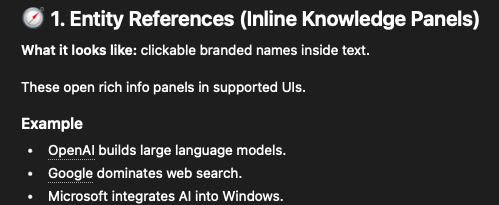
- Entity references – Including specific brand names within text (with or without links):
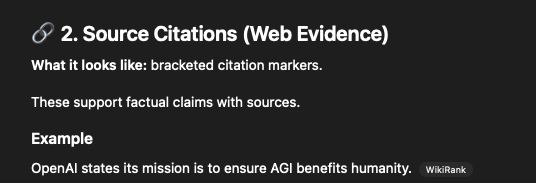
- Source citations – Online evidence to back up claims (hyperlinks at the end of responses):
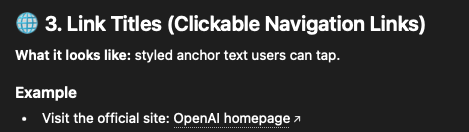
- Clickable navigation links – These are hyperlinks embedded within ChatGPT responses:
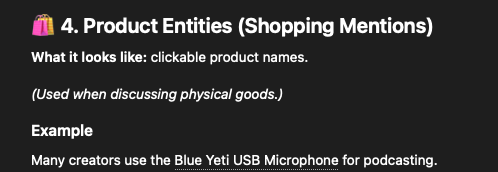
- Product entities – Hyperlinks that include specific product names:
- Visual carousels – These add multimodal enrichment and help spruce up explainer content:

Here’s what we’re not referring to when we say ChatGPT citations:
- ChatGPT quoting or paraphrasing your content with no visible attribution
- Humans citing ChatGPT in their own work (which is now permitted in academia)
There are times when your content may influence one of ChatGPT’s responses, but you’re not given any type of attribution.
These do not count as ChatGPT citations since your audience will have no way of knowing that the information came from you.
The idea is to get ChatGPT to trust your brand enough to consistently mention your name and link to your website for relevant queries and prompts.
How do ChatGPT citations impact your bottom line? Are they worth pursuing?
The answer to the second question is yes, but they impact brand visibility differently than organic SEO.
Here are the three primary impact zones of ChatGPT citations.
Zone #1: Brand visibility inside AI answers

Citations inside AI-generated summaries are increasingly becoming the new way that audiences discover new brands, products, and services.
As proof, there’s something these two stats have in common:
- 60% of searches now end in zero clicks
- The presence of a Google AI Overview reduces click-through rates by 58%
It’s that most users don’t scroll past the AI-generated summary on traditional search engines, so AI visibility is paramount for remaining relevant.
On a platform like ChatGPT, which doesn’t have any organic results (i.e., the 10 blue links on Google), earning citations is literally the only way for your audience to discover you.
The good news?
AI citations are excellent for spreading brand awareness, yielding benefits like:
- Gaining implied authority in your audience’s minds through repeated exposure
- Appearing at high-intent moments (getting cited for queries like ‘which brands are best at X’)
- Becoming part of the answer layer for queries related to your business
- Entering your target audience’s consideration set
68% of consumers use ChatGPT to research products and services, reinforcing the need for businesses to earn consistent AI citations (Yext’s AI Search Archetypes Report 2025).
Zone #2: Assisted discovery
Here’s where ChatGPT visibility can translate into actual leads and sales for your business.
It’s also the area that’s trickiest to monitor with the tools currently available.
Traditionally, ranking in Google’s search results funneled traffic to your site, which was (and still is) easy to keep track of.
Through tools like Google Search Console and Google Analytics 4, you can check keyword rankings, average traffic, CTRs, and a boatload of other metrics to measure your ROI.
AI search traffic isn’t nearly as black and white.
Instead of following a direct cause-and-effect chain (ranking #1 practically guarantees traffic), AI funnels are nonlinear and indirect.
A typical user experience on ChatGPT might look like this:
- A user asks ChatGPT, “What are the best email marketing platforms?” Your brand appears as the top recommendation for small businesses, which is right up their alley (they work for a startup).
- They don’t click on any links or take any further action at this time because they’re not ready to make a purchase, but they remember your name.
- A week later, their team is discussing options for an email marketing provider, and the user mentions your name. They visit your site directly by searching for your brand name, and sign up later that day.
As you can see, the ChatGPT citation led to a sale, even though it was delayed by a week (which is already typical for B2B transactions).
Yet, you appeared at a high-intent moment, which is what led to the conversion down the line.
Research shows that AI traffic converts 4.4x better than organic visitors for this very reason (targeted traffic with higher intent).
Brands have become privy to this nonlinear cycle and are beginning to optimize for it (more on this in a bit).
Zone #3: Compounding authority signals

While ChatGPT citations don’t pass link juice (PageRank signals), they can indirectly influence your brand’s online ecosystem in a few positive ways.
These include:
- Increasing direct brand searches from your target audience
- Reinforcing entity associations in vector databases (Ahrefs Content Explorer and other AI indexes)
- Indirectly leads to citations on other AI tools (because they reward similar content traits and trust signals)
- Boosting your brand’s perceived expertise
- Influencing publisher awareness in your field
These traits combine to form a virtuous cycle that can feed back into your bottom line (leads and sales) and traditional SEO performance (more traffic and links).
How ChatGPT Citations Work and How to Win Them

Next, let’s take a closer look at how ChatGPT decides which brands to cite and when.
From a marketing perspective, there are several stages of optimization involved:
- Indexing and eligibility
- Semantic retrieval alongside keywords
- Citation ranking (trust signals)
Ignore one stage, and you risk becoming invisible on ChatGPT, so it’s important to go in order.
Stage #1: Indexing and eligibility
Remember, ChatGPT has its own index now, so you need to give its bot access to crawl your content.
In your robots.txt file, OAI-SearchBot AND GPTBot need permission to access your content (just like Googlebot).
Here’s the difference:
- OAI-SearchBot is for live citations
- GPTBot is for including your brand in AI training data
Here’s what giving both full coverage looks like in your robots.txt:
User agent: GPTBot
Allow: /
User agent: OAI-SearchBot
Allow: /
This step is necessary for becoming eligible for citations in the first place.
During indexing, ChatGPT and other answer engines don’t store entire documents. Instead, content gets chunked into query-sized pieces (definitions, lists, frameworks).
At query time, the model can retrieve relevant chunks, rank them, and cite the strongest ones. This speeds up the answer generation process.
Beyond that, there are certain optimizations you can make to ensure your content is easy to parse, compress, and vectorize.
JavaScript-heavy pages, 4xx errors, and paywalls all kill your eligibility, so the basics of technical SEO still apply.
Stage #2: Semantic retrieval and keywords
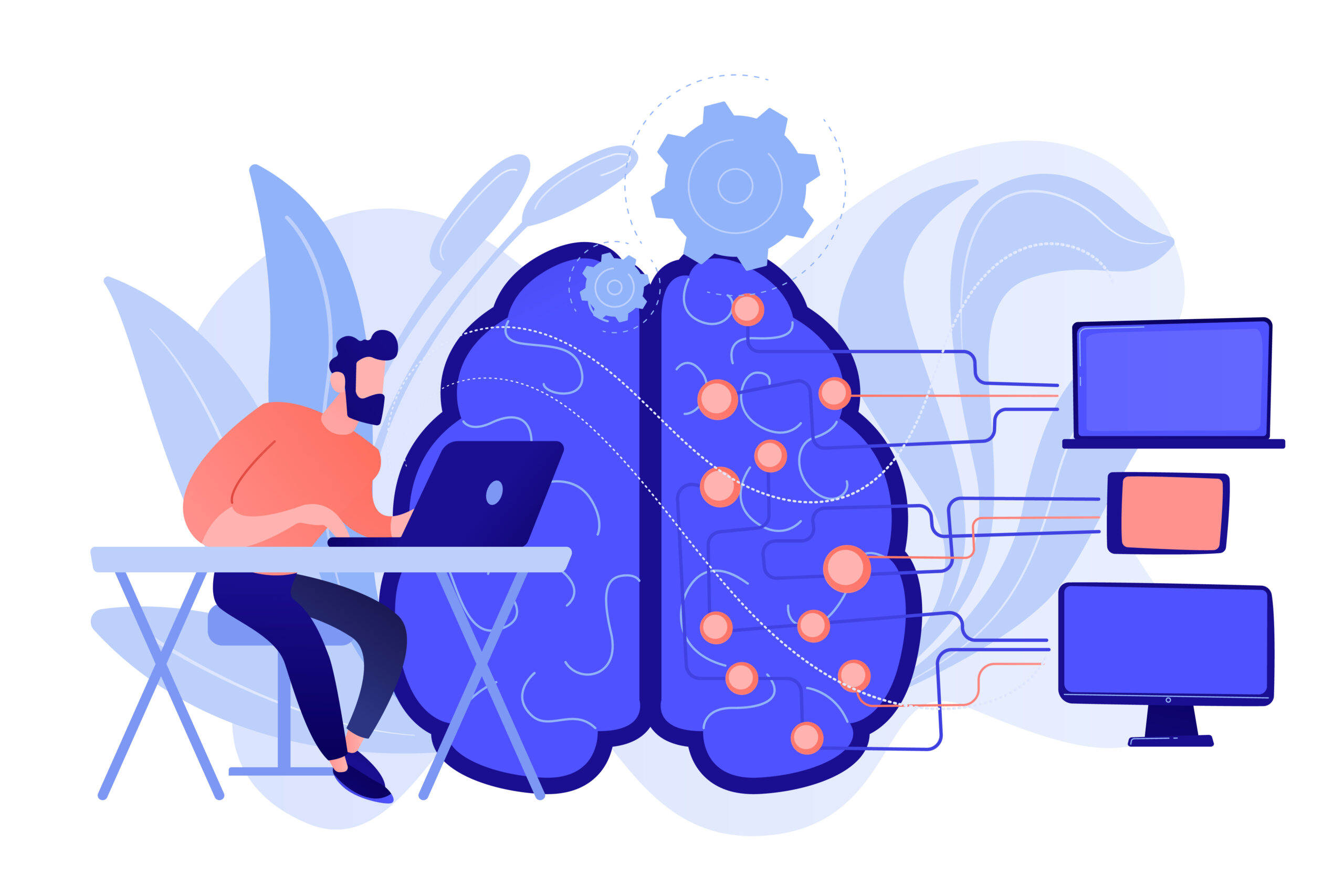
Your content ‘chunks’ are converted into multi-dimensional, numeric embeddings that convey the semantic meaning behind the words. These meanings are then compared by measuring the distance between embeddings. If two embeddings are clustered close together, it means they’re related concepts.
This process is called vector search.
Translation?
Vector search is how platforms like ChatGPT are able to cite content that’s relevant but doesn’t contain exact-match keywords.
The relationship between concepts is what matters most, not lexical keyword matching.
At the same time, AI models still use BM25 keyword matching as a supplementary signal that keeps AI search results grounded in relevant language.
Here’s how to optimize for semantic retrieval and keywords:
- Create content around topic clusters to improve topical authority and rank for related concepts
- 44% of ChatGPT citations come from the first third of content, so you need to front-load crucial definitions, answers, and concepts.
- Continue to research trending keywords from your target audience
- Split content into topical boundaries marked by subheadings (H2, H3, H4, etc.)
- Treat each subheading as a self-contained mini-article (don’t venture off-topic or bring up unrelated concepts)
| Don’t have time to optimize your online presence for ChatGPT? Sign up for HOTH X, our fully managed search optimization service. |
Stage #3: Citation ranking (trust signals)
On AI search platforms, not just ChatGPT, a consensus amongst authoritative sources will always beat out individual page quality.
Here’s what that consensus looks like:
- Exclusive news coverage that paints your brand in a positive light and presents consistent narratives
- Third-party brand mentions that vouch for your products and services
- Strong user reviews on platforms like Google and Yelp
- Positive brand sentiment on community platforms like Reddit
Corroboration like this tells ChatGPT that your brand is verifiable, trusted, and worthy of getting cited.
Final Thoughts: How ChatGPT Citations Work for Search Marketing
ChatGPT citations are more akin to Featured Snippets than they are traditional ranking traffic.
That said, visibility on ChatGPT can lead to improved brand authority, highly targeted referral traffic, and single-session conversions.
Users trust the recommendations ChatGPT provides, so getting it to trust your brand is a powerful position to hold.
Do you want to earn more citations on ChatGPT and other generative AI platforms?
Try out AI Discover to become the brand that AI answer engines trust over your competitors!