
Black Hat Backlinks: What They Are, The Risks, and the Legit Alternatives
Corey Batt
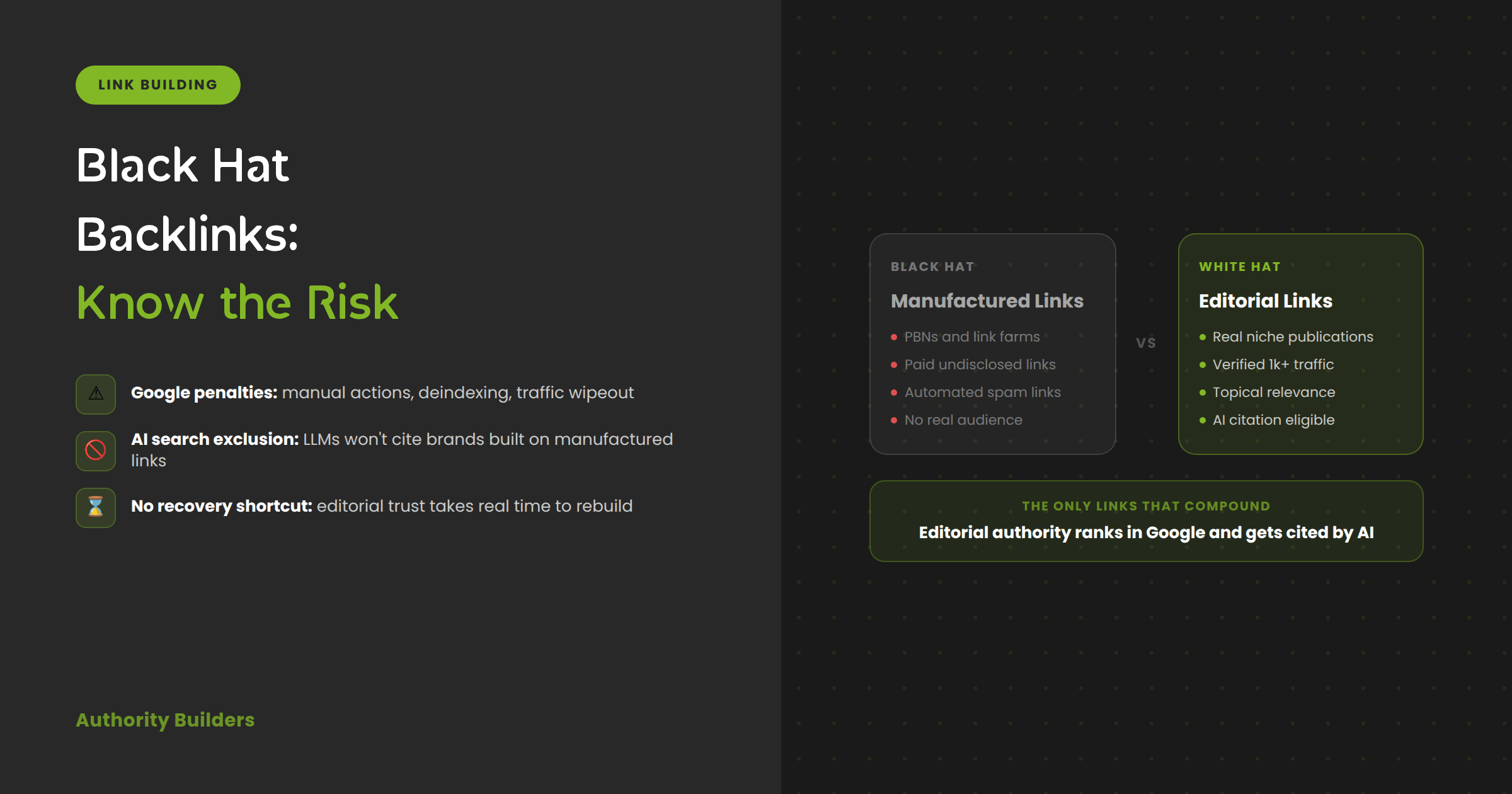
If you’ve spent any time in SEO communities, you’ve seen the debate: black hat link building is risky, sure, but does it actually work? Some people swear by it. Others have the manual action emails to show exactly why they stopped.
Here’s the honest answer: some black hat tactics have worked, for some sites, for some period of time. But the window for making that calculus work has been closing for years, and in 2026 it’s effectively shut. Between Google’s increasingly aggressive spam enforcement and the rise of AI search, the sites that relied on manipulative links aren’t just at risk of penalties. They’re being quietly excluded from an entirely new search channel.
This post covers what black hat backlinks are, what the real risks look like, and what the legitimate alternatives are if you want links that actually compound over time.
What Are Black Hat Backlinks?
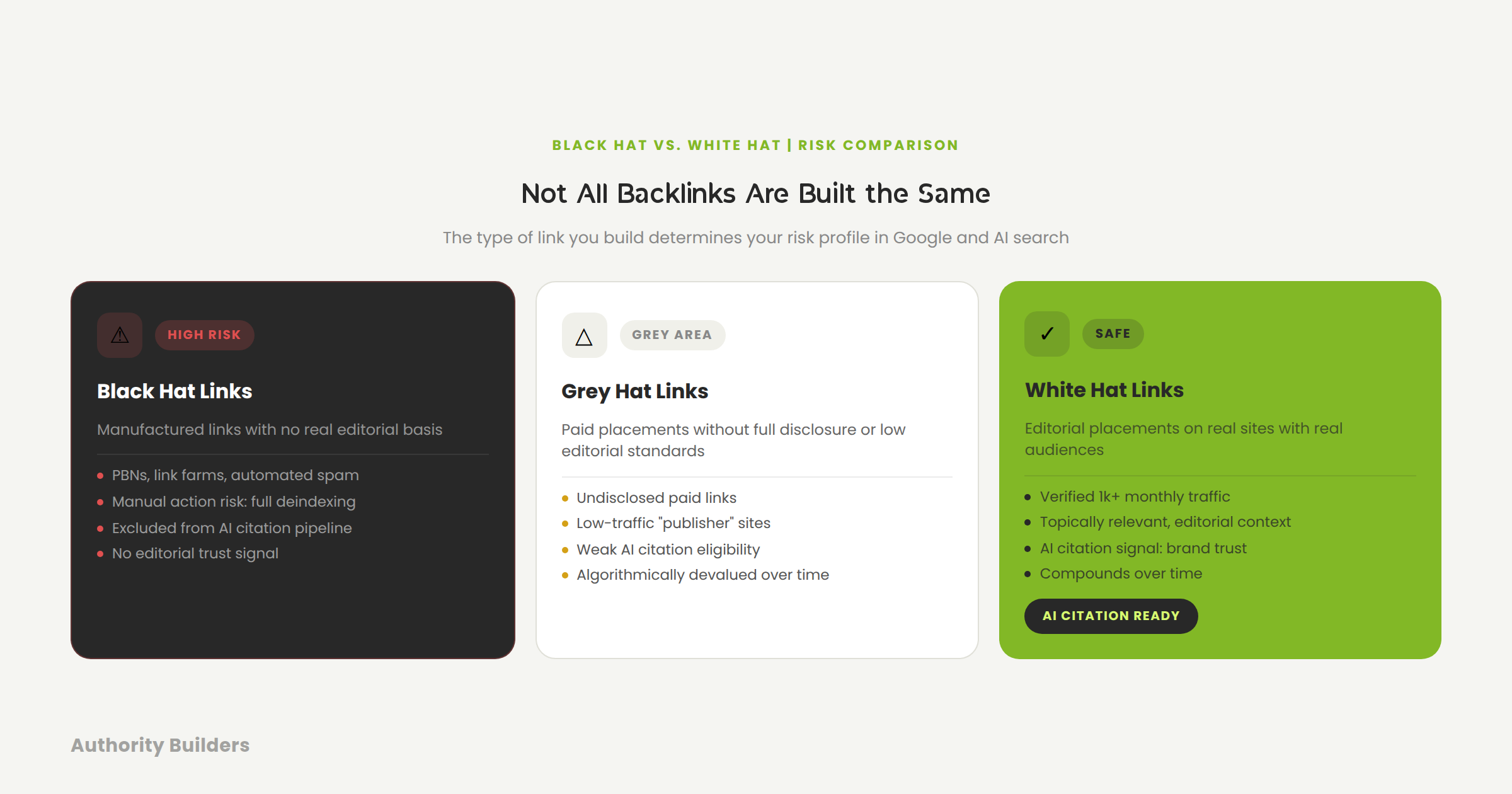
Black hat backlinks are links acquired through methods that violate Google’s guidelines. The term comes from the old Western film convention of villains wearing black hats, and it’s been borrowed by the SEO world to describe anything on the manipulative end of the link building spectrum.
Google’s link spam policies are clear: any links intended to manipulate PageRank or a site’s ranking in search results may be considered link spam. That includes buying links that pass PageRank, exchanging links excessively, using automated programs to create links, and participating in private blog networks (PBNs).
The line between black hat and grey hat isn’t always obvious in practice. But the common thread is intent. Black hat tactics are built around gaming the algorithm rather than earning genuine editorial endorsement.
The Most Common Black Hat Link Tactics
It’s worth knowing what you’re looking at, whether you’re auditing your own profile or evaluating a link building service making promises that seem too easy.
Private Blog Networks (PBNs)
PBNs are networks of websites built specifically to pass link equity to a target site. The domains are typically acquired from expired or auctioned domains that already carry some authority, then populated with content designed to look legitimate. The links from these sites look like editorial endorsements but they’re manufactured.
Google has been devaluing and penalizing PBN links for years. The footprints that give them away, shared hosting, similar site structures, thin content, unnatural internal linking, have become well-understood by both Google’s algorithms and its manual review teams.
Paid Links Without Disclosure
Paying a publisher to place a link without using a nofollow or sponsored attribute violates Google’s guidelines. This is different from legitimate link building services that place editorially relevant guest posts on real sites with real traffic. The distinction is whether the placement would exist independent of payment and whether it follows Google’s link attribute requirements.
Link Farms and Directories
Low-quality link farms exist purely to sell links, with no real audience or editorial standards. Submitting to hundreds of these directories, or buying packages from services offering thousands of links for a few dollars, creates a link profile that looks nothing like a naturally earned one.
Automated Link Building
Tools that auto-generate links across forums, comment sections, and web 2.0 properties at scale. The links themselves are often low-quality and the anchor text is usually over-optimized. Google’s SpamBrain system has become increasingly good at detecting and devaluing these at the algorithmic level before they ever provide a ranking benefit.
Reciprocal Link Schemes
“I’ll link to you if you link to me” at scale. Some reciprocal links happen naturally between genuinely related sites and that’s fine. But coordinated, systematic link exchanges designed to inflate each other’s authority are treated as manipulation.
The Google Penalty Risk: What Actually Happens
The risks from black hat links fall into two buckets: algorithmic devaluation and manual actions.
Algorithmic Devaluation
Most spammy links today don’t help and don’t hurt, they’re simply ignored. Google’s SpamBrain system identifies and devalues manipulative links at scale without issuing a formal penalty. Your link count goes up but the ranking benefit never materializes, or the boost fades as the links are devalued in the next algorithm update.
This is the more common outcome for low-level black hat tactics. You spend money, see a temporary lift (if that), and end up no better off than before.
Manual Actions
When a human reviewer at Google determines your site is violating spam policies, they issue a manual action. This is visible in
Google has issued approximately 750,000 manual penalties for web spam per month since 2023. Following the March 2024 spam policy updates, a wave of manual actions hit sites that Google’s reviewers felt were engaged in link manipulation. Site owners reported overnight deindexing of sites they’d been running for years.
Recovering from a manual action requires removing or disavowing the offending links, fixing the underlying issues, and submitting a reconsideration request to Google. That process can take months. And
The AI Search Problem Nobody’s Talking About
Here’s where the calculus has shifted most dramatically in 2026, and most people in the black hat conversation haven’t caught up to it yet.
Google penalties and algorithmic devaluation are the risks everyone knows about. But there’s a second, quieter disqualification happening in parallel: AI search exclusion.
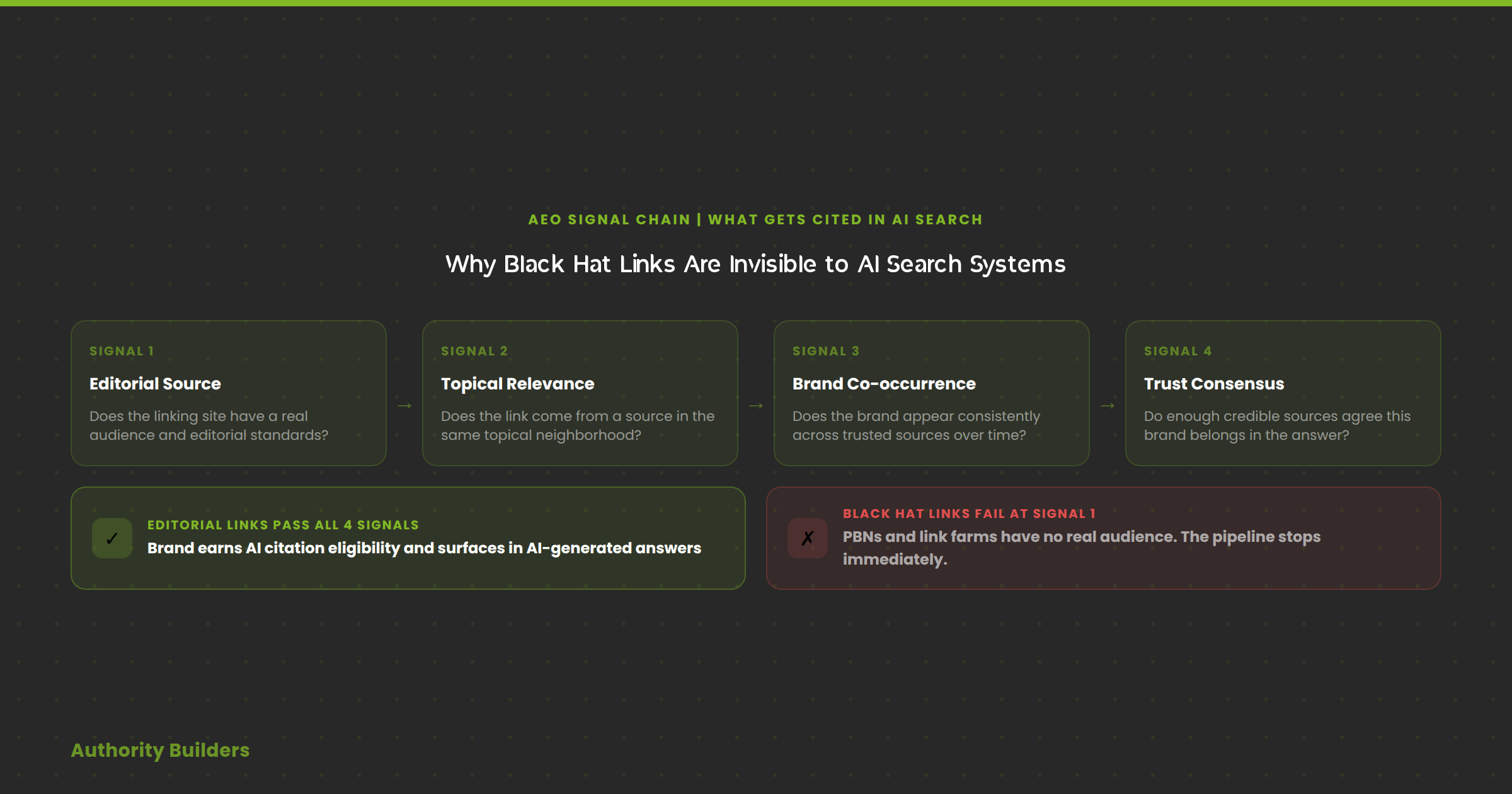
When ChatGPT, Google’s AI Overview, Perplexity, or any other AI-powered search tool generates a response that cites sources, it’s not just pulling from the pages that rank highest. It’s pulling from sources that its training data and retrieval systems have identified as credible, trustworthy, and editorially endorsed. Links from real publications with real audiences are part of the signal set that tells AI systems your brand belongs in that category.
Black hat links, by definition, come from sources with no real editorial standard. PBN sites have no audience. Link farms exist only to sell links. Automated forum comments have no credibility signal attached to them. These links don’t just fail to help you in AI search. They may actively dilute your brand’s trust profile in the eyes of LLMs, which are trained to recognize the difference between editorial mentions and manufactured ones.
The brands that show up in AI-generated answers have almost universally built their authority through real editorial relationships. They’ve been cited by publications with genuine readership. They’ve earned links because a journalist or editor decided their content or product was worth referencing. That’s exactly what AI systems are trained to look for.
A site with 10,000 PBN links and zero real editorial coverage is not going to surface in AI recommendations for its category. A site with 300 carefully earned links from topically relevant, high-traffic publications stands a far better chance.
The risk of black hat links has always been Google penalties. The newer risk is being invisible in the search channel that’s growing fastest.
Why the Short-Term Math Doesn’t Add Up Anymore
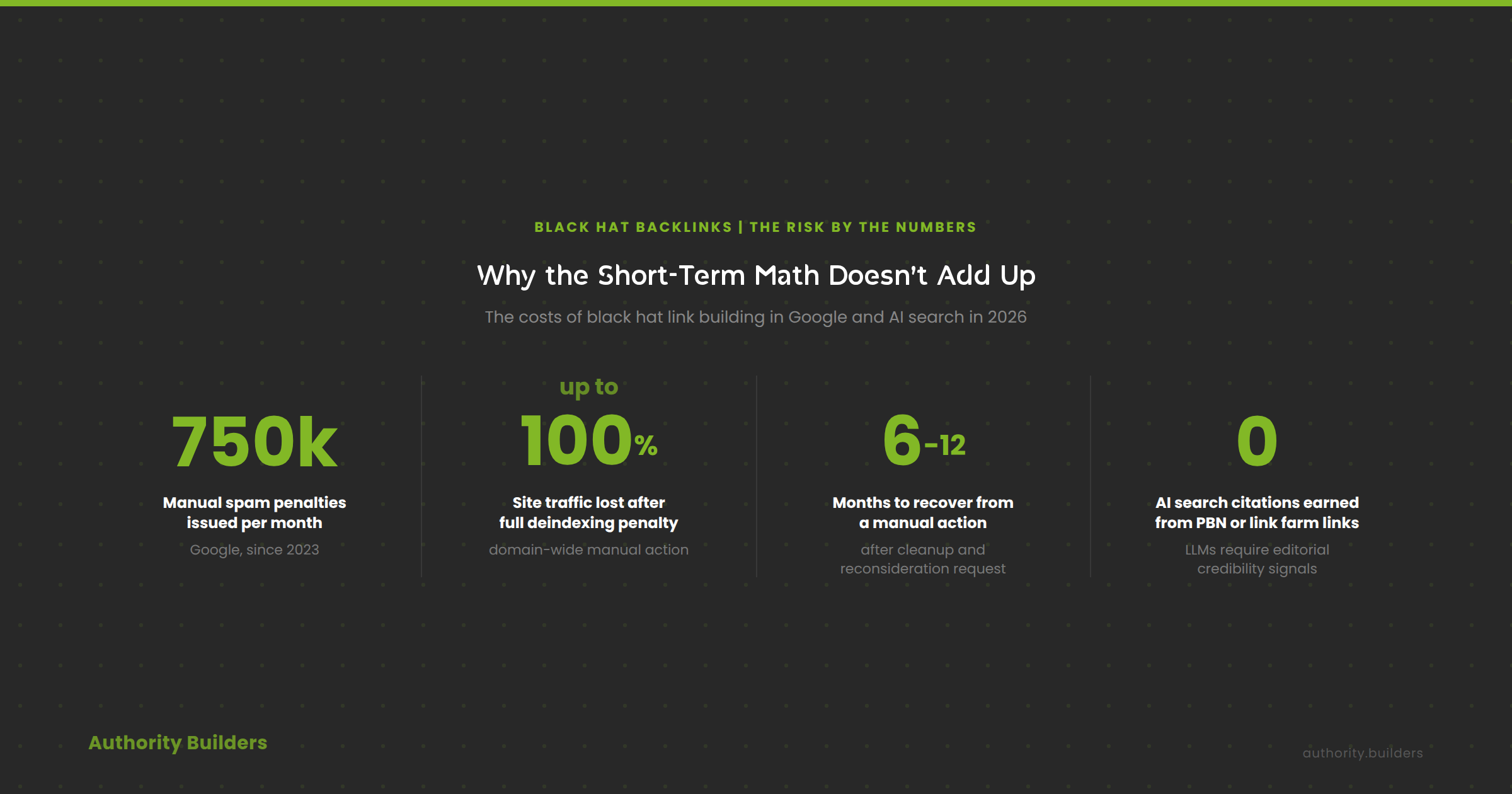
The case for black hat links was always a short-term arbitrage argument: get the ranking benefit now, deal with the risk later, or just move on to a new site if it gets penalized. That model made some sense in an era when starting a new site was cheap and recovery was theoretically possible.
In 2026, three things have changed that make that math harder to justify.
Google’s detection has improved significantly. SpamBrain’s ability to identify and devalue artificial links has made the baseline scenario, where you get the benefit without the penalty, much less reliable. You’re more likely to spend money on links that simply don’t work.
Manual actions have become more aggressive. The 2024 spam policy updates signaled Google’s intention to take a harder line. The wave of manual actions that followed showed they meant it.
AI search doesn’t give you a second chance. If your brand’s authority signal is built on manufactured links, you’re not building toward AI search visibility, you’re building away from it. And unlike a Google ranking, which can recover after a penalty cleanup, the editorial credibility signals that AI systems look for take real time and real work to build.
The sites winning in search right now, both traditional and AI-powered, are the ones that invested in links Google and AI systems actually trust.
What White Hat Link Building Actually Looks Like
The alternative to black hat isn’t just “don’t do anything sketchy.” It’s building a link profile that would make sense to a journalist, a potential customer, or an AI system trying to determine whether your brand deserves a citation.
Guest Posts on Real, Niche-Relevant Sites
Placing content on publications that have real audiences in your niche. Not link farms or PBN sites, but genuine editorial outlets where the content serves readers and the link placement makes topical sense. Authority Builders’
Link Insertions in Existing, Ranking Content
Link insertions place your link within content that already exists and already has traffic. Done properly in relevant content with editorially appropriate context, they’re one of the most efficient ways to build authority. See how our link insertion service works.
Digital PR and Earned Media
Getting your brand covered by journalists, publications, and media outlets. These are the highest-trust links in the ecosystem and carry the most weight for both traditional search and AI citation eligibility. They’re harder to earn, but they compound in a way that manufactured links never will.
Citations and Business Profile Links
For newer sites or those building foundational presence, citations and business profile links provide a reliable way to establish basic legitimacy signals across the web. Consistent NAP data across Google Business Profile, Yelp, and relevant industry directories tells search engines your brand is a real, verifiable entity, which is the foundation everything else is built on.
How Authority Builders Can Help
We’ve been doing white hat link building since 2016. Every site in our network is vetted against real traffic standards, verified by Ahrefs. Every placement is editorially appropriate. And we’re never going to put a link on a site that could hurt you.
If you’re looking to clean up a link profile that has some black hat history, or you want to build authority the right way from the start, we have a few ways to work together:
- ABC Plus — fully managed link building subscription with monthly reporting, competitor analysis, and anchor text mapping
- ABC Platinum — custom campaign built from a complete link gap analysis, highest-DR placement access, dedicated account manager
- Browse individual placements through our self-serve marketplace at authority.builders/apply
If you’ve got questions about your current link profile or want to know what a legitimate campaign looks like for your niche,