
Link quality has always mattered in SEO. But for most of its history, “quality” was defined by a fairly simple set of metrics: domain rating, traffic, topical relevance, dofollow status. A high-DR link from a relevant site was a quality link. A low-DR link from an unrelated site was not.
AEO changes that definition in ways that aren’t immediately obvious, and in some cases, turns conventional link quality thinking on its head.
When AI systems decide which sources to cite in a generated answer, they’re not running a PageRank calculation. They’re making a judgment about editorial credibility, brand trust, and topical authority that’s more nuanced than any single metric captures. A link that’s excellent for traditional rankings may contribute almost nothing to your AEO citation eligibility. And certain kinds of links that were previously treated as supplementary, earned media placements, editorial mentions in publications your audience actually reads, are now among the most valuable signals in the ecosystem.
This post breaks down exactly what’s changed, why it matters, and what a quality-first link building approach looks like when AEO is part of the objective.
The Shift From Ranking Links to Citation-Eligible Links
In traditional SEO, the question a link has to answer is: does this signal to Google that the destination page deserves more authority? The mechanism is the link graph. PageRank flows from linking page to linked page based on the authority of the source.
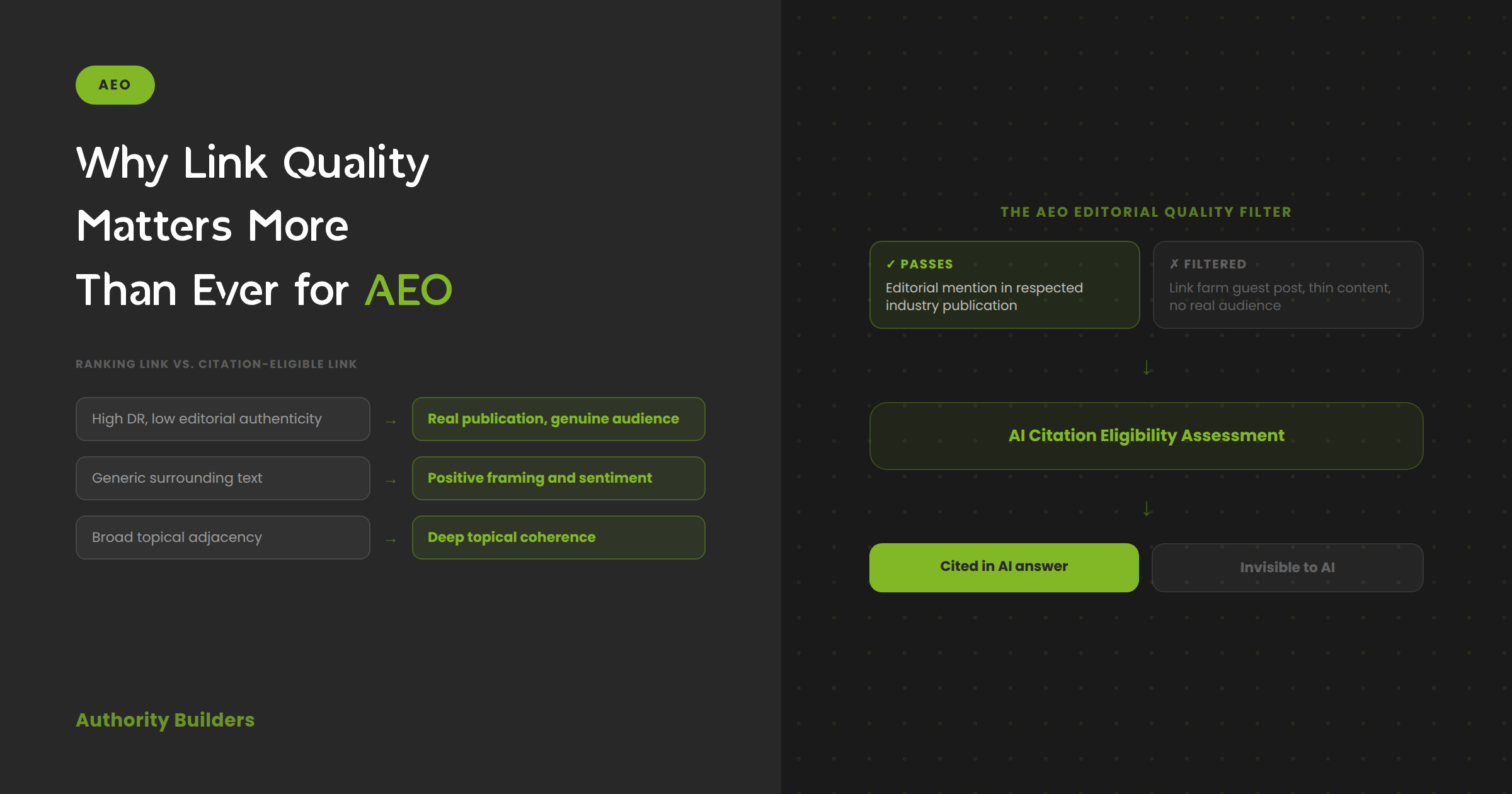
In AEO, the question is different: does this signal to an AI system that this brand or domain is a credible, trustworthy source worth citing in a generated answer? The mechanism is closer to how a journalist evaluates sources. An AI system that’s learned from the web knows the difference between an editorial mention in a respected industry publication and a link placed in a guest post on a content farm that exists primarily to sell links.
The distinction matters because these two questions have overlapping but non-identical answers. Many of the same signals help with both, but the weighting is different, and some tactics that are neutral or mildly helpful for rankings are actively counterproductive for AEO.
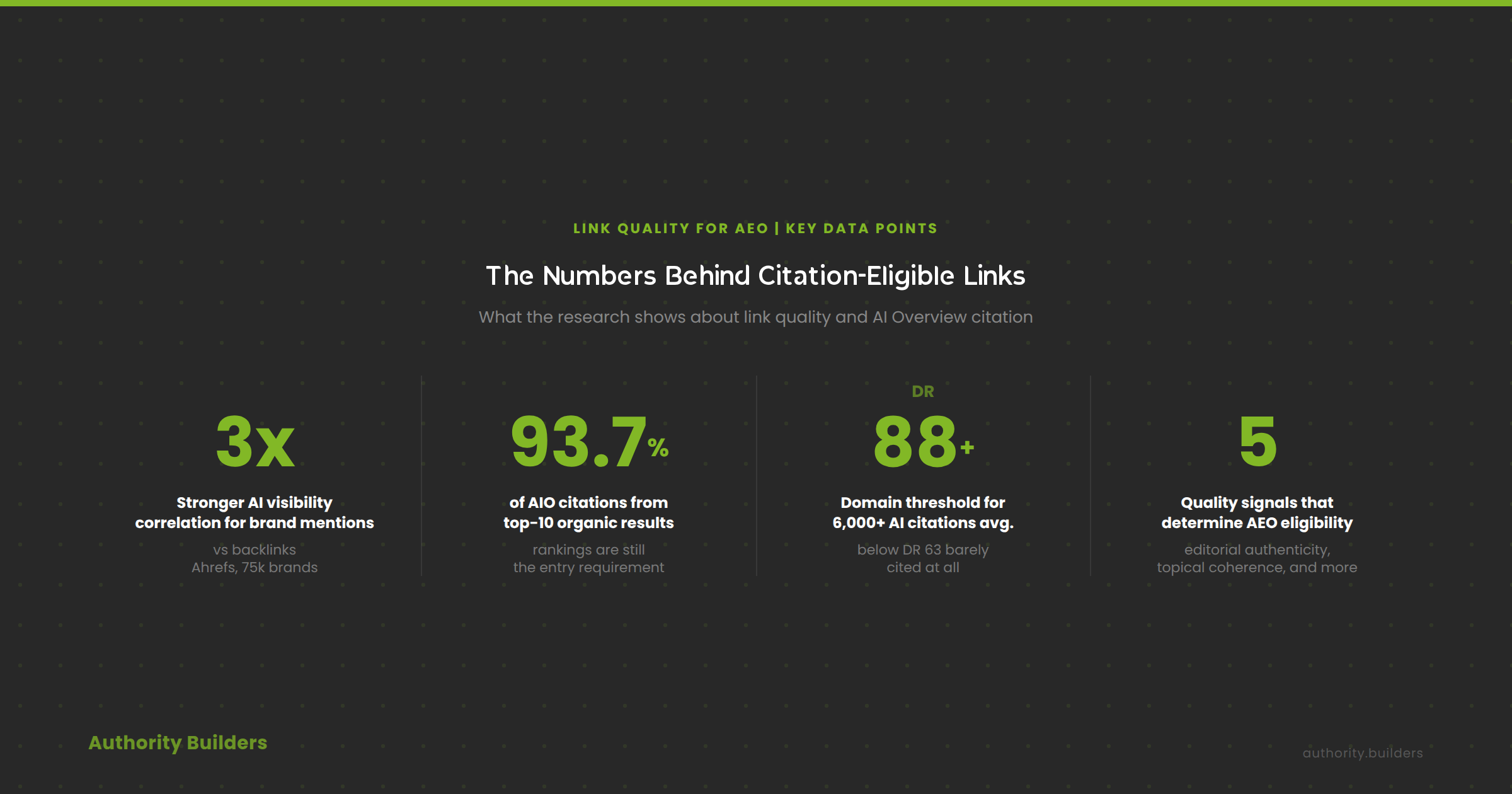
As we covered in our analysis of what the data shows about AI Overview citations, brand web mentions correlate with AI visibility at 0.664 compared to 0.218 for backlinks. That doesn’t mean links don’t matter for AEO. It means the type of link, and the editorial context around it, matters more than the count.
What Traditional Link Quality Got Right (and What It Missed)
The traditional quality framework, domain rating, topical relevance, dofollow status, in-content placement, got a lot of things right. These signals genuinely predict ranking performance. And because rankings correlate with AI Overview citation eligibility (93.7% of AIO citations link to top-10 results), they indirectly support AEO too.
What it missed is the editorial layer. Traditional link quality metrics tell you about the authority of the linking domain. They tell you less about whether the link reflects genuine editorial judgment, whether the surrounding content treats your brand as a trustworthy source, and whether the placement looks like something a knowledgeable human would choose to include.
AI systems are trained on the full text of the web. They learn not just that Domain X linked to Brand Y, but what the surrounding language said about Brand Y. A link accompanied by “we recommend”, “the leading resource for”, or “according to [Brand Y]” carries different semantic weight than the same link from the same domain in a generic listicle.
This is the piece that traditional link quality frameworks didn’t account for, because Google’s traditional algorithm couldn’t evaluate it at scale. LLMs can, which is why it now matters.
The 5 Quality Signals That Determine AEO Citation Eligibility
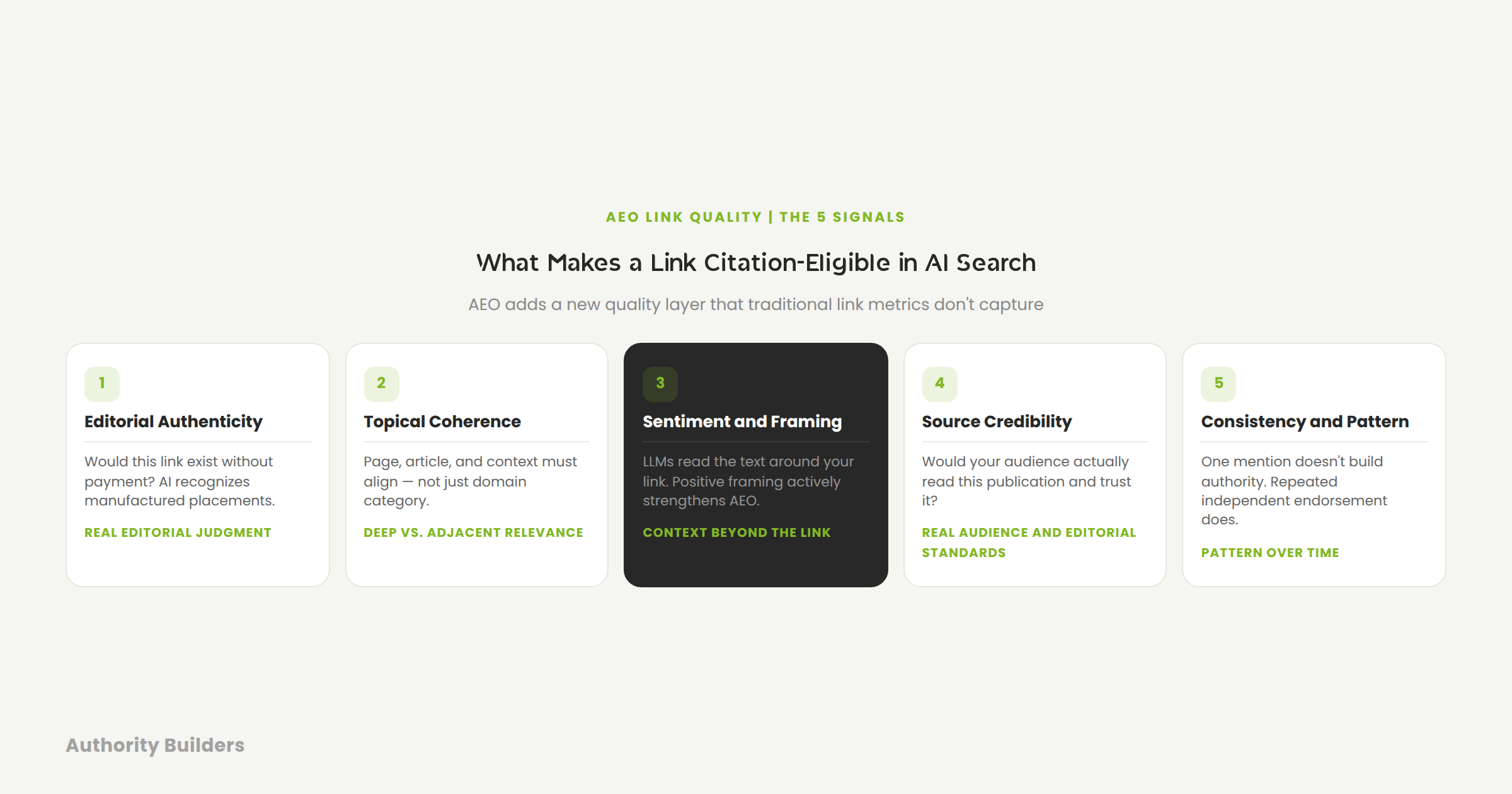
1. Editorial Authenticity
Does the link reflect a real editorial decision by a real human? AI systems are trained to recognize the difference between genuine editorial endorsement and manufactured link placements. Content that reads like it was created for the purpose of hosting links, thin guest posts on low-traffic sites, exact-match anchor text in contexts where it feels forced, keyword-stuffed surrounding text, these register differently than in-body links within genuinely useful, well-written content on publications that have real audiences.
The practical test: would this link appear here if you weren’t paying for placement? If the answer is probably not, it’s not contributing meaningfully to your AEO authority.
2. Topical Coherence
Topical relevance has always mattered for SEO, but for AEO the standard is stricter. It’s not enough for the linking domain to be in a broadly related category. The specific page, the specific article, and the specific context of the link all need to be topically coherent with what your brand does.
A link to an SEO agency from an article about “the best CRM tools” on a marketing software blog is topically adjacent at best. A link from an article about “how to build backlinks for SaaS” on a respected industry publication is deeply topically coherent. AI systems that understand language know the difference.
3. Sentiment and Framing
This is the signal that surprises most people. LLMs don’t just see that a link exists. They read the text around it. As our guide to how authority signals shape AI search answers covers, AI models pay attention to the framing and sentiment surrounding each mention. A link accompanied by positive, specific language about your brand’s quality, expertise, or usefulness actively strengthens your AEO position. A neutral name-drop, a link buried in a resource list with no context, carries little signal.
This means the quality of the content surrounding your link, not just the quality of the linking domain, is part of the AEO equation.
4. Source Credibility and Audience Reality
AI systems are trained to recognize authoritative sources: publications with real editorial standards, sites with genuine audiences, domains that consistently produce accurate, expert content in a field. A link from a publication that a person in your industry would actually read, respect, and cite in their own work is a stronger AEO signal than a link from a high-DR domain that no human actually visits or trusts.
This is why earned media, press coverage, and editorial placements in trade publications consistently outperform generic guest post volume for AI citation purposes. The sources that AI systems have learned to trust are the ones that real communities of experts trust.
5. Consistency and Pattern
A single editorial mention doesn’t make a brand citation-worthy in the eyes of an AI system. What builds the pattern that LLMs recognize as genuine authority is consistent, repeated endorsement from multiple independent, credible sources over time. This is the same principle that makes PR campaigns compound: each placement adds to a pattern that AI systems increasingly recognize as evidence of real-world authority.
This is also why a portfolio of genuinely quality links is harder to replicate than a large volume of lower-quality ones. Volume can be manufactured quickly. Consistent editorial credibility across a category takes time and genuine quality to build.
Why Volume-Based Link Building Actively Hurts AEO
Here’s something that doesn’t get discussed enough: it’s not just that low-quality links don’t help AEO. In some cases, they can actively work against it.
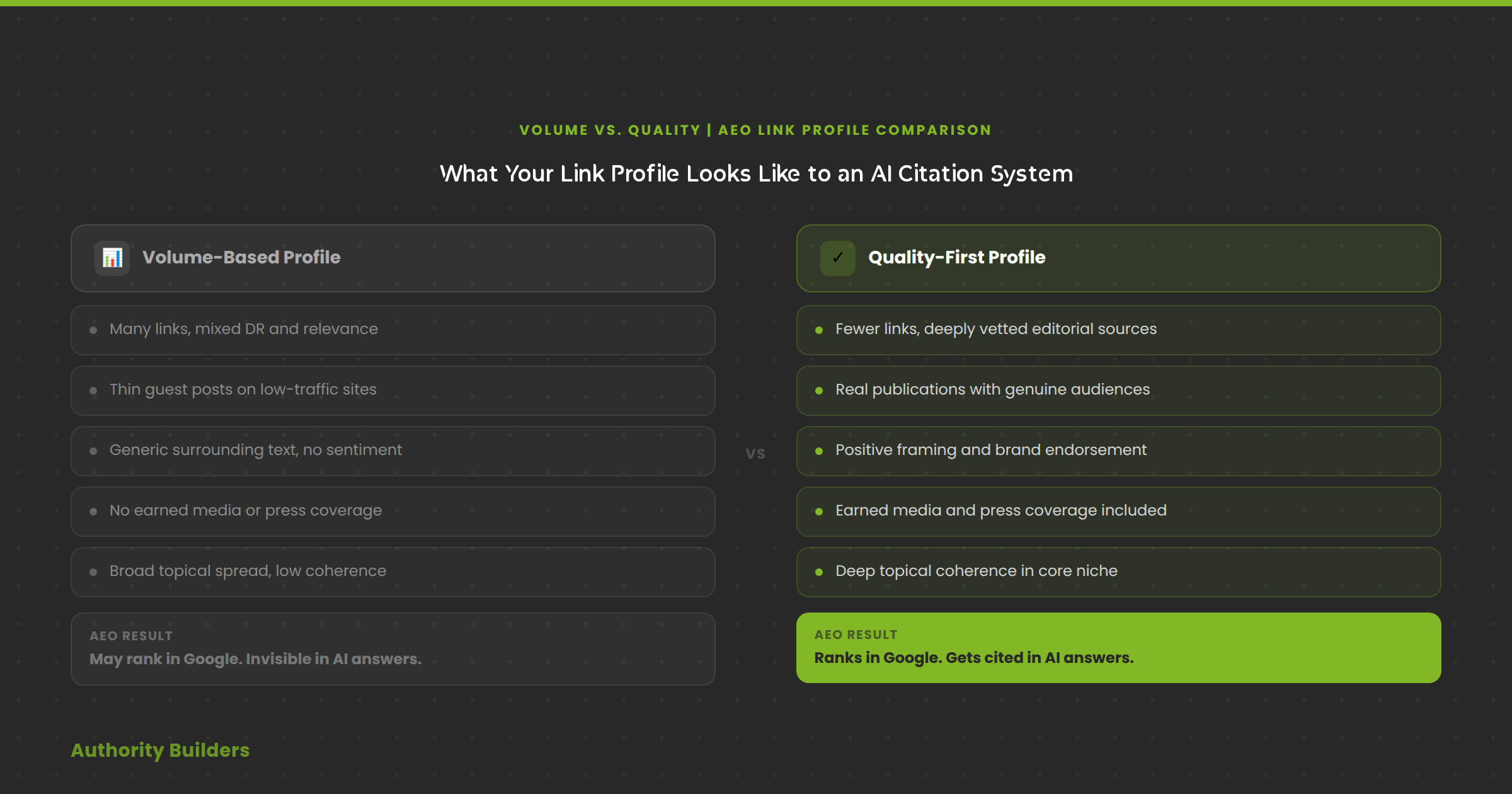
AI systems trained on the web develop a model of what genuine authority looks like in each domain. A brand that appears primarily on low-traffic content farms, in thin articles with generic surrounding text, alongside dozens of other paid link recipients, doesn’t match the pattern of a credible, independently-endorsed source.
More concretely: if the majority of your link profile points toward manufactured placements rather than genuine editorial coverage, you’re building the wrong kind of footprint. You might rank for target keywords through sheer link volume while being largely invisible in AI-generated answers, because the quality signals that AI systems use don’t correlate with the volume signals you’ve optimized for.
The risk isn’t limited to AEO invisibility either. As covered in our post on black hat backlinks and why they’re not worth the risk, Google’s ability to detect and devalue manufactured link patterns has only gotten sharper. Volume-first strategies that rely on low-quality placements create a footprint that’s increasingly easy for both Google’s algorithm and AI systems to identify and discount.
What AEO-Ready Link Building Looks Like in Practice
Translating these quality signals into a practical link building approach means shifting from metrics-first selection to editorial-first selection.
Prioritize editorial context over DR alone
Domain rating matters, but it’s a proxy for authority, not authority itself. A DR 55 site with a real, engaged audience in your niche, with editorial standards and genuine readership, is a stronger AEO signal than a DR 70 content farm. When evaluating link opportunities, look at the actual publication: does it have a recognizable editorial voice? Do real people in your industry read it? Would you be proud for a potential customer to see your brand mentioned there?
Target in-body editorial placements with meaningful surrounding text
The content around your link matters. Placements within genuinely useful, well-written articles where your brand is mentioned in a context that reflects positively on your expertise, in ways that feel natural rather than inserted, are the placements that build AEO-relevant authority. Our guest post placements and link insertions are placed exclusively on sites with verified real traffic, with content written to editorial standards.
Add earned media and press coverage to your mix
Earned media placements in genuine news publications, industry journals, and respected trade outlets build the kind of credibility signal that AI systems weight most heavily. These are the sources that editorial AI training data treats as authoritative. Authority Builders’ Earned Media, Press Authority, and Digital PR services are specifically designed to place your brand in the publications that carry the most weight for both traditional rankings and AI citation eligibility.
Build topical depth, not just topical breadth
A cluster of links from deeply relevant sources within a single topical area builds stronger AEO authority than a scattering of links from broadly adjacent domains. If you’re a link building agency, links from SEO publications, digital marketing journals, and agency-focused trade sites build a tighter topical signal than links spread across generic business blogs. Depth of topical endorsement is what builds the pattern AI systems recognize as genuine category authority.
How to Audit Your Current Link Profile for AEO Readiness
A quick framework for evaluating where your current link profile stands:
- Check the editorial reality of your top referring domains. Pull your top 20-30 referring domains by DR or traffic. For each one, ask: is this a real publication with a real audience? Would a person in your industry recognize this site? If more than half the answer is “not really,” your profile is weighted toward manufactured links.
- Assess the surrounding content quality. For a sample of your most recent link placements, read the articles they appear in. Is the surrounding text substantive and well-written? Does it treat your brand as a credible source? Or is it generic content that exists primarily to host the link? The answer tells you a lot about how AI systems are likely to interpret these placements.
- Check for topical coherence. Sort your referring domains by their primary topic. What percentage are genuinely topically aligned with your core subject matter? Broad topical spread with low coherence is a sign your profile is optimized for volume rather than editorial relevance.
- Look at your earned media footprint. How many of your referring domains are genuine news or media publications? Press coverage, trade journals, and industry publications are the highest-trust links for AEO purposes. If this category is thin or absent, it’s the highest-priority gap to fill.
How Authority Builders Can Help
Every link we place is evaluated against exactly these quality criteria. We don’t just vet for domain rating. We vet for editorial authenticity, real audience size, topical coherence, and placement quality. Every site in our network has a minimum of 1,000 verified monthly visitors (confirmed by Ahrefs), and placements are made through genuine outreach, not pre-existing agreements with content farms.
For brands specifically looking to build AEO-ready authority:
- Guest Posts and Link Insertions on editorially vetted, real-audience sites build the ranking foundation and topical coherence that AEO depends on
- High-Authority Links target the news publication tier, the highest-trust editorial layer for AI citation eligibility
- Earned Media, Press Authority, and Digital PR build the independent editorial coverage pattern that AI systems treat as the strongest credibility signal
- ABC Platinum builds a fully managed campaign from a complete link gap analysis, with AEO authority built into the strategy from the start
If you want to understand how your current link profile scores against AEO quality criteria and what it would take to close the gap, book a call with our team and we’ll walk you through a personalized assessment.