
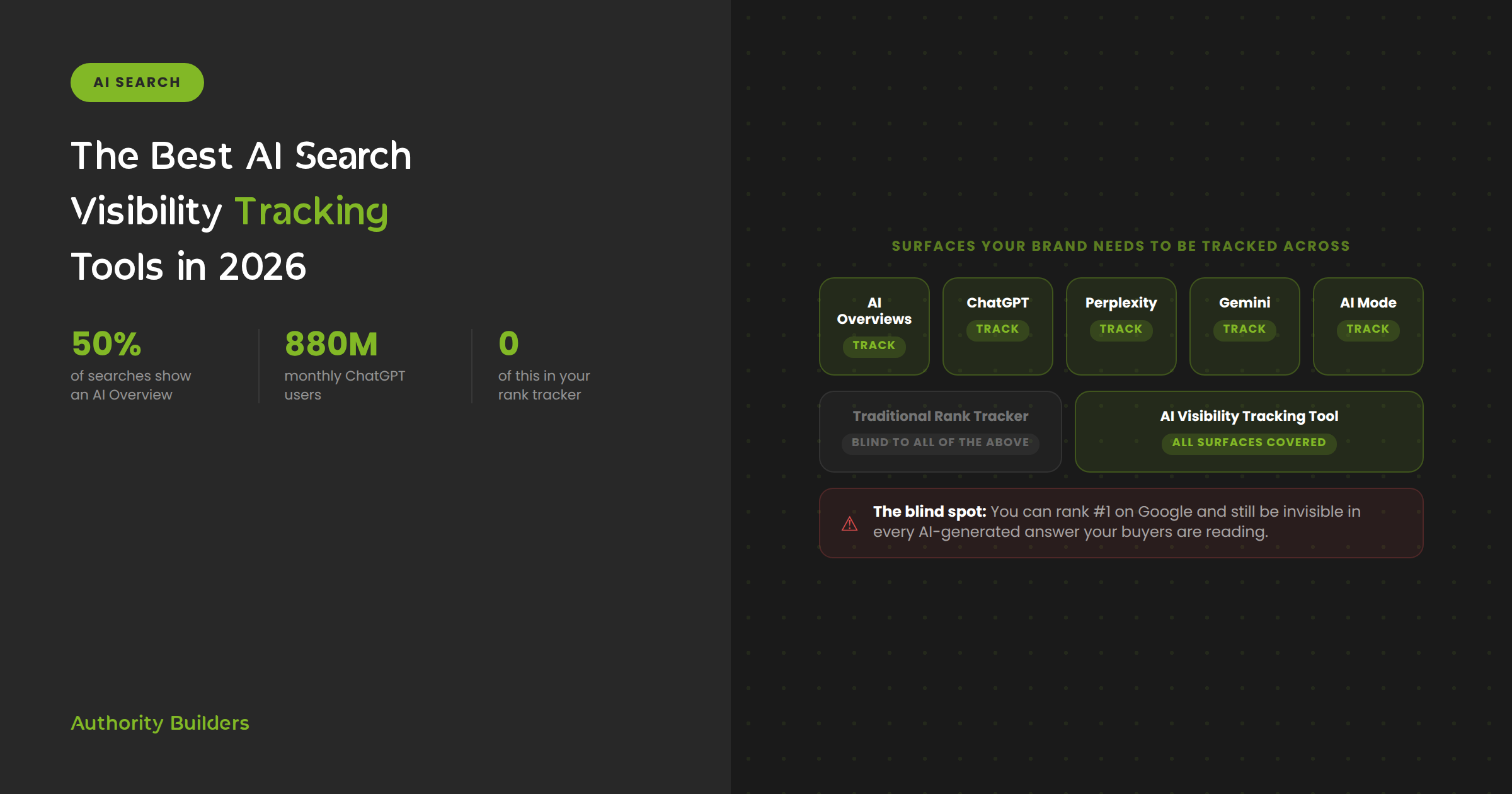
If you’ve been tracking your rankings in Ahrefs or Semrush and feeling pretty good about where things sit, there’s a blind spot worth knowing about.
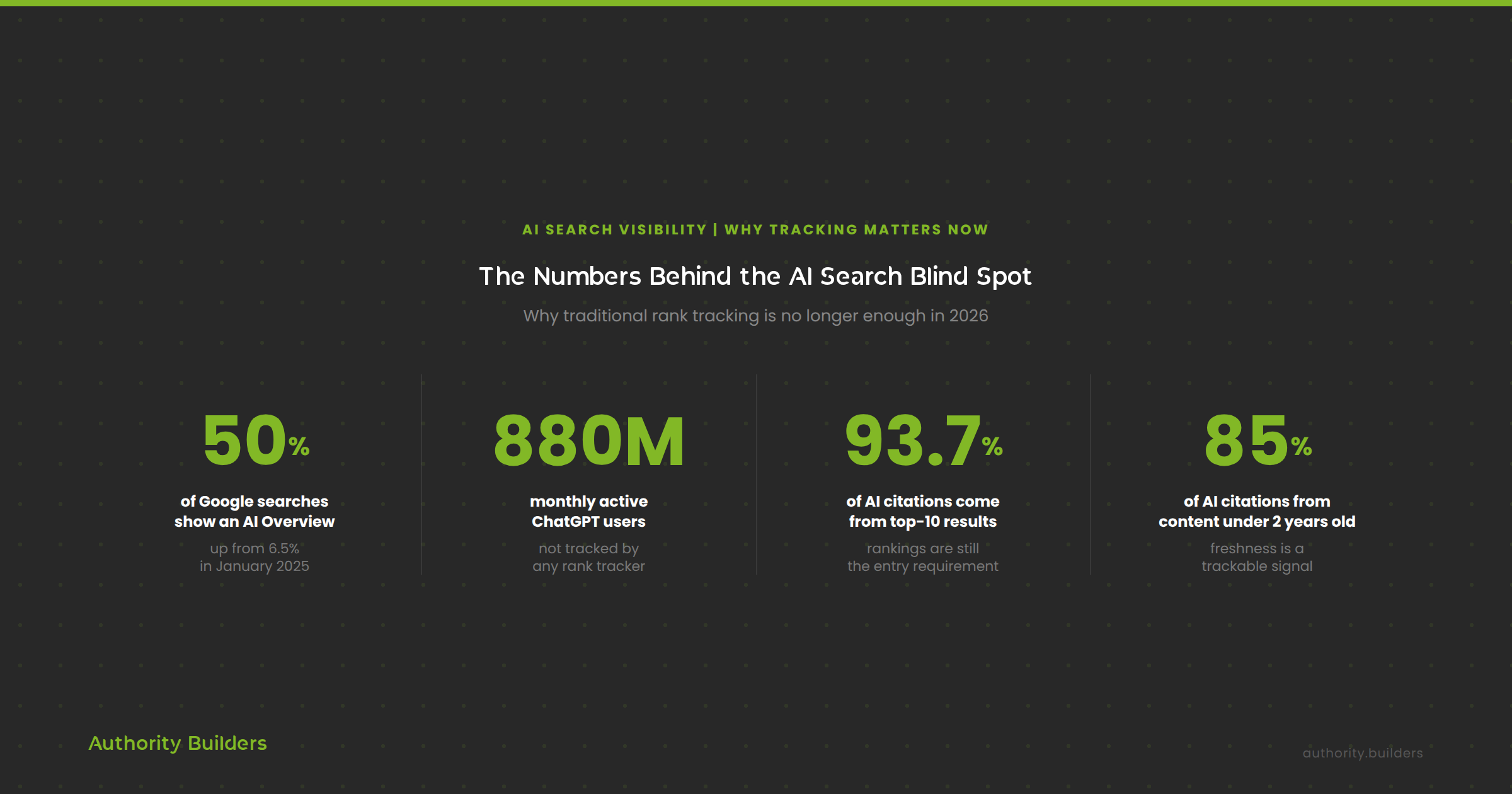
AI Overviews now appear in roughly 50% of Google searches. ChatGPT has over 880 million monthly active users. Perplexity is the tool of choice for a growing share of research-first buyers. And none of those surfaces show up in a traditional rank tracker.
That gap has spawned an entirely new category of software: AI search visibility tracking tools. Two years ago these didn’t exist. Today there are more than a dozen serious options, ranging from enterprise platforms to affordable agency tools to manual workflows you can set up in an afternoon.
This guide covers the tools that are actually worth your time, how to pick the right one for your situation, and how to build a monitoring workflow that gives you a real picture of your brand’s position across AI search.
Why AI Visibility Tracking Is Different From Rank Tracking
Traditional rank tracking is deterministic. You enter a keyword, the tool returns a position. Position 1 today means position 1 for everyone searching that keyword (broadly speaking). It’s measurable, comparable, and trackable over time.
AI search doesn’t work that way. When someone asks ChatGPT which link building agency they should use, the answer is probabilistic. It varies based on how the question is phrased, what the user said earlier in the conversation, what the model’s current training data includes, and dozens of other factors. There’s no single “position” to track.
What you can track is: how often your brand appears in AI-generated answers for a defined set of prompts, where in the answer it appears, whether it’s cited as a source, how the sentiment around the mention reads, and how that changes over time relative to your competitors.
That’s a fundamentally different measurement problem. And as we’ve covered in our guide to how to rank in AI Overviews, the work that earns those mentions looks pretty different from the rank optimization most teams are used to, so it makes sense that measuring it would too.
What to Actually Measure
Before picking a tool, it’s worth being clear on what metrics actually matter. Not everything these platforms surface is equally useful.
Citation frequency
How often does your brand get mentioned when AI systems answer questions in your category? This is the core metric. Track it across a set of 20 to 50 prompts that represent the questions your target buyers are asking.
Citation position
Are you mentioned first, in the middle, or at the end? Lead mentions carry more weight both for user impression and for how AI systems tend to frame authority.
Sentiment and framing
Is the mention positive, neutral, or negative? Is your brand described as a recommended option, a cautionary example, or just listed without context? As we’ve covered in our post on link quality and answer engine optimization, the framing AI systems attach to your brand tends to track the quality of the sources talking about you, so sentiment is really a signal about where your authority is coming from.
Source attribution
When AI systems cite your brand, what sources are they pulling from? Are they citing your own site, your press coverage, third-party reviews, or industry publications? This tells you where your AI authority is actually coming from and where the gaps are.
Competitive share of voice
How often are your competitors mentioned in the same prompt set? Share of voice across AI answers is the metric that maps most directly to competitive position. A brand that appears in 60% of answers for category-defining prompts has a very different AI search position than one that appears in 15%.
The Tools: Dedicated AI Visibility Platforms
These are platforms built specifically for AI search monitoring, not SEO tools that added an AI tab.
NextNet.AI
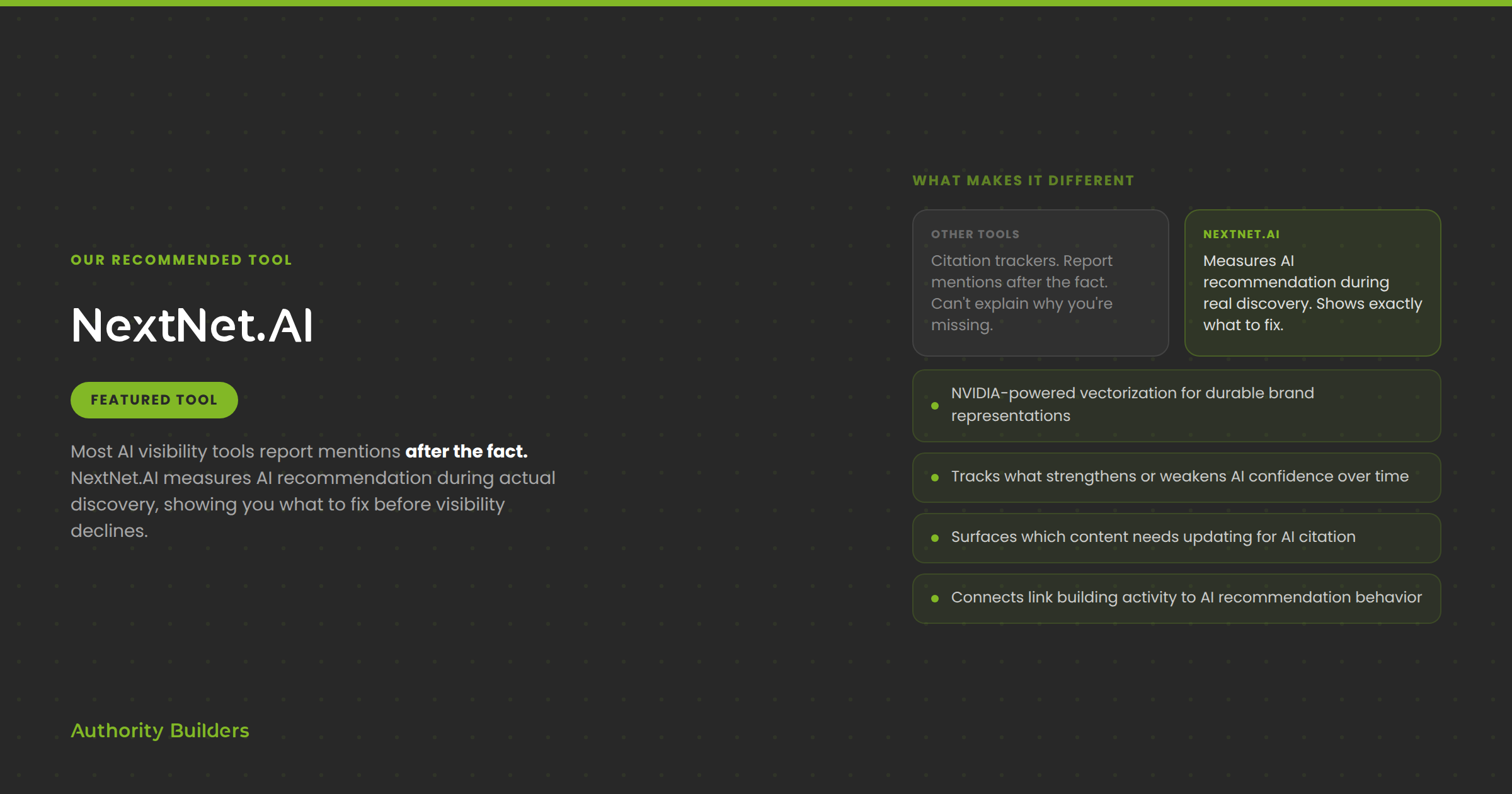
NextNet.AI is the tool we recommend for teams serious about understanding and improving their AI visibility. While most tools in this space are citation trackers, meaning they report whether your brand was mentioned after the fact, NextNet.AI is built around measuring AI recommendation during actual discovery. That’s a meaningful distinction.
The platform uses NVIDIA-powered vectorization to create durable semantic representations of your brand that AI systems can consistently interpret and compare. In practice, this means you can see what specific signals are strengthening or weakening AI confidence in your brand over time, which content needs updating so AI can understand and reuse it, and where competitors are outperforming you at the signal level rather than just the mention level.
For brands running link building and earned media campaigns alongside their AI visibility work, NextNet.AI surfaces the connection between those activities and actual AI recommendation behavior. That closes the feedback loop that most other tools leave open.
Otterly AI
Otterly tracks citation rates across ChatGPT, Gemini, Perplexity, Copilot, and AI Overviews, and pairs the monitoring with content optimization recommendations. It runs predefined prompts and surfaces which pages are getting cited, where the gaps are, and what changes are likely to improve inclusion.
It’s positioned as a full-cycle tool: research, monitoring, and optimization in one platform. For teams that want a single place to manage their AI visibility workflow rather than stitching together multiple tools, it’s a strong option.
SE Ranking AI Search Toolkit
SE Ranking has built out an AI search toolkit that covers AI Overviews, AI Mode, ChatGPT, Perplexity, and Gemini. It’s part of their broader SEO platform, which makes it a good fit for teams that are already in SE Ranking and want to add AI tracking without switching tools.
The multi-client workspace management and reporting features are clearly built for agencies running multiple client brands. If you’re managing five or more clients and want AI visibility reporting alongside traditional rank data, this is one of the more practical setups.
Semrush One (AI visibility features)
Semrush has added AI visibility tracking to their broader platform under the Semrush One offering. It covers ChatGPT, Perplexity, and Gemini brand mention monitoring with competitive benchmarking. For teams already running Semrush for SEO and PPC, this is the lowest-friction way to add AI monitoring, since the data sits alongside everything else you’re already tracking.
The Tools: SEO Suites With AI Tracking Built In
Several of the traditional SEO platforms have added meaningful AI visibility features. They’re not as deep as the dedicated tools but they’re often good enough, especially if you’re already paying for the platform.
Ahrefs
Ahrefs has added AI Overview tracking to their rank tracking suite. You can see which of your tracked keywords trigger AI Overviews and whether your content is being cited. It doesn’t yet cover ChatGPT or Perplexity citation tracking, but for Google-focused monitoring it’s integrated cleanly into the workflow most SEOs are already running.
Semrush (core platform)
Separate from Semrush One, the core Semrush platform has added AI Overview position tracking. If you’re an existing Semrush user, it’s worth checking what’s now available under your plan before paying for a separate dedicated tool.
The Tools: Manual Monitoring Methods That Still Work
Not everyone needs a $500/month platform. If you’re monitoring your own brand or working with a small number of clients, a manual workflow can give you 80% of the signal for a fraction of the cost.
Prompt testing across platforms
Build a set of 20 to 30 prompts that represent the questions your target buyers are asking in your category. Run them monthly in ChatGPT, Perplexity, and Gemini. Record whether your brand is mentioned, where in the answer it appears, and what’s said about it. A simple spreadsheet tracking these over time tells you a lot.
Google Search Console for AI Overview signals
Google Search Console now shows impression and click data that lets you infer AI Overview citation. If a keyword is showing high impressions but very low CTR, there’s likely an AI Overview above your result absorbing the clicks. If you’re seeing impressions rise while CTR falls, that’s the pattern described in our post on how to rank in AI Overviews, where the Overview answers the query before your result ever gets the click.
Google Alerts and brand monitoring
Google Alerts on your brand name, key product names, and your main competitors gives you a passive stream of new mentions. It doesn’t tell you about AI citations directly, but it surfaces new editorial coverage that’s likely to feed into AI training data and citation patterns over time.
How to Set Up a Basic Monitoring Workflow
Whether you use a dedicated platform or a manual approach, the workflow structure is the same.
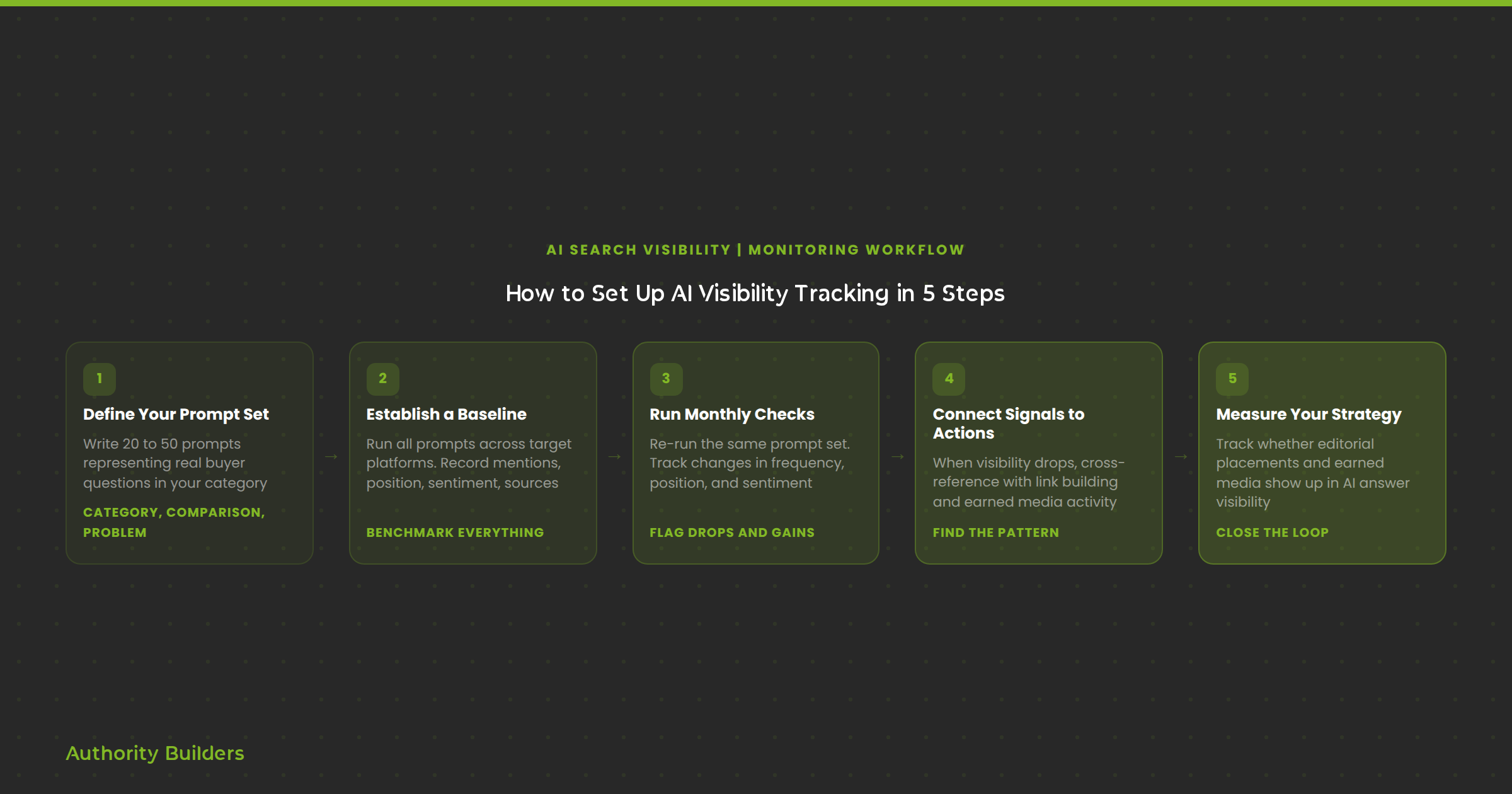
Step 1: Define your prompt set. Write 20 to 50 prompts that represent the questions buyers in your category ask when they’re evaluating solutions. Think category questions (“what’s the best link building service”), comparison questions (“[your brand] vs [competitor]”), and problem questions (“how do I build high authority backlinks”). These are your tracking prompts.
Step 2: Establish a baseline. Run all prompts across your target platforms and record the results. Note which prompts mention your brand, which mention competitors, sentiment, and source attribution. This is your benchmark.
Step 3: Run monthly checks. Re-run the same prompt set monthly. Track changes in mention frequency, position, and sentiment. Flag any significant drops or gains for investigation.
Step 4: Connect signals to actions. When visibility drops, the question is always: what changed? New competitor content? A shift in AI training data? A gap in your editorial coverage? Cross-reference your monitoring data with your link building activity and earned media placements to find the pattern.
Step 5: Measure against your link building strategy. AI visibility isn’t a separate initiative from your SEO and link building work. As we’ve covered in our post on link quality and answer engine optimization, the placements that build genuine editorial authority are the same ones that move your AI visibility, so it pays to track them together rather than in separate reports.
What to Do When Your Visibility Drops
Visibility drops in AI search aren’t always obvious in the moment. Unlike a Google penalty, there’s no notification. You just gradually stop appearing in answers that used to mention you.
The most common causes:
- Competitors earned stronger editorial coverage. If a competitor published original research, got featured in major industry publications, or built a strong earned media footprint, AI systems may have shifted toward citing them as the authoritative source in your category.
- Your content aged out. 85% of AI Overview citations come from content published in the last two years. If your key pages haven’t been updated recently, they may be getting deprioritized in favor of fresher sources.
- Your topical authority has gaps. AI systems build a picture of which brands are genuinely authoritative in a topic area based on consistent coverage across multiple credible sources. A thin editorial footprint in a specific sub-topic creates citation gaps.
- Your link profile isn’t signaling the right things. As covered in our post on link equity and how authority flows through your links, a profile weighted toward volume over quality sends weaker authority signals than a smaller set of genuinely credible placements, and AI systems read that difference when they decide which brands to trust.
The fix in all these cases is the same: build more genuine editorial authority. More high-quality placements in real publications. More earned media coverage. More topically coherent brand mentions from sources AI systems trust.
How Authority Builders Can Help
Tracking your AI visibility is the diagnostic step. What you do about it is the strategy.
If your monitoring reveals gaps in editorial coverage, thin earned media presence, or a link profile that’s weighted toward volume over quality, that’s where Authority Builders’ services are specifically designed to help:
- High-Authority Links: placements in established US news publications, the tier AI systems weight most heavily for citation trust
- Earned Media and Press Authority: building the independent editorial coverage pattern that AI citation systems recognize as genuine brand authority
- ABC Plus and ABC Platinum: fully managed campaigns built with AI search visibility as part of the strategy from the start, not an afterthought
If you want to talk through what your current AI visibility looks like and what a realistic improvement strategy would involve, let’s set up a quick call. We’ll walk through where you stand today and what it’d actually take to move the numbers.