
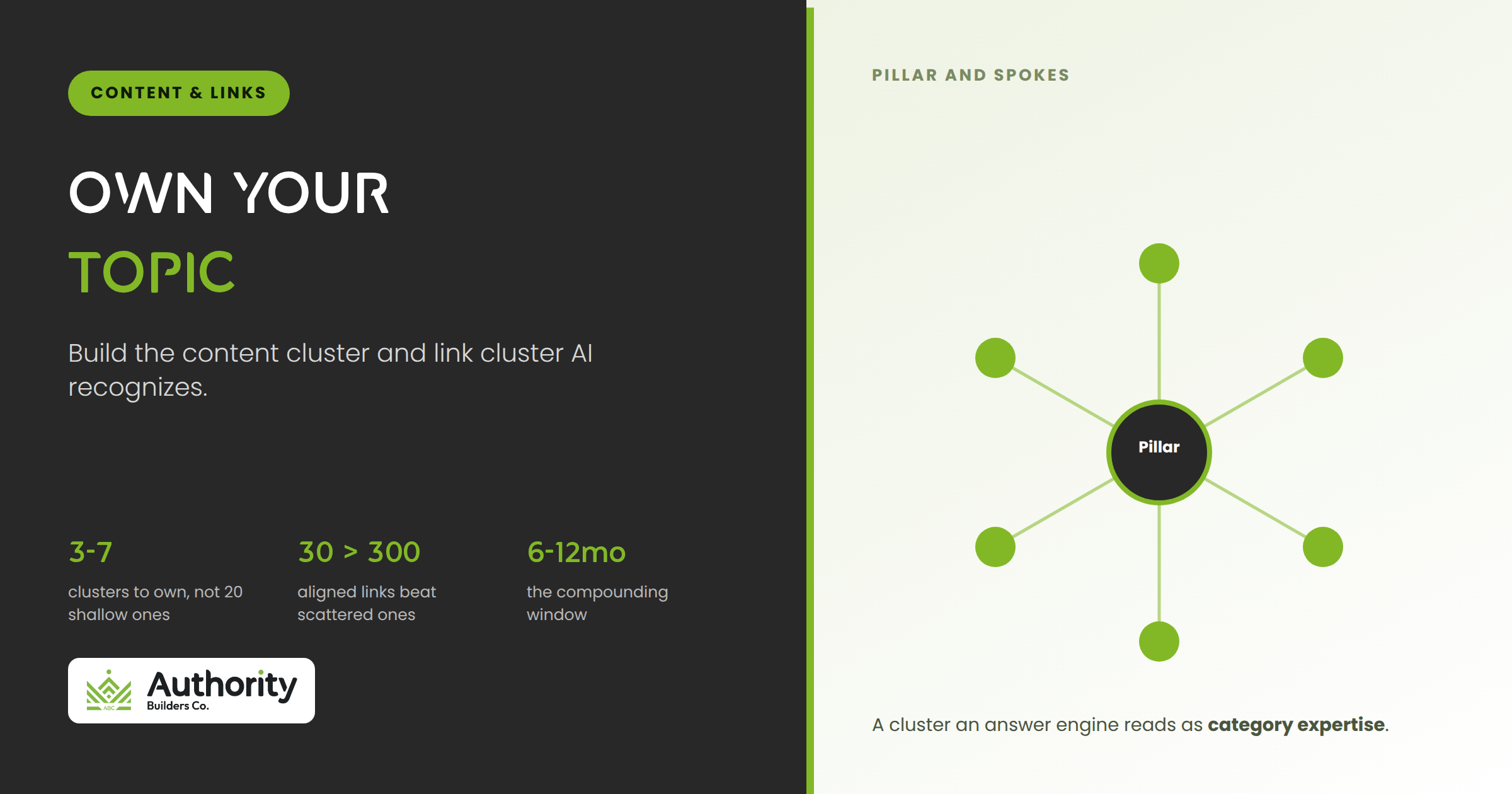
The old game was ranking a page for a keyword. The new game is being recognized as the authority on a topic, by Google and by the AI answer engines that now sit on top of it. A site that covers a subject completely, and earns links concentrated in that subject, gets treated as the category expert and cited. A site with scattered content and scattered links doesn’t, no matter how many total links it has piled up.
That’s topical authority, and it’s built from two things working together: a cluster of content and a cluster of links. Most teams build one and ignore the other. This guide is about wiring both so that search engines and AI systems can look at your site and immediately place you as the expert on your topic.
What topical authority really is
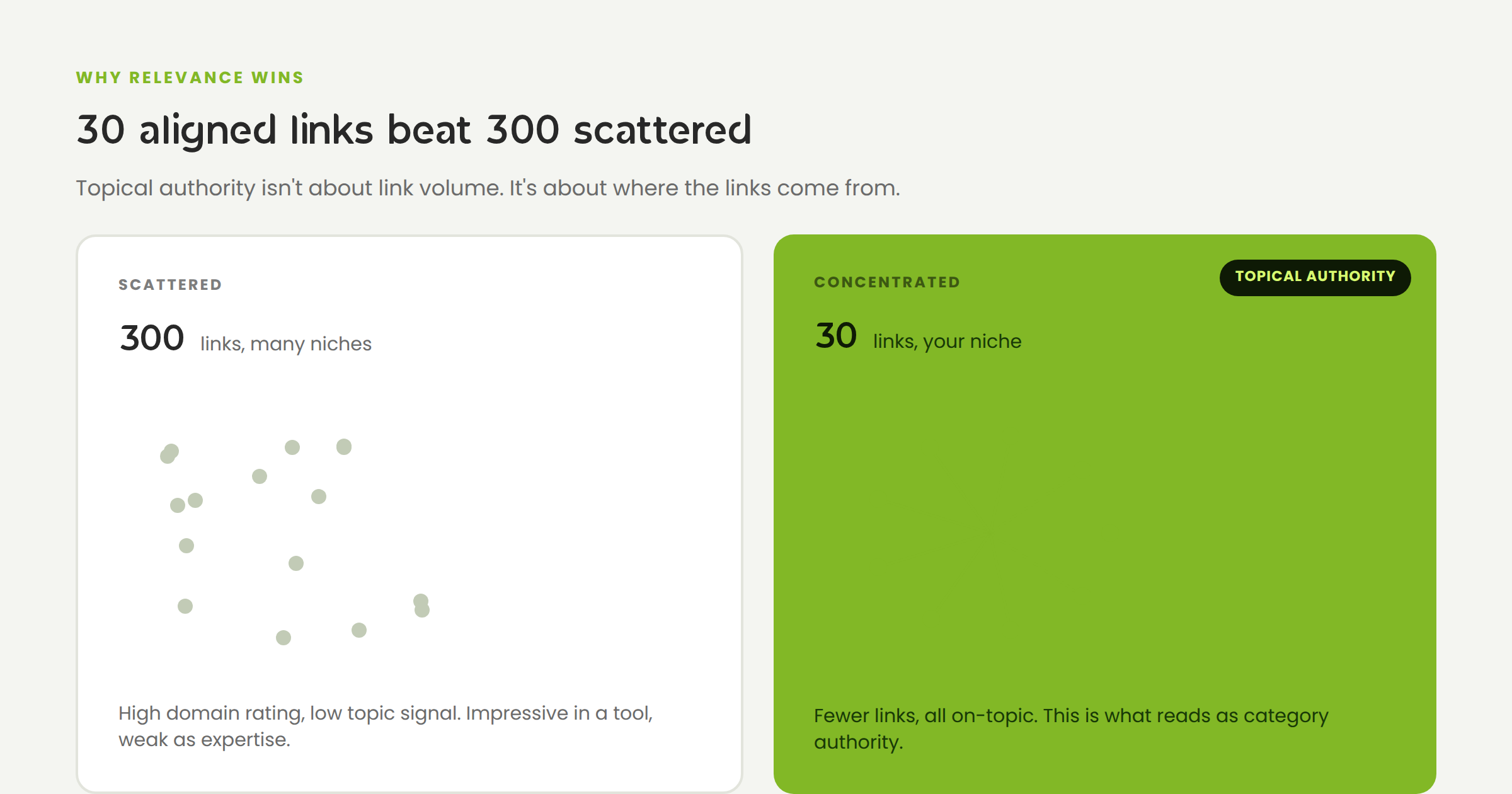
Topical authority is the expertise and credibility a site demonstrates on a subject, proven through comprehensive, interconnected content and reinforced by the links that point at it. It isn’t a number Google publishes. It’s the invisible result that explains why a focused site with 30 aligned backlinks can outrank a sprawling one with 300 scattered ones.
A concrete version: picture two roofing sites. One has published 40 interlinked articles covering every roofing question, from material comparisons to storm-damage claims, and earns links from roofing suppliers, trade associations, and local builders. The other has a higher domain rating built on 300 links from unrelated marketing blogs and two thin roofing pages. For a roofing query, the first site is the obvious expert, and both Google and an AI answer engine treat it that way. Raw authority loses to focused authority.
Google has a formal version of this. Its topic authority system determines which expert sources to surface for queries in specialized areas, and it leans on a few signals worth internalizing: how notable a source is for a topic, how often its original work is cited by others in the field, and its reputation for quality over time. The system was described for news, but the principle generalizes: depth and recognition in a subject earn preferential treatment.
In practice, topical authority shows up as three things: depth of coverage, entity coverage (how well your content hits the concepts and questions a topic implies), and links and mentions from trusted sources inside that topic. As Kevin Indig has documented in measuring it, topical relevance is a real ranking factor, not an SEO ghost story, and in the era of AI answers it’s often the difference between being the cited source and being buried under a summary.
Why AI rewards the category expert
Here’s the shift that makes this urgent. Search engines rank individual pages. AI answer engines retrieve based on how completely your site covers a topic. When ChatGPT or Perplexity needs a source for a category question, it gravitates to the brand it can confidently identify as the category authority. That’s answer engine optimization at the level of a whole topic, not a single page.
The mechanism is association. A model builds its sense of who’s expert in what from consistent, concentrated signals. A site that covers every facet of a subject and is linked by others in that same subject is easy to classify as an authority there. A generalist site that touches the topic once is noise. This is the topic-level version of how authority signals shape AI search answers.
The data backs the focus. Depth beats breadth: a handful of deeply developed clusters consistently outperforms fifteen or twenty shallow ones, and generalist, low-depth sites have been penalized harder in recent updates. Being pretty good at ten topics is now a weaker position than owning three.
Picture the model’s problem. Someone asks, “who’s good at technical SEO for large e-commerce sites?” The system needs a source it can name with confidence. It looks for a brand whose content covers that exact territory in depth and whose mentions cluster around it. A site with one generic technical-SEO post and links from random directories gives it nothing to hold onto. A site with a full technical-SEO cluster, cited by other SEO authorities, is a safe answer. The category expert wins not because it shouted louder, but because it’s the least risky thing to recommend.
The content cluster: pillar and spokes
The content half of topical authority has a well-worn shape: the topic cluster. One pillar page acts as the comprehensive hub for the subject and targets the head term. Around it sit cluster pages, each a deep treatment of one narrow subtopic or question. Then you wire them together: every cluster page links to the pillar, the pillar links to every cluster page, and related clusters cross-link where it truly helps a reader.
The coverage target is the question landscape. List every significant question someone interested in your topic might ask, and make sure each one eventually has a page that answers it directly. That serves search (you capture the long-tail) and AI at once (you fill the citation gaps where answer engines have query volume on subtopics). This dual purpose is why the topic-cluster model now serves SEO and AEO together.
Write the pages to be liftable. Clear definitions, structured steps, and entity-rich phrasing let an answer engine pull a coherent chunk without losing the thread. The same depth that earns a ranking is what makes a passage quotable. This is where a consistent SEO blog program pays off: the win comes from publishing into a structure, not from scattering one-off posts that compete with each other and decay.
Two details separate a real cluster from a folder of related posts. The internal links have to be two-way and consistent, so authority and context flow between the pages instead of dead-ending. And the pillar has to deliver on its promise: a 6,000-word hub that skims the surface signals less authority than a tighter one that answers the core questions with precision. Depth is the currency here, not word count, and a cluster that reads as a coherent body of expertise is what both crawlers and answer engines reward.
The link cluster: concentration beats volume
Now the half most link builders underweight. Topical authority isn’t only about content. It’s about where your links come from. A link from a site that is itself about your topic carries far more topical signal than a higher-authority link from an unrelated one.
Think of it as a link cluster: a concentration of links pointing at your topic pages from sites that share that topic. That pattern tells Google and AI something a raw link count can’t. It says this brand belongs to this category, and others in the category vouch for it. Fifty links from inside your niche say more about your expertise than three hundred scattered across unrelated ones. Quality and relevance beat volume, every time.
Two practical moves follow. First, point links at the cluster, not just the homepage. Build to your pillar and your strongest cluster pages so authority flows into the topic structure rather than pooling on the front door. Second, use anchor text that describes the topic, so each link reinforces the association instead of wasting it. This is what a real high-authority link program should optimize for, topical relevance and placement, not domain rating for its own sake, and it’s a core reason link quality matters more than ever for AEO.
A quick gut check for any link opportunity: would a reader of that site plausibly care about your topic? If a link sits in content about your subject, on a site known for your subject, it reinforces your category membership. If it’s a footer link on an unrelated high-authority site, it moves a tool metric and little else. Building for relevance is slower, and it’s the version that compounds into real topical authority instead of a bigger number in a dashboard.
Co-citation: the company your links keep
Direct links are only part of the signal. Models also read co-citation: when your brand appears alongside recognized authorities in your category, even without a link between you. Being listed in the same roundups, comparisons, and best-of guides as the category leaders teaches a model that you belong in that set.
This is why placement in your niche’s comparison content and expert roundups punches above its weight. You’re borrowing the category’s credibility by association, and that association is exactly the kind of pattern that shapes how AI decides which brands to trust. The practical goal is simple: get named in the places your category’s authorities already show up, over and over, until the model can’t describe the category without you in it.
A simple way to picture it: if the recognized names in your space are the three brands that appear in every best-tools-for-X roundup, your job is to become the fourth name in those same roundups. Once a model repeatedly sees you listed beside them, it starts returning you when someone asks for options in that category. You didn’t outrank them. You joined the set, and in an answer engine, being in the set is most of the battle.
How the two clusters compound
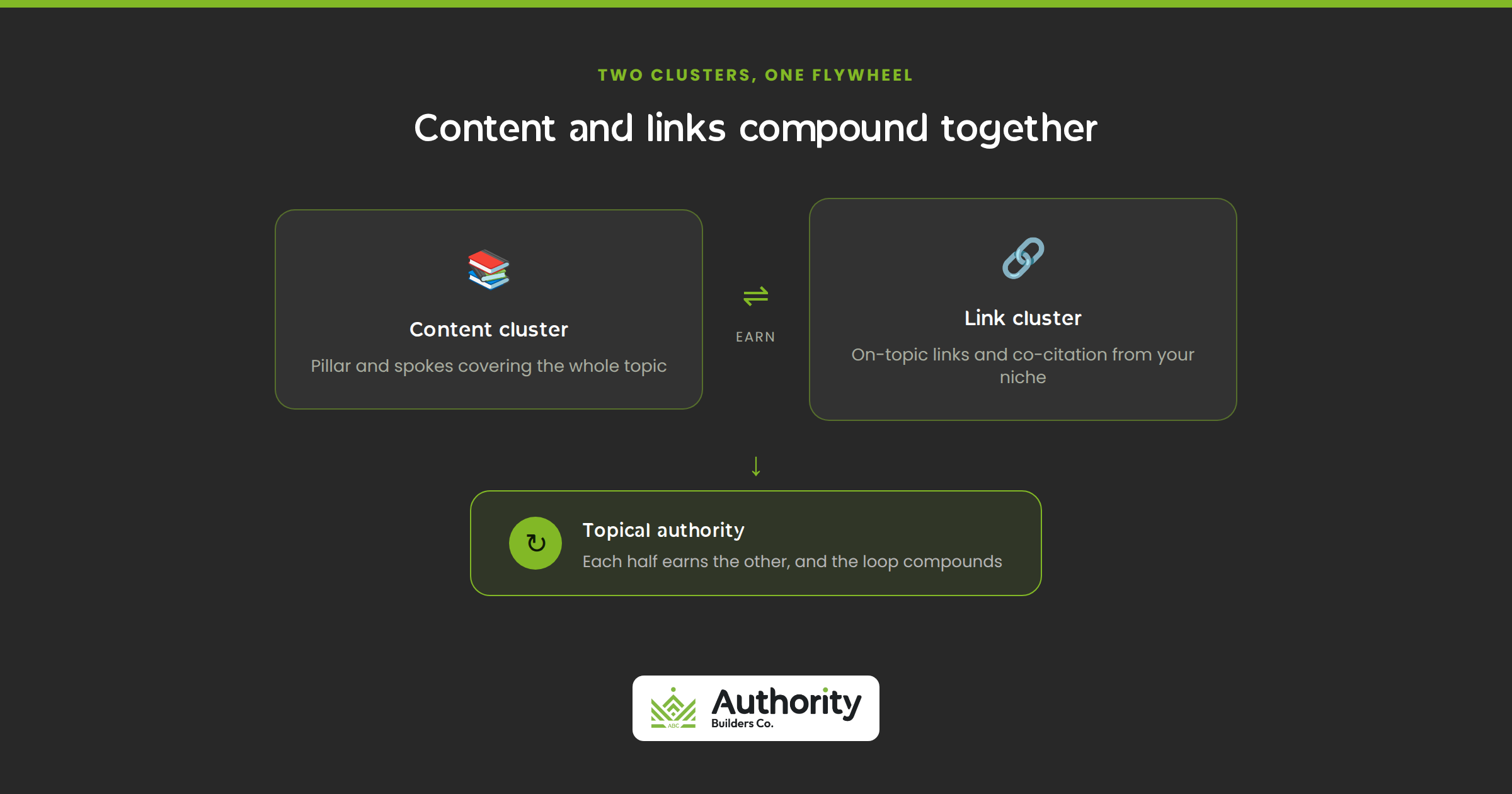
Content and links aren’t two separate projects. They’re two halves of one flywheel, and they feed each other. A deep, well-structured content cluster is what earns links in the first place, because comprehensive pillars become the reference other sites cite when they need to point somewhere authoritative. Those topically relevant links then push the cluster up the rankings and deepen the category association in AI systems. More visibility earns more mentions and more co-citation, which earns more links, and the loop tightens with every turn.
The reverse explains why lopsided efforts stall. Great content with no links stays invisible long enough to feel like a failure. Aggressive link building pointed at thin content builds authority the content can’t cash. The teams that win run both halves in step: publish into the structure, concentrate links on it, measure what moved, and repeat. The compounding is the whole point, and it only happens when both clusters grow together.
Mistakes that dilute topical authority
Most authority problems are self-inflicted. These are the ones we see most:
- Generalist sprawl. Covering ten unrelated topics shallowly. Pick three to seven clusters and go deep. Cross-link only where it helps a reader, so each cluster keeps a clean topic signal.
- Cannibalization and orphans. Several thin pages fighting for the same subtopic, or cluster pages nothing links to. Merge the duplicates and wire the orphans into the structure.
- Chasing DR over relevance. A stack of high-authority links from unrelated sites. Impressive in a tool, weak as a topic signal. Relevance is the lever.
- A thin pillar. A hub that doesn’t truly cover the topic undermines every cluster page hanging off it. The pillar has to earn its place.
- Publishing without structure. Volume of disconnected posts feels productive and compounds into nothing. A structure compounds. A pile decays.
Building topical authority: the playbook
Here’s the sequence we run to build it deliberately rather than hoping it accretes:
- Choose the topic you should own. One where your business has real expertise and can cover the whole subject. Depth requires focus, so resist the urge to claim everything.
- Map the question landscape. List every meaningful question and subtopic in the topic. That map becomes your pillar plus its cluster articles.
- Build the cluster and wire it. Publish the pillar and the spokes, link them both ways, cross-link related spokes, and keep the whole thing cleanly crawlable.
- Concentrate your links. Earn high-authority, topically relevant links to the pillar and best cluster pages, with descriptive anchors. Relevance before raw authority.
- Earn co-citation. Get into the roundups, comparisons, and best-of lists where your category’s authorities already appear.
- Measure your topic share. Track the share of your topic’s traffic and AI citations you own, find the gaps, and fill them. It compounds over 6 to 12 months.
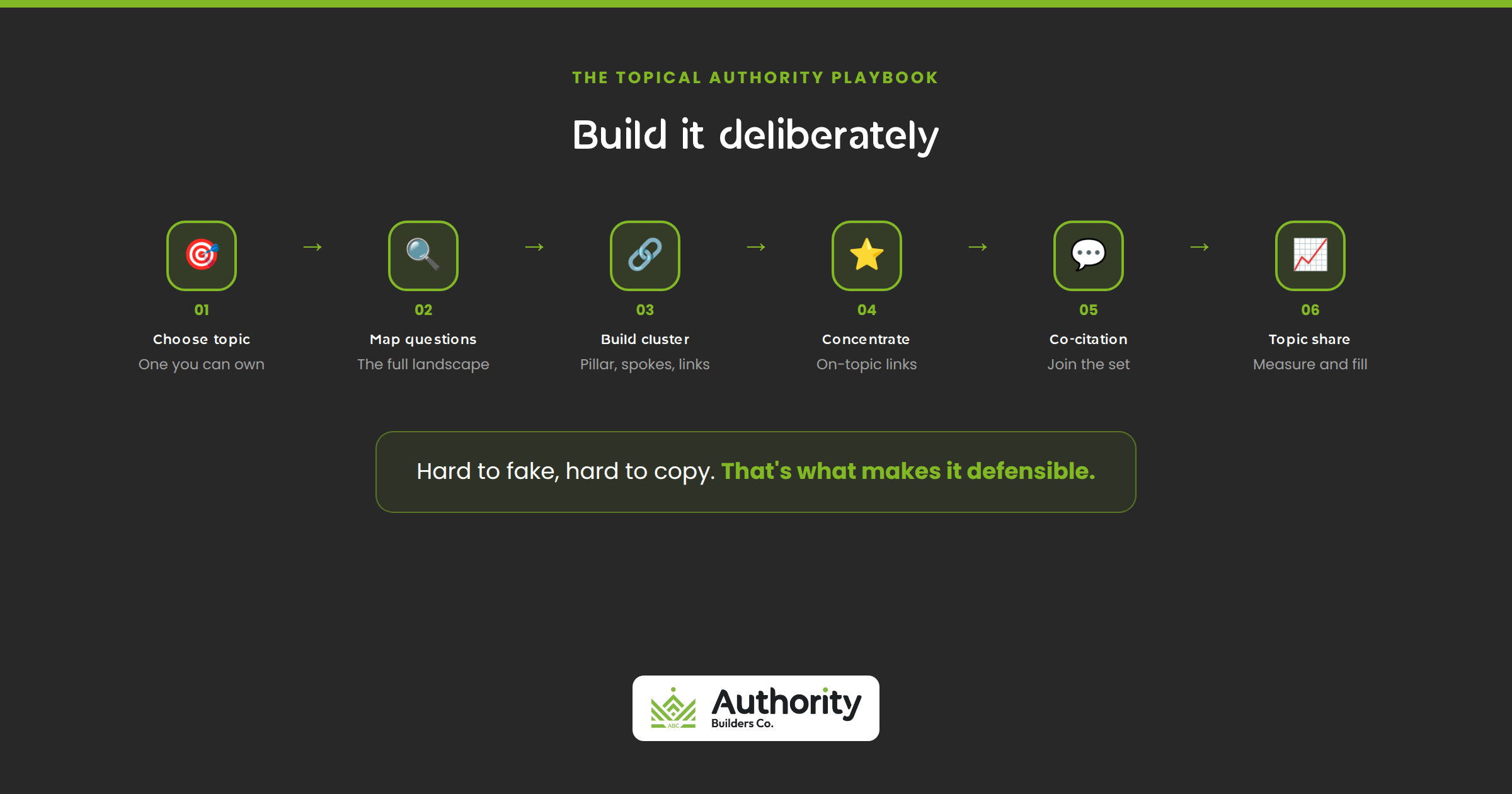
None of this is fast, and that’s a feature rather than a bug. Topical authority is hard to fake and hard for a competitor to copy overnight, which is exactly why it holds. A rival can outspend you on a single campaign, but they can’t shortcut a year or two of concentrated content and relevant links that have taught every engine you’re the expert. The slow-compounding asset is the defensible one, and it keeps paying off long after a one-time push would have faded.
Build authority AI recognizes
Topical authority is the durable version of SEO. A content cluster and a link cluster that reinforce each other compound while one-off pages decay, and together they make you the source an answer engine names when someone asks about your category.
Our High-Authority Links service is built to do the link half right: topically relevant, high-authority placements pointed at your cluster, not domain rating collected for its own sake. Pair it with our SEO Blogs service to build the content cluster that earns those links in the first place, and the two halves start compounding together.
Want to know which topic you’re closest to owning, and what it would take to get there? Book a call and we’ll map it with you, from the content gaps to the links worth chasing first.