
Nobody browses for a lawyer. Somebody searching “personal injury attorney near me” at 11pm has a police report on the kitchen table and a deadline they only half understand. Somebody searching “how to file for divorce in Texas” is in the worst week of their year. These are not casual queries, and Google treats them accordingly.
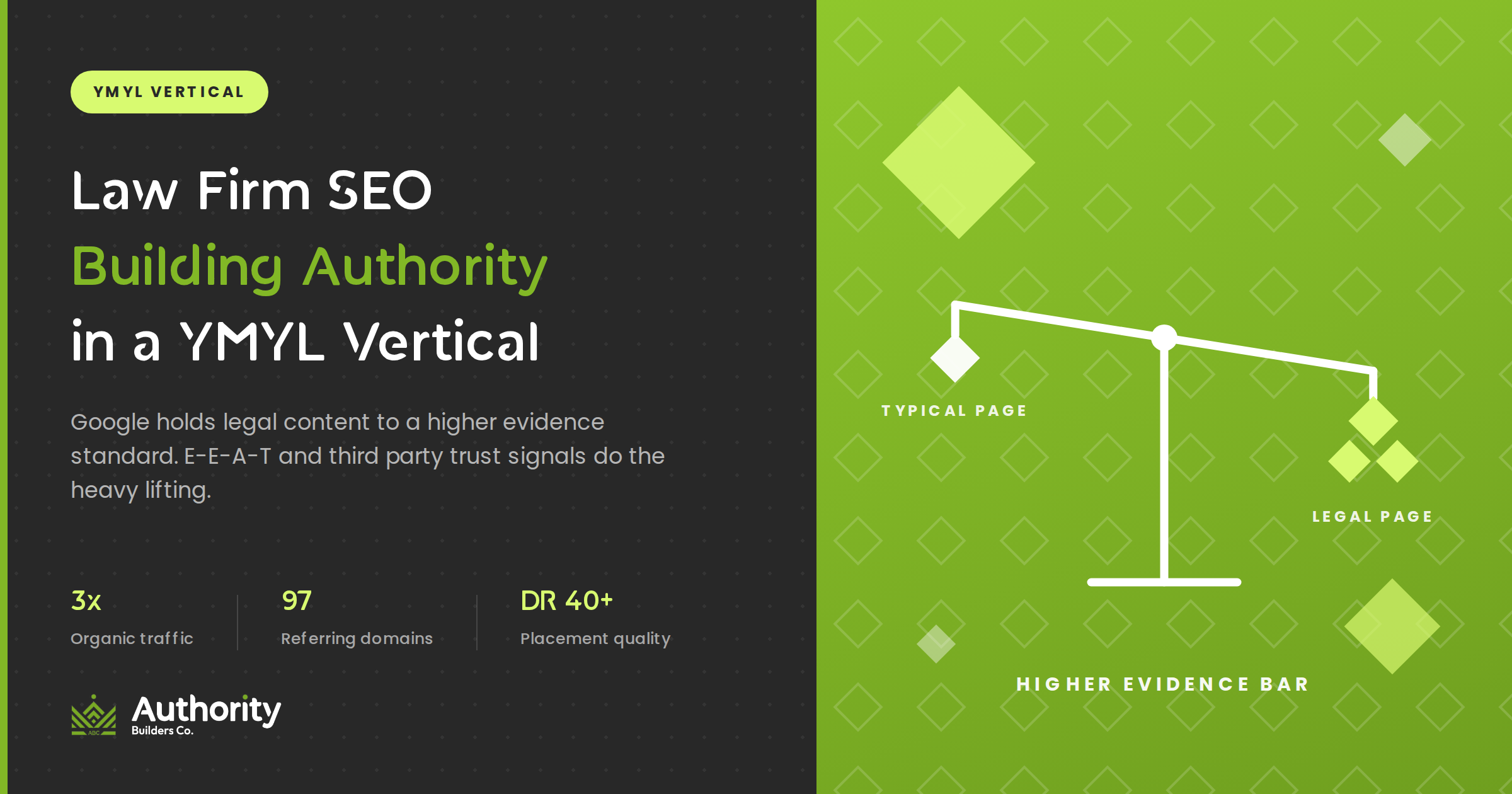
Legal search falls under what Google calls Your Money or Your Life content, the category where bad information causes real damage to somebody’s finances, health, or legal standing. That classification changes the rules. Firms in this space are held to a higher evidence standard than a recipe blog or a gear review site, and the gap between firms that clear that bar and firms that do not keeps getting wider.
Here’s the thing: most law firm SEO advice still reads like it was written for a plumbing company. Add some city pages, get some directory listings, publish a blog post a month. That approach stopped working in legal a while ago, because the vertical is crowded with well funded competitors and because Google applies extra scrutiny to who is allowed to give advice about a court case.
This guide covers what works now. We’ll walk through the trust signals Google weighs in a regulated vertical, where those signals come from, how local search fits in, and how the same foundation gets your firm cited in AI answers. Let’s break it down.
Why Legal Search Gets Judged Differently
Google’s Search Quality Evaluator Guidelines single out legal advice as a YMYL topic alongside medical and financial content. Human raters are instructed to look for signals that the source is qualified to speak, and those ratings feed back into how Google tunes its ranking systems.
In practice, that means three things for your firm.
- The bar for content quality is higher. A thin 600 word page on “what is comparative negligence” will not compete with a 2,000 word explainer written and signed by a licensed attorney who handles those cases.
- Anonymous content struggles. Legal pages without a named author, bar credentials, or a linked bio face an uphill climb against firms that publish that information clearly.
- Reputation carries more weight. What third parties say about your firm counts more heavily in YMYL categories than in low stakes verticals. Off-site signals do a lot of the work.
There’s a second layer that most verticals don’t deal with: state bar advertising rules. Every claim on your site has to survive both Google’s scrutiny and your state bar’s. We’ll get to how to handle that without gutting your copy.
What E-E-A-T Means When You Are a Law Firm
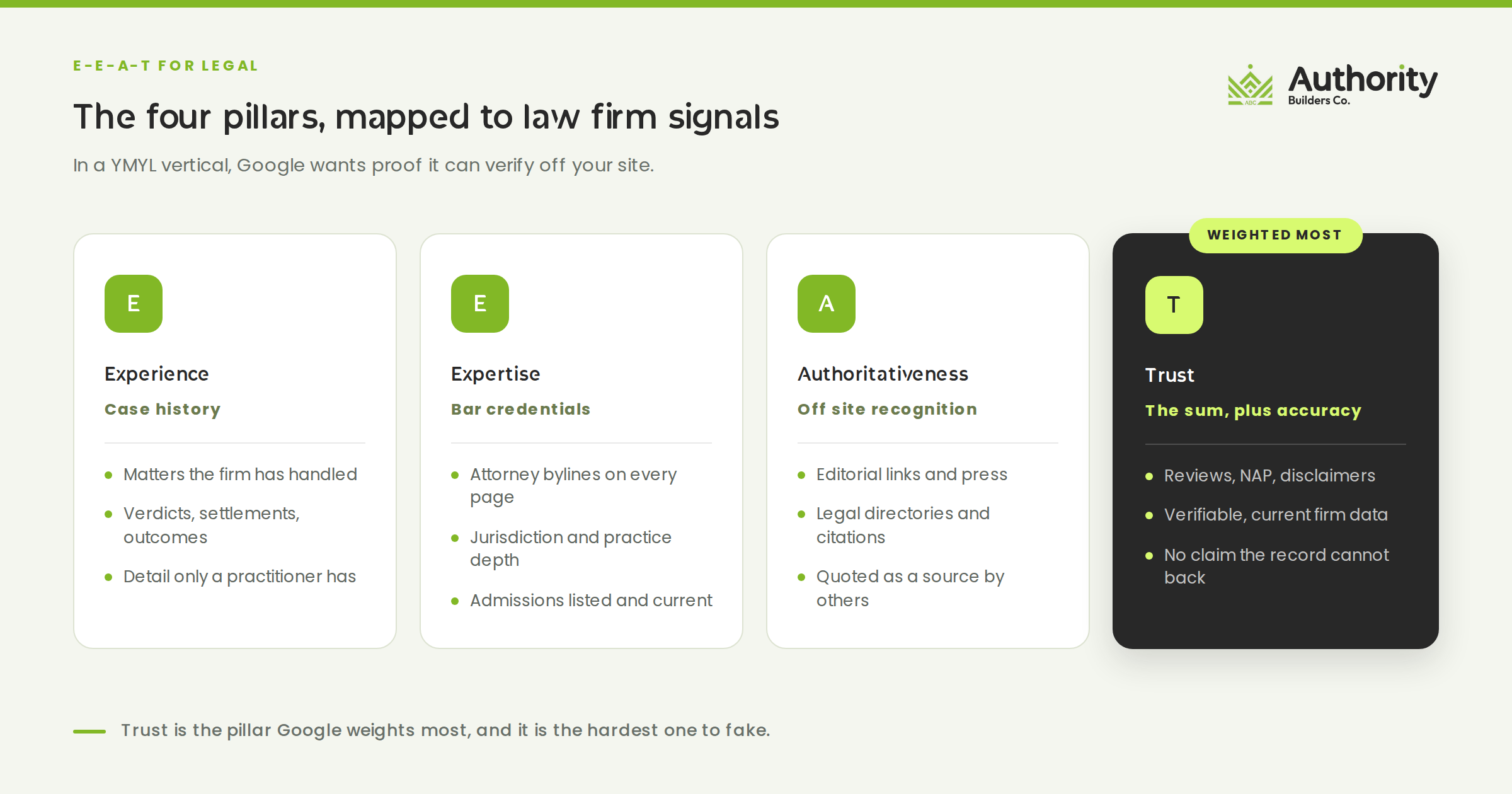
E-E-A-T stands for Experience, Expertise, Authoritativeness, and Trust. It is not a ranking factor you can toggle on, it is a framework Google uses to describe what its systems are trying to approximate. Google’s own documentation on creating helpful, reliable, people-first content spells out the self-assessment questions behind it. For a law firm, each letter maps to something concrete.
Experience
First-hand involvement with the thing you are writing about. For a firm, that’s case history. A page about wrongful termination claims written by an employment attorney who has litigated forty of them should read differently from one assembled off other blogs, and it should say so.
Concrete ways to show it: reference case types you have handled, describe procedural realities that only somebody who has been in that courtroom would know, and include verdict or settlement information where your bar rules allow it.
Expertise
Formal qualification. Every substantive page on a legal site should carry an author byline linking to a full bio that lists bar admissions, jurisdictions, practice focus, and years in the field. If a non-attorney marketer wrote the draft, have an attorney review it and credit them as the reviewer with a visible date.
This is one of the cheapest wins available in legal SEO and one of the most commonly skipped. Firms will spend thousands on content and then publish it under “Admin.”
Authoritativeness
Recognition from outside your own website. Bar association profiles, legal directory listings with substance behind them, speaking engagements, published articles in legal trade press, quotes in news coverage of cases in your practice area. This is the letter most firms underinvest in, and it is the one that separates page one from page three.
Trust
The one Google has said matters most. Trust is the sum of everything above plus the practical stuff: accurate contact details, a physical office address that matches your listings, clear fee structures, a real privacy policy, secure hosting, and a review profile that looks like it belongs to a functioning business.
Trust is also where technical problems bite hardest. A legal site with mixed content warnings, broken forms, or a two second delay before the phone number renders is leaking conversions and credibility at the same time. A technical SEO audit is worth running before you spend anything on content or links, because those two investments compound on a broken foundation about as well as they compound on nothing.
Trust Is Built Off Your Site, Not On It
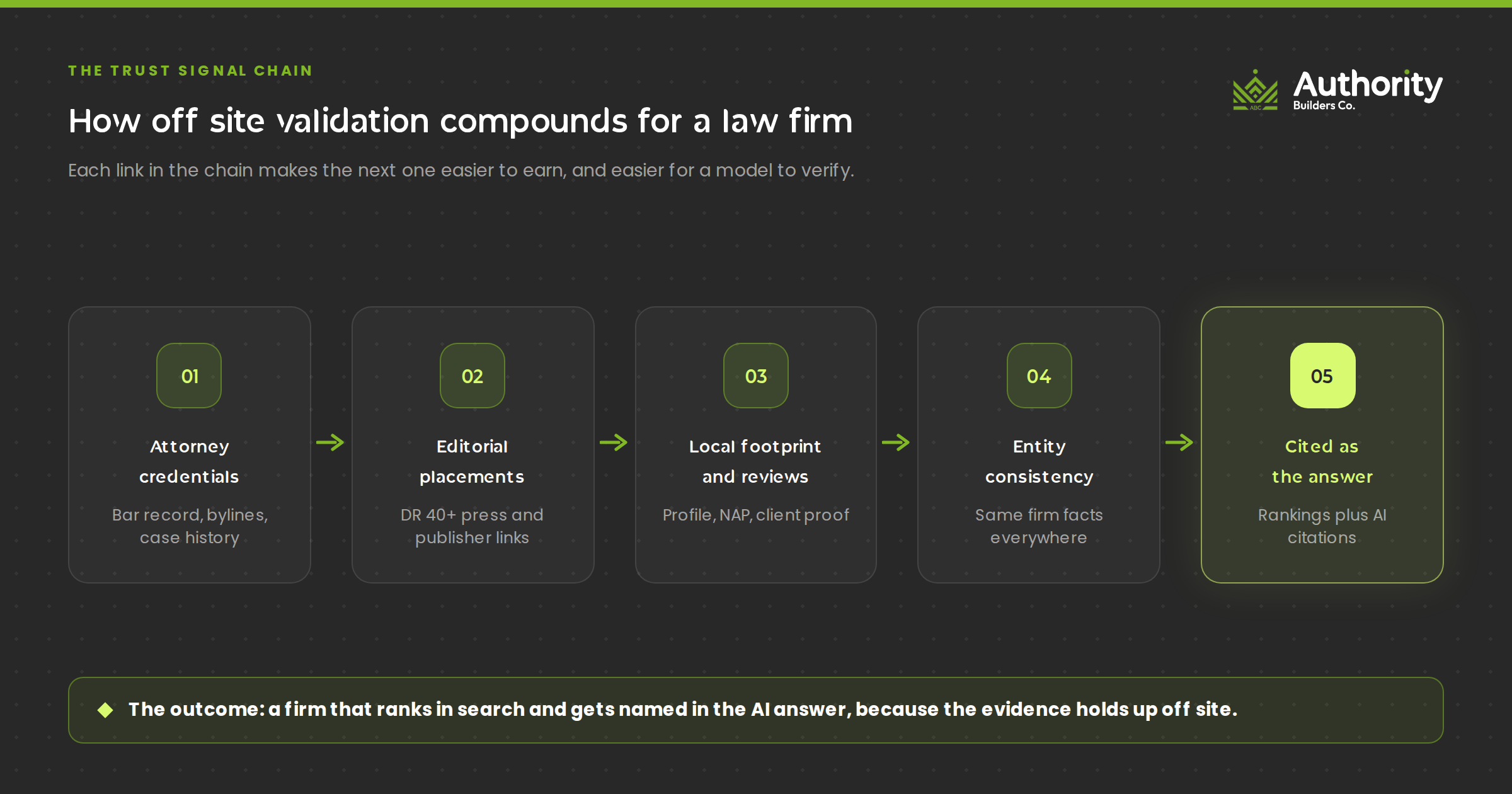
You can write anything you want on your own website. Google knows that, which is why it weighs what other credible sources say about you far more heavily than what you say about yourself.
The rater guidelines are blunt about this. Raters are told to be skeptical of the claims a site makes about itself, to go looking for independent reviews, news coverage, and expert references instead, and to judge reputation in YMYL categories by what experts in that field say. Your About page is not evidence. A bar association profile, a trade publication byline, and a news quote are.
This is the part where legal SEO becomes a link and PR problem rather than a content problem. Your competitors have the same practice area pages you do. What they may not have is coverage in legal trade publications, citations from bar association resources, or links from local news outlets that covered a case they won.
The link profile a legal site should be building
- Legal directories with editorial standards. The ones that vet admissions and disciplinary history carry weight. Pay-to-list aggregators with no vetting carry almost none.
- Local news and regional business press. A quote in a story about a local ordinance, a verdict write-up, or a community sponsorship page all build the local plus authoritative combination that legal search rewards.
- Legal trade and industry publications. Bylined articles in publications your peers read signal expertise to both readers and search systems.
- Universities, nonprofits, and civic organizations. Clinic partnerships, pro bono work, and scholarship pages produce links from domains that are hard to replicate.
- Topically relevant editorial placements. Coverage on sites about small business compliance, workplace safety, insurance, or family services depending on your practice areas.
What should not be in the mix: private blog networks, bulk link packages, comment links, and anything sold by volume rather than by placement. In a YMYL vertical, a manual action is a business-threatening event, and legal is a category Google’s spam teams watch closely.
We covered the tactical side of this in depth in our guide to law firm link building strategies, which walks through outreach angles, directory selection, and what to look for in a placement before you commit to it.
For firms that want the placement work handled, our High-Authority Links service targets vetted sites with real traffic and editorial standards, and ABC Plus bundles ongoing placements with the content to support them.
Earned coverage is the other half. Our Press Authority and Digital PR services exist to put firms into the publications that carry weight with both search engines and the AI systems now summarizing legal queries, and Earned Media focuses on the editorial placements that are hardest to buy and most valuable to hold.
Local SEO: Where Most Legal Traffic Is Won
The majority of high-intent legal searches carry local intent, whether or not the searcher types a city name. Google infers location and serves a local pack above the organic results. If your firm is not in that pack, you are competing for the leftovers.
Google Business Profile
Your profile is the single highest-leverage asset in local legal search. Get these right:
- Categories. Set a specific primary category that matches your dominant practice area, then add secondary categories for the others. “Personal injury attorney” and “law firm” are different categories and they surface for different queries.
- Service areas and location. If you meet clients at your office, list the address. Verify that the address on your profile matches the one on your website footer and every directory listing character for character.
- Hours, including after hours. Legal emergencies do not respect business hours. If you have a 24 hour answering service, your profile should reflect it.
- Photos of the actual office and the actual attorneys. Stock images of a gavel help nobody and signal a firm that has not invested in its own presence.
- Q&A and Posts. Seed the Q&A section with the questions clients ask on intake calls and answer them properly. Post case updates, community involvement, and practice area explainers on a regular cadence.
Citations and NAP consistency
Name, address, and phone number consistency across the web is dull work that quietly determines whether Google trusts your location data. Firms that have moved offices, changed names after a partner departure, or run multiple office locations tend to have a trail of stale listings undermining them.
Auditing and cleaning that trail is a one-time project with a long tail of benefit, and our Citations service handles the manual build and cleanup across the directories that matter for legal.
If you run more than one office, each location needs its own profile, its own landing page with unique content, and its own citation set. Duplicating your main location page and swapping the city name is the most common way multi-office firms cap their own local visibility.
Reviews
Legal reviews are complicated. Some clients will not want to be publicly associated with their matter, and bar rules restrict what you can say in response. Neither of those is a reason to skip review generation, they are reasons to build a compliant process.
Ask every satisfied client at case closure. Never respond to a negative review with case details, because confidentiality obligations do not lift because somebody criticized you in public. Respond with a short, professional note that invites the conversation offline. Our Review and Reputation service is built for exactly this kind of regulated review environment.
Volume, recency, and response rate all feed local ranking. A firm with 140 reviews averaging 4.7 and a reply on every one will outperform a firm with 12 reviews averaging 5.0 in almost every local pack.
For firms that want the full local footprint handled as one program, our Local SEO service covers profile optimization, citation building, review workflows, and the location page architecture underneath it.
Practice Area Pages That Do Real Work
Practice area pages are the commercial core of a legal site. They are also where most firms publish 400 words of generic copy and wonder why nothing ranks.
A practice area page that competes needs to answer the questions a person in that situation is already asking. For a car accident page, that means statute of limitations in your state, how fault is determined, what to do about the insurance adjuster who has already called, what the process looks like week by week, and what it costs to hire you.
Structure that content so it is easy to scan and easy to extract:
- One page per practice area, not one page per keyword variation
- A clear H1 naming the practice area and the jurisdiction
- Question-formatted H2s that mirror how people ask
- Short answers directly under each heading, detail below
- An attorney byline with credentials and a review date
- FAQ schema and Attorney or LegalService structured data
- Internal links to related practice areas and supporting blog content
The supporting blog content matters more than firms expect. A practice area page ranks better when it sits at the center of a cluster of articles that cover the topic from every angle and link back to it. Our SEO blog writing services build those clusters with attorney-reviewable drafts rather than generic filler.
If you handle family matters, our guide to SEO for family law goes deeper on the intake dynamics and search behavior specific to that practice area.
Getting Cited in AI Search Results
A growing share of legal research now starts in an AI assistant rather than a search box. Somebody asks ChatGPT what their options are after a workplace injury, gets a summary with two or three firms or sources named, and clicks through already knowing what they want.
That referral is worth more than a blue link. The person arrives having been told by a system they trust that you are a credible answer. But getting named requires different work than ranking.
What AI systems weigh
Large language models reason through language rather than crawling a link graph in real time. When they decide which sources to reference, they lean on patterns of corroboration: is this entity mentioned consistently across credible publications, does the coverage agree on what the firm does, is the source of the claim something an editor stood behind.
That makes editorial coverage and brand mentions the currency of AI visibility. We broke down the mechanics in why link quality matters more than ever for AEO, and the short version is that a handful of placements in publications with real editorial standards move the needle more than a hundred low-grade links.
Structuring legal content for extraction
- Answer first. Put a two or three sentence direct answer immediately under each question heading, then expand. Extraction systems pull the first clear answer they find.
- Be specific about jurisdiction. “In Florida, the statute of limitations for most negligence claims is two years from the date of injury” is citable. “Deadlines vary by state” is not.
- Date and attribute everything. Legal rules change. A visible last-reviewed date and a named attorney reviewer make your page a safer source for a system that has to decide whether to trust it.
- Use structured data properly. FAQPage, Attorney, and LegalService markup give machines an unambiguous read on what your page covers and who stands behind it.
- Keep entity information consistent. Firm name, founding date, attorney names, and locations should read identically across your site, your profiles, and any coverage you place.
For firms that want AI visibility managed as a program alongside traditional rankings, our AI Plus service tracks citation share across the major assistants and builds the authority signals that drive it.
Working Inside Bar Advertising Rules
Every state bar regulates attorney advertising, and websites count as advertising. Most state rules are modeled on the American Bar Association’s framework, and ABA Model Rule 7.1 is the one to know: it prohibits false or misleading communications about a lawyer or their services, including omissions that make an otherwise accurate statement misleading as a whole. Your state’s version is the one that binds you, but the themes are consistent enough to plan around.
- Avoid unverifiable superlatives. “Best divorce lawyer in Chicago” is a compliance problem in most jurisdictions. “Over 300 custody matters resolved since 2011” is a factual claim you can support.
- Handle results carefully. Many states require a disclaimer that past results do not guarantee future outcomes, and some restrict what settlement figures you can publish at all.
- Watch specialization language. Calling yourself a specialist or expert is restricted in many states unless you hold a recognized certification, and ABA Model Rule 7.2 requires that the certifying organization be named in the communication. “Focused on” and “practice concentrated in” are usually safe alternatives.
- Include required disclosures. Some states require the name of a responsible attorney and an office address on advertising materials, which includes your site.
- Testimonials have rules too. A number of jurisdictions restrict client testimonials or require specific disclaimers alongside them.
None of this needs to make your copy weak. Specific, verifiable claims tend to convert better than superlatives anyway, and they hold up better against Google’s scrutiny at the same time. Run your practice area pages and any results content past whoever handles compliance at your firm before publication, and build that review into your content calendar rather than treating it as a bottleneck.
What This Looks Like in Practice
We ran this playbook for a client operating in the law and accounting space in Australia, a market where a handful of well established firms compete for the same terms and differentiation is hard to come by.
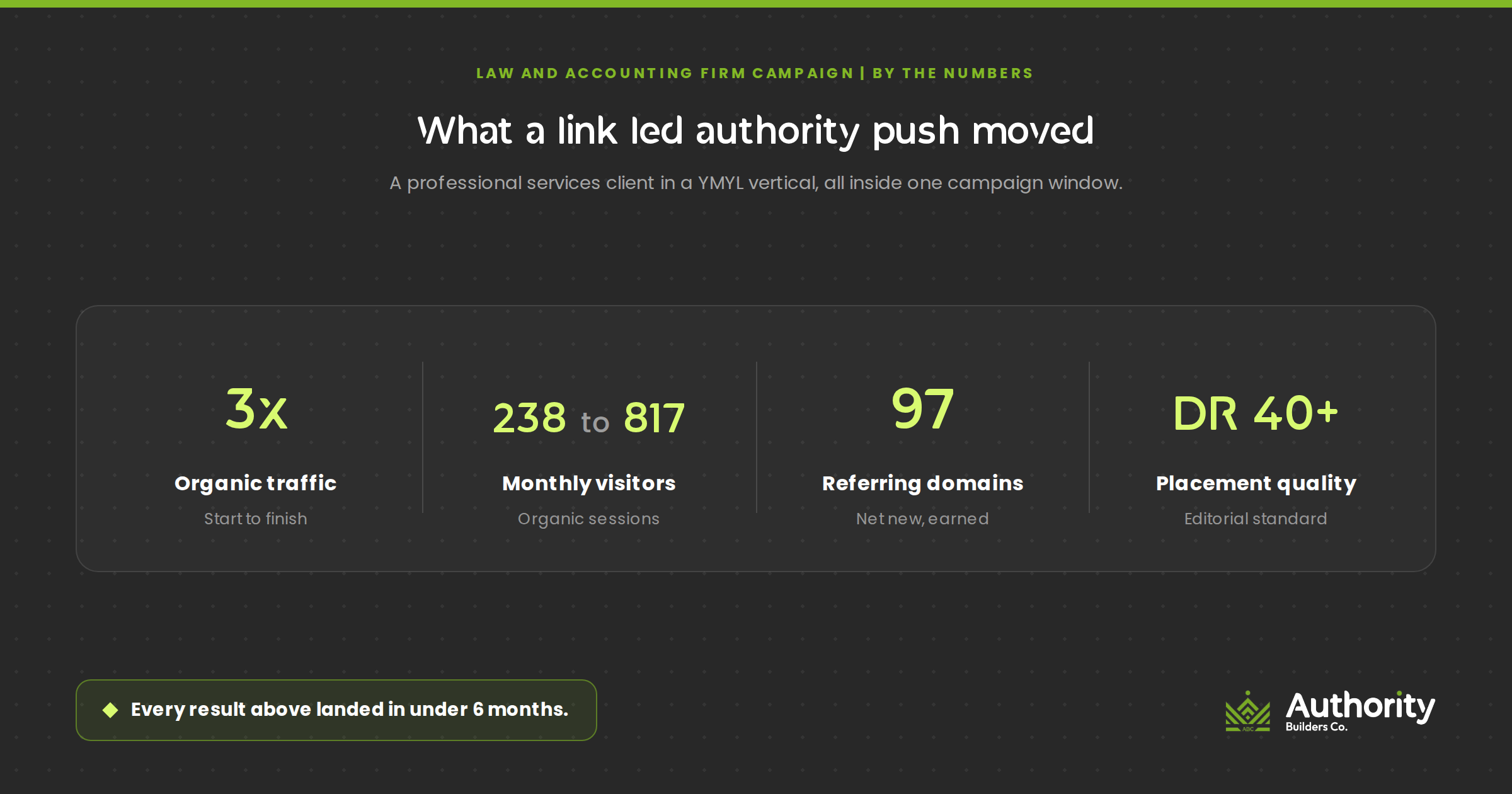
The starting position was modest. The firm was pulling roughly 238 organic visitors a month. We recommended a six month ABC Plus campaign built around DR 40+ placements on sites that were relevant to the law and accounting niche rather than broadly adjacent, paired with a keyword strategy that went after winnable terms first to build momentum.
In under six months:
- Organic traffic tripled, from 238 to 817 monthly visitors
- 97 referring domains were added to the firm’s backlink profile
- Rankings expanded into competitive law and accounting terms, including local variations that drove qualified regional traffic
The pattern is worth noting. We did not start by chasing the highest-volume head term. We built authority through relevant placements, captured the accessible keywords first, and used the resulting domain strength to make the harder terms winnable. You can read the full breakdown in the law and accounting firm case study.
The other proof point is our own site. Authority Builders grew generative AI traffic 784% across ChatGPT, Perplexity, Gemini, and Claude over a comparable period, using the same foundation: consistent editorial placements, content velocity, and a coherent brand entity. Traditional organic declined during that window while AI referrals climbed, which tells you where attention is moving.
Your First 90 Days
If you are starting from a site that has never had a real SEO program, here is the order of operations we would run.
Days 1 to 30: Foundation
- Run a technical audit and fix anything blocking indexation, slowing page load, or breaking forms
- Claim and fully build out your Google Business Profile for every office location
- Audit NAP consistency across existing listings and correct every mismatch
- Add attorney bylines, credentials, and review dates to every substantive page
- Implement Attorney, LegalService, and FAQPage structured data
Days 31 to 60: Content
- Rewrite your top three practice area pages to the depth standard described above
- Build out attorney bio pages with bar admissions, case types, and publications
- Publish supporting articles that answer the questions your intake team fields most often
- Set up a compliance review step in your publishing workflow
- Start a review generation process at case closure
Days 61 to 90: Authority
- Begin outreach for legal directory placements with real editorial vetting
- Pitch bylined articles to legal trade publications in your practice areas
- Identify local news angles: verdicts, community involvement, commentary on local legal developments
- Launch a consistent placement program rather than a one-time push
- Establish baseline tracking for both organic rankings and AI citation share
Ninety days will not put a new firm at the top of a competitive metro market. What it will do is remove every reason Google has to distrust you and start the compounding process that gets you there. Legal SEO rewards patience and punishes shortcuts more than almost any other vertical.
Where Authority Builders Fits In
Most firms can handle the on-site work themselves or with their existing web developer. The part that stalls is authority, because it requires relationships with publishers, editorial judgment about which placements are worth having, and a consistent cadence that nobody inside a busy practice has time to maintain.
That is the layer we handle. Our Local SEO program covers the profile, citation, and review foundation that legal search runs on. High-Authority Links and ABC Plus build the off-site credibility that YMYL rankings depend on. Press Authority and Earned Media place your attorneys in the publications that carry weight with editors, search engines, and AI systems alike.
Every placement is vetted for real traffic, editorial standards, and topical relevance before it goes into a campaign, which matters more in a regulated vertical than anywhere else.
The Short Version
Law firm SEO is a trust exercise wearing a marketing costume. Google is trying to figure out whether your firm is a credible answer to a question with real consequences, and it makes that determination mostly from evidence that lives outside your website.
Get the foundation clean, publish content that a licensed attorney would put their name on, own your local footprint, and then invest steadily in the third-party validation that no competitor can copy overnight. That same foundation is what gets you named when somebody asks an AI assistant who to call.
If you want a read on where your firm currently stands and what the gap looks like against the firms outranking you, schedule a call with our team and we will walk through it with you.