
HARO Link Building in 2026: HARO Is Back, and It Still Won’t Carry Your Links
Corey Batt
If you searched for HARO link building in the last two years, you got three different answers depending on the date of the article. HARO is dead. HARO is back. HARO was never HARO, it was Connectively, and that’s dead too.
Here’s the thing: all three were true at some point, and most of the advice built on them is now stale. So we’re going to do two things in this post. First, we’ll lay out exactly what happened to HARO and what’s live today, with dates and sources. Second, we’ll show you why the old HARO link building playbook doesn’t produce what it used to, and how to build a journalist link program that doesn’t depend on winning an inbox lottery three times a day.
This is a long one. It’s meant to be the last HARO explainer you need for a while.
What Happened to HARO (the Verified Timeline)
Let’s get the facts straight before anything else, because half the posts ranking for this topic get them wrong.
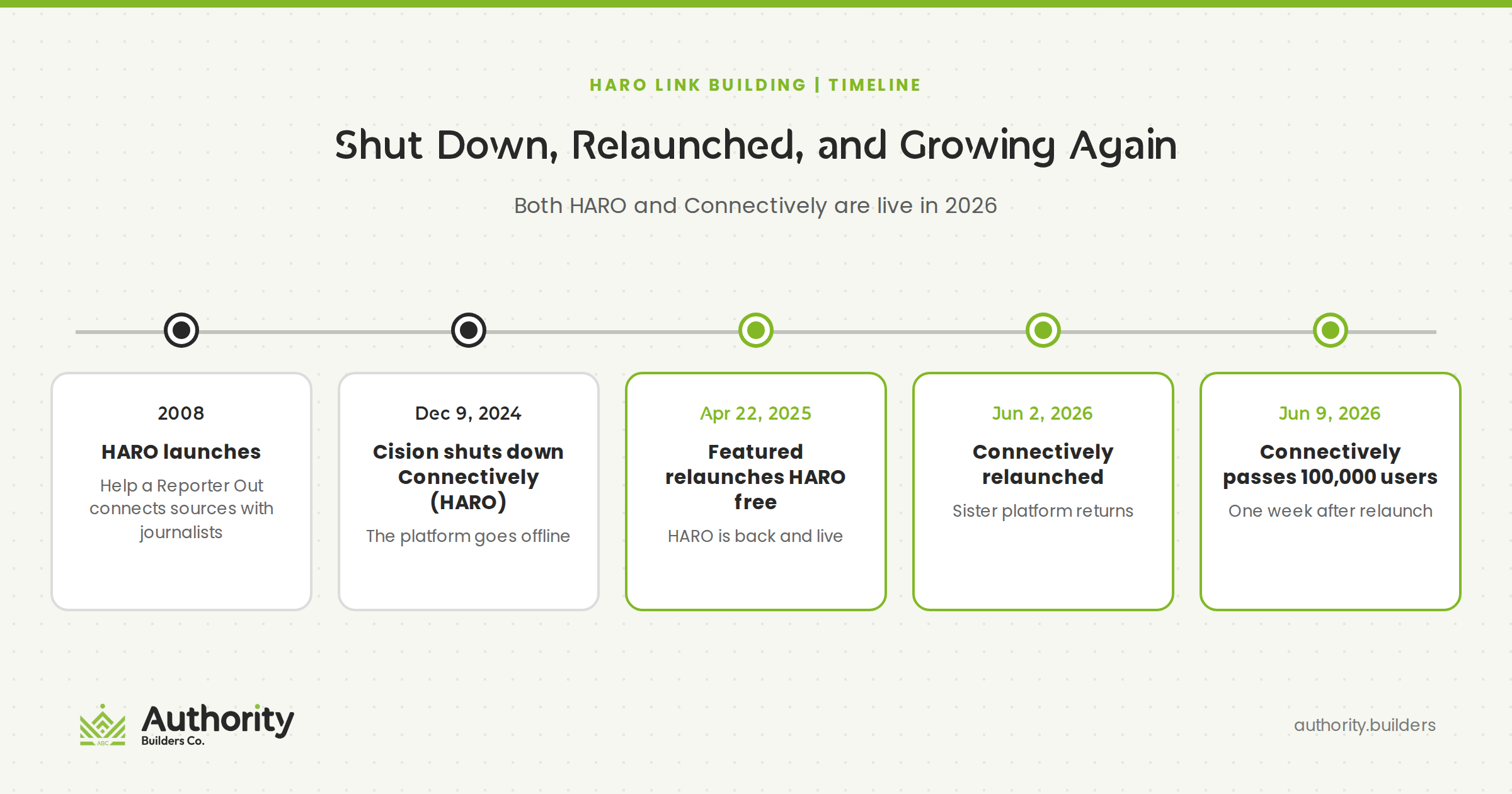
- 2008: Peter Shankman launches Help a Reporter Out as a Facebook group, then an email list. Journalists post queries, sources reply, everyone gets something.
- 2010 to 2014: Vocus buys HARO, then Cision merges with Vocus. HARO becomes a Cision brand.
- 2024: Cision rebrands HARO as Connectively and moves it toward a paid platform model. Longtime users push back on the change.
- December 9, 2024: Cision permanently discontinues Connectively. Cision’s own discontinuation notice says the company chose to focus its effort on CisionOne instead.
- April 2025: Featured.com acquires the HARO brand from Cision. HARO’s relaunch announcement confirms the service returned as a free email newsletter, with the first digests going out on April 22, 2025.
- June 2, 2026: Featured revives the Connectively name as well, this time as its platform product sitting alongside the HARO newsletter. HARO’s own post on the Connectively revival describes it as a sister brand with filtering, tracking, and a dashboard for people who want more than an inbox.
- June 9, 2026: Featured announces that Connectively has passed 100,000 users, and that HARO serves a community of more than 800,000 sources and 75,000 journalists.
So as of today, both HARO and Connectively are live, both are owned by Featured, and HARO is free. If you read a post telling you HARO is gone and you need to find a replacement, check the publish date. It’s probably from late 2024 or early 2025.
That’s the good news. The rest of this post is about why the return of the tool doesn’t mean the return of the easy links.
What HARO Link Building Looks Like Now
The mechanics haven’t changed much from the original model, which is the point of the relaunch. You sign up with an email address at helpareporter.com. Three times a day you get a digest of journalist queries grouped by category. When a query matches what you know, you reply with your answer, your credentials, and a link to your site. If the journalist uses your response, you usually get a mention, and often a link.
What has changed is the filtering on both sides:
- AI detection on pitches. HARO runs submissions through AI detection and flags responses that are entirely machine-written. Journalists can choose to filter those out before they ever see them.
- Query approval. Journalist requests are reviewed before they go out. According to HARO’s 2026 data on 100 million emails, about 32% of journalist requests are rejected during that review.
- Bans. The same data set reports one user banned roughly every 23 minutes, mostly for spam and terms-of-service violations.
- Two products, one owner. If you want a newsletter, that’s HARO. If you want a platform with filters and response tracking, that’s Connectively. Same query pool behind both.
In other words, the free channel is open again, and it’s cleaner than the version that collapsed in 2024. That’s real. It just doesn’t solve the underlying problem, which is competition.
Why HARO Alone Won’t Carry a Link Program
We’ve run journalist sourcing for clients for years, and we’d still recommend HARO as one input. We wouldn’t build a link target around it. Here’s why, using the platform’s own numbers and the most recent journalist survey data.
1. The inbox is flooded, and most of it is AI
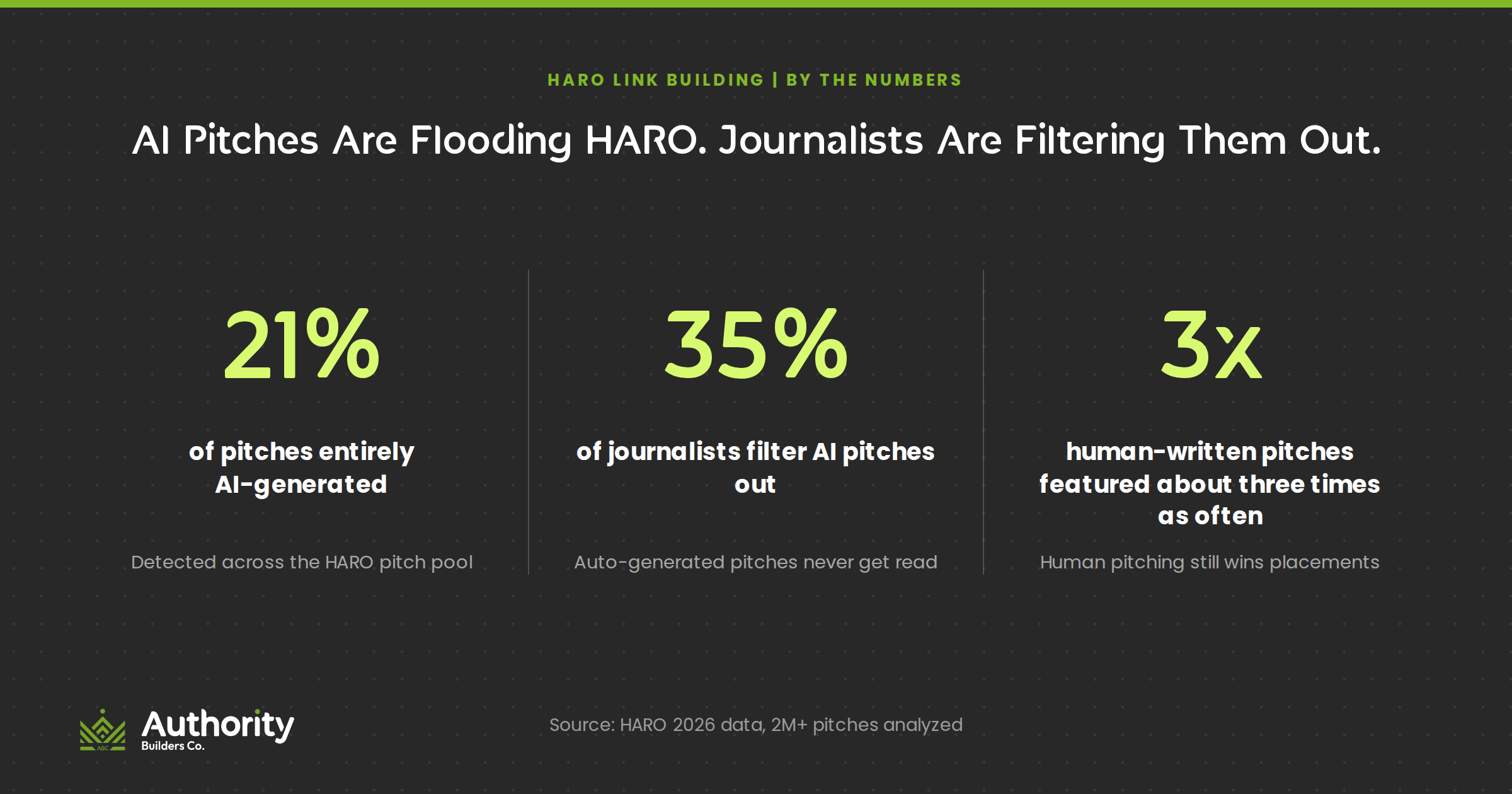
HARO’s 2026 analysis covered more than 2 million pitches. Of those, 21% were flagged as entirely AI-generated, and 35% of journalists now filter AI-flagged responses out when they post a request. Human-written pitches were roughly three times more likely to get featured than AI-written ones.
That tells you two things. The volume problem that killed the original HARO is still there, and the platform is now actively sorting for it. If your process for HARO link building is a template and a prompt, you’re competing in the pile that gets filtered.
2. Journalists delete most of what they get
The Muck Rack State of Journalism 2026 report, based on roughly 900 journalist responses collected earlier this year, found that 86% of journalists say at least some of their stories started with a PR pitch. That’s the encouraging half. The other half: 88% say they immediately disregard pitches that miss their beat, and nearly half say they seldom receive pitches that match their coverage at all.
The journalists are not the bottleneck. Relevance is. A HARO query gets dozens of replies, and the reporter is scanning for the one that answers exactly what they asked.
3. You don’t control where the link goes, or whether there is one
When a HARO pitch lands, the journalist decides the outlet, the placement, the anchor text (almost always your brand name), and whether to link at all. Plenty of features are unlinked mentions. That’s fine for authority and brand signals. It’s not fine if your quarterly plan says “12 links from DR 50+ sites” and the channel can’t promise any specific number.
4. The time cost is real
Three digests a day, every weekday, read in full, with a fast and specific reply to the two or three queries that fit. That’s a standing commitment of several hours a week for someone who can write in your expert’s voice and knows the subject well enough to be specific. Most in-house teams start strong and fade by month two. That’s not a knock on them. It’s the reason managed services exist.
None of this means HARO is a waste. It means HARO is a variable-yield channel, and a link program needs at least one predictable channel underneath it. We’ll get to that.
How to Pitch Journalists in 2026 (What the Data Says Works)
If you’re going to run HARO, Connectively, or any journalist request platform, here’s the process we use. Most of it lines up with what HARO’s data and Muck Rack’s survey both point to: relevance beats volume, and usable beats fast.
- Pick two or three beats and ignore the rest. Only respond where you can give a specific, credentialed answer. Ten relevant pitches outperform a hundred generic ones, and the platform’s ban rate should tell you what happens to the spray-and-pray crowd.
- Keep credentials ready before the query appears. Name, title, company, one-line proof of expertise, headshot link. The winning response is the first great one, not the first one.
- Read the whole request. If the journalist asks three questions, answer three. If they specify a format, use it. If they ask for a particular kind of expert and you aren’t that, skip it.
- Lead with the credential, then the quote. Journalists are looking for something they can paste into a draft. Give them two to four sentences in your own voice that stand on their own, then stop.
- Bring something they can’t get elsewhere. First-hand experience, a number from your own data, a contrarian take you can back up. Generic advice pulled from the query itself is exactly what AI detection is trained on.
- Write it yourself. Use AI to spot relevant queries or organize your workflow if you like. Don’t use it to write the pitch. The 3x placement gap for human-written responses is the single clearest finding in HARO’s data.
- Don’t ask for the link. Include your URL in your signature and let the journalist decide. Asking for a dofollow link in a pitch is the fastest way to get filtered.
- Track everything. Query, date, outlet, response, outcome. After 60 days you’ll know which beats convert and which don’t, and you can cut the losers.
Run this for a quarter and you’ll get placements. You won’t get a predictable number of them, which brings us to the rest of the stack.
The Other Journalist Request Platforms Worth Running
HARO’s relaunch didn’t kill the alternatives that grew up during the gap. A few are worth running in parallel, because query pools only partly overlap and different journalists use different tools.
- Connectively. Same owner as HARO, platform interface instead of email. Filtering by topic and outlet, response tracking, and a dashboard. Worth it if you’re managing pitches for more than one brand or expert.
- Source of Sources (SOS). Started by HARO’s original founder after the Cision shutdown. Source of Sources is a free email digest, up to three times a day, with a strict one-strike policy for off-topic pitches. Smaller pool, cleaner signal.
- Qwoted. A curated request platform with a free tier that picked up a lot of former HARO users in late 2024. More vetting on both sides than the email digests.
- Journalist requests on social. Reporters still post source requests on LinkedIn and X. Muck Rack’s 2026 survey found LinkedIn is the platform journalists trust most, at 58%. Set up saved searches for your beat terms plus “looking for a source” and similar phrasing.
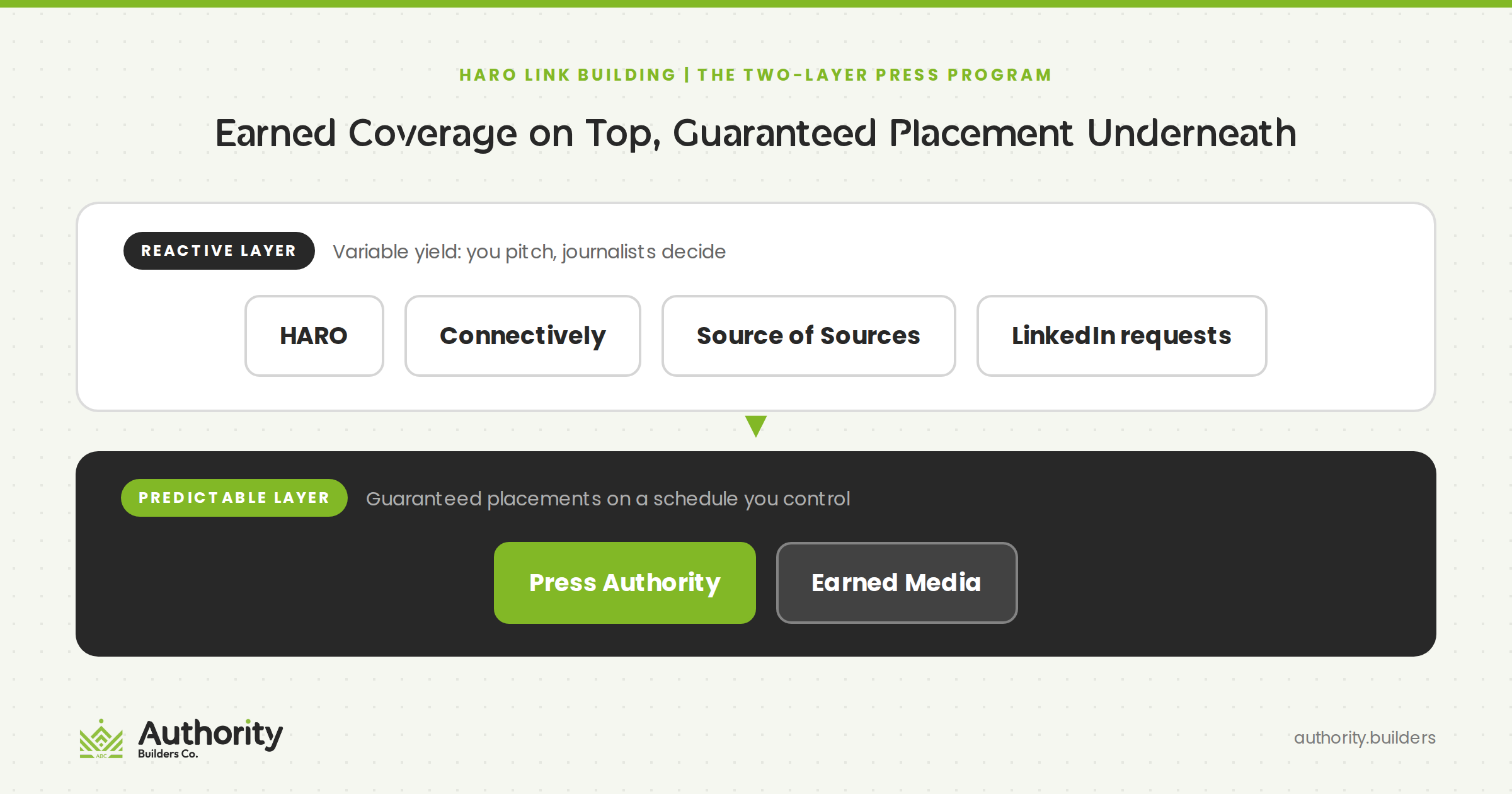
All of these share HARO’s core limitation: they’re reactive. You wait for the right query, then compete for it. That’s why we treat them as the top of the funnel, not the whole funnel.
The Layer HARO Can’t Give You: Predictable Press Placement
Every serious link program we build has two layers. One earns coverage on merit and accepts the variance that comes with it. The other secures presence on established news domains on a schedule you can plan around. HARO and its cousins live in the first layer. Nothing in that layer can do the second job.
For the second layer, this is where Press Authority fits. It’s structured press syndication with guaranteed placement across hundreds of established news sites, with optional tiers for premium publishers. You submit an announcement, choose a tier, approve the copy, and receive a placement report with live URLs, typically within five to seven business days. Placements are brand mentions with contextual links on domains that search engines and AI systems already treat as trusted.
A few things to be clear about, because we’d rather you buy the right product than the wrong one:
- Press Authority is not journalist pitching. There’s no reporter to persuade, no editorial negotiation, and no waiting on pickup. That’s the point. It’s the predictable layer.
- It’s not a substitute for earned coverage. A reporter choosing to cite you in a story carries a different kind of weight than syndicated press. You want both.
- Press links follow Google’s rules like any other link. Google’s spam policies list press releases with optimized anchor text that pass ranking credit as an example of link spam, while separately noting that wire and press release sites are not treated as site reputation abuse. Press Authority placements are built as brand mentions with contextual links for visibility and authority, not as keyword-anchored ranking plays. If a vendor promises you exact-match anchors from a press release, that’s a red flag, not a feature.
If what you want is editorial storytelling that earns organic pickup, and you’re comfortable trading certainty for credibility, Earned Media is the better fit. Each campaign is a single journalist-style story distributed across a large publisher network with a guaranteed pickup floor. And if you want a team pitching real editors on your behalf for individual high-authority placements, that’s Digital PR.
The AEO angle matters here too. AI answer engines pull heavily from the same established news and publisher domains that Google trusts. Consistent, accurate brand mentions across those domains are one of the clearest signals we can influence for both search and AI visibility, and they’re far easier to plan when at least part of the program is guaranteed.
How We’d Structure a Journalist Link Program
If you asked us to set this up for a mid-sized brand starting from zero, here’s roughly what the first quarter looks like.
Month 1: Foundations
- Define two or three beats where your expert can answer with specifics.
- Build the credential kit: bio lines, headshot, proof points, three or four evergreen quotes in the expert’s voice.
- Sign up for HARO, Connectively, and Source of Sources. Set up LinkedIn saved searches.
- Run one Press Authority placement on a real announcement (a launch, a hire, a data release) so the brand has a baseline of trusted-domain mentions before pitching starts.
Month 2: Pitch and Measure
- Respond to every relevant query with a human-written, credentialed answer. Target quality, not count.
- Log every pitch and outcome. Note which beats and query types convert.
- Run an Earned Media campaign on the strongest story angle you have, ideally one built on original data.
Month 3: Cut and Double Down
- Drop the beats that haven’t produced. Add one adjacent beat if a pattern suggests it.
- Put Press Authority on a cadence tied to your announcement calendar, monthly or quarterly.
- Review the mix. If earned placements are landing consistently, keep the ratio. If they aren’t, the predictable layer keeps the program moving while you fix the pitching.
The principle is simple. Reactive channels earn the coverage that money can’t buy. Guaranteed channels make sure the program delivers something every month regardless. Skip either one and you’re either overpaying for links or waiting on luck.
FAQ: HARO Link Building
Is HARO still around in 2026?
Yes. Cision shut down HARO (under the Connectively name) on December 9, 2024. Featured.com acquired the brand and relaunched it as a free email newsletter in April 2025. It’s live at helpareporter.com and sends three query digests a day.
What’s the difference between HARO and Connectively?
Same owner, same query pool, different interface. HARO is the free email digest. Connectively is the platform version with filtering, tracking, and a dashboard, relaunched by Featured on June 2, 2026. Connectively was also the name Cision used for HARO in 2024 before shutting it down, which is why the history gets confusing.
Is HARO free?
The HARO newsletter is free for both journalists and sources, supported by newsletter sponsors. Connectively is the platform product, so check current plans on connectively.us if you want the dashboard features.
Do HARO links help SEO?
Editorial links from established publications are among the most valuable links a site can earn, and HARO placements are editorially given, which keeps them inside Google’s guidelines. The catch is that you don’t control whether you get a link, where it points, or what the anchor text says. Treat HARO as an authority and mention channel first and a link channel second.
How many HARO pitches does it take to get a link?
There’s no reliable ratio, and anyone quoting one is guessing. What HARO’s own 2026 data shows is that human-written, on-topic, fully responsive pitches get featured about three times as often as AI-written ones, and that a small number of relevant pitches outperforms a large number of generic ones.
Are press release links safe for SEO?
Press placements are fine when they’re brand mentions with natural contextual links. Google’s spam policies specifically call out press releases with optimized anchor text that pass ranking credit. Use press syndication for visibility and authority signals on trusted domains, not for keyword anchors.
Should I hire a HARO link building service?
If you have someone who can commit several hours a week and write in your expert’s voice, run it in-house. If you don’t, or you need a number you can plan around, pair light in-house pitching with a guaranteed press layer like Press Authority and an earned layer like Earned Media.
The Bottom Line on HARO Link Building
HARO came back. Connectively came back. The problem they had before they left, too many pitches and not enough relevance, also came back, and the platforms now filter for it aggressively. Running HARO well in 2026 means fewer, better, human-written pitches on beats where you have something specific to say.
That will earn you coverage. It won’t give you a plan. For that, you need a predictable press layer underneath the reactive one. Press Authority gives you guaranteed placement on established news domains on a timeline you control, and Earned Media gives you editorial pickup at scale when you have a story worth telling.
If you want help structuring the whole thing, book a call with our team. We’ll look at your current link profile, your announcement calendar, and where journalist sourcing fits, and we’ll tell you which layer to build first.