
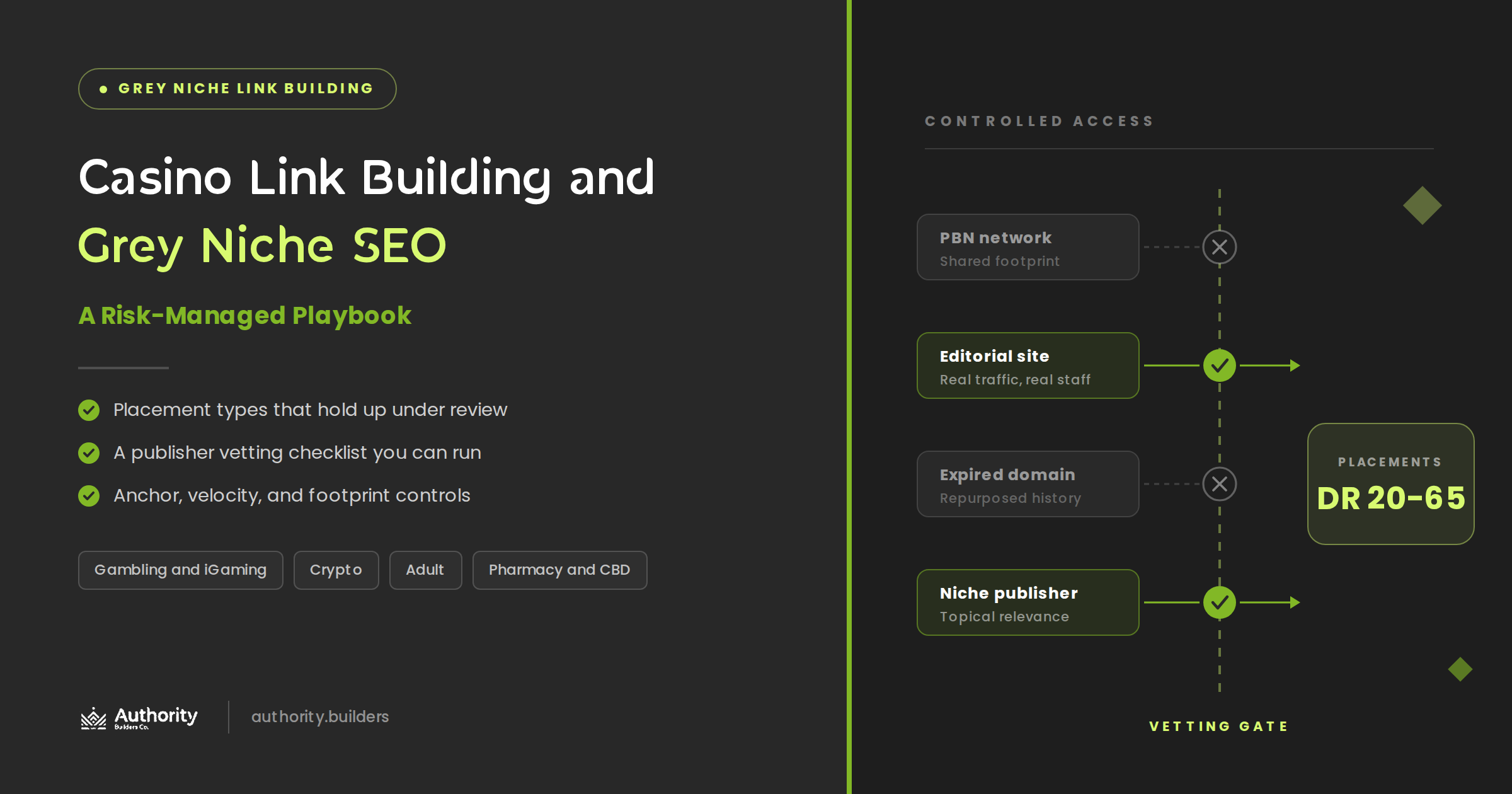
If you run SEO for a casino, a sportsbook, a crypto exchange, a CBD brand, or an adult site, you know the pattern. You try to buy ads and hit a certification wall. You pitch a publisher and never hear back. Then you find a vendor who says yes to everything, takes your money, and six months later your rankings collapse.
Grey niches aren’t harder because Google has a grudge against your industry. They’re harder because the normal acquisition channels are gated, the vendor pool is crowded with people selling footprints instead of links, and the margin for error is thinner than in any other vertical.
We build links in these verticals every month. Below is what holds up, what gets sites burned, and how to tell the two apart before you spend the budget. We’ll cover how Google’s published spam policies describe your industry by name, which placement types still earn real equity, how to manage anchors and velocity so your profile doesn’t read as engineered, and why spam risk now costs you visibility in AI answers on top of rankings.
What Counts as a Grey Niche, and Why the Rules Are Different
A grey niche is a vertical that’s legal, or legal somewhere, but restricted enough that mainstream platforms treat it as a special case. The usual list:
- Gambling and iGaming: online casinos, sportsbooks, poker, bingo, affiliate and comparison sites
- Crypto and Web3: exchanges, wallets, DeFi protocols, token projects
- Adult: content platforms, cam sites, retail
- Pharmacy, supplements, and CBD: anything touching health claims or controlled substances
Payday lending, vaping, and firearms accessories sit in the same bucket. The specifics differ, but the SEO problem is identical.
Two things make these verticals different from ordinary competitive SEO.
1. Paid acquisition is gated, not just expensive
In most industries you can offset a slow SEO ramp with paid. In gambling you often can’t. Under the Google Ads gambling and games policy, advertisers have to apply for certification before running gambling ads, and the requirements are set country by country. In the United States, operators of sports betting and online casinos need to be licensed by the relevant state authority, and ads can’t target users outside the states where the advertiser holds a license.
The certificate is also tied to the specific website you applied with. Promote a different domain and the ads get disapproved until you file again. Certification isn’t available at all for sites hosted on free platforms or on a subdomain of somebody else’s root domain.
Crypto, pharmacy, and adult each have their own restrictions. The practical result is the same everywhere: paid is narrow, conditional, and revocable.
2. Organic is doing more of the work
When paid is capped, organic search stops being one channel among five and becomes the channel. That raises the stakes on link building considerably. It also means a penalty doesn’t just dent one line in your reporting. It takes out your primary acquisition engine, in a vertical where you can’t simply spend your way back to visibility while you recover.
What Google’s Spam Policies Say About Your Vertical
Here’s the thing most grey niche operators miss. You don’t have to guess how Google views your industry. It’s written down, in public, and it isn’t flattering.
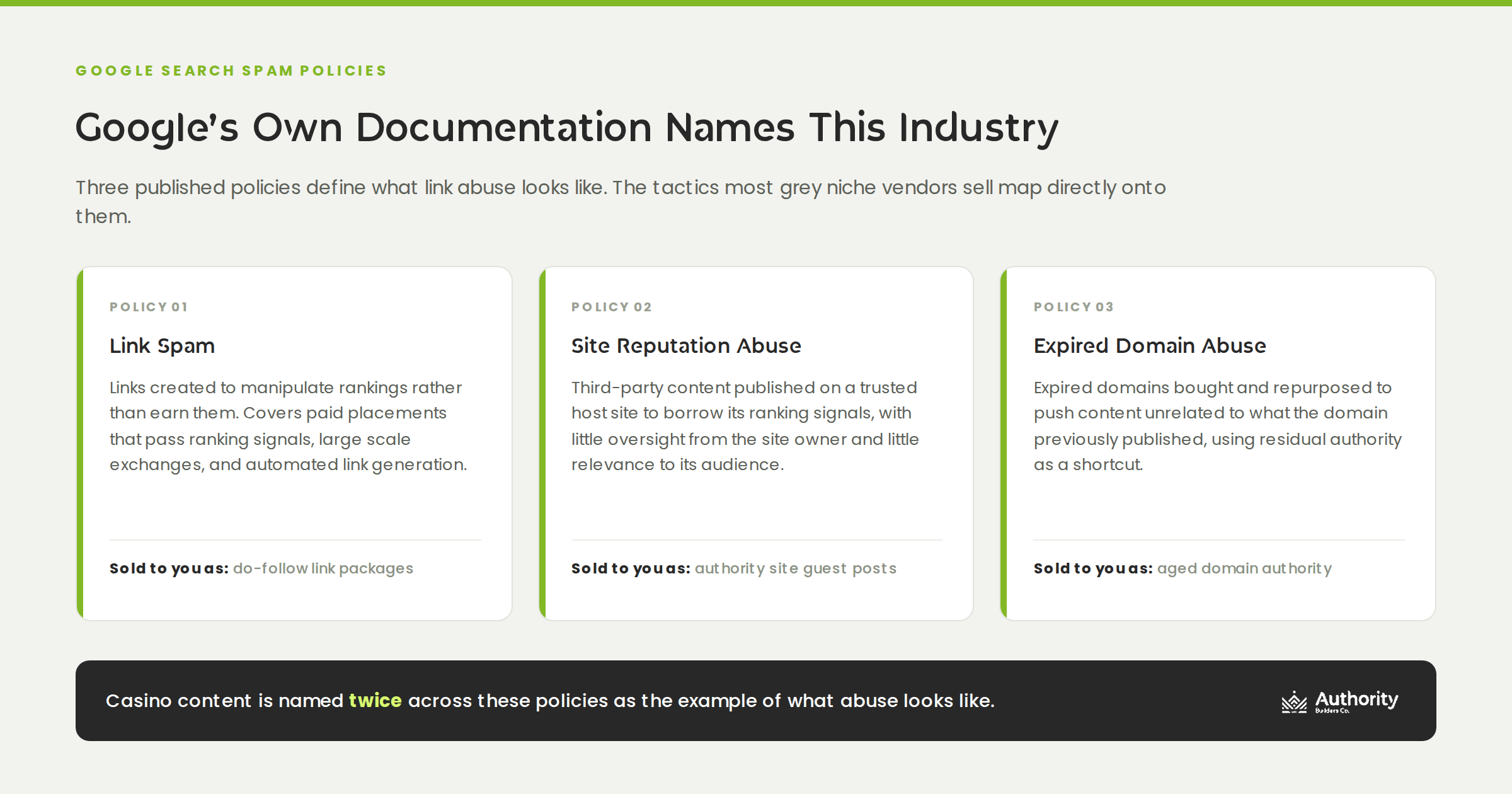
Read through the spam policies for Google web search and you’ll find casino content used repeatedly as the illustrative example of abuse. Under site reputation abuse, one of Google’s own examples is a medical site publishing a third-party advertising page about the best casinos, placed there to borrow the host site’s ranking signals. Under expired domain abuse, one example is casino content on a domain that used to belong to an elementary school.
Sit with that for a second. The two tactics grey niche vendors push hardest, parasite placements on unrelated high-authority domains and rebuilt expired domains, are the exact scenarios Google reaches for when it needs to define what abuse looks like.
Three more policies matter directly to how you buy links.
Link spam
Google defines link spam as creating links to or from a site primarily to manipulate rankings. The list includes exchanging money for links or for posts that contain links, and advertorials or native advertising where payment is received for articles containing links that pass ranking credit, or links with optimized anchor text in articles, guest posts, or press releases.
Google is clear that buying and selling links is a normal part of the web’s advertising economy, and that such links don’t violate policy as long as they’re qualified with a nofollow or sponsored attribute. That distinction is the whole game. A paid placement that’s disclosed and qualified is an advertising buy. A paid placement engineered to pass ranking credit is the thing the policy exists to catch.
Site reputation abuse
This one is worth understanding precisely, because it’s widely misread. Hosting third-party content isn’t a violation on its own. It becomes a violation when that content is published on the host site mainly because of ranking signals the host earned through its own first-party work.
Google also lists what isn’t site reputation abuse: wire services and press release sites, syndicated news, user-generated content areas like forums, columns and opinion pieces and other editorial work, and advertorial content where the purpose is to reach the publication’s actual readers rather than to farm its rankings. The line is intent and audience, not format.
Thin affiliation
If you run comparison or review sites, this is your policy. Thin affiliation covers pages with affiliate links where product descriptions and reviews are copied from the merchant with no original content or added value. Google explicitly says not every affiliate site is a thin affiliate, and that good affiliate pages add value through original reviews, real testing and ratings, price information, and useful comparison. For a casino affiliate, that means your own play-testing, verified payout timelines, and current licensing status, not a rewritten operator blurb.
The Placement Types That Still Work
The pool of publishers willing to touch your vertical is smaller. That’s a constraint, not a death sentence. It just means every placement has to earn its slot instead of padding a monthly quota.
Trade and industry publishers
iGaming trade press, crypto and blockchain news outlets, cannabis and wellness publications, adult industry trade sites. These have real readerships that overlap with your customers, and editorial standards you can meet with a decent pitch. There are fewer of them, they cost more, and they’re worth it.
Adjacent vertical editorial
This is where most of the upside sits and where most campaigns underinvest. Sports analytics and fan publications for sportsbooks. Fintech, payments, and personal finance for crypto. Wellness, fitness, and lifestyle for CBD. Travel and hospitality for land-based gaming.
The test is simple: would a regular reader of that publication plausibly care about this piece? If yes, you’re contributing to the site. If no, you’re renting its ranking signals, and you’ve wandered back into site reputation abuse. Our guest post service works this angle hard, because relevance is what separates a link that compounds from one that ages into a liability.
Data assets and tools
Original research and useful tools earn links from people who would never accept a paid placement. State-by-state legality trackers. Payout speed comparisons built on your own transaction data. Odds movement analysis. Wallet fee benchmarking. Survey data on player or user behavior.
These assets take real effort, and they’re the only reliable path to links from journalists and regulators-adjacent publications that won’t sell placements at any price. They also age well, which matters when you’re building something meant to last more than two quarters.
Sponsorships handled correctly
Team, event, podcast, and creator sponsorships are legitimate marketing in these verticals. Qualify the link with a sponsored attribute and take the brand exposure, referral traffic, and audience. You give up ranking credit on that specific link. What you get in return is a channel that doesn’t expose you to a manual action, and a real-world footprint that supports the brand entity signals Google increasingly leans on.
Contextual insertions into live content
Placing a link inside an existing article that already ranks and already earns traffic often outperforms a fresh guest post, because the host page has established equity and a crawl history. Our link insertion service handles this, and the vetting standard is the same as for new placements: real traffic, real relevance, real editorial control.
Risk Management: Anchors, Velocity, and Footprint
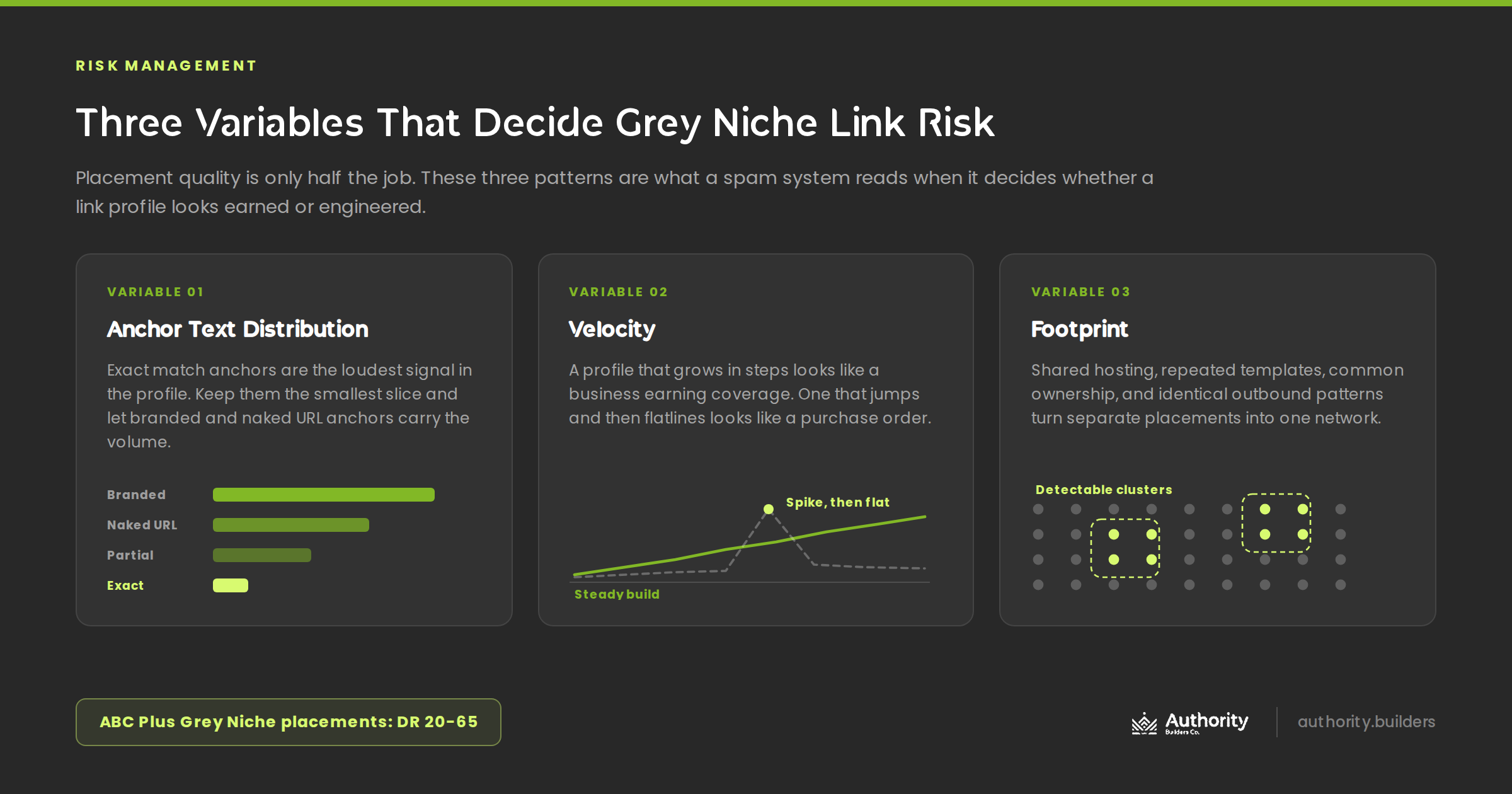
In a normal vertical, a sloppy link profile costs you some efficiency. In a grey niche it’s the thing that gets you flagged. Three variables drive most of the risk.
Anchor text distribution
Exact-match commercial anchors are the fastest way to look engineered. A profile where a large share of inbound anchors read like your target keyword, over and over, across dozens of unrelated domains, is a pattern no natural linking behavior produces.
Weight your distribution toward branded anchors, bare URLs, and natural phrases that happen to contain a keyword. Keep exact match as a small minority of the profile and reserve it for placements where the surrounding content clearly supports it. Google’s link spam policy calls out optimized anchor text in paid articles specifically, so this isn’t a theory about what might be risky.
Velocity
Link acquisition should look like a business growing, not a campaign firing. A domain that goes from twelve referring domains to two hundred in eight weeks is telling on itself. Pace the build, keep it consistent month over month, and let the profile thicken rather than spike.
Consistency also compounds better. The sites we see win in these verticals are the ones that ran a steady program for eighteen months, not the ones that bought a huge batch and stopped.
Footprint
Footprint is the tell that catches most cheap grey niche packages. Watch for placements that share an author bio across unrelated sites, run on identical templates with identical category structures, sit on the same hosting, or link out to the same rotating cast of gambling and crypto brands. Any one of those can be coincidence. Together they describe a network.
Diversity is the defense: a spread of domain ratings rather than a cluster at one number, a mix of traffic levels, varied geographies, and a mix of link types. A profile made entirely of followed guest post links is itself a pattern. If you want the fundamentals on this, we covered profile composition in our guide to building a healthy backlink profile.
How to Vet a Grey Niche Friendly Publisher
When a vendor sends you a placement list, run every domain through this before you approve anything. Most of it takes under two minutes per site.
- Real organic traffic, holding steady or rising. A site with a collapsing traffic graph has usually been hit already, and the link you buy today is attached to a domain on its way down.
- Confirmed indexation. Run a site: query. If the publisher’s pages aren’t in the index, the link passes nothing at all.
- Evidence of editorial oversight. Named staff, a masthead, an about page with real people, coverage that predates their interest in your vertical.
- Grey niche content density. If a general lifestyle blog is already hosting forty casino posts, it isn’t a lifestyle blog. It’s a link farm with a nice header image, and Google’s site reputation abuse policy describes it exactly.
- Outbound link neighborhood. Look at who else the site links to. You inherit the company it keeps.
- In-content placement only. Sidebar, footer, and author-bio links are called out in the link spam policy. Insist the link sits inside the body of the article.
- Price sanity. A DR 60 placement offered at forty dollars is not what it claims to be. Real editorial placements in restricted verticals carry a premium, because the publisher is taking on risk alongside you.
For context on what defensible placements cost, we published a full link building pricing guide covering managed campaign ranges and per-link economics across our services.
The AEO Angle: Spam Risk Now Costs You AI Visibility
This is the part that has changed the calculus for grey niches, and most operators haven’t priced it in yet.
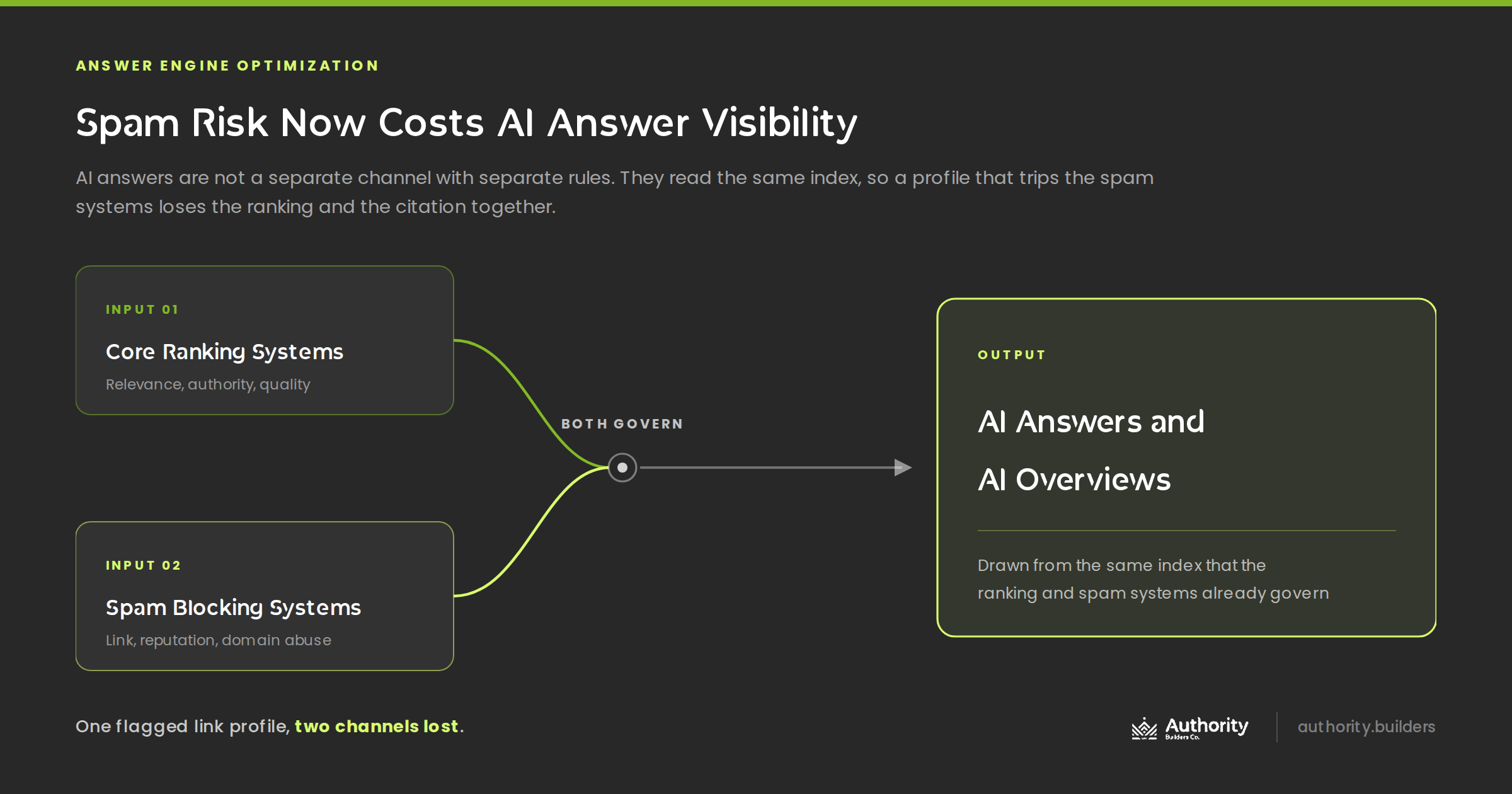
In its guide to optimizing for generative AI features on Google Search, Google explains that its generative AI features are rooted in the core Search ranking and quality systems. They rely on retrieval-augmented generation, pulling relevant pages from the Search index to ground the response, and on query fan-out, where the model issues a set of related queries and gathers results across all of them.
Google states plainly that its core ranking systems focus on high-quality content while other systems block spam, and that its generative AI features depend on both. Read that as a link builder and the implication is sharp: a link profile that trips spam detection doesn’t just cost you positions on a results page. It can remove you from the pool of sources AI answers are built from.
The same guidance takes a swing at a pitch you’ve probably received. Google says chasing inauthentic mentions across the web isn’t as helpful as it might seem. So when a vendor offers five hundred brand mentions to boost your AI visibility, that’s the same game in new packaging, aimed at a buyer who hasn’t read the documentation.
These SERPs are already generative
This isn’t a future problem. Running our own keyword research for this article in Ahrefs, US results for cbd link building, cbd seo, crypto seo, and igaming link building all returned AI Overviews in the SERP feature data. Grey niche queries are already being answered above the traditional results.
Which means the sites earning citations in those answers are compounding an advantage right now, while sites carrying spam risk are locked out of a surface they can’t even see in a rank tracker. Our AI Plus service is built around this specific problem, prioritizing the placements and entity signals most likely to be surfaced in AI-generated responses.
What the Foundation Looks Like in Practice
One of our ABC Plus clients came to us with a brand-new site: zero domain rating, zero referring domains, and single-digit monthly organic visits. Good content, no authority signals, no reason for Google to surface any of it.
We ran a homepage-first strategy. Phase one concentrated placements on the homepage to lift domain-level trust, on the logic that homepage equity distributes across the whole site through internal linking rather than trying to rank individual pages in isolation. Phase two shifted a portion of the budget to supporting content pages once the domain rating had a baseline to build on.
Results across the first three months:
- Domain rating: 0 to 10
- Referring domains: 0 to 88
- Total backlinks: 0 to 171
- Organic keywords: 7 to 25, a 257% increase
- Traffic value: up 708%
- Top 10 rankings: 6 to 13
Worth stating plainly: this client was an outdoor recreation site, not a grey niche account. We’re including it because the sequencing lesson is what transfers, not the vertical.
And the sequencing is where grey niche campaigns most often go wrong. The temptation is to point everything at money pages with commercial anchors from day one, because those are the pages that make revenue. That produces precisely the profile shape that looks manufactured: a young domain, thin brand signal, and a concentrated wall of optimized anchors aimed at conversion pages.
Building homepage and brand authority first is slower on paper. It’s also the version that survives a core update.
A 90-Day Starting Sequence
If you’re starting or restarting a grey niche link program, this is the order we’d run it.
Days 1 to 30: audit and mapping
- Full backlink audit. Identify existing toxic placements, network footprints, and any anchor concentration already in the profile.
- Decide on disavow. Be conservative. Most sites over-disavow and remove equity they needed.
- Build the publisher shortlist across trade, adjacent vertical, and data-friendly outlets.
- Draft the anchor map before a single link is placed, with target ratios per page.
Days 31 to 60: brand and domain authority
- Weight placements toward the homepage and top-level brand pages.
- Skew anchors heavily to branded and URL variants during this phase.
- Secure the first trade press and adjacent vertical placements.
- Verify each placement is live, indexed, and in-content within two weeks of publication.
Days 61 to 90: depth and money pages
- Begin measured link building to commercial pages, with partial-match anchors leading.
- Ship the first data asset or tool and pitch it properly.
- Add contextual insertions on relevant pages that already rank.
- Review velocity and anchor distribution against the map, and correct drift.
From there it’s a monthly rhythm: consistent placement volume, quarterly profile review, and a digital PR layer once the foundation holds. Our digital PR service is usually the right next step once brand authority is established and you’re ready to compete for editorial coverage rather than placements.
Where Authority Builders Fits
We built ABC Plus Grey Niche for exactly this problem. It’s a fully managed campaign for crypto, adult, gambling, and pharmacy brands, running through publisher partnerships we’ve developed specifically because these verticals get turned away everywhere else.
Every plan includes anchor text analysis, link velocity analysis, an authority diagnosis, and transparent month-to-month reporting. Placements are high-traffic, niche-relevant guest posts in the DR 20 to 65 range. Plans start at $1,000 per month at the Starter tier and scale through Intermediate and Pro as the campaign matures.
If your site isn’t in a restricted vertical, ABC Plus is the standard managed program. If your priority is visibility inside AI answers rather than classic rankings alone, AI Plus is the better fit. Plenty of accounts run a combination.
The Bottom Line
Grey niche link building isn’t a matter of finding someone willing to break the rules faster than the competition. The operators who win in gambling, crypto, adult, and pharmacy are the ones who treat the constraint seriously: fewer placements, better publishers, disciplined anchors, patient velocity, and a brand that looks like a business rather than a ranking vehicle.
The upside of a hard vertical is that most of your competitors won’t do this. They’ll keep buying cheap packages, keep rebuilding after each penalty, and keep starting over. A profile built carefully over eighteen months is close to impossible for them to catch, because the thing you’re accumulating can’t be bought in a batch.
If you want a second opinion on your current profile before you spend another dollar on placements, schedule a call with our team and we’ll walk through what’s working, what’s exposing you, and what a defensible program looks like for your vertical.