
High authority backlinks have always been the most valuable links you can earn. Links from respected, relevant sources signal to Google that your content is worth ranking, and they’ve driven more sustainable SEO results than any other single factor for the past two decades.
But the definition of “high authority” has changed.
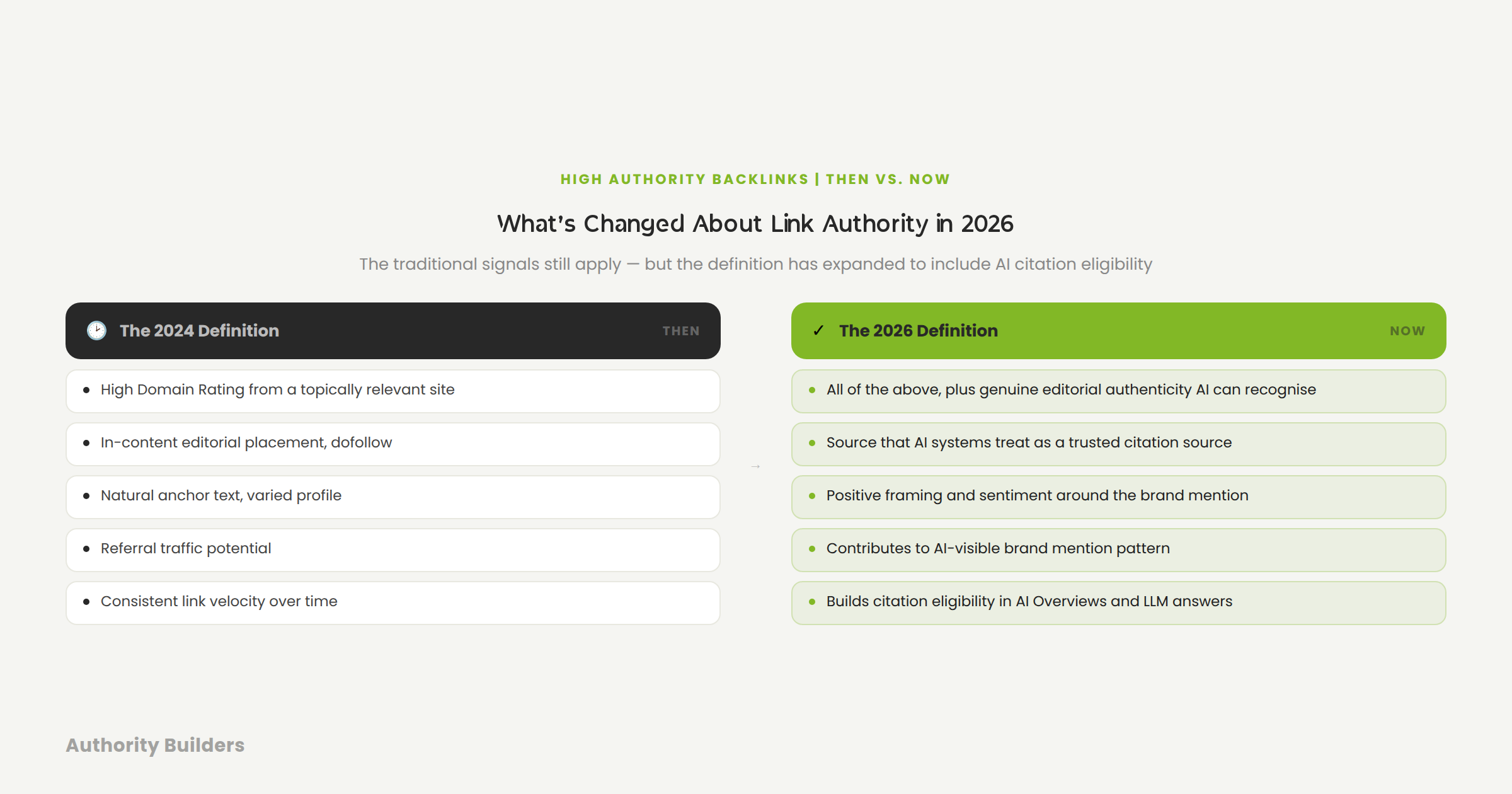
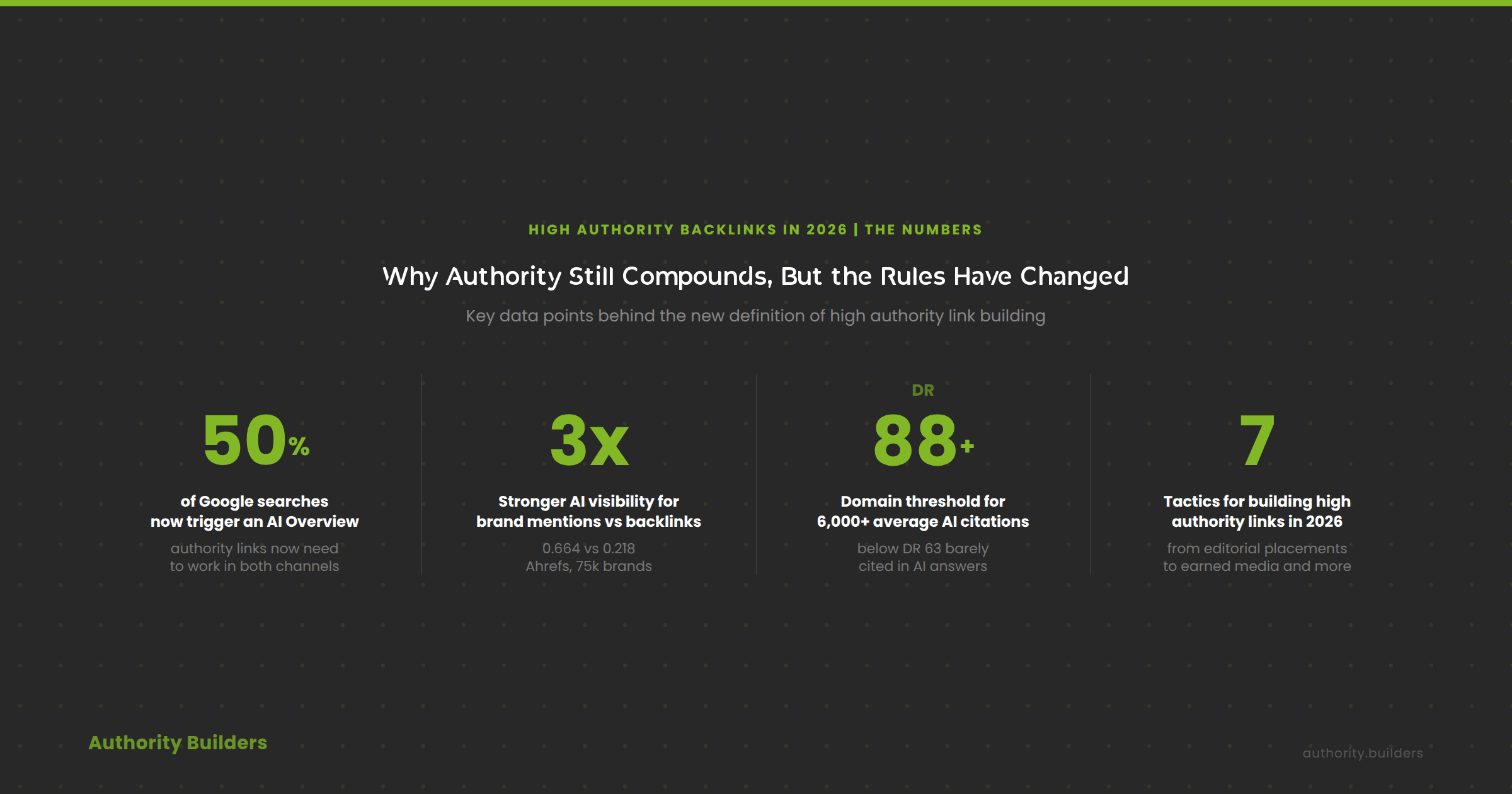
In 2024, a high authority backlink was primarily defined by domain rating, topical relevance, and whether the link was editorial and in-content. Those signals still matter. But in 2026, there’s a new layer: AI citation eligibility. With AI Overviews now appearing in over 50% of Google searches, and AI tools like ChatGPT and Perplexity increasingly used for research and purchasing decisions, the links that build genuine authority are also the links that make your brand visible in AI-generated answers.
The good news: the strategies that earn the best links for traditional SEO are largely the same ones that build AI search visibility. This post covers both, with updated tactics for where we are now.
What High Authority Backlinks Actually Mean in 2026
A high authority backlink is a link from a domain that Google and AI systems genuinely trust. That trust is built from several overlapping signals.
Domain Rating and Backlink Profile
Domain Rating (DR), as measured by Ahrefs, remains the most widely used proxy for link authority. Sites with higher DR scores have stronger backlink profiles themselves, which means a link from them passes more authority to you. But DR is a proxy, not the thing itself. What it’s measuring is how much of the web’s trust graph points to that domain.
The practical implication: target sites that have earned their DR through genuine editorial content and real audience growth, not sites that have gamed their way to a high score. The former compound in value. The latter get devalued over time as Google’s spam detection improves.
Topical Relevance
Google has become considerably better at evaluating whether a link makes topical sense. A DR 70 site in an unrelated industry contributes less than a DR 45 site that’s deeply focused on your niche. Both matter, but topical coherence is increasingly weighted.
For AI systems, topical relevance is even more important. LLMs organize knowledge by topic clusters. A consistent pattern of links from topically relevant sources teaches AI systems that your brand belongs in a particular category, which is exactly how you earn citation eligibility in AI-generated answers.
Editorial Placement and Context
Where the link sits on the page matters. In-content links within the body of a relevant article carry far more weight than footer links, sidebar links, or links in boilerplate sections. The surrounding text matters too: a link accompanied by positive framing about your brand or content reinforces its value as a signal.
Locality
For local businesses, links from local news publications, city-specific directories, and regional industry bodies carry disproportionate weight for local rankings. National authority links are valuable, but a local bakery benefits more from a local paper feature than from a Forbes mention.
Recency and Link Velocity
A link profile that’s actively growing signals to Google that your site has ongoing relevance. Stagnant profiles from sites that built links years ago and stopped can see rankings erode even without penalties. Consistent, sustainable link acquisition at a natural velocity outperforms bursts of aggressive building followed by long gaps.
The New Rule: AI Citation Eligibility
This is the dimension that wasn’t part of the conversation in 2024. As we’ve detailed in our posts on link quality for AEO and how to rank in AI Overviews, AI systems evaluate authority differently from traditional ranking algorithms. The signals that determine whether your content gets cited in an AI-generated answer include:
Editorial Authenticity
AI systems trained on the web have learned to recognize the difference between genuine editorial endorsement and manufactured link placements. Links from publications with real editorial standards, real staff, and real audiences register as trust signals. Links from content farms and thin guest post sites, regardless of their DR, register as noise.
Brand Mention Pattern
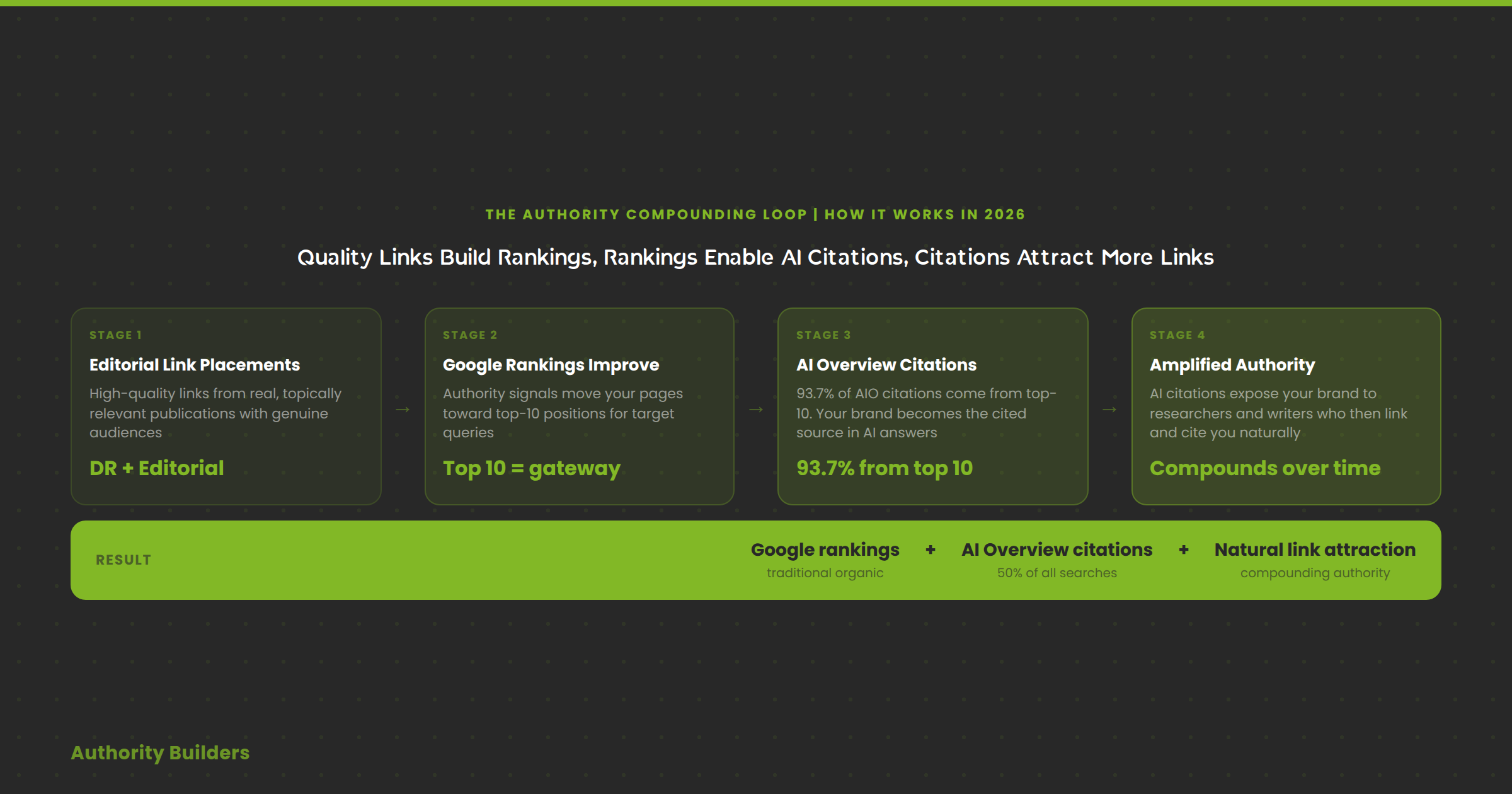
Ahrefs’ analysis of 75,000 brands found that brand web mentions correlate with AI Overview visibility at 0.664, compared to 0.218 for backlinks. This doesn’t mean links don’t matter. It means that the links which also drive brand mentions, links from publications where real people read and reference your brand, are doing double duty. They pass PageRank and build AI citation eligibility simultaneously.
Source Credibility Tier
Not all high-DR sites are equal for AI citation purposes. News publications, industry journals, and respected trade outlets sit at the top of the trust hierarchy. These are the sources AI systems have learned to treat as authoritative. A single placement in a genuine news publication from Authority Builders’ High-Authority Links network typically outperforms multiple guest posts on content-heavy but editorial-light sites when it comes to AI citation signal.
Consistency Over Time
A one-off press mention doesn’t make a brand citation-worthy. What AI systems recognize as genuine authority is a consistent pattern of independent editorial endorsement from multiple credible sources over time. This is the compounding logic of quality link building: each placement adds to a pattern that becomes increasingly recognizable as the real thing.
Why the Definition of “Authority” Has Expanded
Here’s the framing that brings this together. In the original version of this post, high authority backlinks were defined primarily by domain metrics and placement quality. Those are still necessary conditions. But in 2026, they’re no longer sufficient.
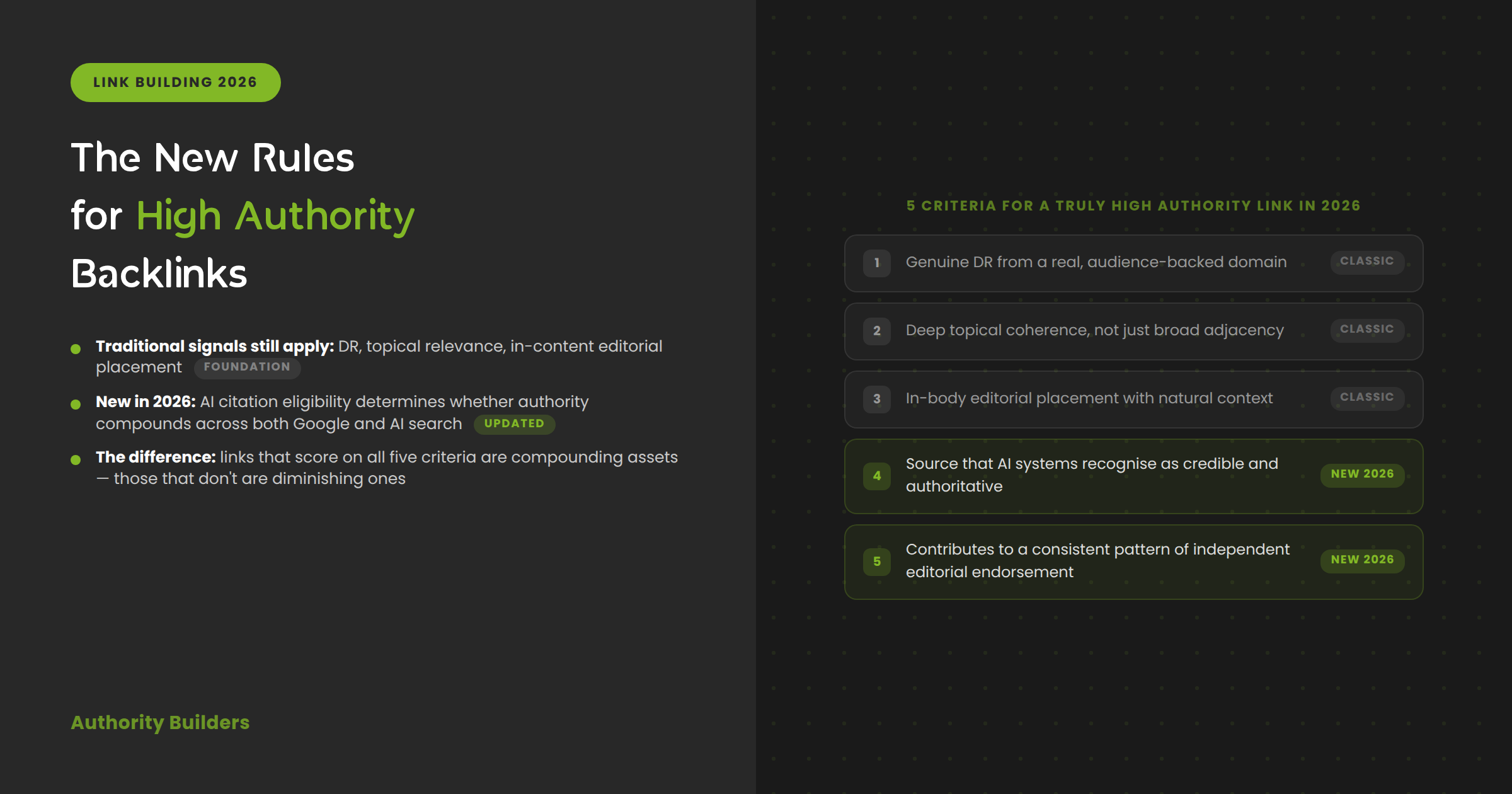
A truly high authority backlink in 2026 is one that:
- Comes from a domain with genuine DR and a real, engaged audience
- Is topically coherent with your brand’s subject matter
- Is placed editorially, in-content, with natural surrounding text
- Comes from a source that AI systems have been trained to recognize as credible
- Contributes to a consistent pattern of independent endorsement over time
Links that meet all five criteria are compounding assets. Links that meet only the first two or three are diminishing assets, contributing to rankings today but doing less over time as AI search reshapes how authority is evaluated.
7 Ways to Build High Authority Backlinks in 2026
1. Target your competitors’ best link sources
Pull your top competitors into Ahrefs and filter for their highest-DR, topically relevant referring domains. These sources have already demonstrated willingness to link to content in your space. They’re your warm outreach list. Build content that’s genuinely better than what they linked to and approach the same publications.
2. Earn editorial placements in real publications
Guest posting still works, but the bar has risen. The publications that deliver the most value, for both rankings and AI citation eligibility, are ones with genuine editorial standards and real audiences. Thin sites that exist primarily to host links don’t deliver the compounding authority that genuine editorial placements do. Authority Builders’ Guest Posts service places content exclusively on sites with verified 1,000+ monthly organic visitors through direct outreach.
3. Pursue news and press placements
Links from genuine news publications sit at the top of the authority hierarchy for both Google and AI systems. Journalists link to expert sources. Digital PR campaigns, newsjacking, original research, and expert commentary are the most reliable paths to press coverage. Authority Builders’ Earned Media, Press Authority, and Digital PR services are built specifically for this tier of link acquisition.
4. Create genuinely linkable assets
Original research, data studies, industry surveys, and comprehensive tools attract natural links because they give other writers something to cite. Pages with unique statistics earn significantly more backlinks than standard blog posts. This is the highest-leverage content investment for earning high authority links organically, because the links come with strong editorial context.
5. Convert unlinked brand mentions
If your brand has been mentioned in publications without a link, those mentions are warm opportunities. The publication has already editorially endorsed you. A polite outreach email asking whether they’d add a link converts at a much higher rate than cold outreach. Tools like Ahrefs, Google Alerts, and Mention track these opportunities.
6. Build link insertions into established content
Link insertions place your link into existing, ranking content on relevant domains. Because the content already has traffic and authority, the link delivers value immediately. It’s also more efficient than pitching entirely new content. Authority Builders’ Link Insertions service sources these opportunities through genuine manual outreach.
7. Run a managed link building campaign
For brands that need to close a significant link gap against competitors, a fully managed campaign handles the research, strategy, outreach, and reporting so your team focuses on other priorities. For brands that need to close a significant link gap against competitors, a fully managed campaign handles the research, strategy, outreach, and reporting so your team focuses on other priorities. ABC Plus and ABC Platinum start with a competitor link gap analysis and anchor text roadmap, then build consistently toward your targets with monthly transparent reporting.
What to Avoid: Links That Look Good but Deliver Nothing
As Google and AI systems get better at evaluating genuine authority, links that game the metrics but lack real editorial quality deliver less value and increasing risk. The specific tactics to avoid:
- PBNs and link farms: As covered in our post on black hat backlinks, these are the highest-risk links in 2026. Google’s spam detection has become more aggressive, and AI systems don’t recognize PBN links as credible sources regardless of their DR.
- AI-generated sites built to sell links: A growing category. These sites look real at a glance but have no genuine audience, no editorial standards, and no staff. The links they sell have no AI citation value and are increasingly flagged by Google’s spam filters.
- High-DR but topically irrelevant links: A DR 80 site in an unrelated industry contributes less than you’d expect. Google is better at evaluating topical relevance, and AI systems specifically evaluate topical coherence when deciding which sources to cite.
- Exact-match anchor text patterns: A link profile dominated by exact-match keyword anchors looks engineered. It’s a pattern Google is trained to detect and that AI systems also recognize as a sign of manufactured rather than genuine endorsement.
How Authority Builders Can Help
Every service we offer is built around the quality criteria this post describes. Not just DR and traffic thresholds, but genuine editorial placement, topical coherence, and the brand authority signals that matter for AI search visibility.
- Guest Posts and Link Insertions: editorial placements on verified, real-audience sites, sourced through genuine outreach
- High-Authority Links: placements in established US news publications that sit at the top of the AI citation trust hierarchy
- Earned Media, Press Authority, and Digital PR: the strategies that build the press coverage and brand mention pattern that AI systems are trained to recognize as genuine authority
- ABC Plus and ABC Platinum: fully managed campaigns starting from a competitor link gap analysis, with AI search visibility built into the strategy
If you want to understand where your current authority profile stands relative to your competitors and what it would take to close the gap, book a strategy call. Or create a free account to browse our publisher network.