
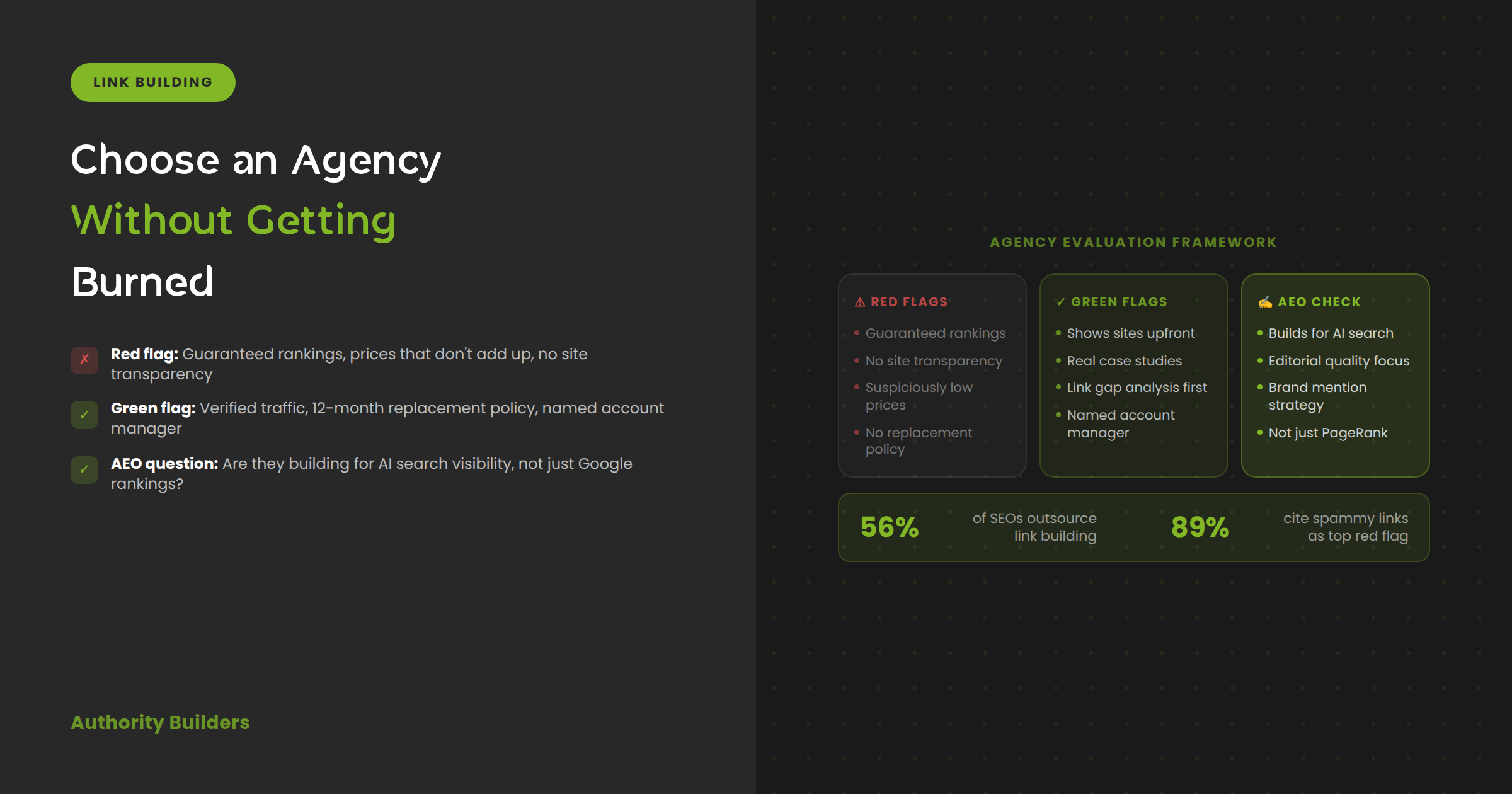
More than half of SEO professionals outsource at least part of their link building. According to a survey of 518 SEO practitioners by Editorial.link, 56% outsource at least some of it, and the ones who’ve been burned by the wrong agency tend to have a very similar story: impressive-sounding promises, a convincing pitch, then a delivery of low-traffic guest posts on sites nobody reads, links that disappear after 90 days, and a backlink profile that looks worse than when they started.
The link building industry has a real quality problem. Not because good agencies don’t exist, but because the barriers to entry are low, the metrics are easy to fake, and the damage from a bad campaign can take months to undo. A few hundred dollars spent on the wrong provider can mean six months of recovery work and rankings that never fully come back.
This guide gives you the due-diligence framework to evaluate any link building agency before committing. We cover the red flags that should end a conversation immediately, the green flags that signal a legitimate operation, the questions to ask, and the new dimension that most agency buyers overlook entirely: whether the agency is building for AI search visibility as well as traditional rankings.
Why Choosing the Wrong Agency Is an Expensive Mistake
A bad link building campaign doesn’t just fail to help. It can actively damage your site. Links from private blog networks (PBNs), link farms, and content mills with no real audience are the kind of footprint that triggers Google manual actions. And unlike an algorithm update that might recover on its own, a manual penalty requires filing a reconsideration request after cleaning up your profile, a process that typically takes two to six months even when done correctly.
The indirect costs are worse. If you’re in a competitive niche, six months of lost momentum while your competitors keep building is a gap that’s very hard to close. And because link building results compound over time, starting over with a clean slate means you’ve not only lost the investment in the bad campaign, you’ve lost the time value of what a good campaign would have built during that same period.
There’s also the AEO dimension. As we’ve covered in our posts on link quality for AEO and how to rank in AI Overviews, AI systems evaluate editorial trust differently from traditional ranking algorithms. A volume-heavy link profile built on low-quality placements can actively hurt your AI citation eligibility, not just your Google rankings.
The good news is that bad agencies leave predictable footprints. Once you know what to look for, they’re not hard to spot.
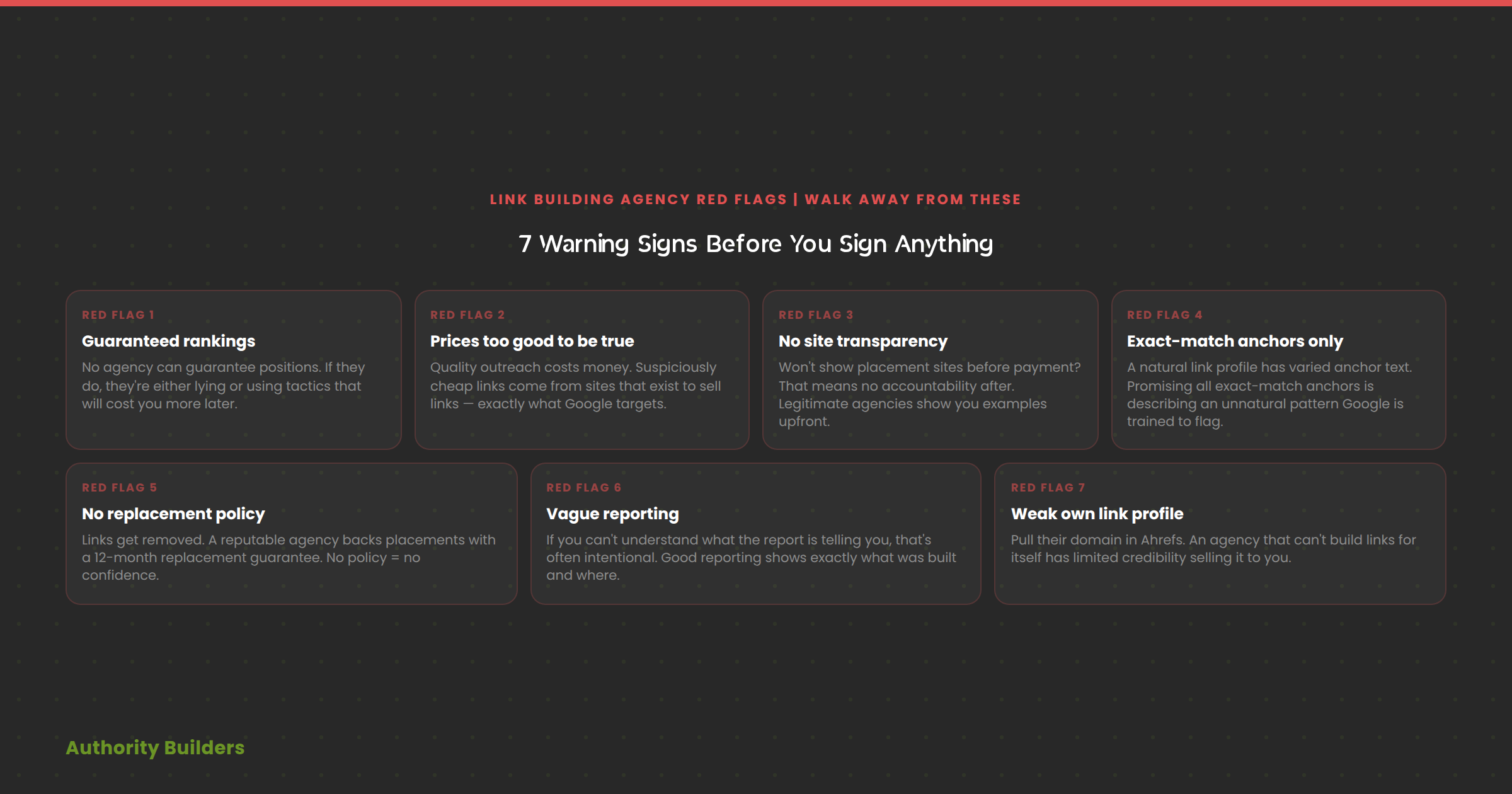
7 Red Flags to Walk Away From
1. Guaranteed rankings or guaranteed results
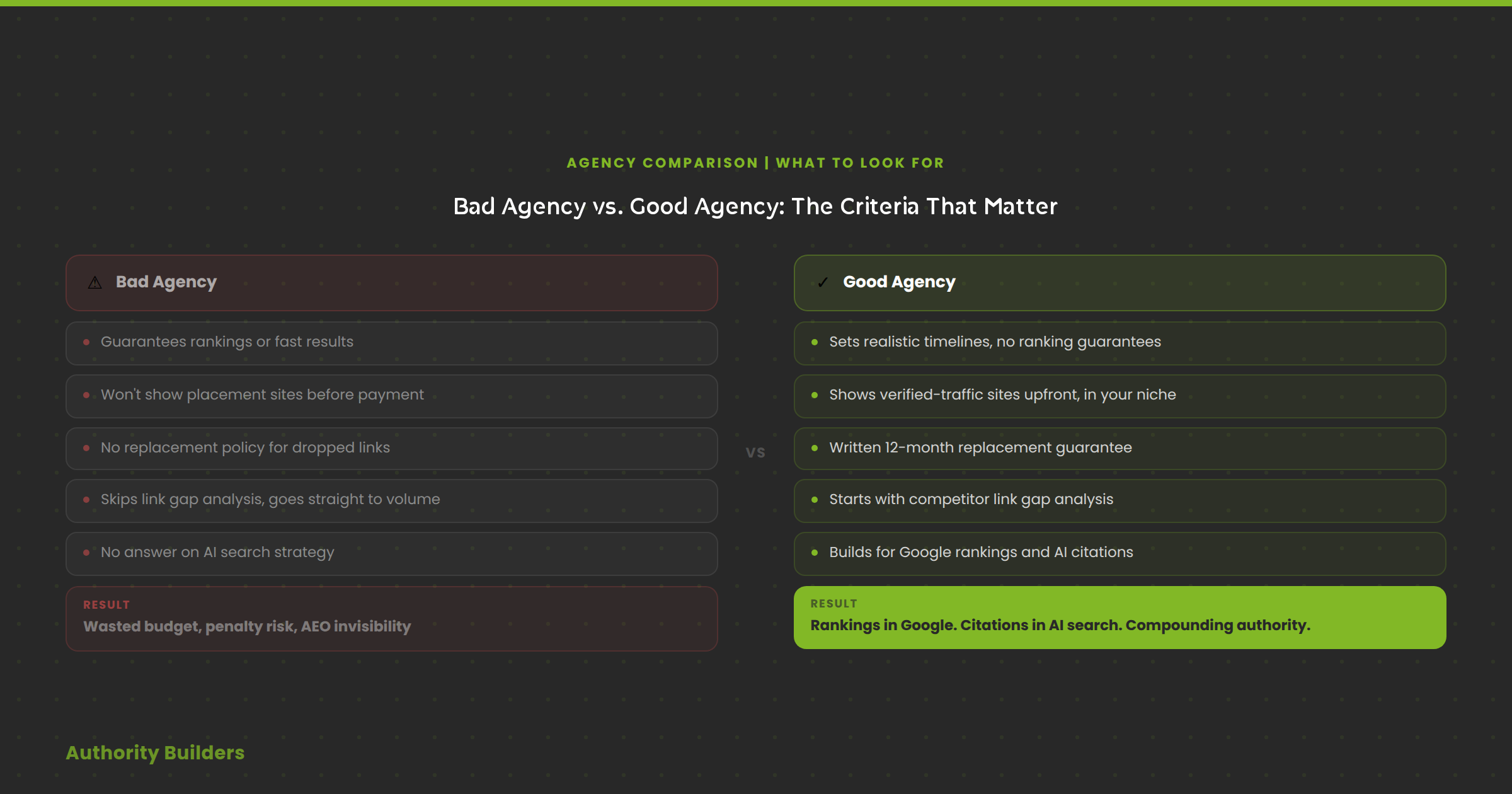
No legitimate agency guarantees specific rankings. Google’s algorithm has hundreds of factors, many of them outside any agency’s control. An agency that promises “page one in 60 days” is either lying about what they can deliver or planning to use tactics aggressive enough to temporarily game the algorithm, which will cost you more than you saved when the penalty hits.
2. Prices that seem too good to be true
Quality link building involves real outreach to real publishers, real content creation, and real editorial review. That costs money. If an agency is offering 20 DR60+ links for $300, the math doesn’t work for legitimate placements. What you’re actually buying is links from sites that exist to sell links, which is exactly the footprint Google’s spam detection is trained to find. Our link building pricing guide covers what realistic pricing looks like across different link types.
3. They won’t show you sites before you pay
A legitimate agency can show you examples of sites in your niche before you commit. If an agency is vague about where your links will be placed, or only reveals the URLs after payment, that’s a serious problem. You need to be able to verify that the sites are real, have genuine organic traffic, and are editorially appropriate for your brand. No transparency before purchase means no accountability after.
4. Exact-match anchor text on every link
A natural backlink profile has varied anchor text: branded terms, partial matches, generic phrases, and naked URLs. An agency that promises to build all your links with exact-match keyword anchors is describing an unnatural pattern that Google’s algorithms are specifically trained to flag. Good anchor text strategy is nuanced. Any agency that treats it as a simple fill-in-the-blank is showing you their level of sophistication.
5. No replacement policy for dropped links
Links get removed. Sites go down, articles get deleted, and publishers change their policies. A reputable agency backs their work with a replacement guarantee, typically for 12 months minimum. If an agency has no policy on dropped links, they’re either placing links on sites where removal is common, or they’re not confident enough in their placements to stand behind them.
6. Vague or jargon-heavy reporting
If you can’t understand what an agency’s report is telling you, that’s often intentional. Good reporting is clear: here are the links we built, here are the sites, here are the metrics you can verify yourself, here’s what changed in your rankings. If a report buries the actual deliverables in meaningless graphs and jargon, it’s often because there’s nothing concrete underneath.
7. Their own site has a weak link profile
This one is easy to check and surprisingly revealing. Pull the agency’s own domain into Ahrefs or a similar tool. Do they have strong links from real publications in the SEO and marketing space? Are they ranking for competitive terms in their own industry? An agency that can’t demonstrate link building success on their own site has limited credibility when selling it to you.
6 Green Flags That Signal a Trustworthy Agency
1. Transparent site vetting with verifiable traffic
The best agencies vet every site in their network against a clear set of criteria and will share those criteria with you. At Authority Builders, every placement goes on a site with a minimum of 1,000 monthly visitors confirmed by Ahrefs, with no history of spam or manual actions. Ask any agency you’re evaluating what their site qualification process looks like. If they can’t answer specifically, that tells you something.
2. Real case studies with verifiable results
Look for case studies that show specific outcomes: keyword ranking improvements, traffic changes, timelines. Vague testimonials like “great service, highly recommend” are nearly worthless. You want to see before-and-after data that a prospect could reasonably verify, with enough detail that the claim is falsifiable.
3. Link gap analysis and strategy before outreach
A good agency doesn’t just build links. They start by understanding what links you actually need to rank. That means a competitor link gap analysis, an anchor text roadmap, and a strategy that targets the right DR range and topical sources for your specific situation. If an agency skips this and goes straight to “how many links do you want?”, they’re selling volume, not results.
4. Month-to-month contracts or clear exit terms
Confidence in results and long lock-in periods don’t typically go together. Legitimate agencies are willing to earn your continued business each month. Be cautious of agencies requiring long-term contracts with no clear exit clause, especially before you’ve seen any results.
5. Named account managers and accessible communication
At quality agencies, you work with a real person who knows your account. They can discuss your strategy, answer questions about specific placements, and escalate issues. If pre-sales communication involves a named expert but post-purchase contact becomes a generic support email, that’s a sign the sales process is designed to close deals rather than build client relationships.
6. They push back on bad requests
A good agency will tell you when a request doesn’t make sense. If you ask for 50 links in one month with exact-match anchors to a site that launched six weeks ago, the right answer is “that’s not a good idea, here’s why.” An agency that just says yes to everything is optimizing for your budget, not your results.
The AEO Question: Are They Building for AI Search Too?
This is the question most agency buyers aren’t asking yet, and it’s becoming one of the most important evaluation criteria.
AI Overviews now appear in over 50% of Google searches. AI tools like ChatGPT and Perplexity are increasingly where buyers research purchases and evaluate vendors. The links that help you rank in traditional organic search and the links that build your AI citation eligibility overlap, but they’re not identical. As we covered in our post on link quality for AEO, AI systems weight editorial authenticity, topical coherence, sentiment, and source credibility in ways that go beyond traditional domain rating metrics.
A link building agency that’s only thinking about Google rankings is building half the picture. The right agency understands that editorial placements on real publications don’t just pass PageRank, they build the brand mention pattern and editorial credibility that AI systems use to decide which sources are citation-worthy.
Ask any agency you’re evaluating: how does your approach account for AI search visibility? If the answer is blank stares or a pivot to “we focus on Google,” you’re looking at an agency that hasn’t updated their thinking for the current environment.
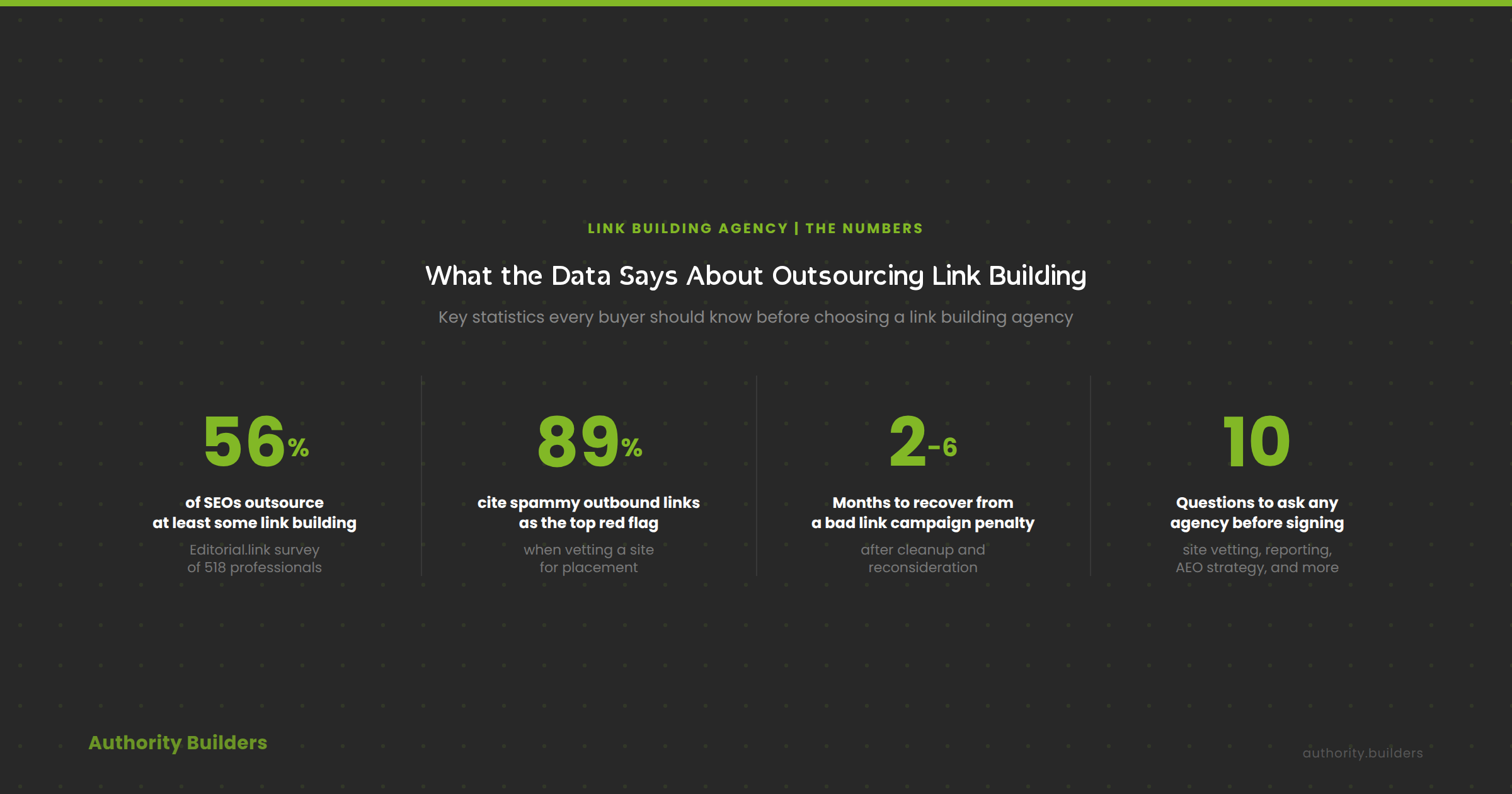
10 Questions to Ask Before You Sign Anything
- Can you show me example sites from my niche before I pay? The answer should be yes, with real URLs you can verify in Ahrefs or Semrush.
- What’s your site qualification process? Listen for specific criteria: minimum traffic, no spam history, manual review, editorial standards.
- How do you handle dropped or removed links? Look for a written replacement policy with a specific timeframe, typically 12 months minimum.
- Can I see a sample report from a current client? Redacted is fine. You’re evaluating the format, the depth, and whether you can understand it.
- Do you start with a link gap analysis? The answer should be yes. A good agency diagnoses before prescribing.
- Who will my account manager be, and how often will we communicate? Named person, regular cadence, accessible via email or call.
- What anchor text strategy do you recommend for my site? Look for a nuanced answer that includes branded, partial match, and generic anchors. Walk away from anyone who says “whatever keywords you want.”
- What does your content look like? Ask to see examples of guest post content they’ve published. It should be substantive, well-written, and editorially appropriate.
- How do you think about AI search visibility in your link building strategy? The answer tells you a lot about how current their thinking is.
- What results have clients in my niche typically seen, and over what timeline? Realistic timelines are 3 to 6 months for noticeable movement. Anyone promising faster is either selling easy wins or setting you up for disappointment.
What Good Reporting Actually Looks Like
Before you commit to an agency, ask to see a sample report. Here’s what a genuine monthly link building report should include:
- Live placement URLs for every link built that month, confirmed and indexable
- Site metrics for each placement: DR/DA, monthly organic traffic (from Ahrefs or Semrush), and topical relevance
- Anchor text used for each placement and cumulative anchor text distribution across your profile
- Ranking changes for target keywords, with before-and-after positions
- Notes on strategy for the next month, including any adjustments based on results
How to Evaluate an Agency’s Own Link Profile
This takes five minutes and tells you a lot. Pull the agency’s domain into Ahrefs Site Explorer and look for:
- Referring domain quality: Are their backlinks from real SEO and marketing publications? From industry blogs that practitioners actually read? Or from generic business directories and low-traffic guest post sites?
- Topical coherence: Do their links come from sources that are genuinely relevant to link building, SEO, and digital marketing? Or is there a random spread that suggests they’re building the same low-quality links they’re selling?
- Their own organic rankings: Are they ranking for competitive terms in their own space? A link building agency that doesn’t rank well for link building terms is a difficult sell.
- Content quality on their site: Is their blog substantive? Do they publish original research, data, or genuinely useful guides? Or is it thin content that exists to target search terms?
An agency that does great link building for clients tends to have a great link profile itself. It’s not a perfect test, but it’s a useful one.
Why Authority Builders
We’ve been building links since 2016, and everything in this guide reflects how we operate.
- Every site in our network has a minimum of 1,000 monthly visitors (verified by Ahrefs), passes a 20-point qualification check, and is placed through genuine manual outreach
- We show you sites before you commit. No surprises after payment
- All placements are guaranteed for 12 months minimum. Dropped links get replaced
- We start with a link gap analysis and anchor text roadmap before building a single link
- Our ABC Plus and ABC Platinum managed services build campaigns with AI search visibility built into the strategy, not treated as an afterthought
- You get a named account manager, transparent monthly reporting, and direct access to the team
If you want to see how we’d approach your specific situation, including a competitor link gap analysis and a look at sample sites in your niche, get in touch here. Or create a free account to browse our publisher network directly.