
Most Link Building Campaigns Skip This Step
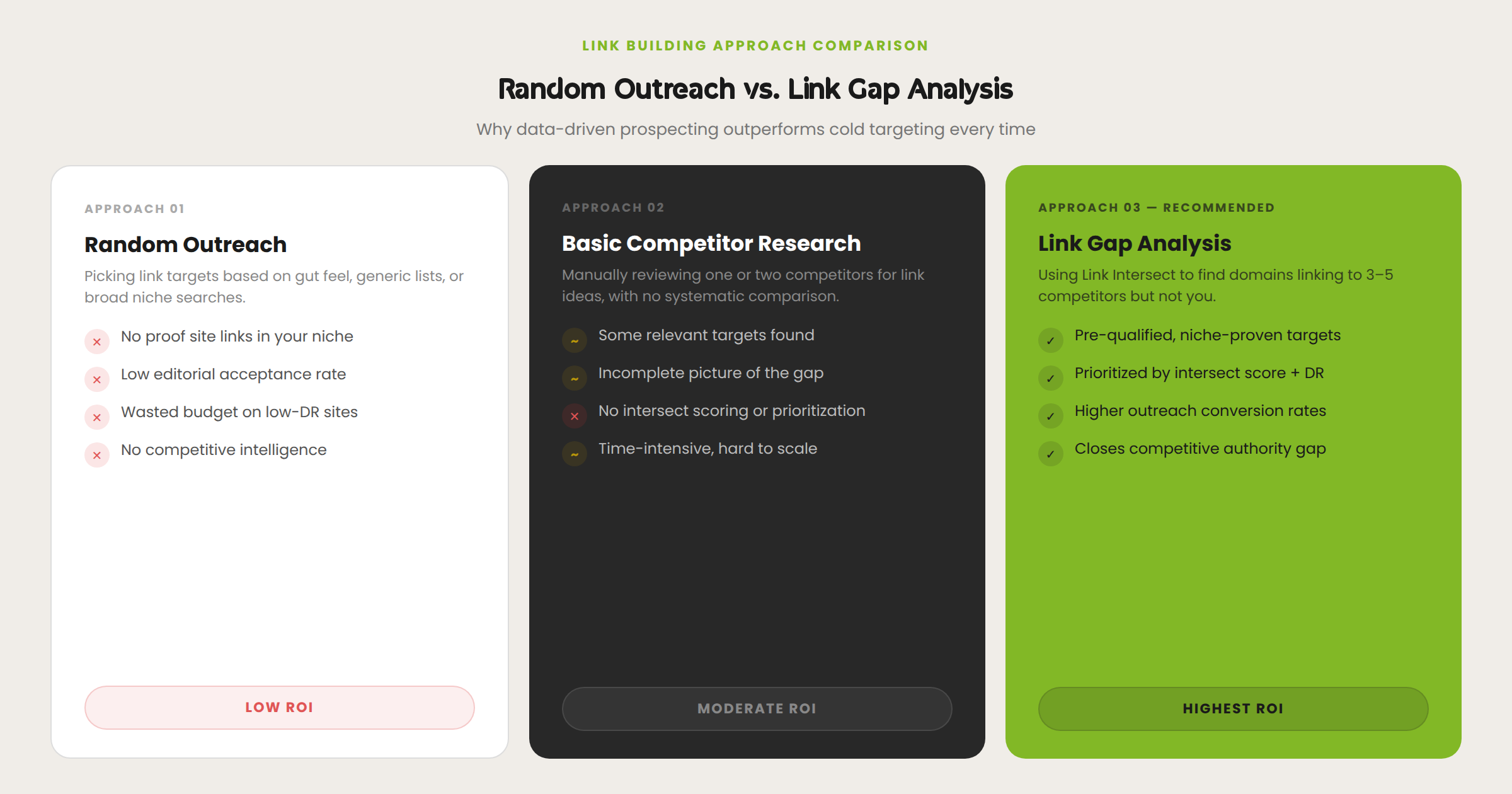
You’ve got a link building budget. You know backlinks matter. So you pick a tactic, reach out to a few sites, and wait to see what sticks.
Here’s the problem: you’re shooting in the dark.
Without a link gap analysis, you don’t know which sites have the most influence in your niche, which ones already trust your competitors, or where the highest-leverage link opportunities actually are. You’re building links based on guesswork instead of data.
A link gap analysis changes that. It shows you exactly which referring domains your competitors have that you don’t, so you can stop guessing and start targeting the sites that are most likely to move your rankings.
In this guide, we’ll walk you through the full process, step by step, so you can run your own analysis today.
What Is a Link Gap Analysis?
A link gap analysis (sometimes called a backlink gap analysis) is the process of comparing your site’s backlink profile against your competitors’ profiles to identify domains that link to them but not to you.
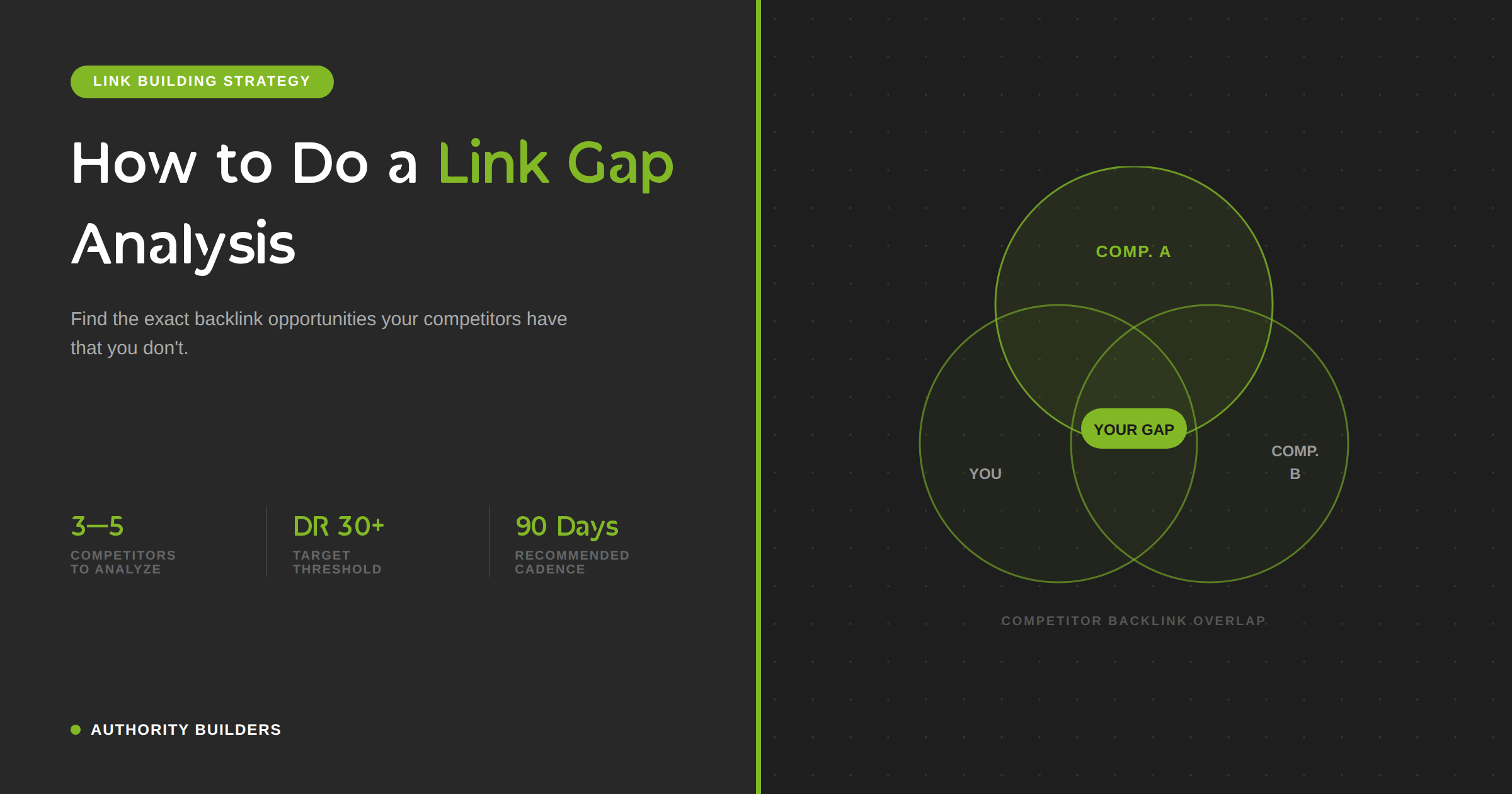
Think of it like a Venn diagram. One circle is your backlink profile. The other circles are your competitors’. The overlapping section is links you share. But the sections that belong only to your competitors? That’s your gap, and it’s a goldmine of potential link prospects.
These sites have already proven they’re willing to link out to businesses in your space. They’re not cold prospects. They’ve already vouched for sites like yours. The only reason they’re not linking to you is that they don’t know you yet.
A link gap analysis gives you the roadmap to change that.
Why Link Gap Analysis Matters More in 2026
Link building has always been competitive, but the stakes have gone up significantly over the last couple of years.
Two things are driving this:
- Google’s quality bar keeps rising. Spammy links no longer just fail to help, they actively hurt. Every link you build should come from a domain that has real editorial standards. Finding those domains manually is slow and inconsistent. A link gap analysis points you straight to sites that have already cleared that bar.
- AI search is changing what ‘authority’ means. Tools like ChatGPT and Google’s AI Overviews don’t just count links. They evaluate whether your brand is mentioned and cited by sources that are already trusted in your niche. As we’ve written about in our piece on how authority signals shape AI search answers, the same sites that link to your competitors for SEO purposes are often the same sources that AI models draw from. Closing the link gap closes the authority gap.
In short: link gap analysis isn’t just a nice-to-have. It’s the foundation of any serious link building strategy in 2026.
Step 1: Identify Your Real Competitors
Before you can find the gap, you need to know who you’re competing against. And we don’t just mean the businesses you think of as competitors.
Your SEO competitors are the sites that rank for the same keywords you’re targeting, which isn’t always the same as your direct business competitors.
To find them, start with a Google search for your primary target keyword and note the top 5 to 10 organic results. Those are your SERP competitors.
You can also use Ahrefs’ Competing Domains report: drop your domain into Site Explorer and navigate to Competing Domains. Ahrefs shows you which sites share the most keyword overlap with you.
Once you have your list, narrow it down. You want 3 to 5 sites that are:
- Ranking for the same core keywords you’re targeting
- In the same niche (not just tangentially related)
- A realistic benchmark, not so far above your current DR that their link profile is irrelevant
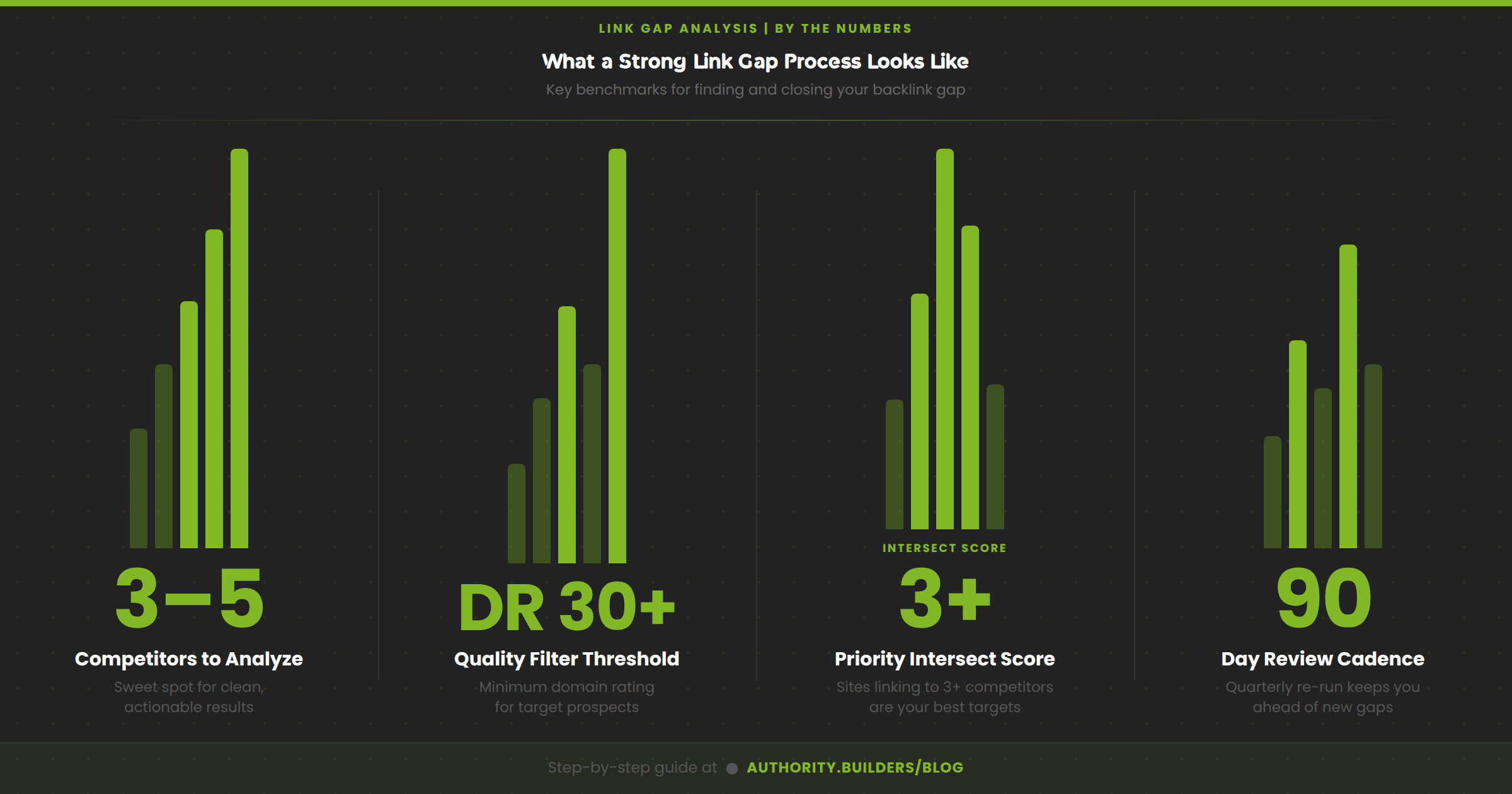
Three to five is the sweet spot. More than that introduces noise. Less than that gives you a thin prospect pool.
Step 2: Run the Link Intersect Report
This is the core of the analysis. In Ahrefs, this feature is called Link Intersect, and it’s available under the Competitive Research section.
Here’s how to run it:
- Go to Ahrefs > Competitive Research > Link Intersect.
- In the top field, enter your domain.
- In the fields below, enter your 3 to 5 competitors.
- Hit Show link opportunities.
Ahrefs will generate a list of referring domains, along with an Intersect number for each. A score of 3 means all three of your competitors get links from that domain. A score of 1 means only one competitor does.
What to prioritize:
- High intersect scores first. If 3 or 4 competitors all have a link from the same domain, that site is clearly willing to link out in your niche. Those are your best targets.
- Domain Rating 30+. Filter the list by DR to remove low-quality domains that won’t move the needle. Links from sites with DR below 20 rarely drive meaningful ranking or authority signals.
- Real traffic. Check that the referring domain gets organic traffic. A site with DR 50 but zero visitors is often a link farm or a dead site. You can check this in the same Ahrefs interface.
If you’re using SEMrush instead, the equivalent tool is the Backlink Gap tool under Competitive Research. The workflow is nearly identical.
Step 3: Qualify the Opportunities
Exporting a list of 500 domains is easy. Knowing which ones are actually worth pursuing takes judgment.
For each domain in your list, ask these questions:
- Is it topically relevant? A DR 60 tech blog isn’t a great fit if you’re in finance. Relevance still matters, both for Google and for the editorial gatekeepers you’ll be contacting.
- Does it have real content? Open the site. Is there an active blog with real authors? Is the content well-written? Or does it look like a content mill with dozens of unrelated guest posts?
- Is it link-diverse? Check how many outbound links the site has. A site with 10 outbound links on its entire domain is much more valuable than a directory with 10,000.
- Has it linked to content like yours before? If your competitors have guest post links from this domain, it means the site accepts contributor content. That’s a strong signal for your outreach approach.
Sort your qualified prospects into tiers:
- Tier 1: High DR, high intersect score, topically relevant, accepts editorial content. These are your priority targets.
- Tier 2: Strong DR and relevance, but lower intersect score. Worth pursuing after Tier 1.
- Tier 3: Lower DR or relevance, but potential for a link insertion or brand mention. Good for filling out volume.
Document everything in a spreadsheet. Include the domain, DR, monthly traffic, intersect score, what type of link placement looks viable, and which page on your site you want to target.
Step 4: Build Your Prioritized Outreach List
Once you’ve qualified your prospects, the next step is sequencing. Here’s the order we recommend:
- Highest intersect, highest DR, most relevant first. These are the sites everyone in your niche links to. Getting a link here has a disproportionate impact on your perceived authority.
- Sites that already accept contributor content. If you can confirm via your competitor’s backlink that this domain published a guest post, your pitch has a much higher conversion rate.
- Sites with an existing URL that could accept a link insertion. Sometimes the fastest path to a link isn’t a new post, it’s adding a link to a relevant existing article. Look for pages that mention your topic but don’t link to your site.
One thing we see teams skip: personalizing the outreach. When you know a site already links to 3 of your competitors, you can reference that in your pitch. “I noticed you’ve covered [topic] and linked to X, Y, and Z. We’d love to be part of that conversation.” It signals that you’ve done your homework and that the link makes editorial sense.
For a full breakdown of how to structure a link building campaign from this point forward, check out our guide to building a link building plan.
Step 5: Close the Gap
Now comes the actual link building. The tactics you use depend on what type of placement makes sense for each prospect.
Guest Posts
If a site publishes contributor content and your competitor has a guest post there, that’s your opening. Pitch a unique angle on a topic the site hasn’t covered. Guest posts remain one of the most reliable ways to earn editorial links from exactly the kinds of domains that show up in link gap reports.
Link Insertions
Sometimes the more efficient path is getting your link added to content that already exists. If a target domain has a post on your topic that links to a competitor but not you, reach out and pitch your page as a resource worth adding. Link insertions are faster than guest posts and often just as effective when the placement is contextually relevant.
Earned Media and Digital PR
For high-authority news and media sites that you can’t approach through traditional guest posting, earned media is the route. If a publication links to your competitors but not you, it’s often because they’ve covered your competitors in editorial pieces. Building a PR-driven strategy to earn that same coverage is the long game, but it’s the one that moves brand authority signals the most, including for AI search.
Once you start closing gaps, track your progress. Update your spreadsheet with each link acquired and re-run the analysis quarterly to catch new opportunities as your competitors build out their profiles.
How Often Should You Run a Link Gap Analysis?
Once a quarter is the baseline for most campaigns.
Your competitors aren’t standing still. They’re building new links every month. If you only run this analysis once and call it done, you’ll find yourself falling further behind over time.
A quarterly cadence lets you:
- Catch new high-value referring domains your competitors have earned
- Identify sites where a competitor lost a link (an opening for you)
- Track whether your gap is narrowing as your outreach builds momentum
You should also run a fresh analysis any time you’re targeting a new keyword cluster, launching a new service page, or entering a new vertical. Different pages attract different link profiles, and the gap looks different depending on the page you’re building authority for.
Best Tools for a Link Gap Analysis
You need an SEO tool with a strong backlink database to do this properly. Here are the main options:
- Ahrefs Link Intersect: The most intuitive option for this specific workflow. The intersect scoring makes it easy to identify high-priority domains at a glance. Available on the Standard plan ($199/month) and above.
- SEMrush Backlink Gap: Nearly identical functionality under Competitive Research. If your team already uses SEMrush for keyword research, you can run the full analysis in one platform.
- Moz Link Explorer: A solid option for qualifying link prospects once you have your list. DA and spam score filters help sort the good from the garbage.
- Majestic Clique Hunter: A unique visualization tool that maps which sites link to multiple competitors simultaneously. Especially useful for identifying niche authority hubs.
All four tools pull from different data sources, so running the same analysis across two platforms and cross-referencing the results can surface opportunities that any single tool would miss. That’s the approach we take when building link gap reports for clients through our managed link building service.
Common Mistakes to Avoid
Even with the right tools, a few recurring mistakes can undermine the whole analysis:
- Using too many competitors. More than five introduces noise. You end up with hundreds of prospects that don’t reflect your actual competitive reality.
- Chasing DR over relevance. A DR 70 fitness site isn’t useful if you’re in B2B software. Domain Rating matters, but only in context.
- Not checking for real traffic. High DR with zero organic traffic is a red flag. It usually means the site was built for links, not content.
- Treating the output as a finished list. The raw export is a starting point. Every domain needs a manual check before it goes into your outreach sequence.
- Running the analysis once. A link gap analysis is a recurring process, not a one-time audit. Set a calendar reminder for quarterly reviews.
A Note on AI Visibility
We’d be leaving out an important dimension if we didn’t mention how link gap analysis connects to AI search.
As we’ve covered in our guide to what AEO means for modern marketing, AI models like ChatGPT don’t rank sites the same way Google does. But they do draw heavily from the same high-authority, frequently-cited sources that show up in link gap reports.
When you close a link gap with a DR 70 industry publication, you’re not just winning a backlink for Google. You’re getting your brand and content into the ecosystem that AI models treat as trusted reference material. Those editorial placements show up in training data, in citation pools, and in the web retrieval systems that tools like Perplexity and AI Overviews use to generate answers.
For a deeper look at how this works, read our breakdown of how ChatGPT citations work.
Let Authority Builders Close the Gap for You
Running a link gap analysis gives you a clear, data-driven target list. But the outreach, relationship management, and placement work that comes after it takes real time and expertise.
Our ABC Plus managed link building service includes a full competitor backlink gap analysis as part of the campaign setup. We identify the highest-leverage domains in your niche, qualify each prospect manually, and then build the links through a combination of guest posts, link insertions, and earned media depending on what each site calls for.
Every placement is editorial. Every domain is vetted. And every link is the kind that moves authority signals for both Google and AI search.
If you’re ready to stop building links blindly and start closing the gap on your competitors, get in touch and we’ll run the analysis for you.
Conclusion
A link gap analysis is one of the highest-leverage things you can do before spending a dollar on link building. It turns your competitors’ backlink profiles into a curated list of pre-qualified prospects, sites that have already shown they link out to businesses in your space.
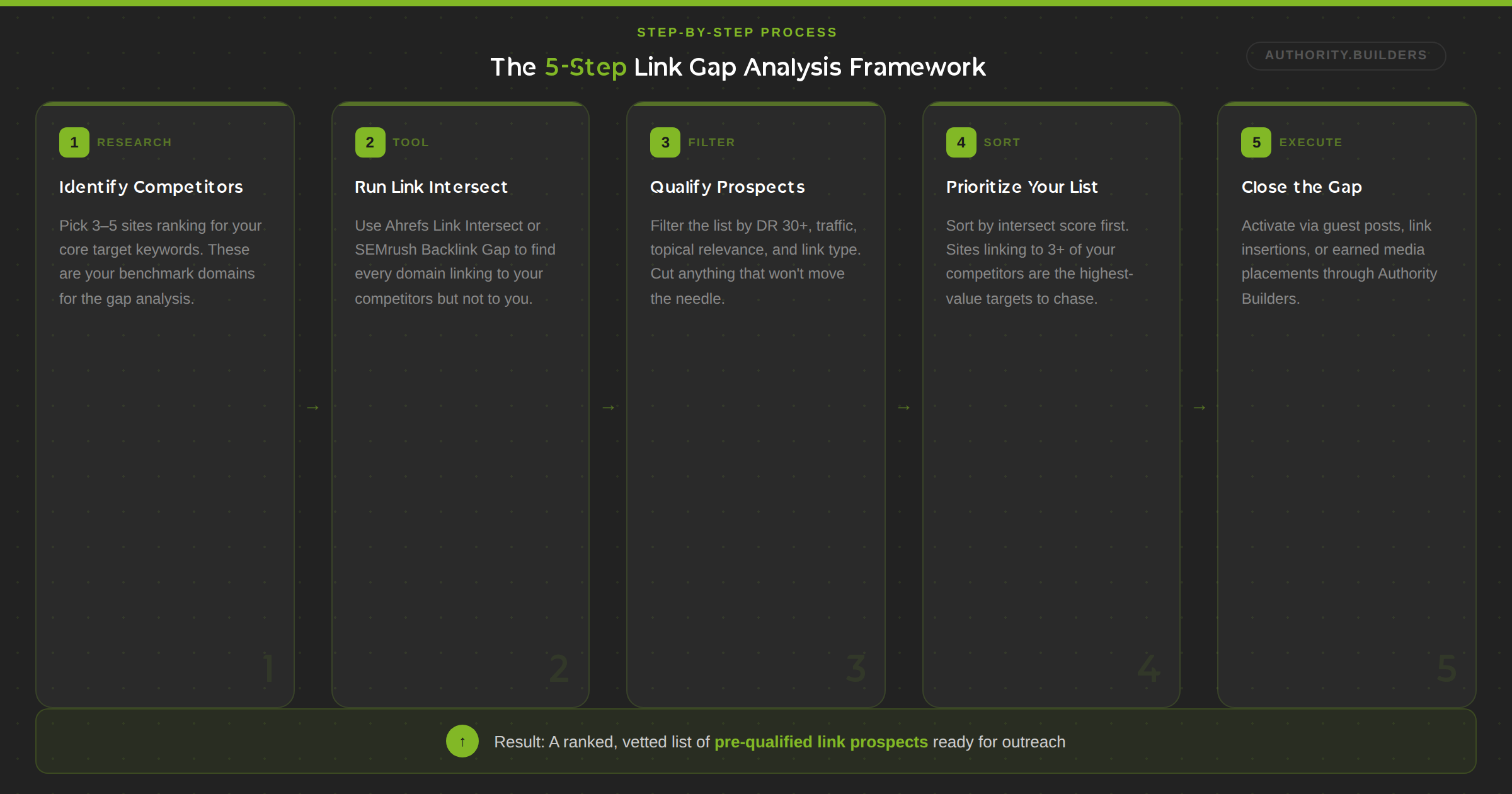
The process itself isn’t complicated:
- Identify your real SEO competitors
- Run the Link Intersect report in Ahrefs or SEMrush
- Qualify each domain for relevance, DR, and traffic
- Prioritize your outreach by intersect score and link type
- Build the links through guest posts, insertions, or earned media
Do this quarterly and you’ll consistently stay ahead of the gaps that open up as your competitors keep building.