
How to Get Into “Best Of” Listicles (and Why AI Engines Cite Them Before They Cite You)
Corey Batt
Ask ChatGPT, Perplexity, or Google’s AI Mode for “the best [thing you sell]” and watch what it cites.
Odds are it isn’t your homepage. It isn’t your product page either. It’s a “7 Best Whatever for Whoever” article on somebody else’s site, and the brands inside that article are the brands that get named in the answer.
Here’s the thing: you can’t control what an AI engine says about your category. But you can influence which roundups it reads before it says it.
That’s what listicle link building is. It’s the work of getting your brand placed, accurately and near the top, inside the “best of” articles that AI engines and buyers already trust. Our sister brand The HOTH covered why AI cites listicles more than it cites you in a recent citation study. This post is the practical follow-up: how you get on those lists.
We’ll cover how to find the roundups that shape your category, how to earn a spot, how to write an entry a model can quote, and how to stay on the right side of Google’s policies while you do it.
Why AI Engines Reach for Listicles First
When someone asks an AI assistant to recommend something, they’re asking it to compare options. And the pages that already contain a comparison are roundups.
The data on this is consistent across studies.
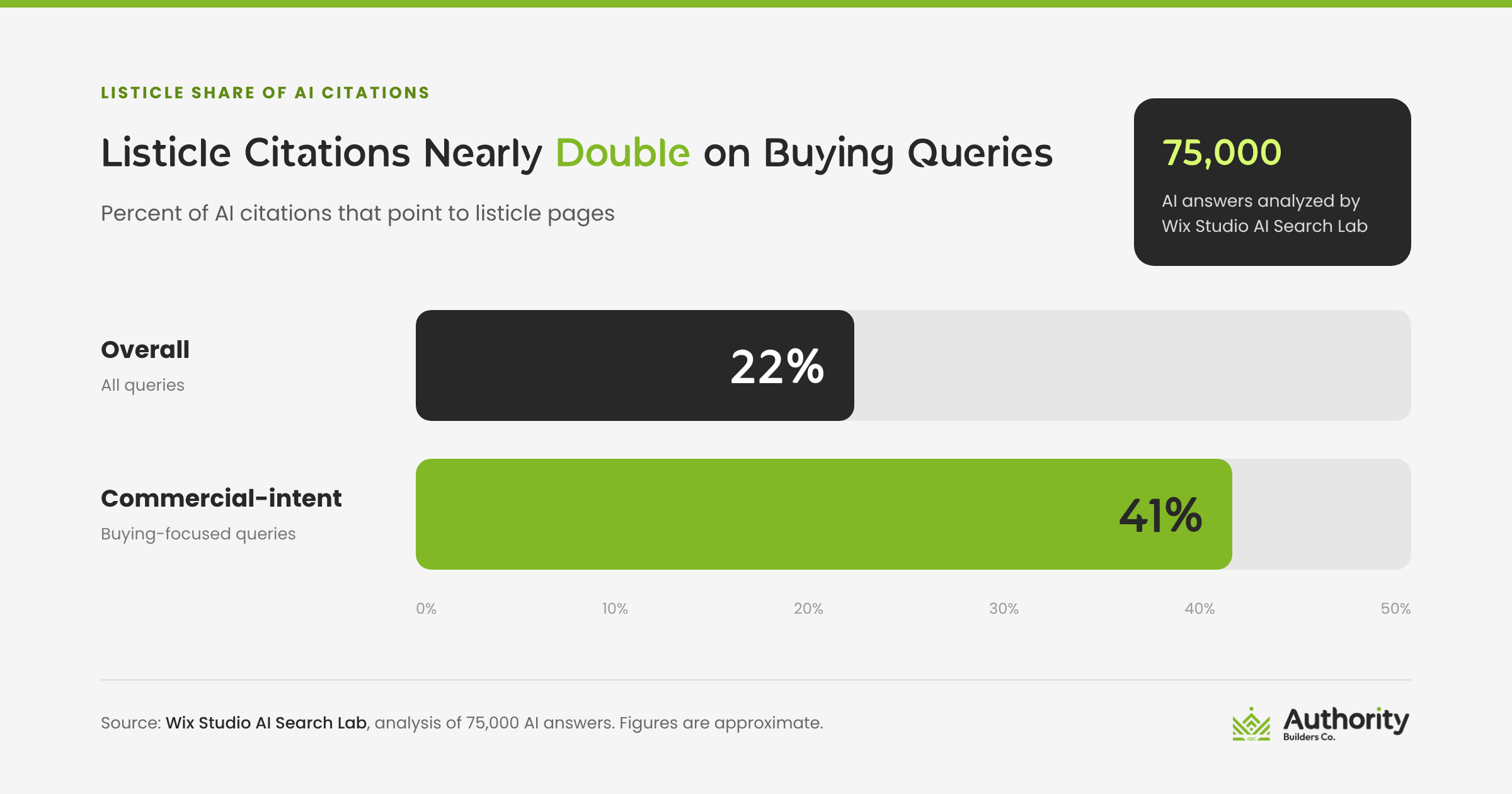
The Wix Studio AI Search Lab analyzed 75,000 AI answers and more than a million citations across ChatGPT, Google AI Mode, and Perplexity in its research on the content types most cited by LLMs. Listicles were the most cited format overall at roughly 22% of citations. For commercial queries, the “help me choose” prompts, that share jumped to about 41%, more than any other content type by a wide margin.
AirOps found a similar pattern from a different angle. Its report on the influence of offsite signals in AI search looked at 21,311 brand mentions across GPT-5, Claude, and Perplexity for discovery-stage commercial queries. Here’s what it found:
- 85% of brand mentions came from third-party domains, against 13.2% from the brand’s own site
- Nearly 90% of those third-party mentions came from listicles, comparisons, or reviews
- 80% of brands in those cited pages appeared as one of the first three companies discussed
That last stat matters more than it looks. It suggests position inside the list carries weight, not just inclusion.
Why the format wins
Google’s own documentation explains a lot of the mechanics. Its guide to optimizing for generative AI features in Google Search describes two processes worth understanding:
- Retrieval-augmented generation: the AI feature pulls relevant pages from the search index and builds its answer from the information in them, with links to the pages that support it
- Query fan-out: the model fires off several related sub-queries to gather more results before answering
Put those together and the listicle advantage makes sense. A good roundup names several brands, compares them on the attributes buyers care about, and answers a handful of those fan-out sub-queries on a single page. It’s already shaped like the answer the model is trying to write.
Your product page, by contrast, answers questions about you. That’s useful once a buyer is verifying details. It’s not what gets retrieved when they’re still asking who to consider.
Not Every Listicle Is Worth Chasing
Before you start pitching, get clear on what a good target looks like. A placement on the wrong list is wasted effort at best and a policy risk at worst.
Here’s what we look for.
It’s on a third-party site
This one is non-negotiable. In the same Wix research, third-party listicles accounted for 80.9% of listicle citations in professional services, while self-promotional lists, the kind where a brand ranks itself first, accounted for just 19.1%.
Your own “best tools for X” post still has a job. It just isn’t this job.
It matches a commercial-intent query
The list should answer a question a real buyer types when they’re shortlisting. “Best reclaimed brick suppliers in the US” is a buying question. “History of brick manufacturing” isn’t. Remember, listicles dominate commercial prompts specifically, so that’s where the payoff is.
The publisher stands behind it
Google’s spam policies for Google web search include a site reputation policy aimed at third-party content hosted on a strong domain mainly to borrow its ranking signals. When Google reviews a page under that policy, it looks at factors like:
- Whether the design and formatting match the rest of the publication
- Whether the quality matches the host site’s normal standard
- Whether authorship and editorial responsibility are clear
- Whether the same content appears on multiple other sites in near-identical form
Use that as your vetting checklist. A roundup that sits inside a real section of the site, carries a byline, and reads like the publication’s other work is a much safer bet than an orphaned page nobody on staff would claim.
It’s fresh, or about to be
Lists with a year in the title get refreshed. A list that hasn’t been touched in two years is less likely to be retrieved, and less likely to have an editor who’s looking for new entries.
How to Find the Listicles That Already Shape Your Category
Don’t guess which roundups matter. Go find the ones AI engines are already citing for your buying queries.
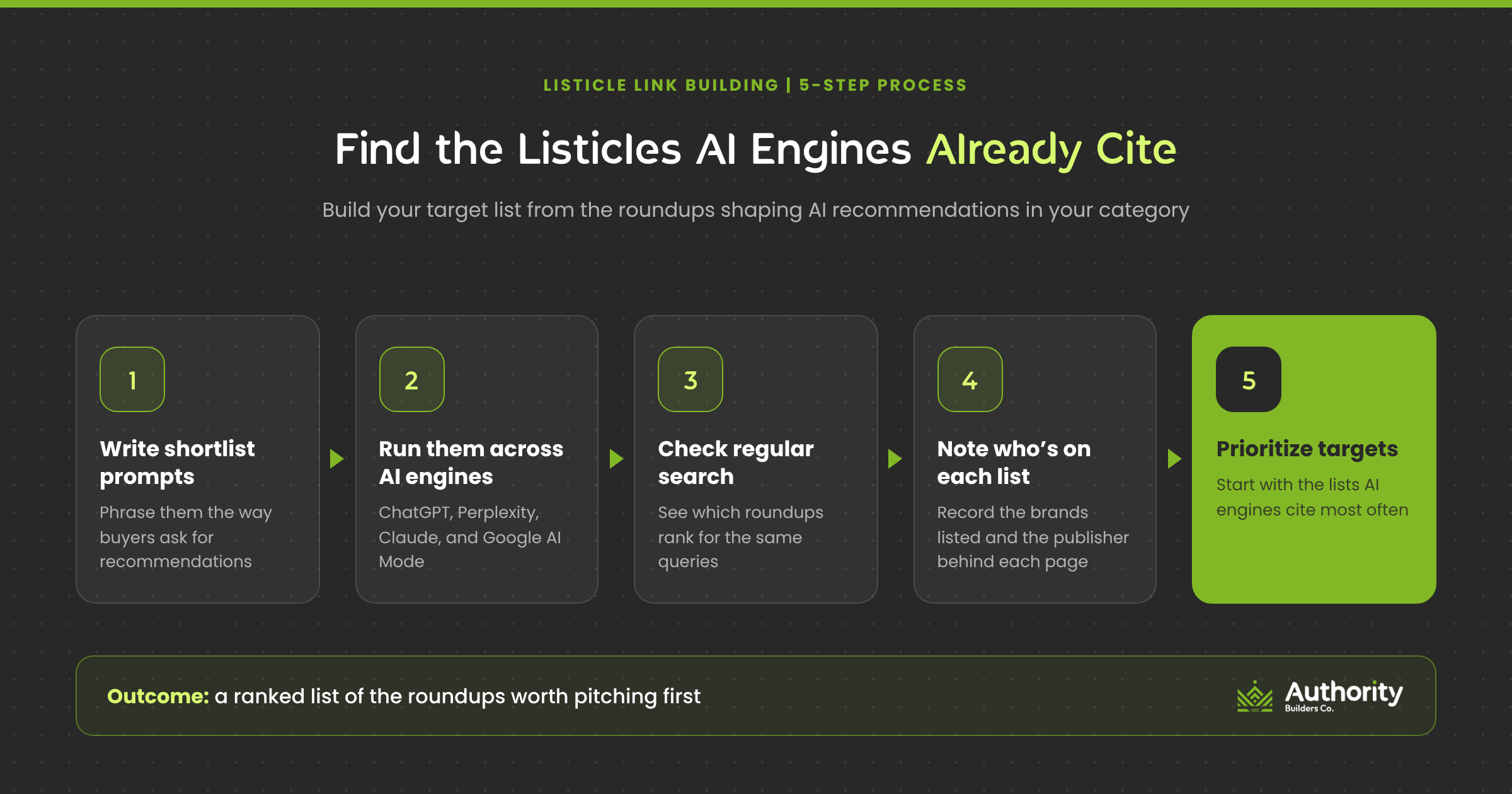
Step 1: Write down your shortlist prompts. List the 10 to 20 questions a buyer asks when they’re choosing a provider in your category. Think “best,” “top,” “alternatives to,” and “for [use case]” phrasings.
Step 2: Run them across engines. Use ChatGPT, Perplexity, Claude, and Google’s AI Overviews or AI Mode. Run each prompt in a fresh session and record every cited URL.
Step 3: Run them through regular search too. Google the same phrases and note which roundups rank on page one. Google’s AI features are built on its core ranking systems, so the pages that rank well are strong retrieval candidates.
Step 4: Note who’s on each list. If three competitors appear on a roundup and you don’t, that page goes near the top of your target list.
Step 5: Prioritize. Rank targets by how often they’re cited, how relevant they are to your best-fit buyers, and how recently they were updated.
One more thing to plan for: AI engines don’t agree with each other. AirOps found that nearly 68% of brands showed up on only one of the AI platforms it tested. A placement that wins in Perplexity might not register in ChatGPT, so you want coverage across several lists, not one.
How to Earn a Spot on an Existing List
Once you know which lists matter, you need to give the person who maintains each one a reason to add you.
Time your outreach to the refresh cycle
Roundups with a year in the headline usually get updated before that year rolls over. Editors planning their 2027 updates are building their shortlists now, which makes the next few weeks a strong window for outreach.
Find the right person
Look for the byline on the article, then check whether the publication has a commerce, reviews, or guides editor. Pitch the person who owns the update, not a general inbox.
Make it easy to say yes
Editors maintaining a roundup need three things from you:
- A clear reason you belong. What makes you different from what’s already on the list? A specific use case, a pricing model, a capability nobody else offers?
- Verifiable facts. Founding year, scale, certifications, notable clients you’re allowed to name, what you ship or deliver
- Access. A product sample, a trial account, a demo, or a call with someone who knows the product
Keep the pitch short. Four or five sentences, one clear ask, and a link to a page with your key facts in one place.
Don’t offer money for a followed link
This is where a lot of DIY listicle campaigns go wrong. Google’s link spam policy specifically lists exchanging money, goods, or services for links that pass ranking credit, including advertorials and native ads with followed links. Sending a product in exchange for coverage that includes a link is on that list too.
Pitching an editor on merit is fine. Offering to pay for a do follow link in their roundup is not. We’ll come back to this below.
Build one more path in: your own facts page
Editors and AI systems both lean on the facts you publish about yourself. Make sure your site has a page that states, plainly, what you do, who you serve, where you operate, and what makes you distinct. AirOps found product pages and homepages made up more than a quarter of first-party mentions, mostly when buyers moved from “who should I consider” to “show me the details.” That page is your verification layer.
Write the Entry a Model Can Quote
Getting on the list is half the job. The other half is what the list says about you.
A model can’t restate an adjective. It can restate a fact.
Compare these two entries:
- Weak: “A trusted, innovative leader offering top-quality products and outstanding service.”
- Strong: “A national supplier of reclaimed full-size brick, thin brick, and street pavers, salvaged from historic buildings in New York and the Midwest and shipped nationwide.”
The first one could describe anyone. The second one gives a retrieval system specific claims it can match to a query and repeat in an answer.
What we saw with one AB Listicles client
We placed a national reclaimed brick supplier in a regional daily newspaper’s roundup of the best reclaimed brick suppliers in the US. The entry was built around verifiable specifics: national scale, the material types offered, and the regions the brick is salvaged from. No superlatives.
In the weeks after the article went live, we ran the buyer query “reclaimed brick supplier USA” across three AI platforms:
- Claude named the client first and sourced the newspaper roundup
- Google AI Overviews surfaced the client in the overview panel, citing the same roundup
- ChatGPT cited the identical roundup for the client
One placement, three engines, the same source every time. That’s the compounding effect of getting onto a page AI systems already retrieve for a buying question. The usual caveat applies: AI answers vary by session, account history, and location, so treat any single result as a snapshot, not a guarantee.
Entry checklist
- Lead with what you are and who you serve, in one sentence
- Include two or three facts a buyer could verify (scale, specialty, location, credentials)
- Name the use case where you’re the strongest pick
- Use the same brand name, spelling, and description everywhere so the mention maps to one entity
- Skip the hype words entirely
The Link Question: What Google Allows and What AI Reads
Let’s be direct about this, because it’s where listicle link building gets misunderstood.
There are two separate things happening when you’re placed in a roundup:
- A mention. Your brand is named and described on a page that AI engines retrieve. This is what gets you into the answer.
- A link. There may also be a hyperlink to your site, which is what traditional link building is concerned with.
Google is clear that buying and selling links is a normal part of advertising, and that it’s not a policy violation as long as paid links are qualified with a rel=”sponsored” or rel=”nofollow” attribute. What the policy targets is paid placement that passes ranking credit.
Google’s AI guide also warns that chasing inauthentic mentions isn’t as helpful as it might seem, because the same quality and spam systems sit underneath AI Overviews and AI Mode.
So here’s how we’d think about it:
- Earned inclusion on merit, where an editor adds you because you belong, is the cleanest path and carries no policy questions
- Any paid or sponsored placement should be on a publisher that discloses it and integrates it like the rest of its editorial work
- Judge every placement first on the quality of the mention and the page, and only second on the link
If a provider can’t tell you how a placement is disclosed, who edits it, and what section of the site it lives in, that’s your answer.
How to Measure Whether It’s Working
Rankings alone won’t tell you much here. Track these instead:
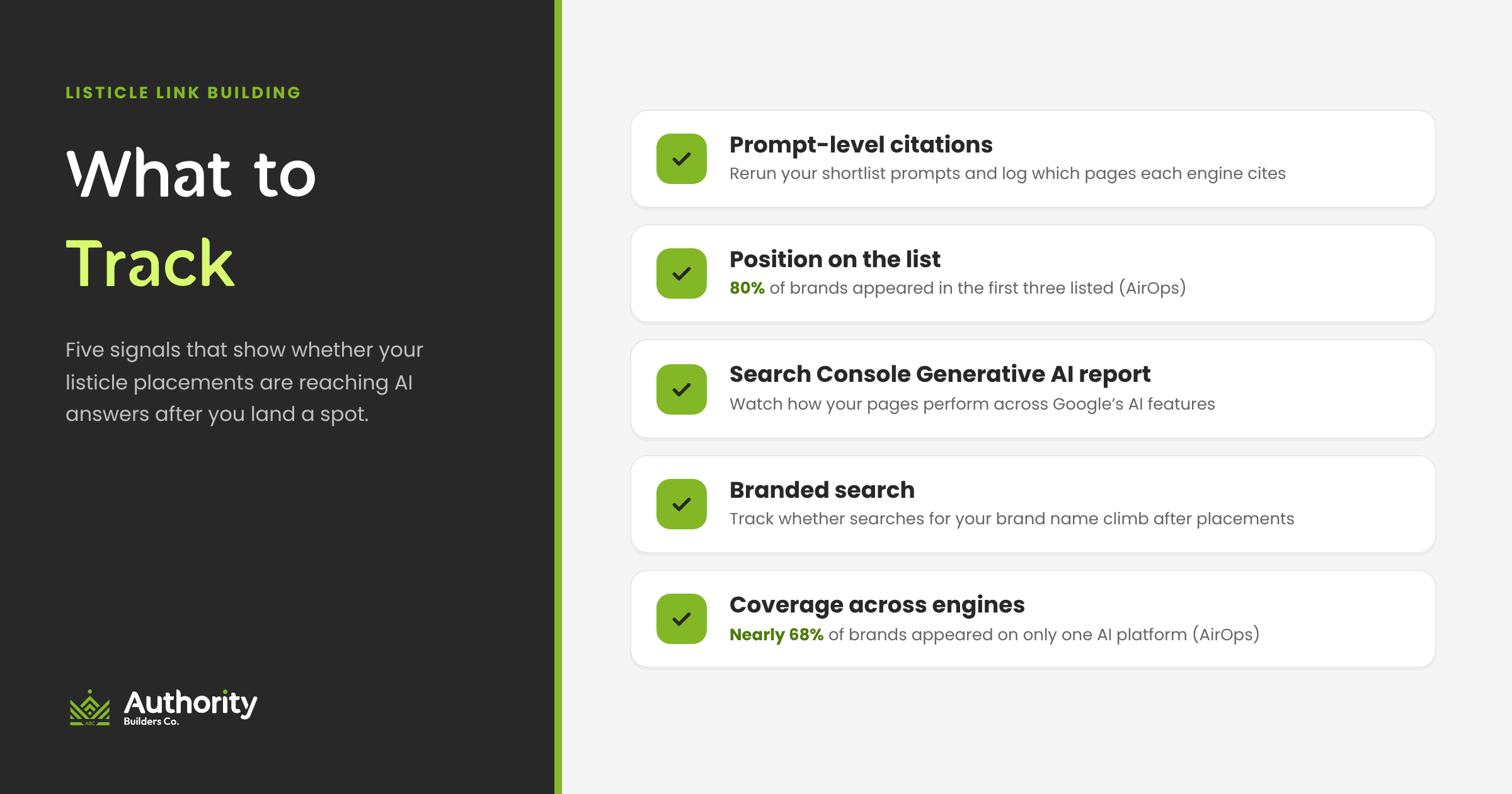
- Prompt-level citations. Re-run your shortlist prompts monthly across engines. Log whether you’re named, where in the answer, and which page is cited.
- Position on the list. Are you in the top three? Given the AirOps finding on early placement, this is worth tracking separately.
- Google’s own data. Google points site owners to the Generative AI performance report in Search Console for visibility in its AI features.
- Branded search. If buyers are seeing you in AI answers, more of them will search your name directly.
- Coverage across engines. Because so many brands show up on only one platform, count how many engines name you, not just whether one does.
Expect variance. Run each prompt more than once, keep screenshots with dates, and look at the trend rather than any single check.
When to Do It Yourself and When to Hand It Off
If you have one or two target lists and a strong story, DIY outreach is worth a shot. Use the steps above, pitch on merit, and track your prompts.
If you need presence across several roundups at once, or you don’t have editor relationships in your category, that’s what our Listicles bundle is built for. We handle the strategy, the writing, and the placement, and we build every entry around the kind of verifiable facts that survive the trip from article to AI answer. Bundles start at $2,200 for five placements, with a 10-pack at $4,200.
Listicles work best alongside other third-party coverage. If you’re also chasing press and broader brand mentions, our Earned Media service and Digital PR Plus campaigns build the news coverage that rounds out your footprint. For more on that side of the strategy, our guide to why AI rewards brands with news coverage breaks down how news outlets act as trust anchors for AI systems, and our post on digital PR for link building covers how earned coverage turns into rankings and citations.
FAQs
What is listicle link building?
Listicle link building is the practice of getting your brand included in “best of” and “top ranked” articles on third-party sites. The goal is twofold: earn a mention on pages buyers read while comparing options, and appear in the sources AI engines retrieve when answering recommendation questions.
Why do AI engines cite listicles so often?
Because recommendation questions are comparison tasks, and listicles are already structured as comparisons. Wix Studio’s AI Search Lab found listicles accounted for about 41% of citations on commercial-intent queries. AirOps found nearly 90% of third-party brand mentions in AI search came from listicles, comparisons, or reviews.
Does publishing my own “best of” list work?
Not for this purpose. Wix’s research found third-party listicles drove about 81% of listicle citations in professional services, compared to about 19% for self-promotional lists. Your own comparison content can still help buyers, but third-party inclusion is what moves AI recommendations.
Do I need to be ranked first on the list?
Not necessarily, but it helps. AirOps found 80% of brands in cited third-party content appeared as one of the first three companies discussed. Aim for the top three, and make sure your entry is specific enough to be quoted wherever it sits.
Is paying for listicle placements against Google’s guidelines?
Paying for placement isn’t automatically a violation, but paying for links that pass ranking credit is. Google’s spam policies say paid links should carry a rel=”sponsored” or rel=”nofollow” attribute. Vet any provider on disclosure, editorial integration, and where the content lives on the publisher’s site.
How long does it take to see AI citations from a listicle placement?
It varies by engine and how quickly the page is indexed and retrieved. In the client example above, the placement was being cited across three AI platforms within weeks of publication. Track your prompts monthly and expect results to differ by platform.
Get On the Lists That Shape the Answer
AI engines don’t recommend brands at random. They recommend the brands named in the roundups they retrieve, and they lean hardest on the names near the top.
That makes “best of” listicles one of the most direct AEO moves you can make. Find the lists that already shape your category, earn your way on with facts instead of adjectives, keep your placements on the right side of Google’s policies, and track the result prompt by prompt.
Want help getting your brand into the roundups AI engines already cite? Book a strategy call with our team and we’ll map the listicles that matter in your category.