
Ask three link builders what a niche edit is and you’ll get three answers. One will tell you it’s the same thing as a link insertion. One will tell you it’s a link on a hacked or expired domain. And one will quietly change the subject.
That confusion isn’t just semantics. It shapes how you buy links, which pages you point them at, and whether the placement you paid for passes any ranking value at all. So in this post we’re going to settle the vocabulary, explain how link equity moves through an existing page, and give you a clear rule for when an insertion beats a fresh guest post (and when it doesn’t).
Here’s the thing: the mechanics haven’t changed since Google was a Stanford research project. What’s changed is how good Google has become at telling an editorial link from a manufactured one. Once you understand that, the niche edits vs link insertions debate mostly resolves itself.
Are Niche Edits and Link Insertions the Same Thing?
Functionally, yes. Both terms describe placing a link inside content that already exists on someone else’s site, rather than publishing a new article to carry it.
The difference is history, not mechanics. “Niche edit” came out of the affiliate SEO world in the mid-2010s, and for a stretch the phrase was attached to some ugly tactics: links dropped into expired domains, private blog networks, and in the worst cases, pages the seller didn’t have permission to edit. “Link insertion” was the cleaner label that outreach-based agencies adopted to describe the same placement done the right way, with the site owner adding the link themselves.
At Authority Builders we use “link insertions” for exactly that reason. Every placement in our Link Insertions service is secured through outreach and added by the webmaster. Nothing is hacked, nothing is injected, and every domain has at least 1,000 monthly organic visitors in Ahrefs. If someone sells you a “niche edit” and can’t tell you who added the link and how, that’s your answer.
So for the rest of this post, treat the two terms as interchangeable. The interesting question isn’t what to call them. It’s why a link inside an existing page can outperform a link inside a brand new one, and under what conditions.
How Link Equity Flows Through an Existing Page
Let’s break down the mechanics, because this is where insertions earn their keep.
Google’s original ranking model, described in Brin and Page’s paper The Anatomy of a Large-Scale Hypertextual Web Search Engine, treats a link as a vote weighted by the importance of the page casting it. Two details in that paper matter enormously for insertions:
- A page’s vote is split across its outbound links. The PageRank formula divides each linking page’s score by the number of links on it. A link from a page with three outbound links carries more weight than a link from a page with thirty.
- The page has to have accumulated importance to pass any. A page earns its score from the pages linking to it, which means a URL with its own backlinks, internal links, and crawl history has something to give. A URL published yesterday does not.
Google has moved far beyond that 1998 formula, and the current guide to ranking systems describes link analysis as one signal among many rather than the whole game. But the underlying logic still holds: equity flows from pages that have it, and an existing page that ranks, gets traffic, and has its own referring domains is holding equity right now.
Compare the two placement types on that basis:
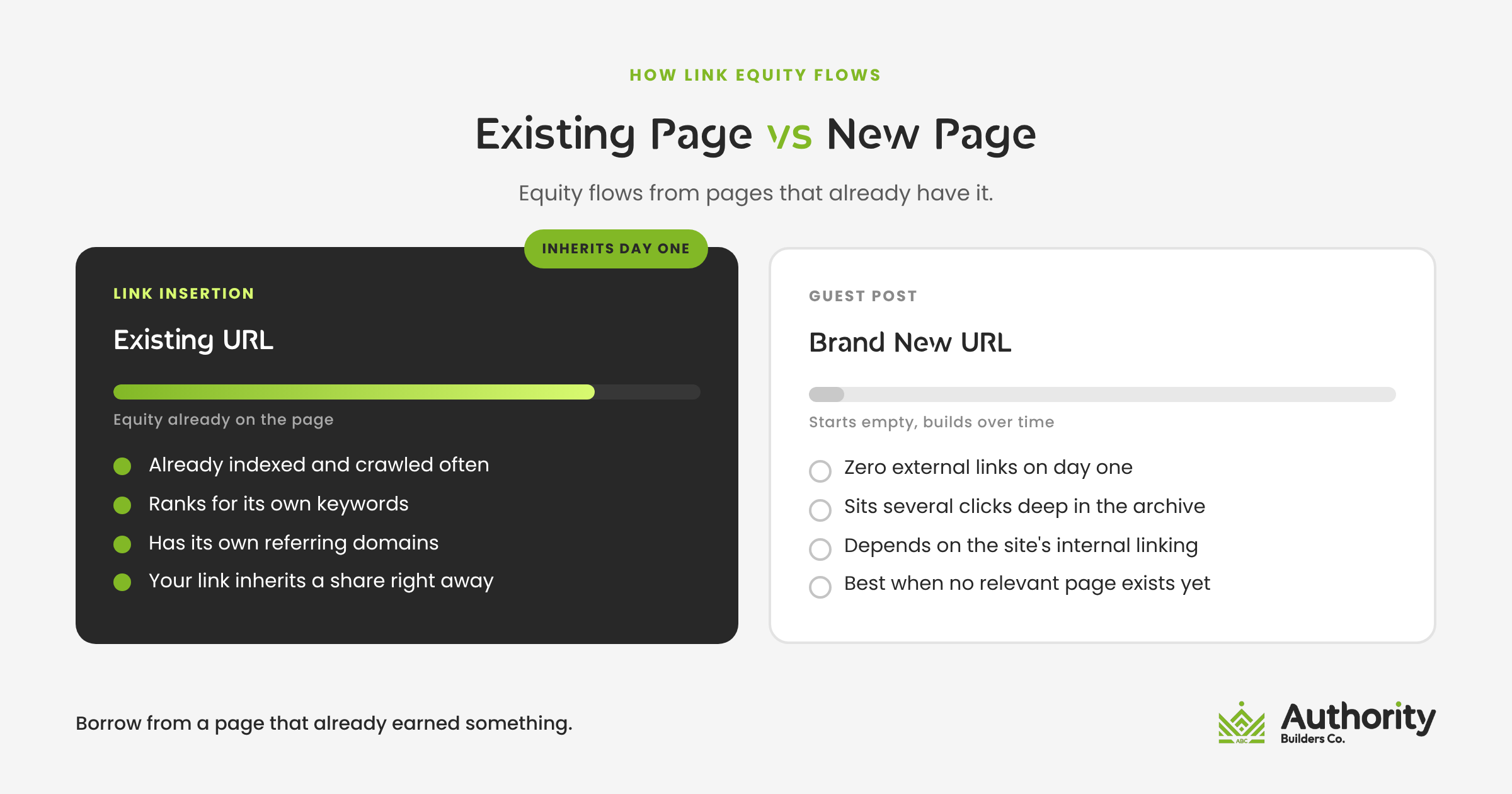
- A guest post is a new URL. On day one it has zero external links, sits several clicks deep in the archive, and depends entirely on the domain’s internal linking to receive any authority at all. It can build value over time, but it starts empty.
- A link insertion goes into a URL that already has a track record. If that page is indexed, ranking for its own keywords, and linked from elsewhere on the site or the web, your link inherits a share of what’s already there.
That’s the whole case for insertions in one sentence: you’re borrowing from a page that already earned something, instead of waiting for a new page to earn it.
|
Why Contextual Relevance Decides Whether the Equity Counts
Equity only matters if Google connects the link to your topic. That’s where context does the work.
Brin and Page’s paper made a second point that’s easy to overlook: Google indexes anchor text against the page the link points to, not just the page it sits on. That’s how a link describes its destination. Google’s current link best practices go further and say the words before and after a link matter too, and that anchor text should be descriptive, reasonably concise, and relevant to both pages.
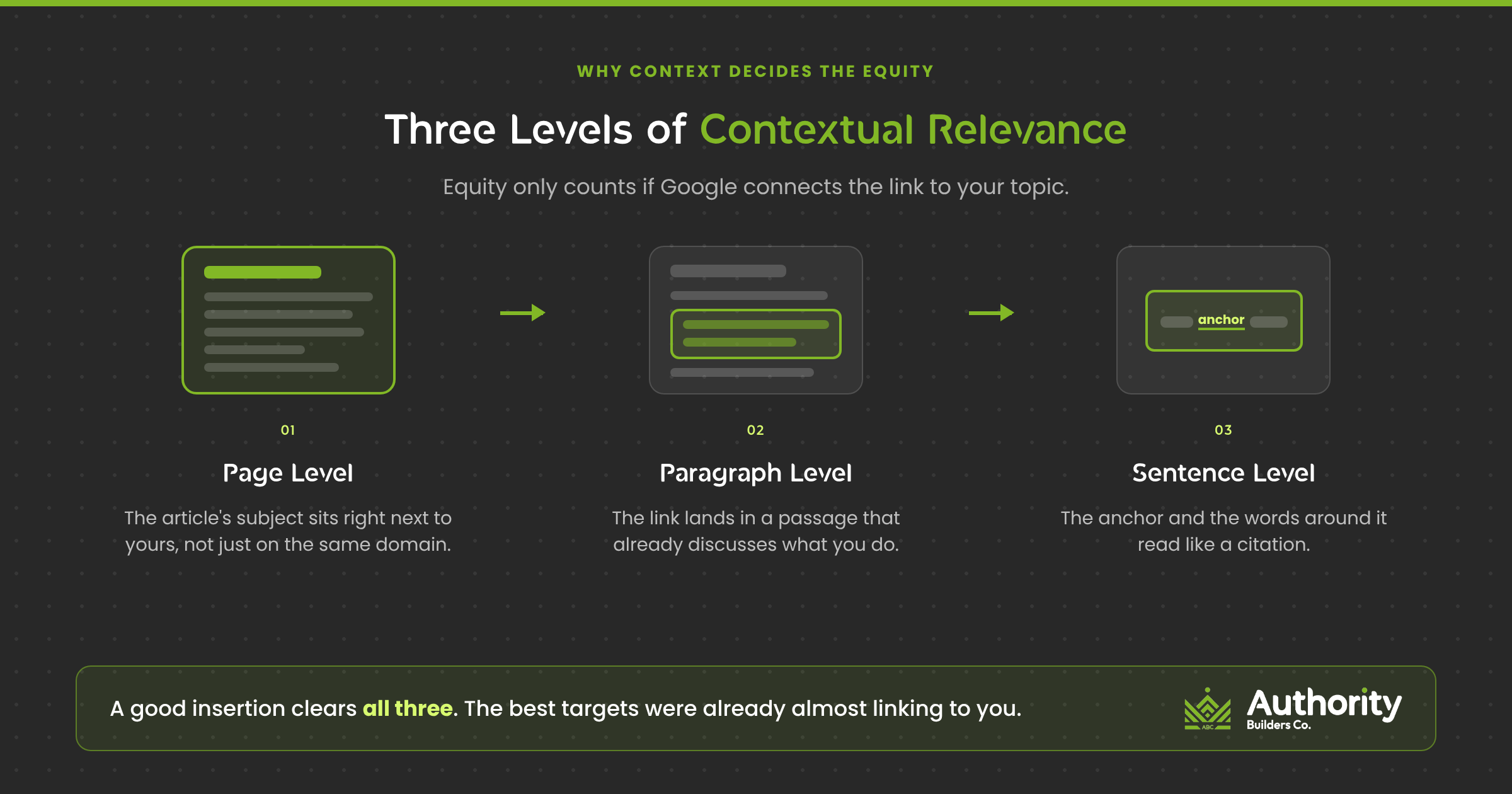
So contextual relevance operates on three levels, and a good insertion should clear all three:
- Page level. The article’s subject should be adjacent to yours. A link to a payroll software page belongs in an article about running a small business, not in a recipe post on the same domain.
- Paragraph level. The link should sit inside a passage that’s already discussing the thing you do. If the webmaster has to write a new paragraph to justify the link, you’re halfway to a guest post anyway.
- Sentence level. The anchor and the words around it should read like a citation. Google’s own example of good external linking is a sentence that names a source and explains what the reader will find there.
This is why we tell clients that the best insertion targets are pages that were already almost linking to you. An article that says “there are several tools for tracking competitor backlinks” is a natural home for a link to a backlink tool. An article that never mentions the topic is not, no matter how strong the domain.
Relevance also compounds. A contextual link on a page that ranks for a related query tends to get crawled often, which means the link is discovered quickly and re-evaluated regularly. A link buried in a page nobody visits and Google rarely re-crawls can take months to register.
When Insertions Beat New Placements
Not every situation calls for an insertion. But in these five, insertions usually win outright.
1. The target page already ranks for a related query
If you can find a page ranking on page one or two for a topic adjacent to yours, an insertion there does two things at once: it passes equity from a page Google already trusts for that subject, and it puts your link in front of real searchers. A new guest post would need months to reach the same position, if it ever did.
2. You need the link to count sooner
New URLs need to be discovered, crawled, indexed, and then linked internally before they carry weight. An existing page skips all of that. Most Authority Builders placements go live within two to four weeks depending on the publisher’s editorial process, and once the insertion is live, it’s already on a URL Google knows.
3. You’ve already published on the site
Publishers have limits on how many guest contributions they’ll take from one brand, and readers notice when the same company shows up in every new article. An insertion into an older post lets you deepen a relationship with a domain without adding another bylined piece.
4. You’re linking to deep pages, not the homepage
Product pages, category pages, and location pages are hard to link to from a guest post without the article feeling like an ad. Existing content that already discusses the specific product category gives you a natural place to link a deep page with a descriptive anchor.
5. Budget efficiency matters
Insertions don’t require writing, editing, or formatting a new article, which is why they typically cost less per link than a guest post on the same domain. When you’re closing a link gap across dozens of pages, that difference adds up fast.
When a Guest Post Still Wins
We’d be doing you a disservice if we pretended insertions were always the answer. A guest post is the better tool when:
- No relevant page exists yet. If the site has never covered your topic, an insertion would be a forced fit. A new article can create the context from scratch.
- You need to control the narrative. Guest posts let you frame the argument, cite your own data, and position your brand the way you want. An insertion inherits someone else’s framing.
- You’re building topical presence, not just equity. Being the author of a piece on an industry site does something for E-E-A-T that a single link in someone else’s article doesn’t.
- The anchor needs its own setup. Some target pages need a full paragraph of context to link naturally. That’s a guest post job.
In practice, most campaigns we run mix both. Insertions carry equity efficiently into pages that need it; guest posts establish new context on domains where none exists. The mistake is treating one as a replacement for the other.
What Separates a Safe Insertion From Link Spam
Let’s address the elephant in the room, because it’s why “niche edits” got a bad name in the first place.
Google’s spam policies are specific about links. Buying or selling links for ranking purposes is listed as link spam, and so are optimized-anchor links placed in articles, guest posts, or press releases distributed for that purpose. The same page says Google understands that buying and selling links is a normal part of the web’s economy, and that such links aren’t a violation as long as they carry a rel=”nofollow” or rel=”sponsored” attribute.
Read plainly, that means the question isn’t whether an insertion is “allowed.” It’s whether the placement looks and behaves like an editorial decision the site owner would defend. In our experience, the placements that hold up over time share four traits:
- The site owner added the link. Not a reseller with a login, and never anyone who gained access without permission. Hacked content is a separate spam policy violation, and it’s the fastest way to lose a placement and a client.
- The page would make sense without the link. The insertion adds a citation to an existing argument. It doesn’t bolt on an unrelated paragraph.
- The anchor reads like a reference, not a keyword. Google’s spam policy literally shows an example of what over-optimized anchors look like, with five exact-match links in three sentences. Don’t build that.
- The site is a real publication. Real organic traffic, real readers, real editorial standards. If the domain exists to sell links, Google’s systems are very good at figuring that out.
The link spam update history is worth reading on this point: Google notes that after a link spam update, cleaning up may not restore lost value. Links that get neutralized stay neutralized. So the cost of a bad insertion isn’t a penalty you can recover from. It’s money that simply stops working.
How to Evaluate an Insertion Opportunity
Here’s the checklist we run before we’ll recommend a specific URL for a client’s link. Steal it.
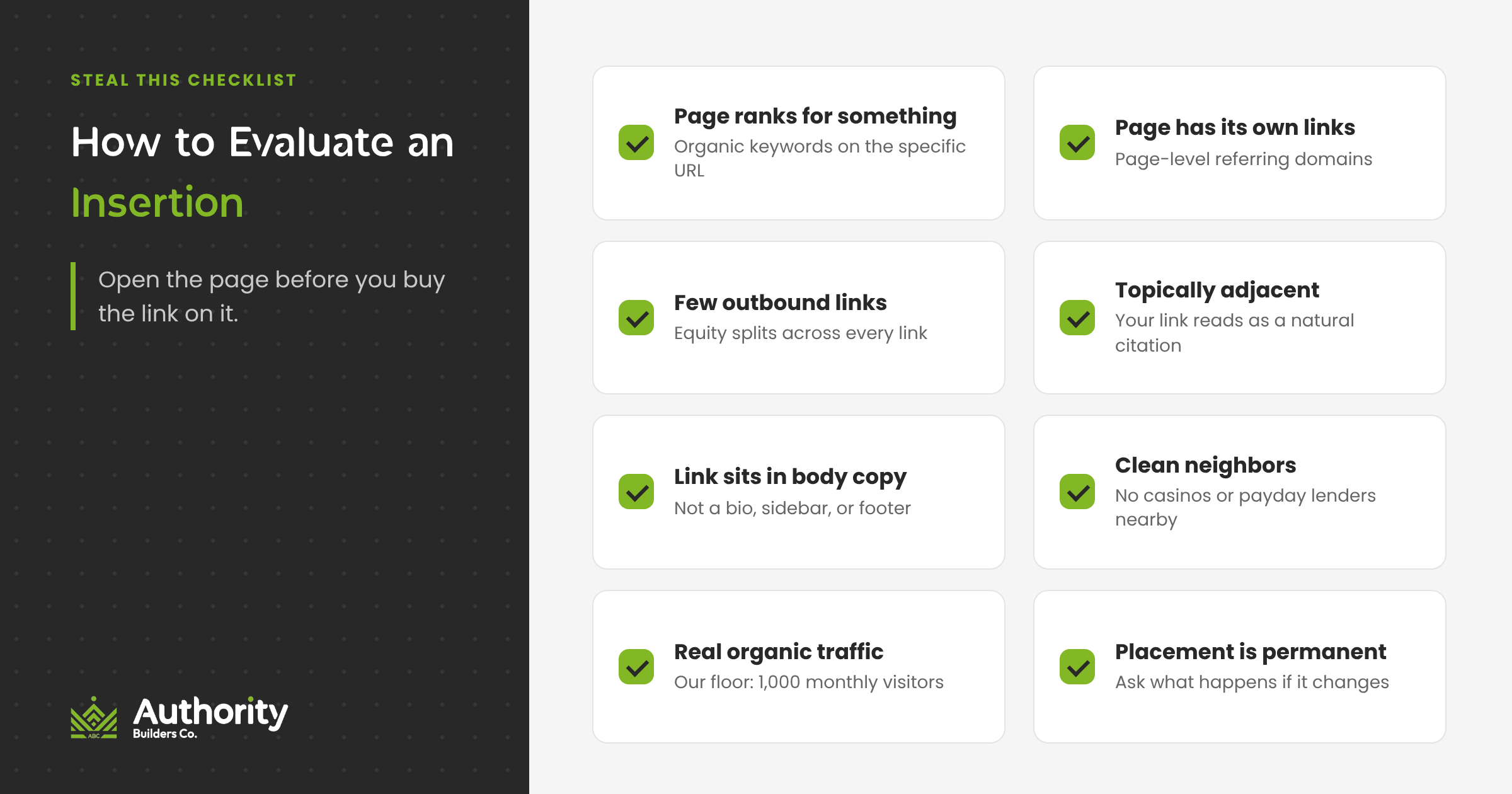
- Does the page rank for anything? Pull the URL in Ahrefs or Semrush. A page with organic keywords is a page Google has judged worth surfacing. A page with none is a question mark.
- Does the page have its own referring domains? Domain-level authority is a proxy. Page-level links are the real source of the equity you’re hoping to inherit.
- How many outbound links are already on it? Remember the split. A page with 8 external links passes more per link than a page with 80. Resource lists and roundup posts are usually poor targets for this reason.
- Is the page topically adjacent to your target? Read it. If you can’t find a paragraph where your link would read as a natural citation, move on.
- Is the link going in the body copy? Author bios, sidebars, and footers pass far less than a link inside the main content, and Google treats widely distributed template links as spam.
- Who else does the page link to? If it already links out to three casinos and a payday lender, your link is joining bad company.
- Does the domain have real traffic? Our floor is 1,000 monthly organic visitors per Ahrefs. That single filter removes most of the link farms from consideration.
- Is the placement permanent? Ask what happens if the link is removed or switched to nofollow. Ours are guaranteed for a year and we replace them if they change.
None of this requires special tools. It requires the discipline to open the page before you buy the link on it.
Anchor Text Strategy for Insertions
Anchor text is where insertions are most powerful and most dangerous, because you’re choosing the words inside a sentence someone else wrote.
Our rule: the anchor should describe the destination in the way the surrounding sentence would naturally describe it. Sometimes that’s your brand name. Sometimes it’s a partial-match phrase. Occasionally it’s the exact keyword, when the sentence is already about that exact thing. What it should never be is a keyword grafted onto a sentence that wasn’t about it.
A healthy mix across a campaign looks something like this:
- Branded and URL anchors as the largest share. They’re the most natural, the safest, and they build entity recognition for both search engines and AI systems.
- Partial-match and descriptive anchors for the bulk of your keyword signal. “a guide to link gap analysis” beats “link gap analysis” in most sentences.
- Exact-match anchors sparingly, only where the sentence already demands it, and never in a pattern across many sites.
Google’s guidance says to write anchors as naturally as possible and resist cramming in every related keyword. That applies with extra force to insertions, because an unnatural anchor stands out even more inside content that wasn’t written around it.
How Insertions Support AI Search Visibility
One more reason insertions have become more valuable in the last two years: AI search systems cite pages that already rank and already carry trust.
Google’s AI Overviews and AI Mode, along with ChatGPT, Perplexity, and the rest, assemble answers from a set of pages they’ve retrieved and judged credible. Those pages skew heavily toward content that already performs in traditional search. When your brand is mentioned and linked inside one of those pages, in a sentence that describes what you do, you’re inserting yourself into the exact context an AI system is likely to pull from.
A new guest post has to earn that standing first. An insertion into a page that’s already being cited in AI answers puts your brand into the answer set immediately. That’s why our AI Plus campaigns lean on contextual insertions alongside earned media: the goal is to get your brand named in the right sentence on pages the models already trust.
For AI visibility specifically, branded anchors and clear descriptive language around the link matter more than keyword anchors. The model needs to understand who you are and what you do, not just which query you’d like to rank for.
Where Link Insertions Fit in Your Campaign
If you’ve read this far, you can probably see where insertions belong in a campaign. They aren’t a replacement for guest posts or high-authority editorial links. They’re the most efficient way to move equity into pages that need it, on domains where relevant content already exists.
Our Link Insertions service handles the outreach, the vetting, and the placement. You send us the URLs you want linked and the anchors you’d like for each, we build a campaign from scratch for your site, and every link goes into real content on a domain with at least 1,000 monthly organic visitors. Placements are added by the site owner and guaranteed for a year.
If you’d rather hand off the whole strategy, including which pages get insertions versus guest posts and what the anchor mix should be, that’s what ABC Plus is built for. It starts with a competitor link gap analysis and an anchor text roadmap, then builds toward your targets month by month with transparent reporting.
Either way, book a call with our team and we’ll look at your link profile together and tell you where insertions would do the most work.
Frequently Asked Questions
Are niche edits and link insertions the same thing?
Functionally, yes. Both place a link inside existing content on another site. “Niche edit” is older and became associated with PBN and hacked-domain tactics; “link insertion” is the term outreach-based agencies use for the same placement done with the site owner’s cooperation.
Do link insertions pass more link equity than guest posts?
Often, in the short term. An existing page already has crawl history, internal links, and often its own backlinks, so a link inside it inherits value immediately. A new guest post starts with none of that and has to earn it over time. Long term, a strong guest post can catch up, especially on a topic the site hadn’t covered before.
Are link insertions safe under Google’s spam policies?
Placements added by the site owner, inside relevant content, with natural anchor text, on sites with real traffic, are the kind of editorial links Google’s systems are designed to reward. Links that are hacked in, dropped into irrelevant content, or stuffed with exact-match anchors are the kind its spam policies describe. The tactic isn’t the risk. The execution is.
How do I pick the right page for a link insertion?
Look for a page that ranks for a related query, has its own referring domains, keeps its outbound link count low, and already discusses your topic in the body copy. Then make sure the link is going into the article itself, not a sidebar or bio.
How long do link insertions take to show results?
The link itself typically goes live within two to four weeks depending on the publisher. Because the page is already indexed and crawled, Google usually discovers the link quickly. Ranking movement depends on your site, the competition, and the rest of your link profile, and generally shows over the following one to three months.
What anchor text should I use for a link insertion?
Whatever the sentence would naturally say. Branded and descriptive anchors should make up most of your mix, partial-match anchors carry your keyword signal, and exact-match anchors should be rare and only used where the sentence is already about that exact topic.
The Short Version
Niche edits and link insertions are the same placement with different reputations. The reason they work is that an existing page already holds equity and context, and a well-placed link borrows both. The reason they fail is that someone skipped the relevance check, over-optimized the anchor, or bought a link on a page nobody visits. Do the checklist, keep the anchors natural, and mix insertions with guest posts where new context is needed. That’s the whole playbook.