
Site Reputation Abuse and Guest Posts: What Google’s New Enforcement Means for Buyers
Corey Batt
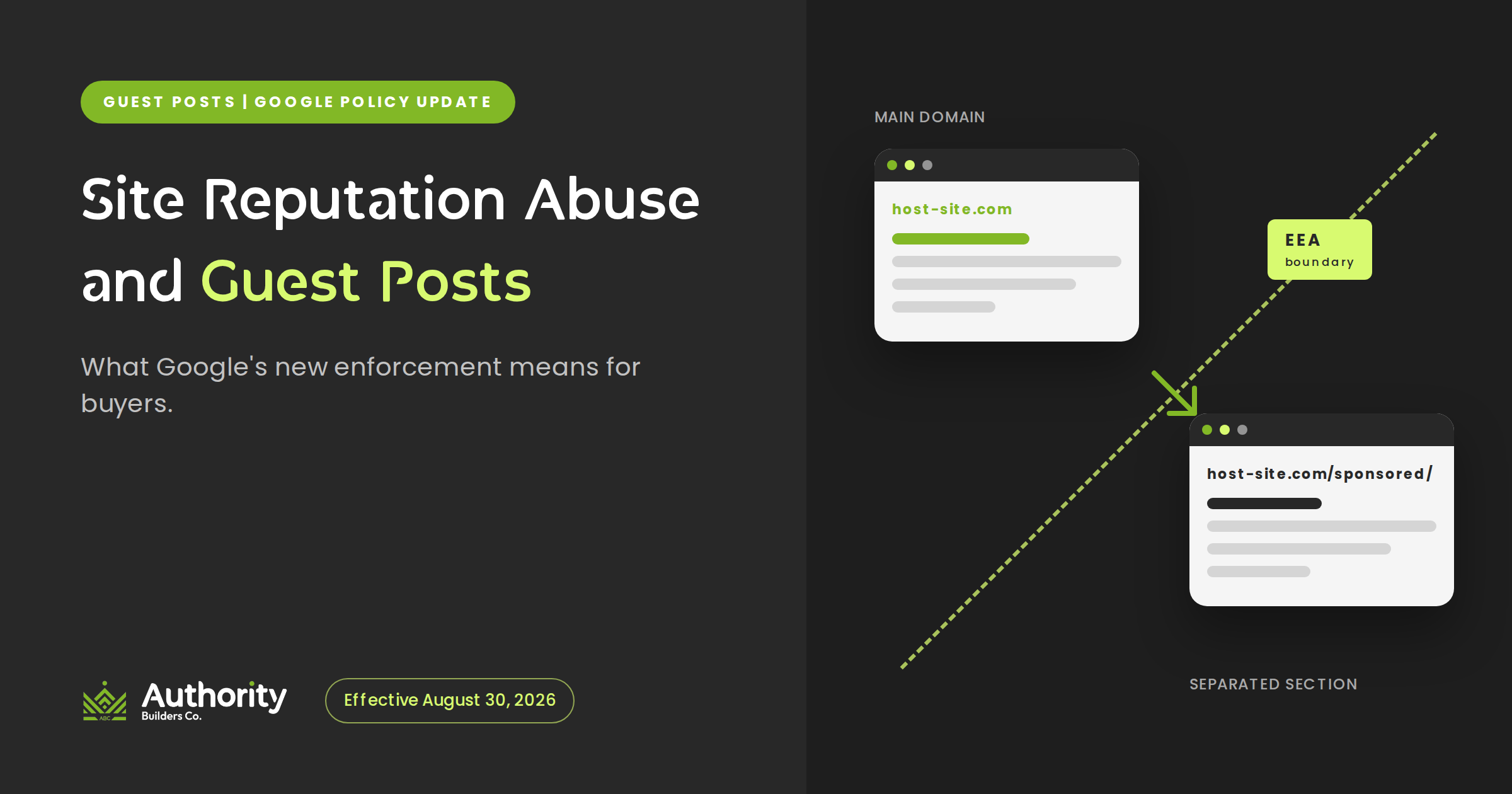
On August 28, 2026, Google published a short blog post that quietly rewired one of the most consequential spam policies of the last two years. Starting August 30, a site reputation abuse manual action no longer works the same way for everyone. Outside the European Economic Area, it still drops the offending section of a site out of results. Inside the EEA, there’s no ranking penalty at all. Instead, Google may split that section off from the host domain so it ranks on its own merits.
If you buy guest posts, this matters more than it might look at first glance. The value of a guest post link depends on the host site’s reputation transferring to the page your link sits on. Google just spelled out, in more detail than ever before, exactly when it will stop letting that transfer happen.
Here’s what changed, why it affects the links you’re paying for, and how we vet host sites so your placements land on pages Google treats as part of the site rather than a bolt-on.
What site reputation abuse is (and what it isn’t)
Google’s site reputation policy targets a specific pattern: third-party content published on a host site mainly because of the ranking signals that host has already earned from its own first-party content. The goal of the tactic is to make content rank better than it could on its own. Most people in SEO know it by its nickname, parasite SEO.
The classic examples are a news publisher running a coupon subdomain powered by an aggregator, or a medical site hosting a “best casinos” page that has nothing to do with medicine and isn’t reachable from anywhere else on the site.
Here’s the thing most buyers miss: third-party content by itself is not a violation. Google’s own policy says so. Freelancers, columnists, syndicated news, forum posts, and editorial guest contributions are all fine. The policy only bites when the content is there to borrow the host’s authority rather than to serve the host’s readers.
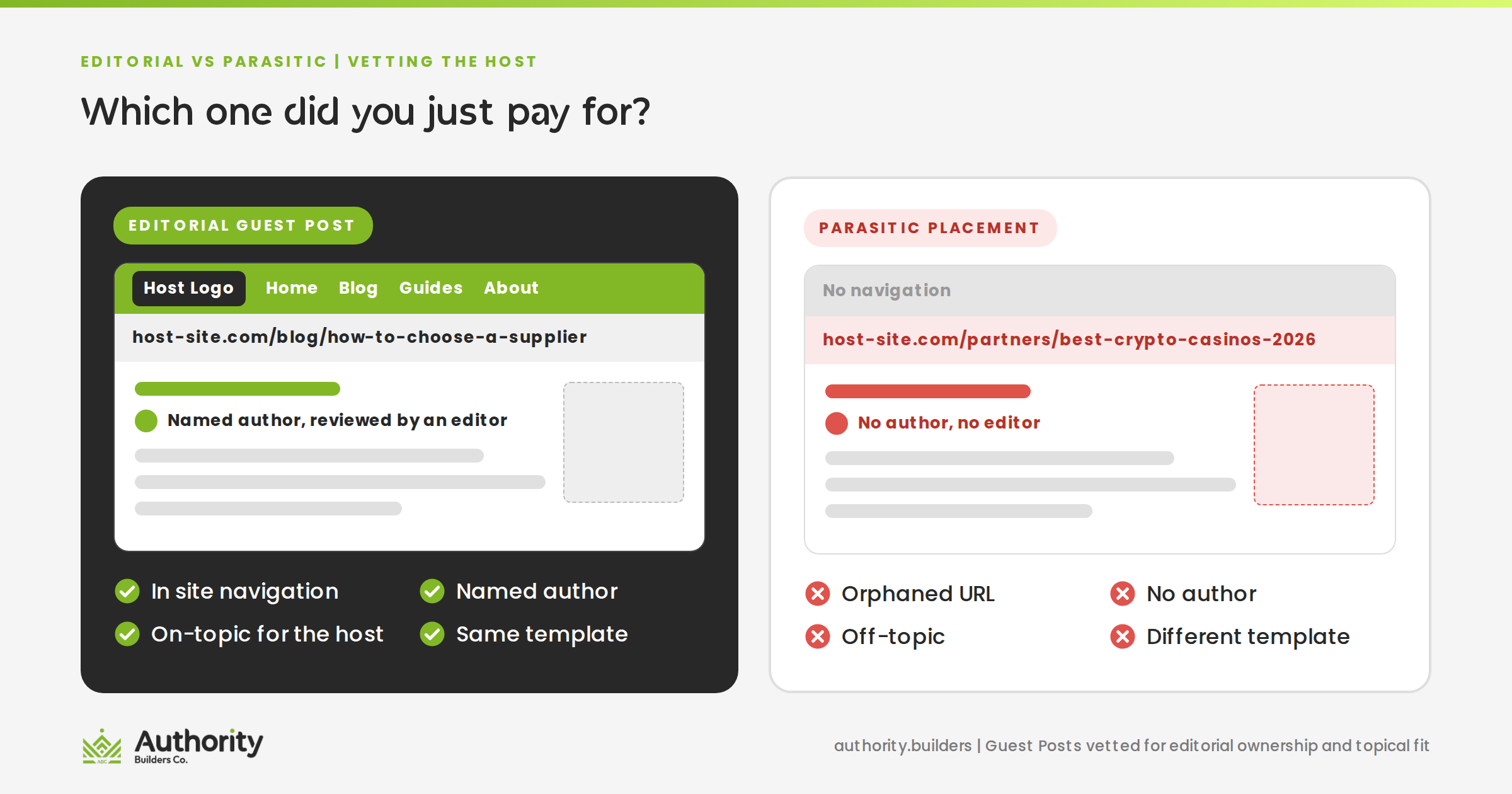
That distinction is the whole ballgame for guest posts. A guest post that the host publication commissioned, edited, and integrated into a relevant section is editorial content. A guest post dropped into an orphaned directory with no author, no editor, and a topic the site never covers is exactly what the policy describes.
What changed on August 30
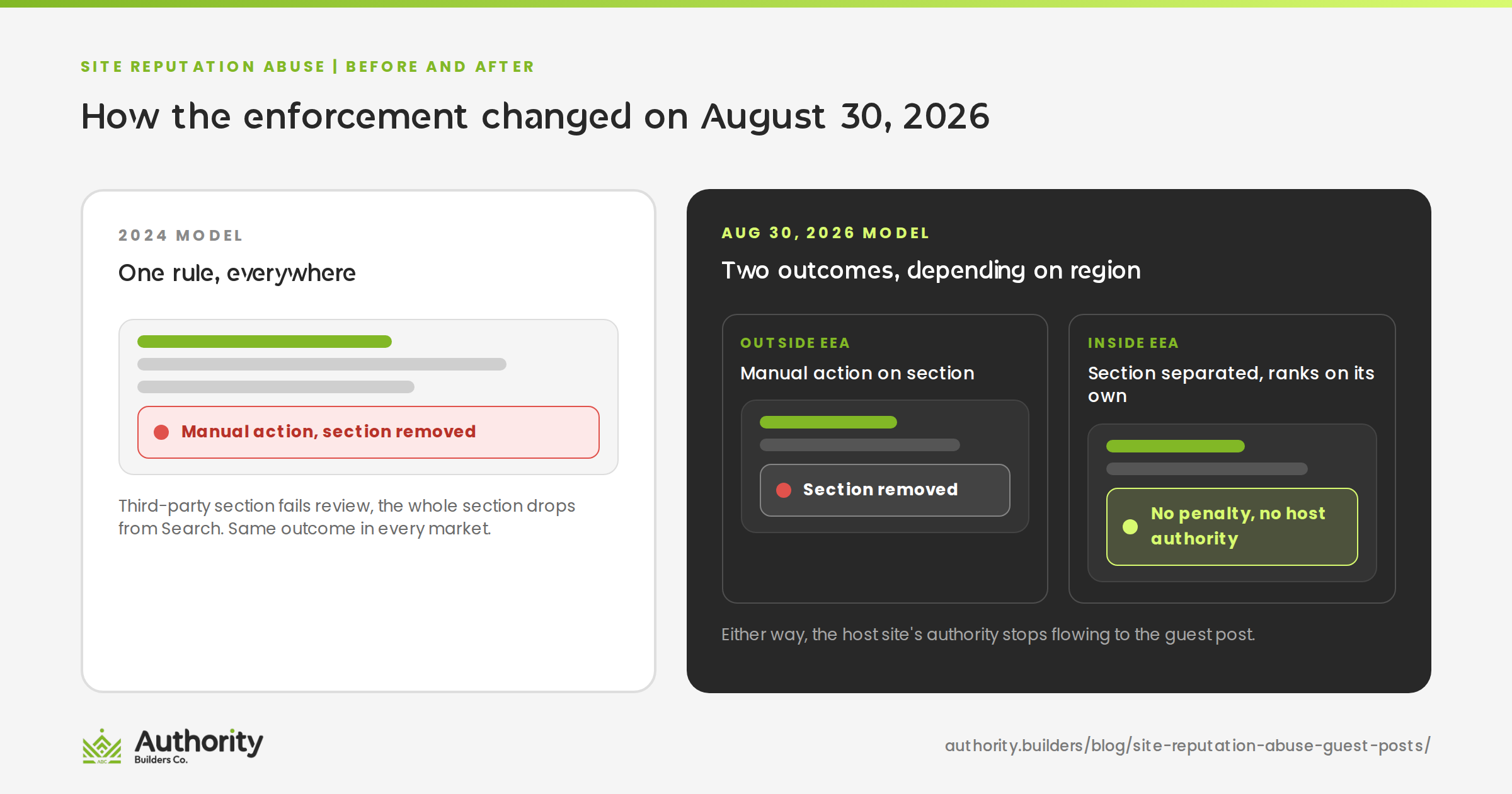
The 2024 version of this policy was blunt. Google’s November 2024 update stated that no amount of first-party involvement changed the third-party nature of the content, and enforcement meant a manual action that removed the offending section from search.
The August 2026 update came out of discussions with the European Commission under the Digital Markets Act, and it changes both the mechanics and the criteria. Four things are new.
1. Enforcement now splits at the EEA border
For searchers outside the EEA, a manual action still directly affects the portion of the site involved. The rest of the site is untouched, same as before.
For searchers inside the EEA, the manual action has no ranking impact. Instead, Google may categorize the affected section as separate from the main domain. Over time, its systems learn to rank that section independently, so casino content ranks against other casino content rather than riding on a newspaper’s authority.
2. Google now states a presumption of quality
The updated policy says Google generally presumes that individual pages, including new pages, match the overall quality of the rest of the domain. That presumption is the mechanism that makes a guest post link valuable in the first place. When Google separates a section, that presumption stops applying to it.
3. Google published the review criteria
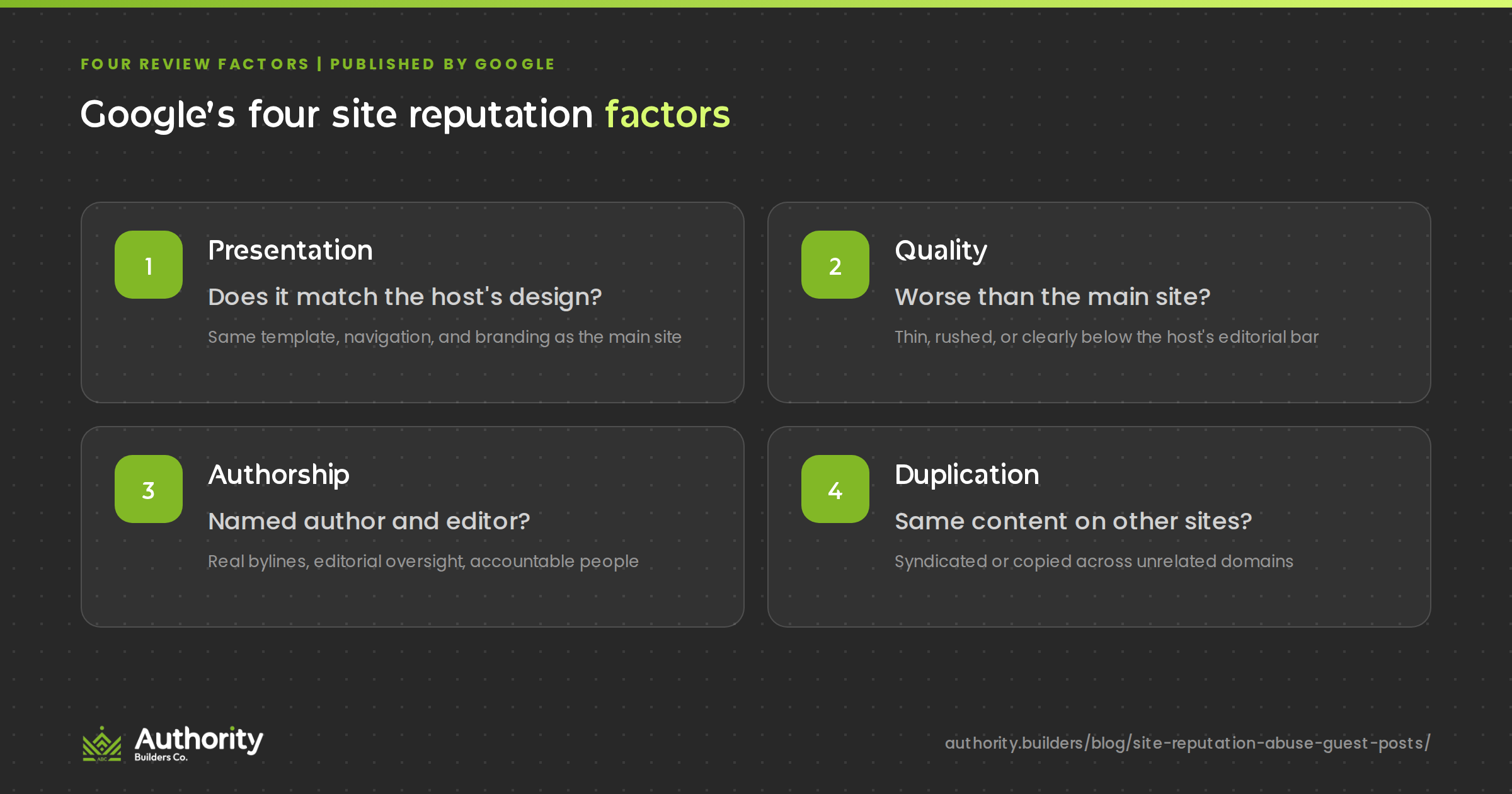
For the first time, Google lists the objective factors its reviewers weigh: how the content is presented, its quality relative to the main domain, its stated or implied authorship, and whether it appears in identical or near-identical form on other sites. We break these down for buyers below.
4. Google published worked examples
The policy now includes three scenarios showing where Google is likely and unlikely to act. Two of them involve third-party content that Google says is fine. One involves an unauthored affiliate article buried outside a publication’s normal sections, and Google says it would likely take action on it outside the EEA.
Google also confirmed that previous EEA manual actions under this policy will be lifted, that Search Console will still notify site owners of a manual action, and that reconsideration requests remain available everywhere. Eligible EEA sites can escalate to mediation.
Why guest post buyers should care
Most coverage of this update has focused on publishers. But if you’re the one paying for placements, the risk runs in your direction too. Let’s break it down.
Your link is only as strong as the section it sits in
A guest post on a DR 70 site is attractive because Google presumes the page inherits the domain’s quality. That’s the presumption Google just named. If the host site’s guest content lives in a section that gets separated, your link is now on a page Google ranks as if it were on a brand new, unproven domain. The DR number you paid for doesn’t transfer.
Outside the EEA, the older outcome still applies. A manual action on the section means the page carrying your link may drop out of results entirely. A link on a page Google won’t show is a link with very little to give.
Separation is quieter than a penalty
The 2024 model was loud. A site got hit, the SEO press wrote it up, and buyers could see which host sites had become toxic. The 2026 model is different. Google says the separation itself isn’t a ranking signal, the affected section doesn’t immediately lose the main site’s signals, and the change plays out over time as ranking systems learn.
In practice, that means a host site’s guest post section can be slowly losing its borrowed authority while the domain metrics you check in Ahrefs look exactly the same. The DR is a domain-level number. The separation is a section-level decision. Metrics alone won’t tell you which host sites Google has stopped trusting.
The criteria are about the host, not about you
Every one of Google’s four factors is a question about how the host site handles third-party content. None of them are about your anchor text, your target URL, or the quality of the article you supplied. You can do everything right on your end and still end up on a page that fails the review because the publisher runs its guest section like a classified ad board.
That’s why vetting for editorial ownership is no longer a nice-to-have. It’s the difference between buying a link and buying a liability.
Google’s four factors, translated for link buyers
Google says its reviewers look at the degree to which the host domain exercises control over the page content, and that no single factor is necessary or sufficient. Here’s what each one means when you’re evaluating a guest post opportunity.
Presentation
Does the guest post use the same design, typography, navigation, and UX as the rest of the site? A guest section that runs on a different template, strips out the site’s standard sidebar, or loads on a separate CMS with different branding is a signal that the host treats it as something other than its own content.
What to check: Open a live guest post on the site alongside a regular editorial article. If they look like they belong to different websites, that’s a problem.
Quality relative to the main domain
Google asks whether the page has quality issues that don’t appear elsewhere on the domain. Thin word counts, generic AI-sounding filler, broken formatting, or obvious keyword stuffing in a section that sits next to well-edited editorial content is exactly the pattern reviewers are looking for.
What to check: Read three recent guest posts on the site. If they’re noticeably worse than the site’s own articles, the section is at risk regardless of how good your contribution is.
Stated or implied authorship
Is there an explicit acknowledgment of who wrote and who is responsible for the content? Google’s likely-to-act example is an article with no identified author and no identified editor. Its unlikely-to-act example names the freelancer, states the publication’s editorial responsibility, and discloses the commercial relationship.
What to check: Look for named authors with real bylines, an editor or editorial policy page that covers contributed content, and disclosure language where the content is sponsored.
Duplication across sites
Does the same content appear in identical or near-identical form on other sites? This one targets marketplaces that syndicate the same article across dozens of hosts. It’s also a warning about host sites that accept pre-written content without checking whether it has been published elsewhere.
What to check: Take a distinctive sentence from a recent guest post on the site and search it. If it turns up on five other domains, the host isn’t exercising editorial control.
The other policy that still applies to guest posts
The site reputation policy is about the host. Google’s link spam policy is about the link. Both apply to guest posts, and the August update didn’t change the second one.
Google lists advertorials and native advertising where payment is received for articles with links that pass ranking credit as link spam. It specifically calls out links with optimized anchor text in guest posts distributed on other sites. It also says buying and selling links is a normal part of the web as long as those links carry a nofollow or sponsored attribute.
This is worth stating plainly because the two policies interact. A guest post on a well-integrated, editorially controlled section of a strong site passes the site reputation review. Whether the link inside it passes the link spam review depends on how the placement was arranged and how the anchor text is handled. Buyers who treat guest posts as a way to stack exact-match anchors on high-DR domains are exposed to both policies at once.
The takeaway isn’t that guest posts are dead. Google’s own policy examples explicitly protect editorial contributions, columns, and authored articles. The takeaway is that the line between an editorial guest post and a paid advertorial is now defined by the same criteria in two places: editorial oversight, authorship, integration, and originality.
How we vet host sites for editorial ownership and topical fit
We’ve covered our full site vetting checklist in our guide to choosing a guest posting service, so we won’t repeat the metrics side here. What’s worth explaining is how the policy-risk side works, because it maps almost directly onto Google’s four factors.
We look for sites that publish guest content as editorial content
The single biggest predictor of whether a guest post section survives a reputation review is whether the publisher treats it as part of the site. That means the section is reachable from the main navigation or category pages, guest posts are interspersed with the site’s own articles rather than quarantined in a separate directory, and the same design and template apply throughout.
A site that has a “write for us” page and publishes contributions into its normal blog feed under a named author is a fundamentally different risk profile from a site with a /sponsored/ folder that exists only to hold paid content.
We look for topical fit, not just topical proximity
Google’s likely-to-act example is a business publication hosting an article about CBD oils. The problem isn’t that business and CBD are unrelated in the abstract. The problem is that the article had no connection to any of the publication’s editorial sections. It was a topic the site never covered, placed on the site purely for the domain’s authority.
When we evaluate a host for a client in, say, home services, we’re asking whether that site has a real, ongoing editorial interest in home services. Does it have a category for it? Has it published on the topic before, from its own writers? Would a reader of that site expect to find your article there? If the answer is no, the placement might still pass a metrics filter, but it fails the fit test.
We look for real traffic on real editorial pages
Our marketplace has always required real sites with real organic traffic, and we’ve never allowed PBNs. The reputation policy adds a layer to that: we want to see that the traffic is going to the site’s editorial content, not concentrating in a coupon subdomain or a syndicated affiliate section that the rest of the site ignores. A site that gets most of its visits from a section Google would consider separate is a site whose domain metrics are overstating what your link would inherit.
We write original content for each placement
Google’s duplication factor is easy to fail if a marketplace recycles articles across hosts. When we handle content for a guest post, the article is written for that specific host and its audience. It’s not a template with the brand name swapped in, and it doesn’t go anywhere else.
We flag hosts that changed after August 30
This is the newest part of our process. Google’s separation mechanism plays out over time, and a host that looked clean in July can start losing its guest section’s authority without any visible manual action. We watch for the signals that suggest a host has been categorized: guest post URLs dropping out of the rankings while the main site holds steady, sudden changes in how the site handles authorship or disclosure, and sections being moved to new subfolders (which Google treats as a circumvention attempt if done to dodge enforcement).
What this means for AI visibility
The reputation policy applies to Google Search, but the same signals it describes are the ones large language models use when deciding which sources to trust and cite. Google’s spam policies now explicitly cover attempts to manipulate generative AI responses in Search, and the editorial oversight, authorship, and originality factors are precisely what makes a source citable.
We’ve seen this in our own data. Over the twelve months from January 2025 to February 2026, we grew generative AI referral traffic to authority.builders by 784%, and the work behind it was the same playbook we run for clients: guest posts and link insertions on high-DR sites with real organic traffic, consistent content, and technical hygiene. That growth didn’t come from placements on separated sections of big domains. It came from links on pages that AI systems could read as editorially owned, on-topic, and authoritative.
For buyers, the implication is simple. A guest post that passes Google’s editorial ownership test is also the kind of guest post that gets a brand mentioned in ChatGPT, Perplexity, and AI Overviews. A placement that fails it is a link on a page no AI system has any reason to trust.
What to do with your guest post strategy now
Here’s how we’d approach the next ninety days if we were managing your links.
- Audit your existing guest post placements against the four factors. Pull every live guest post link you’ve bought in the last two years. For each host, check presentation, authorship, integration, and duplication. Flag anything that would fail Google’s likely-to-act example.
- Separate metrics from policy risk in your vetting. DR, traffic, and relevance tell you whether a site is worth linking from. The four factors tell you whether the link will keep its value. You need both filters, and the second one can’t be automated from a metrics dashboard.
- Stop buying into quarantined sections. If a host publishes paid content into a directory that’s unreachable from its navigation and unbranded relative to the main site, walk away, no matter what the DR says.
- Prioritize hosts with a real editorial interest in your topic. A DR 45 site that covers your industry every week is a safer long-term asset than a DR 75 site that has never touched your topic and won’t after your article.
- Get your anchor text in order. The link spam policy didn’t change, and it’s the second half of the risk. Branded and natural anchors on editorial placements are the combination that survives both reviews.
- Watch for quiet separation. Track the ranking of the guest post URLs themselves, not just your target pages. A host whose guest posts are steadily losing visibility while the main site holds is a host Google may have categorized.
Get placements built for the new rules
If you’d rather not run this audit yourself, our guest post service already screens hosts for editorial ownership and topical fit alongside the traffic and authority metrics you’d expect. You can browse vetted sites and choose your own placements, or let our team hand-select them for you.
For a fully managed approach, ABC Plus builds a custom monthly campaign around your link gaps, handles anchor text balancing, and mixes guest posts with link insertions and high-authority placements so your profile isn’t dependent on any one host or link type. Every campaign now includes tracking of your brand across ChatGPT, Perplexity, and Google AI Overviews, so you can see the AI visibility side of the return, not just rankings.
FAQ
Does Google’s site reputation policy ban guest posts?
No. Google’s policy explicitly lists columns, opinion pieces, articles, and other editorial work as examples that are not inconsistent with the policy, and its August 2026 update includes a worked example of an authored freelance article that Google says it’s unlikely to act on. The policy targets third-party content published mainly to borrow a host’s ranking signals, not guest contributions the host commissions, edits, and integrates.
What happened on August 30, 2026?
Google changed how it enforces the site reputation policy. Outside the EEA, a manual action still affects the offending section of a site. Inside the EEA, there’s no ranking penalty, and Google may instead categorize the section as separate from the main domain so it ranks on its own merits over time. Google also published the four factors its reviewers consider and three worked examples.
Does a site reputation manual action affect my backlinks?
It can. If the page carrying your link is in a section that receives a manual action outside the EEA, that page may drop out of search results. If the section is categorized as separate in the EEA, Google stops presuming the page matches the main domain’s quality, and over time it ranks independently. Either way, the host authority you paid for stops transferring to your link.
How can I tell if a host site’s guest section has been separated?
Google says the categorization itself isn’t a ranking signal and that the effect plays out over time, so there’s no single indicator. The practical signal is guest post URLs losing visibility while the rest of the site holds steady. Site owners are notified in Search Console, but as a buyer you won’t see that notice, which is why vetting the host’s editorial practices upfront matters.
What are Google’s four site reputation abuse factors?
Presentation (does the content match the host’s design and UX), quality (does it have problems the main site doesn’t), authorship (is ownership and editorial responsibility clearly stated), and duplication (does the same content appear on other sites). Google says no single factor is necessary or sufficient on its own.
Is the link spam policy still relevant if my guest post passes the reputation review?
Yes. The site reputation policy is about whether the host controls the content. The link spam policy is about whether the link was arranged to pass ranking credit. Google lists optimized anchor text in paid guest posts as link spam, so anchor text strategy and disclosure still matter independently.
The bottom line
Google didn’t kill guest posting on August 30. It published, for the first time, a detailed description of the difference between a guest post that’s part of a site and a guest post that’s parasitic on one. Buyers who keep evaluating hosts purely on DR and traffic are now buying links whose value can erode without any visible penalty. Buyers who add editorial ownership and topical fit to the filter are buying the kind of placements Google’s own examples say it’s unlikely to touch.
That second kind is the only kind we sell. Browse our vetted sites on the guest post marketplace or talk to us about a managed campaign through ABC Plus.