
If you manage a marketing budget in 2026, you have probably noticed something uncomfortable happening at the top of your funnel. The discovery layer, where potential customers first encounter your brand, has quietly split in two. Half of it still runs through traditional search. The other half now runs through AI.
Users are asking ChatGPT for product recommendations. They are getting purchase research summarized by Perplexity. They are reading Google’s AI Overviews instead of clicking through to your carefully optimized blog post. And the brands that show up inside those AI-generated answers are capturing attention, trust, and pipeline before your website even enters the picture.
This is the problem AEO was built to solve.
What Does AEO Stand For?
AEO stands for Answer Engine Optimization. It is the practice of structuring your content and brand presence so that AI-powered platforms can find, understand, and cite your information when generating answers to user queries.
The “answer engines” in AEO include Google’s AI Overviews, ChatGPT, Perplexity, Gemini, Claude, Microsoft Copilot, and voice assistants like Siri and Alexa. You may also see this discipline called GEO (Generative Engine Optimization) or AI search optimization. The names vary, but the goal is the same: making your brand the source that AI systems choose to reference when someone asks a question you should be answering.
Where traditional SEO focuses on earning clicks from a list of search results, AEO focuses on earning citations inside AI-generated answers. That distinction matters because citation, not ranking, is increasingly what drives brand discovery.
Where AEO Fits in the Marketing Funnel
Understanding AEO starts with understanding how the buyer’s journey has changed.
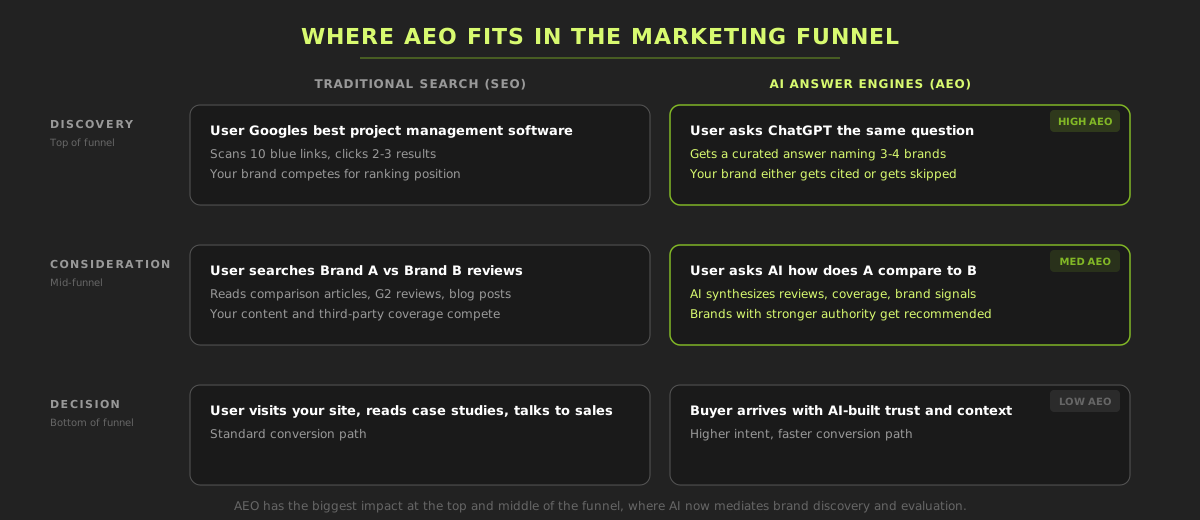
Top of funnel (discovery): This is where AEO has the biggest impact. A potential customer who would have Googled “best project management software for remote teams” two years ago is now asking ChatGPT the same question and getting a curated answer that names three or four brands. If your brand is not one of them, you have lost that prospect before they ever saw your website.
According to a UVA Darden study covered by Marketing Dive, nearly 60% of consumers now use AI tools when researching or evaluating purchases. That is not a niche behavior. It is a mainstream shift in how buyers start their journey.
Mid-funnel (consideration): AI is also reshaping how buyers compare and evaluate options. Users ask follow-up questions like “how does [Brand A] compare to [Brand B] for enterprise teams?” or “what do customers say about [Brand C] pricing?” AI platforms synthesize answers from across the web, pulling from review sites, editorial coverage, and brand content. The brands with stronger authority signals across more credible sources tend to get recommended more consistently.
Bottom of funnel (decision): AEO has less direct impact here, since buyers at this stage are typically on your site, talking to sales, or reading case studies. But the trust that was built by AI citing your brand at the top and middle of the funnel carries through. When a buyer arrives after being recommended by ChatGPT, they come with context and pre-built confidence. That is a fundamentally different entry point than clicking a blue link.
How Search Has Changed for Marketing Teams
The shift toward AI-mediated discovery is not theoretical. The data is clear.
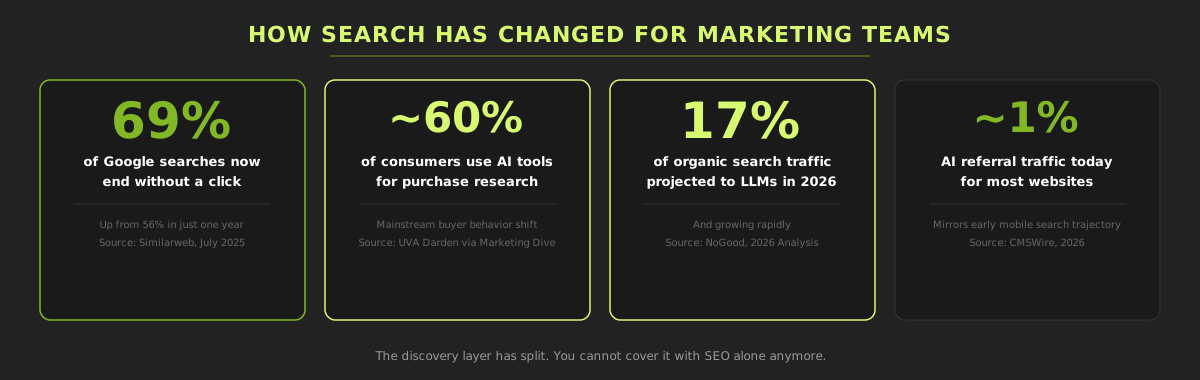
Similarweb reported that zero-click searches jumped from 56% to 69% between May 2024 and May 2025, a 13-point increase in a single year driven largely by the rollout of Google’s AI Overviews. For queries that trigger AI Overviews specifically, the zero-click rate reaches approximately 80%.
Meanwhile, AI platforms themselves are growing fast. NoGood’s 2026 analysis projects that LLMs will capture 17% of organic search traffic this year. And while CMSWire notes that AI referral traffic currently sits at roughly 1% for most sites, that number is growing exponentially and mirrors the early trajectory of mobile search before it became dominant.
For marketing teams, this creates a new strategic reality. You cannot cover the full discovery layer with SEO alone anymore. You need a parallel discipline that ensures your brand is visible inside AI-generated answers, and that discipline is AEO.
AEO vs SEO: Complement, Not Replacement
AEO does not replace SEO. It builds on top of it.
AI answer engines rely heavily on traditional search indexes and ranking signals to decide which content to pull from. A page that ranks well in Google is more likely to be cited by AI systems because they treat ranking as a credibility signal. Strong SEO is the foundation that makes AEO possible.
The key differences are in what you optimize for and how you measure success. SEO optimizes for search engine algorithms with the goal of earning clicks. AEO optimizes for AI comprehension with the goal of earning citations. SEO success is measured in rankings and organic traffic. AEO success is measured in AI mentions, citation frequency, and AI-referred traffic.
The practical overlap is significant. Good content structure, strong authority signals, and technical health support both channels. We cover the authority-building side of this equation in depth in our link building plan guide, which walks through how to build the kind of off-site credibility that drives both traditional rankings and AI citations.
What Changes for Marketing Teams
AEO is not just a content tactic. It changes how marketing teams are structured, what they prioritize, and how they measure results.
Who Owns AEO?
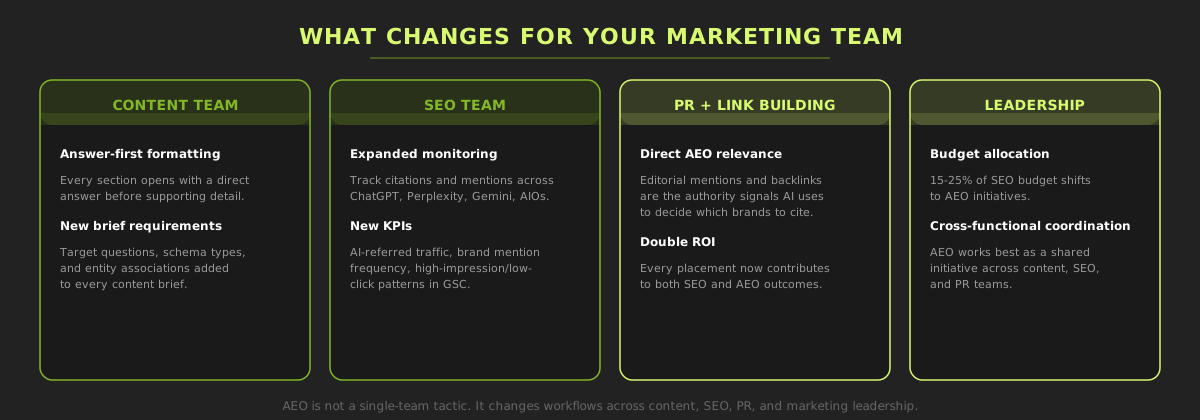
In most organizations, AEO will not live in a single team. It touches content, SEO, PR, and brand, which means it works best as a cross-functional initiative.
The content team needs to adopt answer-first formatting, where every major section opens with a clear, direct statement that answers the implied question before diving into supporting detail. The SEO team needs to expand their monitoring to include AI platforms, tracking not just rankings and traffic but citations and brand mentions across ChatGPT, Perplexity, Gemini, and Google AI Overviews. The PR and link building team’s work becomes directly relevant to AEO because the editorial placements, brand mentions, and backlinks they earn are exactly the authority signals AI systems use to decide which brands to trust and cite.
Marketing Dive reported that Deloitte found more than half of organizations are planning to increase AI-related spending within marketing, and AI-related roles are appearing more frequently across digital, product, and content teams. AEO is part of this broader shift toward marketing that accounts for AI as a channel, not just a tool.
How Content Briefs Change
Traditional content briefs focus on target keywords, search intent, word count, and competitive analysis. AEO adds new requirements.
Every brief should now include the specific questions the content needs to answer directly, a requirement for answer-first paragraph structure at the top of each section, notes on which schema markup types to implement (FAQPage, HowTo, Article), and a list of entity associations the content should reinforce (the topics and terms your brand needs to be consistently connected with).
This does not mean throwing out your existing brief template. It means adding an AEO layer that ensures every piece of content is built for both human readers and AI extraction. If your team needs support building content to this standard, professional SEO blog writing and SEO copywriting services can help bridge the gap.
How the Content Calendar Changes
AEO shifts the balance of your content calendar toward two types of content that perform well in AI answers: comprehensive guides with answer-first architecture, and regularly refreshed evergreen content that AI platforms can rely on as a current, accurate source.
This does not mean abandoning other content types. It means ensuring your highest-value pages, the ones targeting the questions your ideal customers are asking AI, are structured for citation and kept fresh. A consistent content refresh program keeps those pages competitive in both traditional search and AI answers.
Budget and Resource Allocation
One of the most practical questions marketing leaders are asking is how much to spend on AEO and where that budget comes from.
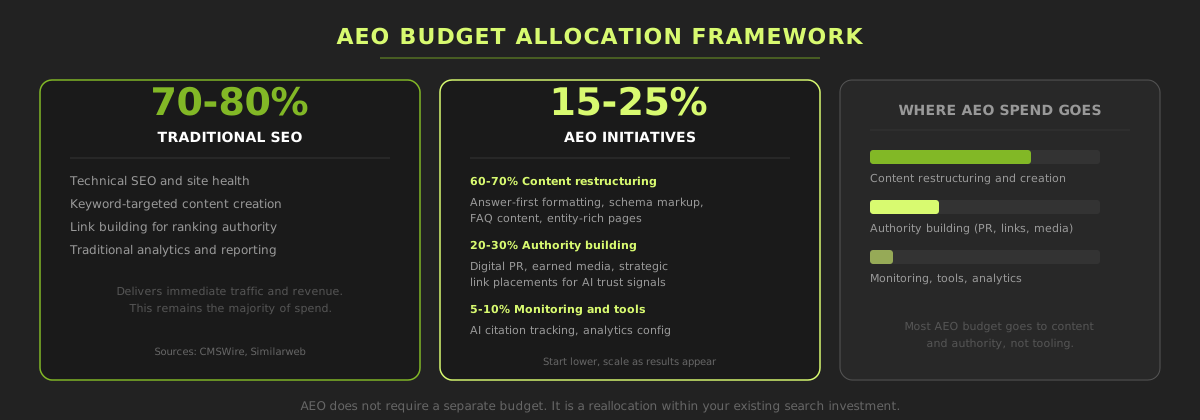
The emerging consensus from multiple industry analyses points to a few practical guidelines.
CMSWire recommends a pragmatic starting framework of 70-80% of search budget on traditional SEO that delivers immediate traffic and revenue, with 20-30% dedicated to AEO experimentation and capability building. Similarweb’s guidance is slightly more conservative, suggesting 15-25% of SEO budget allocated to AEO and GEO initiatives, with 10-20% of that AEO budget going toward monitoring tools.
For most teams, AEO budget breaks down into three areas.
Content restructuring and creation is the largest line item. This includes auditing existing content for answer-first formatting, implementing structured data markup across priority pages, creating new FAQ and guide content targeting question-based queries, and building the kind of comprehensive, entity-rich content that AI systems favor. Depending on whether this work is handled in-house or through an agency, this typically represents 60-70% of the AEO budget.
Authority building is the second area, and it is where digital PR, earned media, and strategic link building come in. AI systems rely on off-site authority signals to decide which brands to trust and cite. Editorial placements in credible publications, guest posts on high-authority sites, and link insertions on existing high-traffic content all build the kind of multi-source validation that makes AI systems confident enough to recommend your brand. This typically represents 20-30% of AEO budget, though for brands building authority from scratch it may be higher.
Monitoring and measurement is the third area and the smallest by spend, typically 5-10% of the AEO allocation. This covers AI citation tracking tools, manual monitoring workflows, and analytics configuration. We cover the specifics of what to track in the next section.
How to Measure AEO
AEO introduces new KPIs that sit alongside traditional SEO metrics. You do not replace your existing reporting. You expand it.
AI citations and brand mentions: Track how often your brand appears in responses from ChatGPT, Perplexity, Gemini, and Google AI Overviews. This can be done manually by regularly querying these platforms with questions relevant to your business, or through emerging AEO tracking tools that automate the process.
AI-referred traffic: Monitor visits that originate from generative AI platforms. Most analytics platforms now surface this data, and the trend line matters more than the absolute number at this stage.
High-impression, low-click queries in Google Search Console: Queries where your content earns many impressions but few clicks often indicate that your content is being surfaced in AI Overviews. Users are getting the answer from the AI summary without clicking through. This is not necessarily bad, since it means your content is being cited, but you need to track it separately from standard organic performance.
Brand search lift: Increased brand searches can indicate that AI citations are driving awareness. If more people are Googling your brand name after AI platforms start recommending you, that is a measurable signal of AEO impact.
Conversion quality from AI traffic: Early data suggests that visitors arriving through AI recommendations convert at higher rates because they come with context and pre-built trust. Track conversion rates for AI-referred traffic separately from organic.
Authority Builders’ AI Plus program was built specifically to help brands monitor and improve their visibility across AI search platforms, combining citation tracking with the authority-building strategies that drive results.
Getting Started with AEO
If you are starting from scratch, here is a practical sequence that builds momentum without requiring a massive upfront investment.
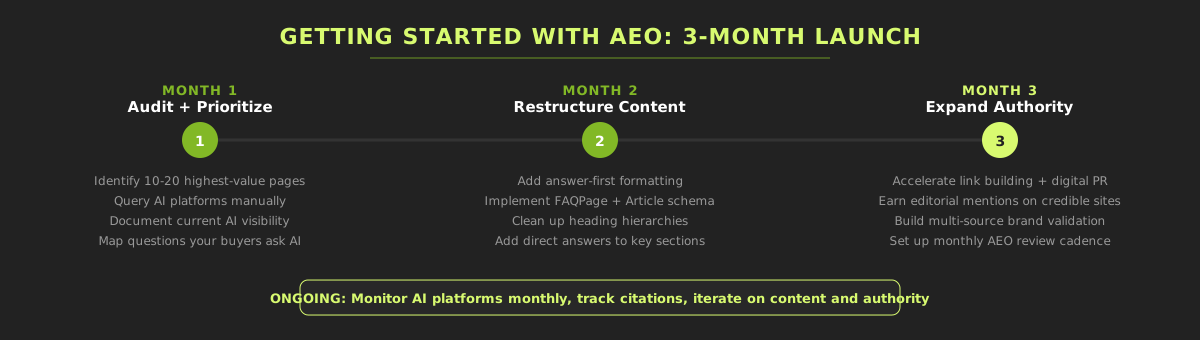
Month 1: Audit and prioritize. Identify your 10-20 highest-value pages, the ones targeting the questions your ideal customers are most likely to ask an AI platform. Query ChatGPT, Perplexity, and Google with those questions and document whether your brand appears in the answers.
Month 2: Restructure content. Take your highest-priority pages and restructure them for answer-first formatting. Add clear, direct answers at the top of each section. Implement FAQPage and Article schema markup. Ensure heading hierarchies are clean and logical.
Month 3: Expand authority signals. Begin or accelerate link building and digital PR efforts focused on earning editorial mentions and backlinks from credible, topically relevant sources. This is where a managed link building program pays double returns across both SEO and AEO.
Ongoing: Monitor and iterate. Set up a monthly AEO review cadence where you re-query AI platforms, track citation changes, and monitor AI-referred traffic trends. Adjust content and authority-building priorities based on what you learn.
If you are ready to build the authority and content infrastructure that drives both traditional and AI search visibility, book a strategy call with our team.
Frequently Asked Questions
What does AEO stand for in marketing?
AEO stands for Answer Engine Optimization. It is the practice of optimizing your content and brand presence so that AI-powered platforms like ChatGPT, Google AI Overviews, Perplexity, and Gemini cite your information when generating answers to user queries.
Is AEO the same as GEO?
AEO and GEO (Generative Engine Optimization) refer to the same core practice. Some practitioners use AEO to describe optimization for all answer formats (including featured snippets and voice search), while GEO refers specifically to generative AI platforms. In practice, the strategies overlap almost entirely and most marketers use the terms interchangeably.
Does AEO replace SEO?
No. AEO builds on top of SEO. AI answer engines rely on traditional search indexes, ranking signals, and authority metrics to determine which content to cite. Brands that perform best treat SEO and AEO as complementary parts of the same strategy.
How much should I budget for AEO?
Industry guidance suggests allocating 15-25% of your existing SEO budget to AEO initiatives. This covers content restructuring, structured data implementation, authority building, and AI monitoring. Most teams start at the lower end and scale up as they see results.
How do I know if my brand is showing up in AI answers?
Start by manually querying the major AI platforms with questions relevant to your business. Monitor AI-referred traffic in your analytics. Use Google Search Console to identify queries with high impressions but low clicks, which may indicate your content is being surfaced in AI Overviews. Dedicated AEO monitoring tools are also emerging that track citations across multiple platforms.
How long does it take for AEO to show results?
Brands with existing domain authority and well-structured content may see AI citation improvements within weeks of implementing answer-first formatting and schema markup. Brands building authority from scratch should expect three to six months of consistent investment in content, link building, and digital PR before seeing meaningful AI platform citations.