
Google’s generative AI Overviews (AIOs) have completely shaken up its search results, and they’re becoming more prevalent at an extremely rapid pace. This has made learning how to rank in AI Overviews an absolute necessity for search marketing.
Here’s why.
In January 2025, research showed they appeared for just 6.59% of Google desktop searches. In March, Google gave its AI Overviews a Gemini 2.0 upgrade and began rolling them out for more searches. The results were immediately noticeable, as AIOs started appearing for 13.14% of all searches, which is a 72% increase in just 3 months.
As of June 2025, an extensive analysis by Xponent 21 and Advanced Web Ranking discovered that AIOs now appear for a whopping 50% of all Google searches.
That means even if your website is ranking in the #1 organic result for an important keyword, you may not get seen by your audience unless you’re cited in the AI Overview.
This guide will teach you:
- How AIOs work (and how they decide which content to cite)
- Which types of pages get cited in AIOs most often
- How to make your content as citation-worthy as possible
Let’s start by learning what makes AIOs tick.
What are AI Overviews?
AI Overviews don’t function like Featured Snippets or sponsored ads in that they don’t highlight a single web result. Instead, AIOs summarize multiple web sources using Gemini 2.0, Google’s family of LLMs. It’s capable of writing original responses that outline key points from a variety of online sources, so it does not share direct quotes the way Featured Snippets do.
Even though you’ve no doubt seen plenty of them at this point, let’s break down how AIOs look:
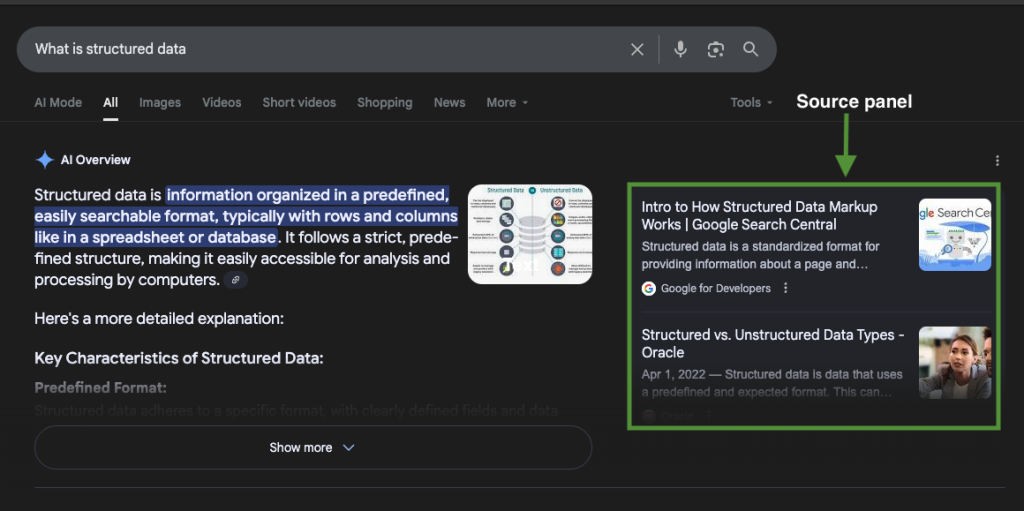
As you can see, it appears at the very top of the SERP, contains a concise definition of the term we searched for, and has a Show more button. There are also two visible cited sources on the source panel.
If we expand the AIO by hitting ‘show more,’ we get to see an additional cited source and some more relevant information:
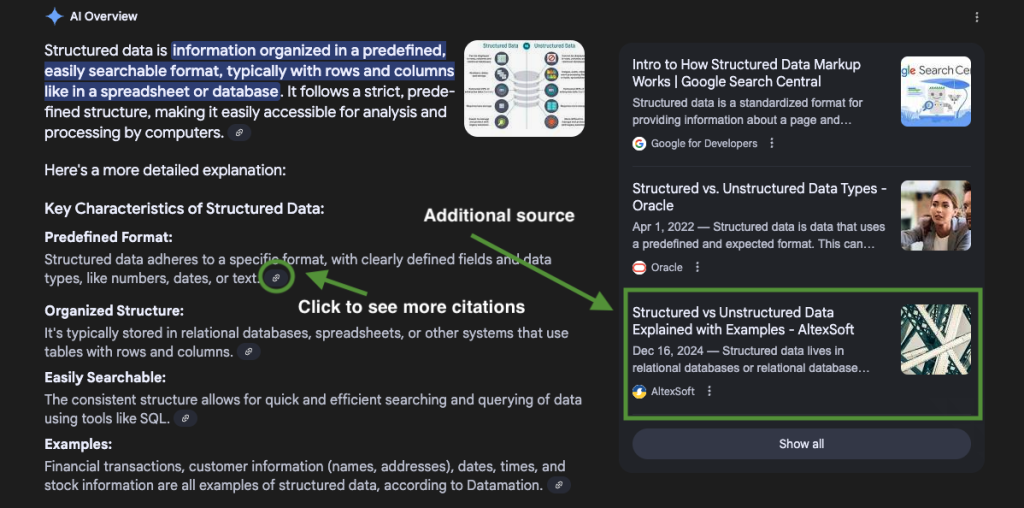
The hyperlink icons by each block of text reveal additional cited content (although sometimes it’s the same as the top 3).
Notice how the AIO takes up the entirety of the visible SERP, especially if expanded. This is why top-ranking websites are starting to see their click-through rates drop. Ahrefs found that the presence of an AIO can reduce your clicks by 34.5%, so learning how to rank in AI Overviews is extremely important now.
Also, not every query on Google generates an AIO, even with how prevalent they’ve become.
For the most part, AIOs tend to appear for longer, informational-style keywords. How-to and problem-solving queries are also common targets for AIOs. They tend not to appear for commercial and transactional keywords. This is likely because Google doesn’t want to cannibalize its paid ads by taking up space with AIOs.
That means you’ll encounter them the most for top-of-the-funnel (TOFU) content, like your how-tos, ultimate guides, FAQs, and step-by-step guides. If you aren’t positioned to get cited in AIOs, you may notice dips in lead generation.
What Types of Pages Get Cited in AI Overviews?
Even though AIOs are from Google, LLMs have a different set of ‘ranking factors’ than traditional search algorithms. This is because they’re more sophisticated and can infer the full meaning behind user queries instead of relying on things like keyword matching.
Because of this, pages that get cited in AI Overviews may not always come from the top 3 organic search rankings. However, Gemini still values things like the E-E-A-T (experience, expertise, authoritativeness, and trustworthiness) quality rating system.
Here are some common patterns that appear in content that’s frequently cited by AIOs.
Structured content containing clear definitions
Semantic HTML and schema markup make it easier for LLMs to parse content, which increases the chances that they’ll cite you (assuming you also have high-quality content). The most important schemas to include to optimize for AI search are:
Besides including structured data, your content should contain crystal clear definitions, questions, and answers.
As soon as you pose a question, answer it in the next sentence. In other words, don’t beat around the bush.
Brand mentions from trusted publications
LLMs love brand mentions because they signal credibility and trust. When searching for content to pull information from online, Gemini and other AI tools look for brand mentions in:
- Credible media outlets (GQ, Business Insider, NYT, BBC, etc.)
- Authority knowledge bases (Wikipedia, LinkedIn, YouTube, etc.)
- Niche authority hubs (trusted blogs and websites inside your specific niche/field)
- Community forums and Q&A sections (Reddit, Quora, and industry-specific forums)
Earning brand mentions from websites like these will also boost your E-E-A-T signals, which is important to Gemini.
Strong E-E-A-T signals
Speaking of E-E-A-T, it’s still crucial to produce truly helpful content that contains original insights.
That’s especially true for AI-powered search since LLMs are driven by entities and semantics instead of keywords. Instead of matching search terms, LLMs will understand how well your content satisfies user prompts by fully comprehending it.
This means it’s essential to produce engaging, in-depth content that demonstrates your expertise and first-hand experience with a topic.
Entity-rich sites
LLMs use named entity recognition (NER) to properly identify people, places, and things. It’s how they’re able to distinguish things like Amazon, the e-commerce company, from the Amazon rainforest.
If your website contains strong entity signals (like schema markup, author biographies, and semantic HTML), LLMs will have an easier time citing your content (and recognizing your brand as a trusted entity).
Topical authority
Niche authority also matters to LLMs like Gemini, so it’s worth establishing topical authority for relevant subjects.
Creating content clusters based on topics that matter to your audience will help you achieve this. The goal is to cover every possible angle of a topic through interlinked posts. If you publish lots of high-quality content that really fleshes out relevant topics, LLMs will view you as an authoritative resource.
Evergreen resources
AIOs like to cite evergreen resources since there’s no chance they contain outdated information.
Aim to create ‘timeless’ reference pages that contain clear answers to common questions and define industry terms. Since these will never expire, they’ll always be viable resources for LLMs to pull from.
Web pages with these characteristics are what Gemini is looking for when pulling information online. Next, let’s dive deeper and explore how you can add these optimizations to your content.
How to Make Your Site Citation Worthy
Let’s focus on how you can improve your visibility on AIOs through link-building, on-page SEO, and content formatting.
Earn links from relevant, trusted sources
First, you should focus your link-building efforts on generating news and editorial backlinks. These are highly authoritative and signal trust to LLMs (and search engine algorithms).
Digital PR is excellent for this since it’s all about networking with online journalists, news sites, and media outlets.
A common yet demanding technique is to use platforms like HARO (Help-A-Reporter-Out) and Qwoted to serve as an expert source for online journalists. In exchange for a quote or interview, you can request that they leave a backlink to your website in their story.
HARO queries go out several times a day, and the competition is really strong. The early bird tends to get the worm on platforms like these, so you’ll have to keep a very close eye on the query emails.
Newsjacking is another way to earn backlinks from news and media websites. It entails finding a trending news story and then brainstorming a fun way to interject your brand into the discussion. Some simple yet effective ways to employ this technique include:
- Creating blog posts that ‘piggyback’ off trending stories
- Posting timely reactions on social media that position your brand as experts (like ‘here’s what this means for you’)
- Publishing reactive infographics or funny visuals that mention trending news stories
It’s important not to overthink it, as a successful newsjacking campaign can be as simple as creating a funny meme related to a recent event.
Build brand mentions on relevant publications
This goes hand-in-hand with building backlinks on news and media sites. The reason this gets its own section is that brand mentions are extremely important to LLMs..
Moreover, AI search tools value brand mentions, whether they contain a backlink or not. This is in stark contrast to traditional SEO, where unlinked brand mentions didn’t carry any ranking value. Since LLMs value semantic relevance above all else, brand mentions (linked or unlinked) are what matter most.
However, not just any type of brand mention will do. Instead, you need to build positive brand mentions on trusted, relevant publications. Irrelevant mentions (and ones with negative sentiment) won’t do you any favors. Direct outreach, HARO, newsjacking, and other digital PR techniques are all solid ways to earn impactful brand mentions.
Clean page structure and answer-first formatting
Your website should contain structured data to make your content easier for LLMs to parse and pull information from. The two most important types that we mentioned before are semantic HTML and schema markup.
Besides that, you need a clean page structure to appeal to LLMs. That means structuring everything with appropriate headers (H1, H2, H3, etc.) and using short, readable sentences and paragraphs. Also, answer-first formatting is a huge deal for AI search tools.
Like we said before, if your content presents a question, answer it in the very next sentence. If your content is about defining a term, give the definition in the opening paragraph. The idea is that you want to make your definitions and answers as easy as possible for LLMs to find.
Internal topical consistency (supporting content, topical authority, related links)
Lastly, remaining topically consistent with your content will help you build authority on search engines and LLMs. In particular, they’ll begin to closely associate your brand with the topics you cover and view you as a trusted source.
That will heighten the chances that your brand will get cited in relevant AIOs, leading to enhanced brand exposure and targeted traffic. Make sure that you include internal links to all supporting content, especially for your content clusters.
Final Notes: How to Rank in AI Overviews
All in all, AI visibility centers on brand credibility and contextual relevance. These two factors matter more than keywords, backlinks, and all the other traditional SEO ranking factors. Once site owners realize this (and adjust their content accordingly), achieving better visibility in AIOs will become feasible.
Do you need help ranking in AI Overviews?
Our Digital PR services and ABC Platinum are both top-tier solutions for SEO and AI SEO.