
If you want link equity that actually influences citations from AI systems, you need editorial backlinks.
AI search models only cite the most trustworthy sources, and building editorial backlinks is one of the most effective ways to generate trust for your brand.
For instance, a backlink from a large, high-authority news or media site is basically a machine-readable proxy for “a human with expertise thought this page was worth referencing.”
At the page level, editorial backlinks help AI models trust your website as a suitable building block for answers (since human editors have already evaluated and endorsed it).
They also reinforce that your brand exists as part of a curated knowledge graph instead of a random content farm.
Even if you’re still focused on blue-link SEO, editorial backlinks carry deeper authority signals than standard link placements. They’re notorious needle-movers for keyword rankings, and they boost your domain’s reputation.
In this post, we’ll analyze why editorial backlinks are so important for AI search.
Here’s what we’ll cover:
- How AI systems interpret editorial content
- Why editorial links pass stronger equity than standard links
- Editorial coverage vs. basic link placement
- When brands should prioritize editorial backlinks
- How to build an editorial-first link-building strategy
How Do AI Systems Interpret Editorial Content?
Regardless of the AI search system you’re trying to optimize for, editorial backlinks function as high-trust signals.
They carry weight because they’re placed by independent publishers to improve their own content, and not to promote the linked site.
In other words, editorial links must be:
- Contextually relevant
- Non-promotional
- Added intentionally on behalf of an editor
They have to exhibit a clear informational purpose, such as:
- Supporting a claim
- Citing a source
- Providing additional context or reading
This is exactly the type of external validation AI models rely on when determining whether a brand’s content is citation-worthy.
They signal that your content is both useful and trustworthy enough to earn the approval of a credible website.
While editorial backlinks tend to come from major publications, this isn’t always the case. Independent blogs, industry research sites, and niche experts can also serve as sources for high-quality editorial backlinks.
What matters most to AI systems is editorial discretion, not brand size.
Human review as a trust anchor
Since editorial backlinks come from real journalists, editors, and experts, they’re like a ‘pre-vetted’ endorsement that AI systems view as a reliable proxy.
Unlike promotional links, human-reviewed placements signal E-E-A-T (experience, expertise, authoritativeness, and trustworthiness), which can make content more likely to get cited by AI search systems.
Also, search engines devalue low-barrier links from common directories or paid promotional posts. Conversely, they reward organic editorial backlinks from credible domains, just as AI search systems do.
Natural language context
LLMs don’t just count links and read anchor text. Instead, they parse the surrounding sentences and page-level semantics to understand a link’s topical relevance and intent.
That means a contextual anchor like ‘for more insights related to CNC machines, check out (your site)’ on a page about precise drilling will provide a more nuanced endorsement than a bare URL buried in the site’s footer.
It also means that there’s no fooling LLMs when it comes to the contextual relevance of your backlinks. If the surrounding content doesn’t support the implied topic, the endorsement collapses.
Editorial Coverage vs. Basic Link Placements
Next, let’s compare how editorial coverage stacks up to basic link placements, both on search engines and AI search platforms like ChatGPT.
Basically, it boils down to context-rich signals (editorial backlinks) versus very thin signals (standard links like directory placements).
Here’s a closer look:
- Editorial backlinks provide rich, multi-layered trust signals like topical relevance, E-E-A-T cues, entity relationships, and content helpfulness.
- Basic link placements like links in sidebars and directories lack surrounding context and often appear manipulative or irrelevant. AI systems do not value these types of links (and often dismiss them as noise), and search engine algorithms are trained to ignore/devalue them.
Here’s an example of a real-world editorial backlink from eMarketer that directs to original research by Ahrefs:
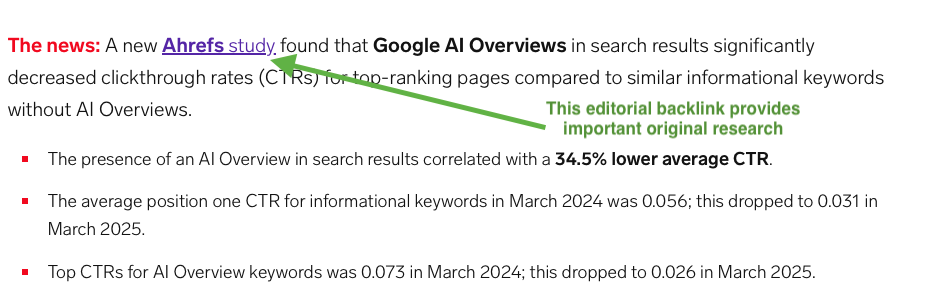
Here, eMarketer links to Ahrefs because their original research on Google’s AI Overviews provided a relevant statistic that made their article more informative.
The link is editorial because it positions Ahrefs as an authority figure in the SEO world capable of providing accurate research and statistics.
It’s the exact type of link you should try to build if you want to improve your AI search visibility.
Can guest posts be editorial backlinks?
Overly promotional guest posts are also devalued and ignored by search engines and AI systems.
Let’s be clear: certain types of guest posts count as editorial links and can improve your site’s reputation.
However, to qualify as editorial, your guest posts should be:
- Approved by the editor
- Contextually necessary to the argument of the piece
- Contains no promotional material
Treated this way, guest posts can serve as editorial backlinks.
The Impact of Editorial Depth on AI Results
Whenever a backlink comes from a credible publication in a paragraph that explains who you are and why you’re being cited, it ties your brand’s entity to relevant concepts, terms, and websites.
For example, if a niche expert links to one of your ‘ultimate guides’ as a resource for his readers, LLMs will begin associating your content with expert-level coverage.
This shines a light on the true goal of building editorial backlinks to improve AI search.
They reinforce entity recognition, meaning they solidify your brand as a relevant, credible entity in your area of expertise.
High-quality editorial mentions also provide clearer topical associations.
In other words, links from niche sites help LLMs place your brand in the right ‘semantic neighborhood.’
Unlocking semantic range
This opens up the possibility for your brand to get cited for prompts containing keywords that you didn’t explicitly target, but that pertain to your area of expertise.
For instance, if you’ve built sufficient editorial depth in the field of photography, an AI system like ChatGPT may choose to cite your content for a prompt related to white balancing, even if you don’t use that exact term (maybe your guide says ‘color balance’ instead).
Here’s how it works:
- The AI system knows that your brand entity is a thought leader in the realm of photography (thanks to your editorial backlinks).
- Due to semantic understanding, the system also knows that color balance and white balance refer to the same thing in your article.
- Since you’re a trustworthy brand and have relevant content, the system decides to cite your content and use it as a building block for its generated response.
Herein lies the true power of better AI search visibility: unlocking the power of semantic range.
If AI search systems view you as one of their ‘go-to’ sources for a particular group of topics, you can earn citations for a wide range of related keywords, all without having to optimize for them outright.
In that sense, strong AI visibility scales much better than traditional blue-link SEO. This fact can also help level the playing field between large publishers and niche players.
When Should Brands Prioritize Editorial Links?
Regardless of niche, editorial backlinks will help improve your AI search visibility. For this reason, every brand should consider building at least some editorial backlinks.
That being said, there are certain sectors where editorial backlinks are even more important (and beneficial).
These include:
- Highly competitive sectors – Certain crowded niches, like eCommerce, SaaS, and digital marketing, require lots of authority to stand out from the pack. High-quality editorial backlinks cut through the noise and let AI systems know that your brand is the one that experts actually reference.
- YMYL (Your Money, Your Life) niches – The health, finance, and legal sectors face extra scrutiny from search algorithms and AI search systems. This is because misinformation in these areas has the potential to negatively impact someone’s health, happiness, or finances. As a result, strong editorial backlinks are a necessity for establishing your brand as a credible YMYL entity.
How to Build an Editorial-First Link-Building Strategy
Starting an editorial-focused link-building campaign may require a shift in focus, especially if you’re used to building transactional links.
The most important requirement is crafting your outreach around genuine storytelling that appeals to journalists and high-authority websites.
Align story angles
First, do some reverse engineering by examining what credible outlets have already covered in your niche. Audit their recent features, ultimate guides, and expert quotes to:
- Identify gaps
- Find fresh angles
- Uncover new topics
Tailor your content to fit the narratives you uncover, and populate your website with content like:
- Original research
- Expert interviews
- Contrarian insights (as long as they’re valid)
Target credible outlets
The other piece of the puzzle is finding the right outlets and publications to target for backlinks.
In particular, focus on 20 to 50 high E-E-A-T domains in your niche. You can use HARO, Qwoted, or a tool like Ahrefs to discover them.
Viable targets include:
- Online industry magazines
- Niche news websites
- Major publications (if feasible)
- Influencer blogs
The key is to find websites with real editorial processes, and not directories or content farms.
For outreach, you should use direct emails with personalized hooks instead of automated templates. Do your best to address your audience’s pain points while leading with the value you’ll provide to the linking website (like adding relevant statistics or a resource for further reading).
Final Takeaways: The Power of Editorial Backlinks
In conclusion, editorial backlinks now sit at the center of modern link equity. Whether you want to rank higher in the organic results or earn more AI citations, editorial links will provide the most impact.
While they’re more difficult to build than traditional link placements, the benefits they provide are more than worth the effort.
Does your website need top-tier editorial backlinks to earn more citations and outrank competitors?
Sign up for Digital PR Plus to earn powerful backlinks from major publications like GQ and The Sun.