
Most conversation about AI Overviews focuses on the fear side: clicks are down, zero-click searches are up, and traditional rankings mean less than they used to. All of that is true. But the more useful question isn’t “what am I losing?” It’s “what does it actually take to get cited?”
Over the past 12 months, a serious body of data has accumulated on exactly that question. Multiple studies, including large-scale analyses of tens of millions of AI Overview citations, have started to reveal clear patterns about which sites get cited, which signals predict inclusion, and where the link building investment actually pays off in AI search.
This post breaks down what the research shows, with specific numbers, and what it means for building authority in 2026. If you want a broader overview of how AI Overviews work and general optimization tactics, we’ve covered that in our companion post on AI Overviews.
Why AI Overviews Now Define Search Visibility
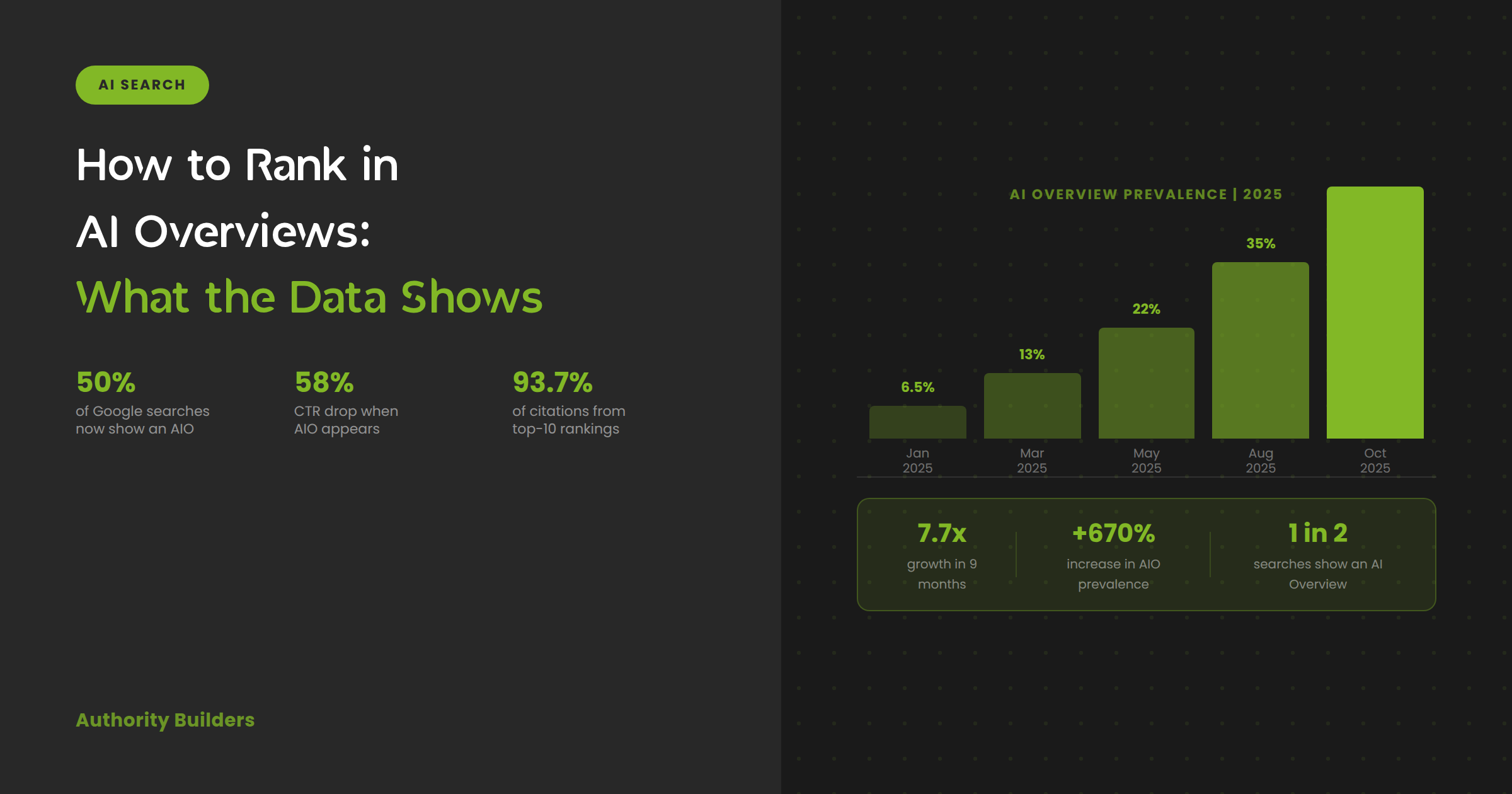
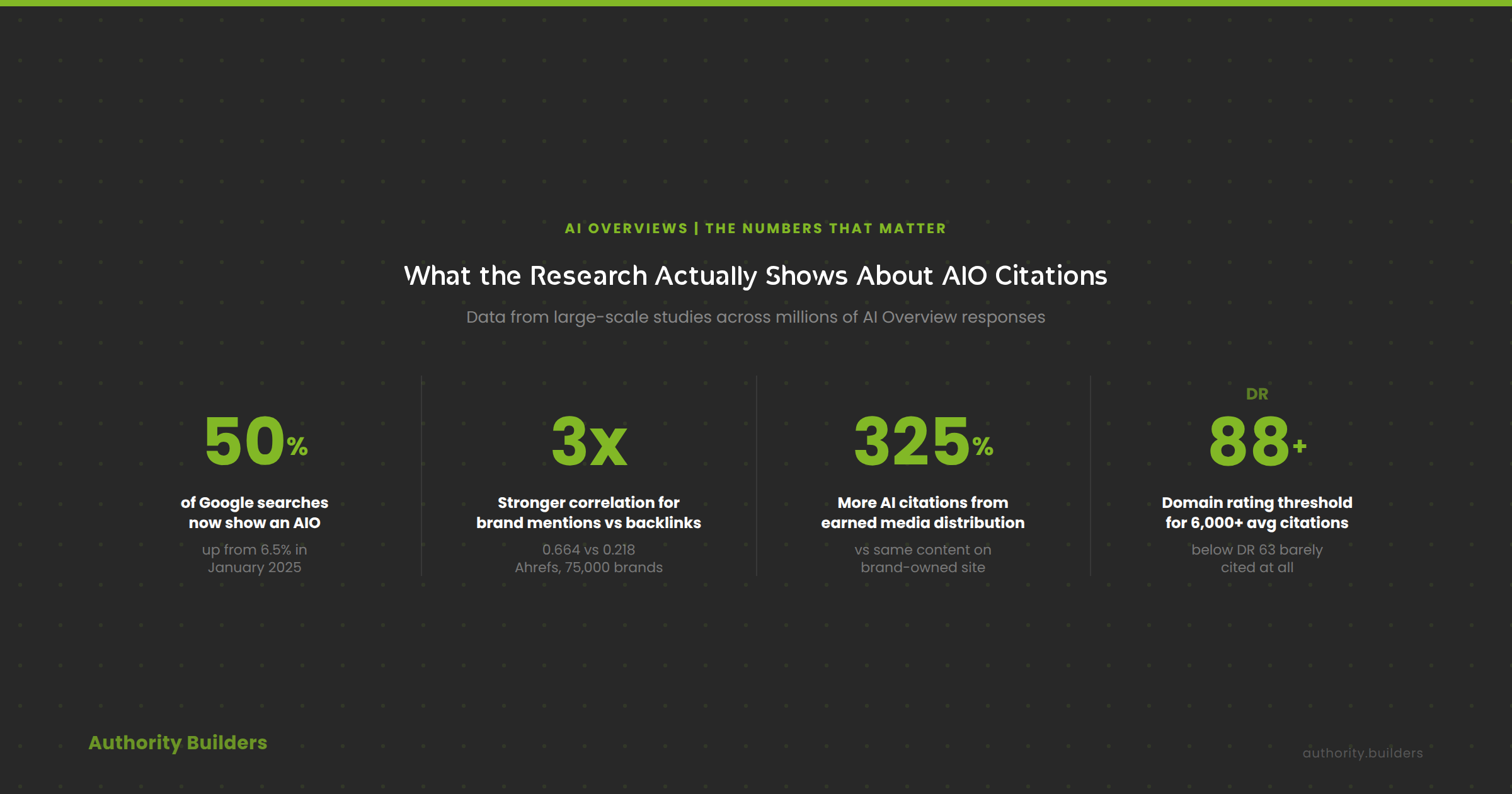
The growth numbers are worth pausing on. In January 2025, AI Overviews appeared for roughly 6.5% of Google desktop searches. By October 2025 they were appearing for over 50% of all queries. That’s not a gradual shift. That’s a fundamental restructuring of what Google’s search results page looks like for most queries.
The click-through implication is significant.
This is why understanding the citation signals matters. It’s not enough to rank. You need to be the source the AI Overview pulls from.
What the Data Says About AI Overview Citations
Several large-scale studies now give us a clearer picture than we’ve ever had. Here are the five findings with the most direct implications for link building and authority strategy.
Finding 1: Rankings Still Matter More Than You’d Think
There’s been a lot of noise about AI search “going beyond” traditional rankings. The data tells a more nuanced story.
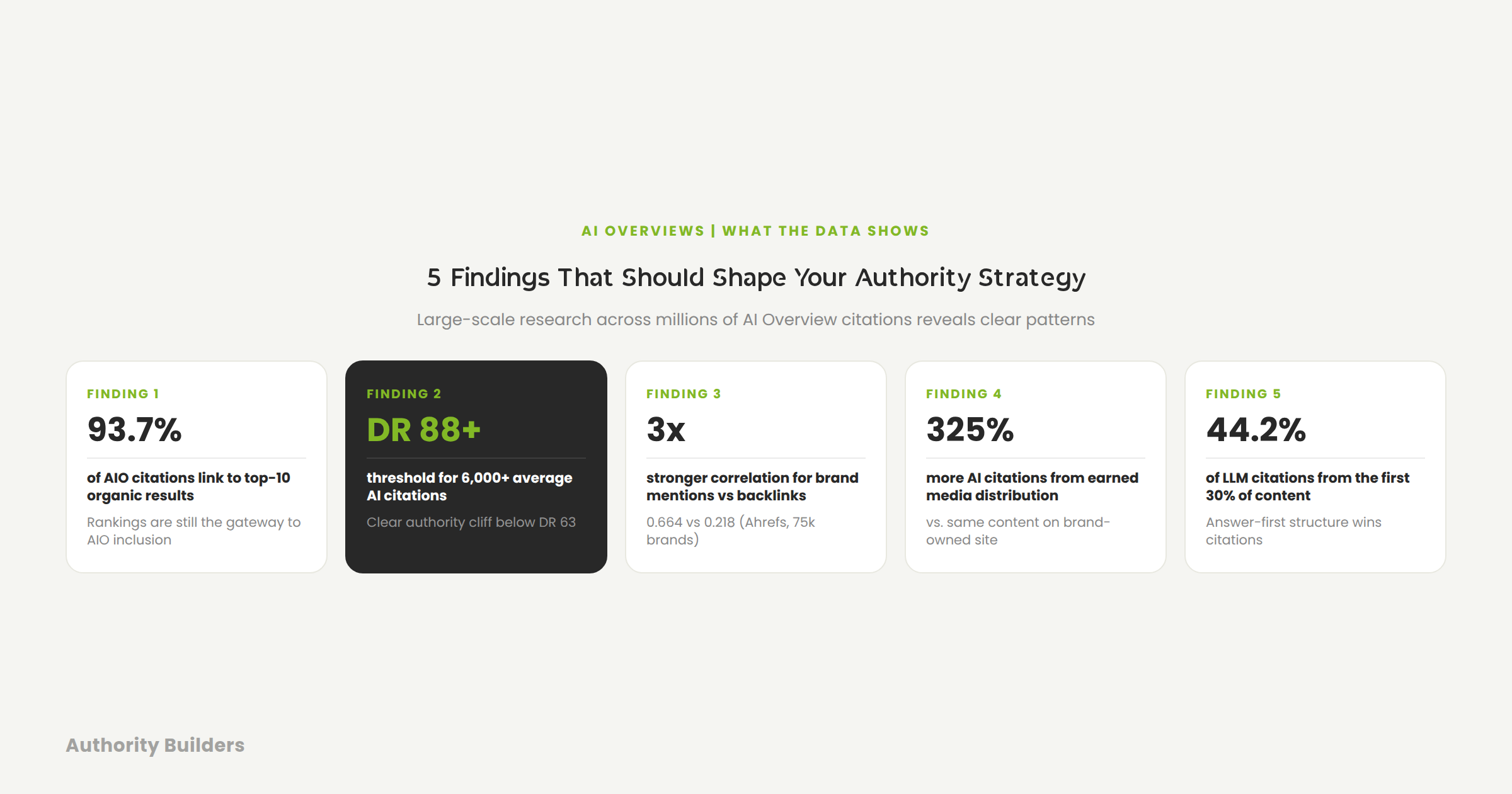
Analysis across millions of AI Overview responses found that 93.67% of citations link to at least one page that appears in the top 10 organic results. Only 15% of AI Overview citations come from pages not appearing in the top 10 at all. And the position effect is dramatic: pages ranking #1 see citation rates of around 33%, dropping to roughly 13% at position #10.
The practical implication: traditional organic rankings are still the gateway to AI Overview visibility. You can’t skip straight to AIO citations without the foundational authority that gets you to page one in the first place. The strategies that earn organic rankings, quality links from authoritative sources, topical consistency, strong E-E-A-T signals, are the same ones that create the conditions for AI citation.
Finding 2: Domain Authority Has a Clear Threshold Effect
Not all authority levels are created equal in AI Overviews. The data shows a sharp cliff rather than a linear relationship.
Sites with Ahrefs Domain Rating scores in the 88-100 range receive an average of over 6,000 AI Overview citations. Sites in the 63-88 range receive far fewer. Sites under 63 are barely cited at all. This suggests AI systems have an implicit trust threshold, below which a domain is effectively invisible regardless of how well-optimized individual pages are.
This finding reframes how to think about link building investment. The question isn’t just “will this link improve my rankings?” It’s “is this moving my domain’s authority profile above the threshold where AI systems start treating it as a reliable source?”
The shift has implications for link quality prioritization. A smaller number of links from genuinely authoritative, topically relevant sources moves the needle more than a larger volume of lower-DR placements. You can read more about how this plays out in our post on link equity.
Finding 3: Brand Mentions Outperform Backlinks for Direct AIO Visibility
This is the finding that’s shifted how authority strategy is being discussed in 2026, and it requires some careful unpacking.
Ahrefs’ analysis of 75,000 brands found that brand web mentions correlate with AI Overview visibility at 0.664, compared to 0.218 for backlinks. Brand mentions are roughly three times more predictive of AI citation than raw backlink counts.
The mechanism makes sense when you think about how language models are trained. LLMs learn from the text of the web. When independent editorial sources consistently discuss and reference a brand, the model learns that brand is a known, credible entity in that topic area. Backlinks pass authority through the link graph. Brand mentions build entity recognition directly in the training and retrieval process.
The important nuance: this doesn’t mean backlinks don’t matter. Backlinks drive organic rankings, and organic rankings drive AIO citation eligibility (see Finding 1). The relationship is: links get you ranked, mentions get you cited. You need both. The brands seeing the strongest AI search visibility are the ones combining authoritative backlink profiles with consistent editorial brand presence.
Finding 4: Earned Media Distribution Multiplies Your Citation Rate
One of the most striking data points to emerge from recent research is about distribution, not just content quality.
A controlled study
The mechanism: AI systems weight the authority of the domain doing the citing, not just the content itself. A story covered by Forbes earns AI citations that reference Forbes as the authority. The same information on a brand blog gets a fraction of that signal.
This is why earned media, press coverage, and editorial placements on high-authority publications matter so much for AI search visibility, not just for traditional link equity. They don’t just pass PageRank. They build the third-party editorial footprint that AI systems use to determine citation-worthiness.
A controlled study from Authority Tech’s Machine Relations research found that the same content distributed through earned media placements on third-party news outlets generated a 325% higher AI citation rate than when published only on the brand’s own site. Same information, same authors, same level of expertise, but a dramatically different signal to AI systems based on where the content lived.
Finding 5: Content Structure Determines Whether You Get Cited
Even with strong authority signals, content that isn’t structured for AI retrieval won’t get cited as frequently as it should. A few patterns stand out from the data.
Answers need to come first
Research found that 44.2% of all LLM citations come from the first 30% of a piece of content, the intro and opening sections. This is answer-first formatting: leading with the direct response to the query before adding context, nuance, and supporting detail. AI systems are essentially skimming for the most relevant passage. If your answer is buried in paragraph seven, it often won’t get pulled.
Question-and-answer structure outperforms dense paragraphs
Q&A format and structured content with clear headings show significantly higher AI citation rates than dense prose. This mirrors how AI systems retrieve information: they’re looking for discrete, self-contained answers to specific questions. FAQ sections, definition blocks, and step-by-step guides create exactly the kind of retrievable chunks AI systems prefer.
Freshness matters, especially for some platforms
85% of AI Overview citations come from content published in the last two years, and 44% from 2025 alone. This doesn’t mean old content is irrelevant, but it does mean regular content updates and refreshes are part of an AI search strategy, not just an SEO hygiene task. Our Content Refresh service is built around exactly this signal, keeping high-value pages current so they stay eligible for AI citation rather than aging out.
What This Means for Your Link Building Strategy
Pulling the data together, the picture that emerges isn’t that link building matters less. It’s that the definition of what makes a link valuable has sharpened.
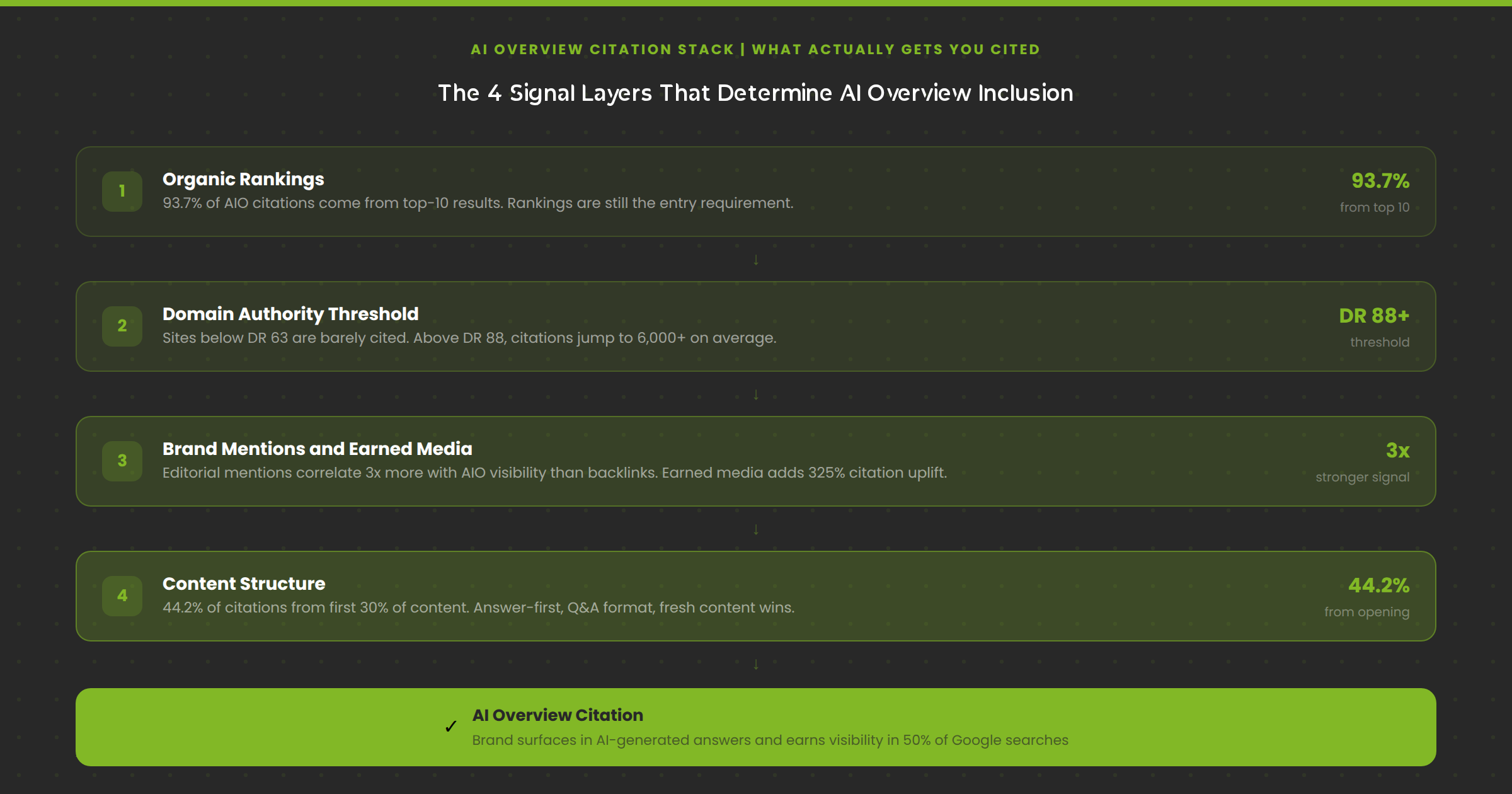
The sites that are winning AI Overview citation share have:
- Strong organic rankings built on topically relevant, authoritative backlink profiles
- Domain-level authority that crosses the threshold where AI systems treat the domain as a credible source
- Genuine editorial brand mentions from publications that independently carry authority
- Content that’s structured to be AI-retrievable: answer-first, Q&A formatted, and kept current
The sites losing ground are those that optimized for link volume over link quality, or that treated content as a one-time investment rather than an ongoing signal.
The good news for anyone already focused on quality link building is that the data validates exactly what you’ve been doing. The opportunity for those who haven’t yet made that shift is significant, because the window for establishing the authority threshold early in a category is still open for most niches.
How Authority Builders Can Help
Every service we offer is built around the signals the data says actually move the needle for AI search visibility.
- Guest Posts and Link Insertions on verified, traffic-confirmed sites build the organic ranking foundation that AI Overview citation depends on
- Earned Media and Press Authority place your brand in the editorial publications that build AI-visible brand mention signals
- High-Authority Links target the DR thresholds where AI systems start treating domains as reliable citation sources
- Content Refresh ensures your existing content meets the freshness and structure requirements that determine whether it gets cited
- ABC Plus and ABC Platinum manage the full campaign, from link gap analysis through ongoing placement, with AI search visibility built into the strategy
If you want to understand where your current authority profile sits relative to the AI citation thresholds and what it would take to close the gap, book a strategy call with our team. We’ll walk through where your brand stands today, where the highest-leverage gaps are, and what a focused 90-day plan would look like.