
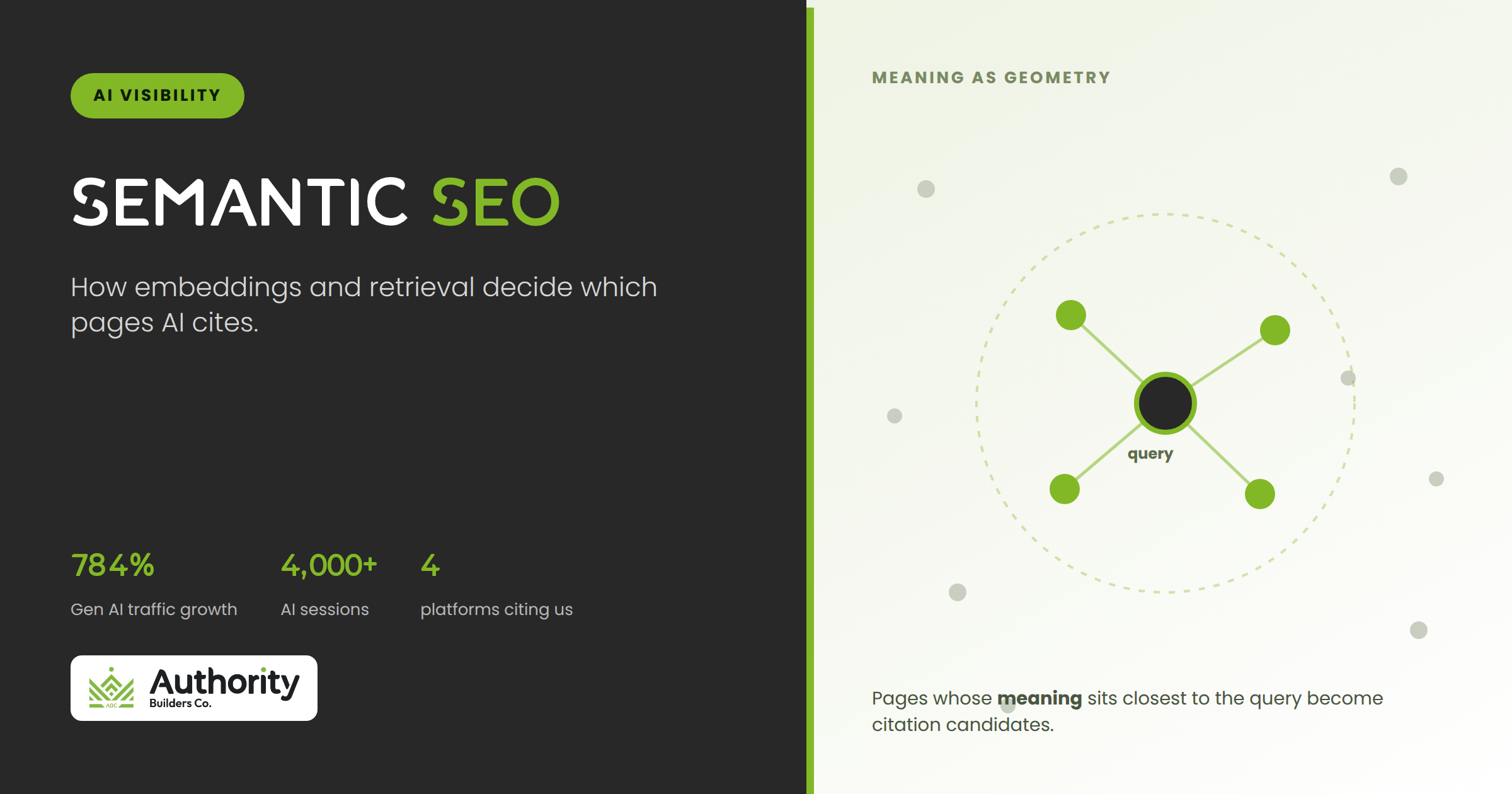
Search stopped rewarding exact-match keywords a while ago. It rewards meaning now. If you’re still optimizing the way you did in 2020, matching literal strings and counting densities, you’re tuning for a system that no longer exists.
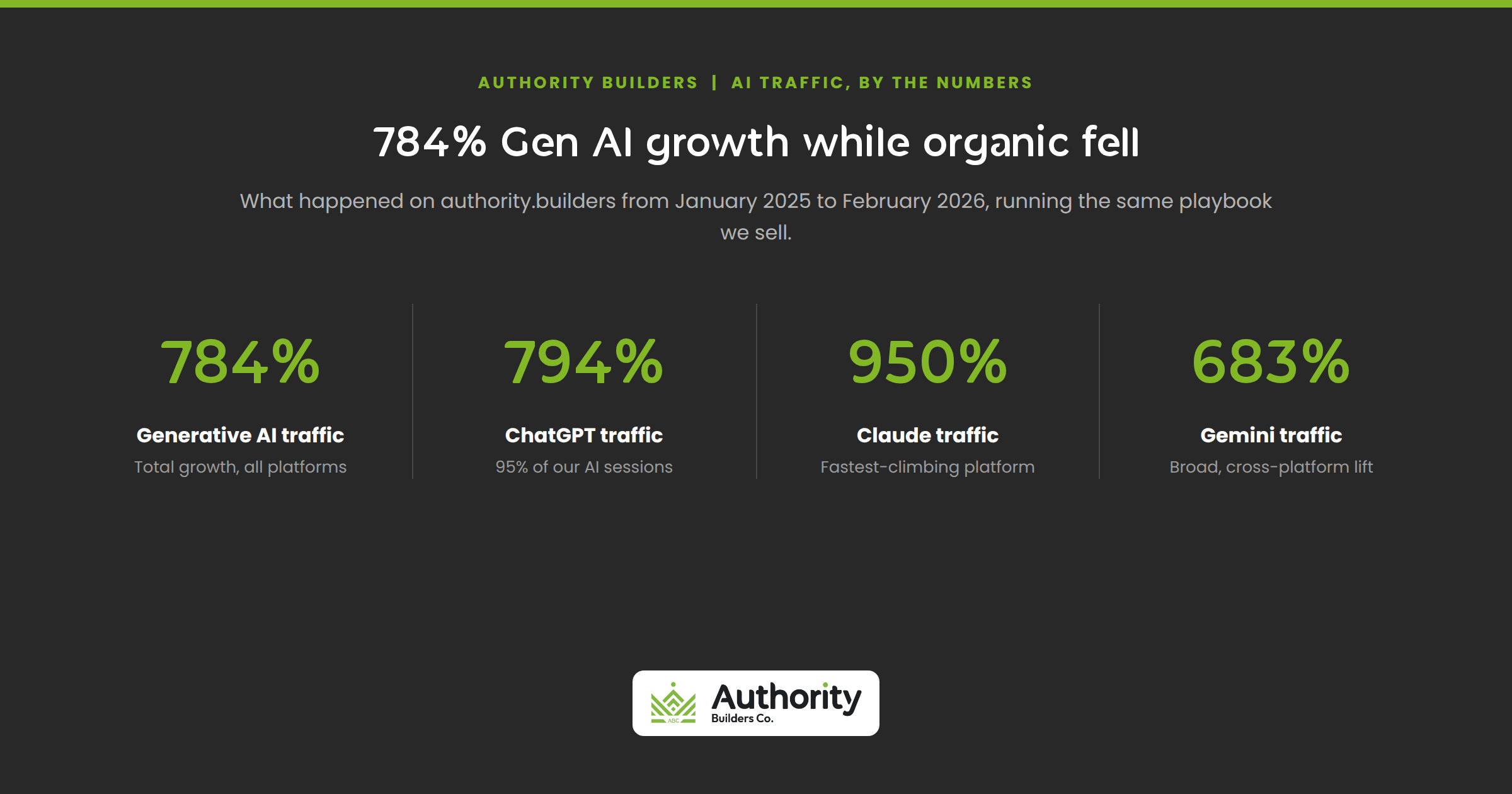
Here’s why this matters right now. Between January 2025 and February 2026, we grew our own generative AI traffic 784% while traditional organic search declined 26% across the industry for authority.builders. That growth didn’t come from keyword stuffing or a clever prompt. It came from understanding how modern search systems read meaning, then building content they could parse, trust, and cite.
This guide breaks down the machinery under that shift: what semantic SEO is, how embeddings turn your content into math, how retrieval systems pick which pages get pulled into an AI answer, and what you can do about it. We’re keeping it technical, because you already know what a backlink is.
What semantic SEO really means
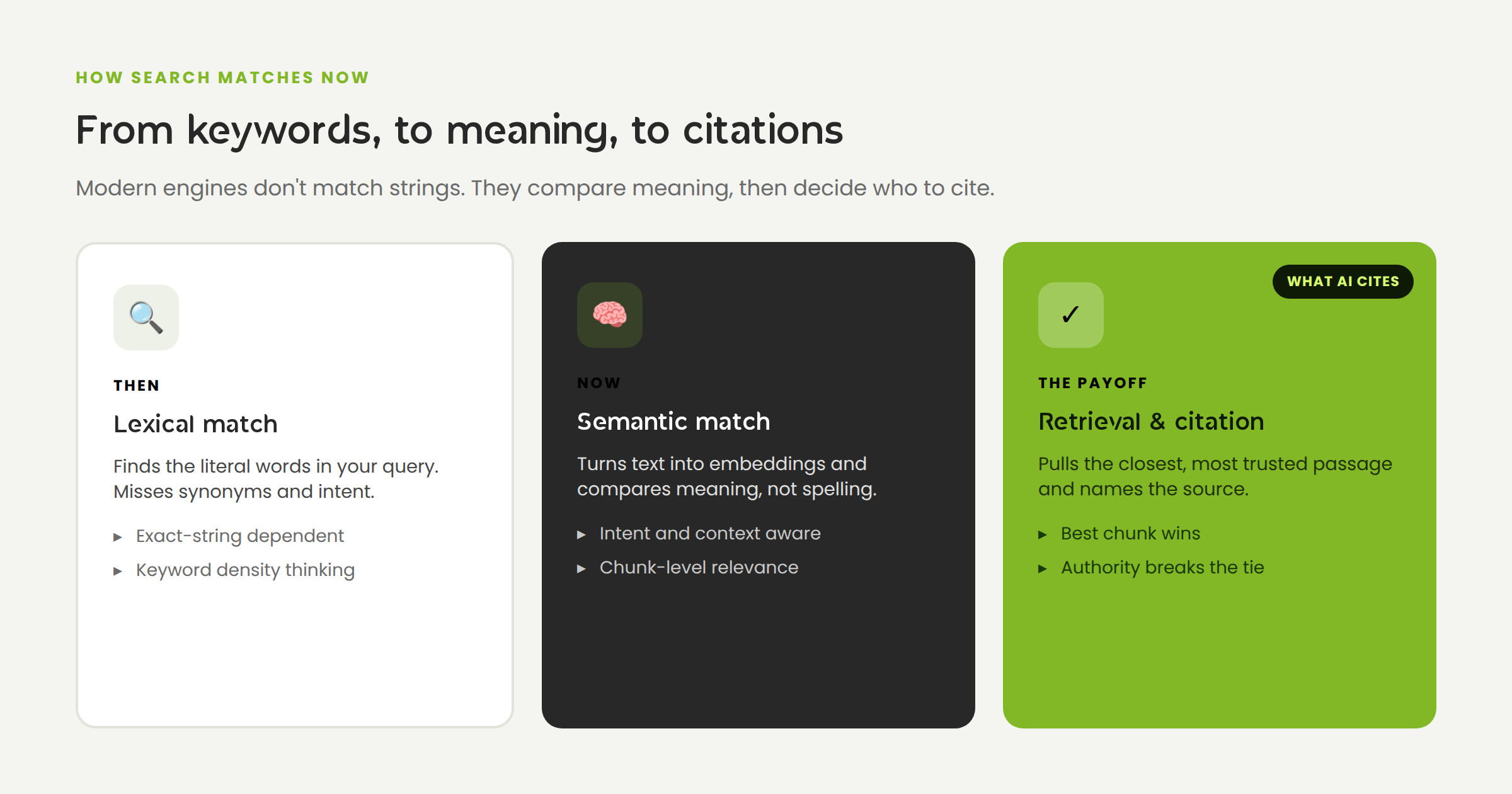
Traditional SEO ran on lexical matching. The engine looked for the literal words in a query and found documents containing those same strings. Search for “affordable link building” while your page says “cheap backlinks,” and you could miss the match entirely, even though you meant the same thing.
Semantic SEO is the practice of optimizing for meaning rather than exact strings. Modern engines and large language models don’t just scan for keywords. They interpret intent, the relationships between concepts, and the context around every phrase. The question shifts from “does this page contain the words?” to “does this page answer the thing the user meant?”
Google has been moving this direction for years, from Hummingbird to today’s retrieval-powered AI features. The difference now is that an interpretation layer sits between your content and the answer the user sees. When an AI Overview or a ChatGPT response summarizes something and cites two or three sources, a retrieval system chose those sources on semantic relevance, not a ten-blue-links ranking you can eyeball. This is the core mechanic behind answer engine optimization, and it changes what “optimized” even means.
Embeddings: how machines read meaning
To match meaning, a machine needs a way to represent meaning as something it can compute with. That representation is an embedding.
An embedding is a list of numbers, a vector, that captures the meaning of a piece of text. A word, a sentence, a paragraph, or a whole page gets converted into a point in a high-dimensional space, often hundreds or thousands of dimensions. Text that means similar things lands close together in that space. Text that means different things lands far apart.
The classic illustration: the vectors for “king” and “queen” sit near each other, and the relationship between them mirrors the relationship between “man” and “woman.” The model learned those relationships from patterns across billions of documents. Nobody hand-coded them.
Here’s what that means for your content. When a user asks a question, the system embeds the question into the same space and looks for content whose vectors sit closest to it, usually measured by cosine similarity. Your page competes not on whether it contains the query words, but on whether its meaning is a close neighbor to the query’s meaning.
Worth knowing what gets embedded:
- Individual passages, or “chunks,” of your page, not always the whole page at once
- The entities you mention and how you relate them to each other
- The surrounding context that disambiguates a term (does “Jaguar” mean the car or the animal?)
This is why thin, vague, or off-topic content fails in AI search even when it technically mentions the keyword. A weak passage embeds into a fuzzy location. A precise, well-structured passage embeds into exactly the neighborhood where the query lands.
Chunking is the detail most people miss. Retrieval systems rarely embed a 2,000-word page as one blob. They split it into passages and embed each one, because a single vector for a long, wide-ranging page averages out into mush. That averaging is your enemy. A page that wanders across five loosely related ideas produces vague chunks that match nothing strongly. A page built from tight, focused sections produces sharp chunks, each one a strong candidate for the specific question it answers. Structure isn’t cosmetic here. It’s what determines how cleanly your meaning survives the split.
How retrieval decides what gets cited
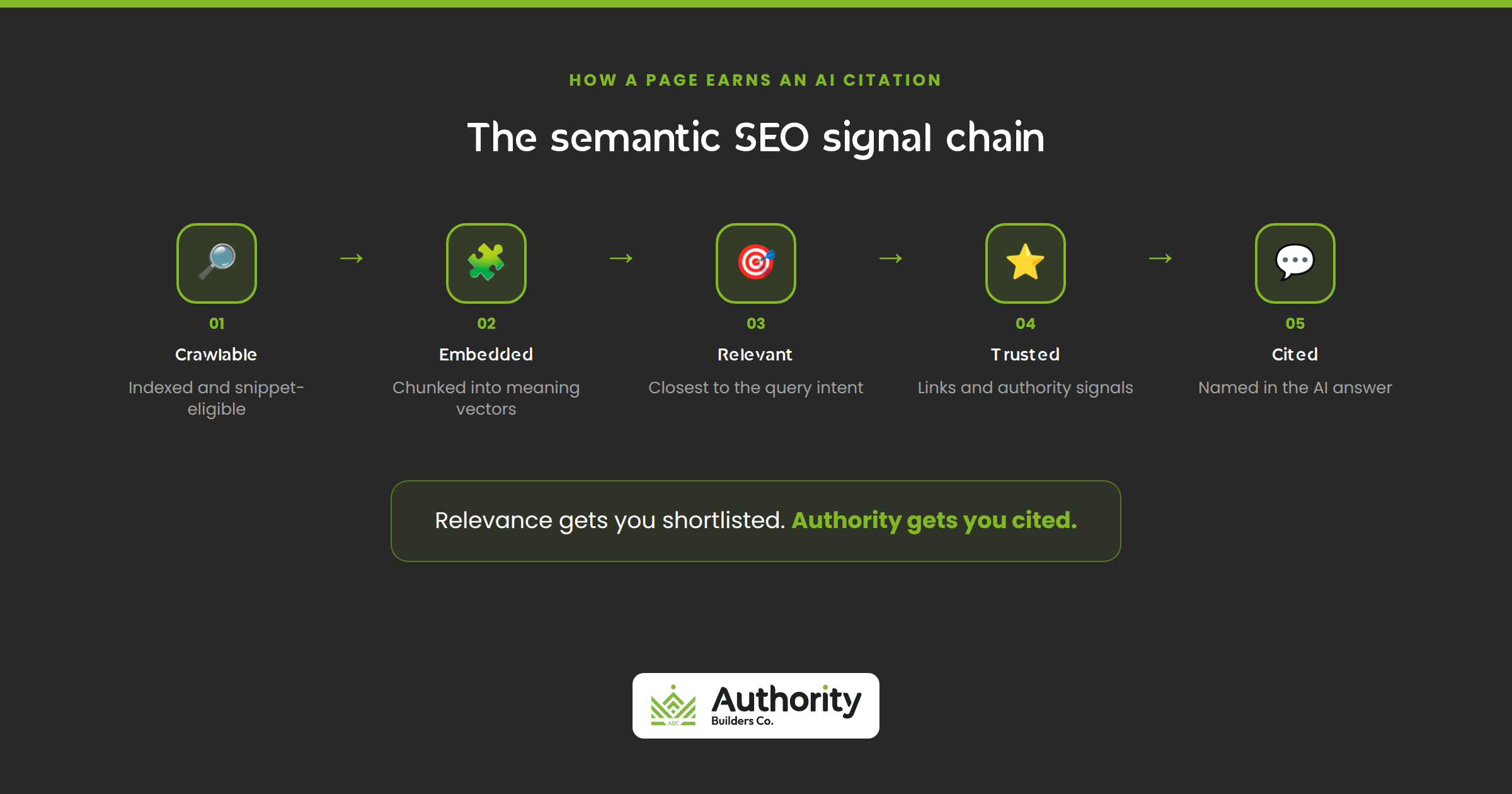
Embeddings get you into the conversation. Retrieval decides whether you make the cut. Two dominant systems are worth understanding, because they behave differently.
- Google’s AI features (AI Overviews and AI Mode).
Google’s generative features run on top of its core Search index. In its own guidance for generative AI features, Google describes using retrieval-augmented generation, also called grounding, to pull content from the index into AI answers. To be eligible at all, a page has to be indexed and able to show a snippet. There’s no separate AI index and no special file you upload.
The twist is a technique Google calls query fan-out. Instead of answering your one question directly, the system breaks it into several related sub-queries, runs them in parallel, and assembles an answer from the best sources for each piece. A page can get cited for a query it was never explicitly targeting, as long as it answers one of the sub-questions cleanly. A page laser-focused on a single head keyword can get skipped if it ignores the surrounding subtopics.
- Standalone LLMs (ChatGPT, Perplexity, Claude, Gemini).
These systems cite through a mix of what the model learned during training and live retrieval at query time. When they retrieve, they typically chunk documents, embed the chunks, and pull the passages that best match the question. The model then synthesizes an answer and names the sources it leaned on.
The balance between memory and live retrieval differs by tool, and it changes your leverage. Perplexity leans hard on live retrieval, so fresh, crawlable, on-topic pages can surface fast even if the brand is newer. ChatGPT and Gemini lean more on what they absorbed during training, plus browsing, so being cited consistently across trusted sources over time carries more weight. The practical read: live retrieval rewards content quality and freshness you can move quickly, while training-weighted systems reward the slow compounding of authority and mentions. You want both working for you.
Two practical consequences follow from this:
- Passage-level quality beats page-level averages. Retrieval pulls the best chunk, so one sharp, self-contained answer buried in a long page can earn a citation the rest of the page never could.
- Brand familiarity compounds. Models are more likely to surface and name brands they encountered repeatedly across trusted sources during training. That repetition gets built the same way authority always has.
We saw this concentration firsthand. Our AI referral traffic didn’t scatter evenly across the site. It piled onto a short list of high-value pages: the homepage, the guest posts service page, and a few core link building guides. Retrieval kept selecting the same trusted, on-topic assets.
Why authority still breaks the tie
Here’s the part the “just chunk your content” crowd skips. Semantic relevance gets you into the candidate pool. It rarely decides the winner on its own. On any competitive question, dozens of pages are semantically relevant. The system still has to choose which two or three to cite.
That choice leans on trust and authority signals, the same ones that have driven rankings for two decades. We’ve broken down how authority signals shape AI search answers and how AI decides which brands to trust before. The short version: LLMs read the language around a mention, the credibility of the sources citing you, and the consistency of your brand’s presence across the web.
This is where link building and semantic optimization stop being separate projects. A high-authority backlink does two jobs at once now. It passes the ranking equity it always did, and it plants another trusted, contextual mention that trains models to associate your brand with your topic. That’s why link quality matters more than ever for AEO, and why we treat every placement as both a ranking signal and a citation signal.
When ChatGPT names a brand as the answer to “who should I hire for link building,” it isn’t sending a link. It’s making an endorsement. The user already asked the question and got your name back. That’s a higher-intent entry point than fighting for a click on a crowded results page.
There’s a compounding effect worth naming: co-occurrence. Every time your brand appears next to your target topic in a trusted context, whether that’s a backlink, a quoted expert mention, or a roundup that lists you, you tighten the association a model holds between your name and that subject. One mention is noise. A consistent pattern across dozens of credible sources becomes a signal the model treats as fact. That pattern is exactly what quality link building and earned media produce, which is why the brands winning in AI search tend to be the ones that were already doing the fundamentals well.
How to optimize for semantic SEO
Enough theory. Here’s the practical work, in the order we’d tackle it.
- Build real topical depth, not isolated posts. Retrieval and query fan-out reward sites that cover a topic and its subtopics thoroughly. Build clusters: a pillar page plus supporting posts that each answer one specific sub-question, all interlinked. That’s how you become the close neighbor for a whole family of related queries instead of a single keyword.
- Write self-contained, extractable passages. Assume a retrieval system will pull one chunk out of context. Make each section answer its question in the first sentence or two, then support it. Clear H2s and H3s phrased as real questions help both the reader and the chunker.
- Sharpen your entities. Name things precisely and consistently. Define what you do, who you are, and how your concepts relate. Ambiguity embeds badly. When your brand and your core service always appear together in clear language, models learn the association.
- Fix your technical foundation. Retrieval can only pull what it can crawl and parse cleanly. Redirect chains, orphan pages, canonical conflicts, and semantic duplicates all blur the signal. When we ran quarterly crawls on our own site, resolving semantic duplicates and tightening URL structure was part of what reinforced our topical authority. Sound technical SEO is table stakes for AI visibility.
- Keep content fresh. Retrieval favors current, maintained sources. A continuous refresh program, auditing and updating existing posts, keeps your best pages eligible instead of quietly decaying out of the candidate pool.
- Earn authoritative, contextual mentions. This is the tie-breaker. Pursue high-authority links and earned coverage that place your brand next to your topic in trusted publications. Every quality placement is a training signal for the models deciding who to cite.
Notice what’s not on this list: llms.txt files, special AI schema, or keyword-density tricks. Google has framed AEO and GEO as still SEO, and says you don’t need special markup or machine-readable AI files to appear in its generative features. The work that wins is the work that was always going to win, done with an understanding of how meaning is now parsed.
How to know if it’s working
You can’t optimize what you can’t see, and this is where semantic SEO gets frustrating. Classic rank tracking tells you almost nothing about whether an LLM is citing you. A page can sit at position 8 in Google and still be the source ChatGPT names for a whole cluster of questions. Or it can rank well and get ignored by every AI answer. The two are measured differently.
So track the AI layer directly. Watch for referral sessions from ChatGPT, Perplexity, Gemini, and Claude in your analytics, monitor whether your brand gets named in AI answers for your core questions, and note which pages the citations point to. We went deep on the tooling in our rundown of the best AI search visibility tracking tools. The point is to build a feedback loop: see which passages earn citations, then produce more of what’s working and sharpen what isn’t.
What we learned growing our own AI traffic
We didn’t theorize our way here. We ran the playbook on authority.builders and tracked it through both the traditional organic lens and the AI referral channel.
Over that window, generative AI traffic grew 784% to just over 4,000 sessions, while industry-wide organic declined. The growth held across every platform we measured, not just one:
- ChatGPT drove about 95% of our AI traffic, up 794%
- Perplexity grew 541%
- Gemini grew 683%
- Claude grew 950%
Every major platform was independently learning to recommend us. That only happens when the underlying signals line up across the board: content depth, links, technical health, and brand presence. There was no AI-specific hack. The same fundamentals that maintain organic authority are what taught these systems to cite us.
The traffic also landed where it counts. It concentrated on our highest-value pages, service pages and core guides, which means visitors arrived ready to explore and buy, not just read. Semantic retrieval didn’t only find us. It found the right pages.
Turn semantic relevance into AI citations
Optimizing for meaning is a discipline, not a one-time fix. It combines content architecture, technical hygiene, and the authority signals that decide which relevant page gets named.
That’s what we built ABC AI Plus to manage. It’s our managed AI search authority service, built to make your brand the one retrieval systems trust and cite, using the same link building, content, and technical work we ran on ourselves. If you’d rather hand the whole system to a team that’s already proven it, that’s the fastest path there.
Want to see where your brand stands in AI search today? Book a call with our team and we’ll map it out with you.