
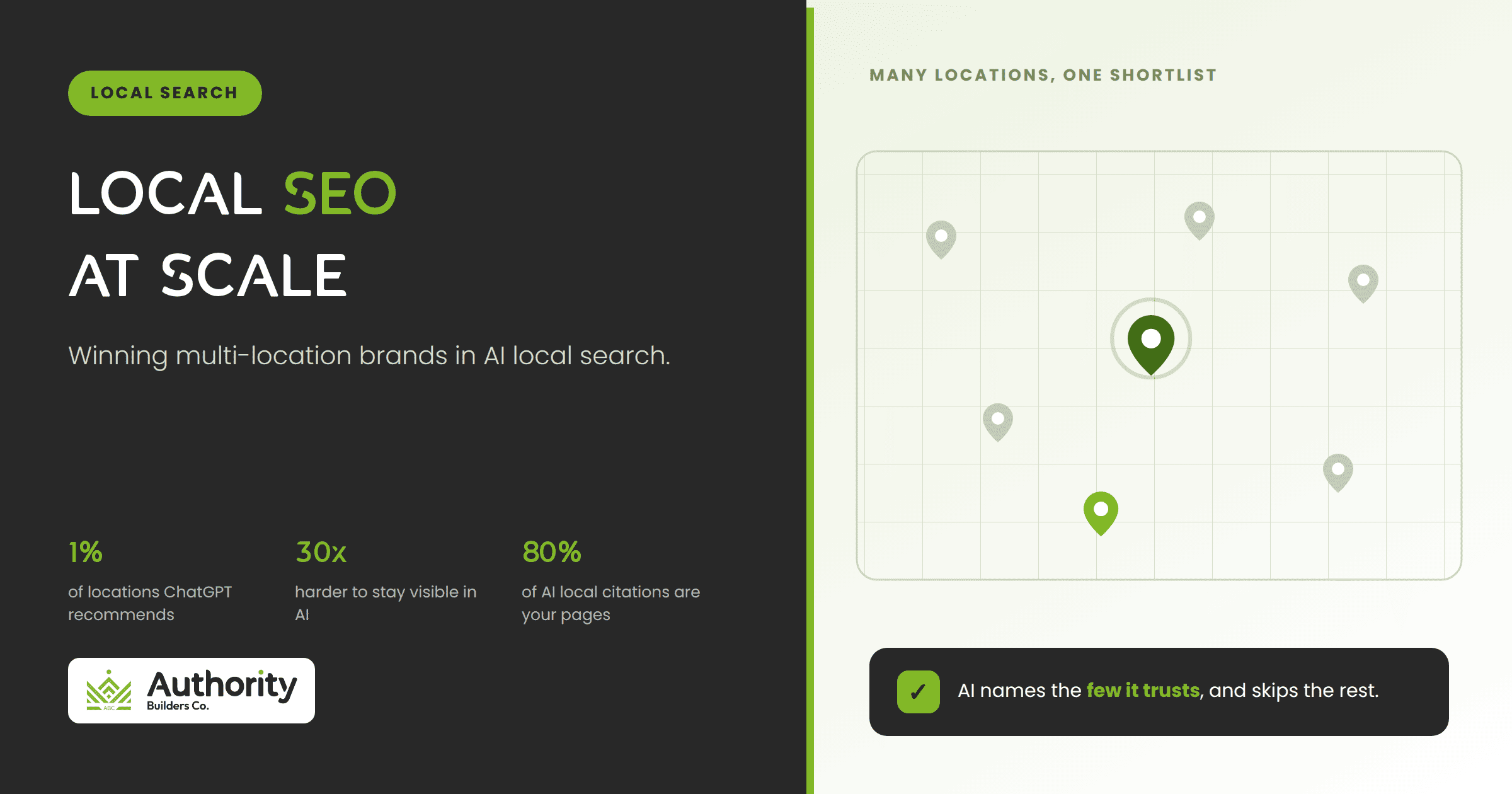
Ranking number one in the map pack used to be the finish line. Now it’s the qualifying round. Someone searching for what you sell might see a Google local pack, an AI Overview, an Ask Maps summary, or a ChatGPT answer that names three businesses and moves on. For a brand with one location, that’s a challenge. For a brand with two hundred, it’s a governance problem wearing a marketing costume.
Here’s the shift that matters. Local discovery has split across Google Maps, AI Overviews, AI Mode, ChatGPT, Gemini, Perplexity, and Apple’s ecosystem, and every one of them is more selective than the old ten-blue-links page. The research is blunt about it: AI assistants recommend a short list, and multi-location brands are disproportionately the ones getting left off.
This guide is for teams running local at scale. We’ll cover the ranking model that still sits underneath everything, why AI local search plays by stricter rules, and the specific technical and content work that gets your locations recommended instead of bypassed.
Why local search fractured
For years, local SEO had one main arena: the Google local pack, driven mostly by proximity. You optimized your Google Business Profile, built some citations, chased reviews, and watched the map rankings.
That arena is now one of many. A single local query can resolve inside an AI Overview, inside Google’s AI Mode, inside an Ask Maps summary, or entirely inside ChatGPT or Perplexity, often without a click to anyone’s website. Most local actions now happen on the results surface itself, which means the game shifted from being clicked to being chosen. This is the local version of answer engine optimization, and it rewards different work than chasing a blue-link position.
The queries changed too. People used to type “plumber near me.” Now they ask “best emergency plumber near me with same-day service and financing.” The engine has to match a specific, layered intent, and a thin listing that just says “plumber” won’t clear the bar.
The behavior around those queries changed as well. A growing share of local journeys never leave the results surface: the searcher gets the name, the hours, the rating, and the directions without visiting a single website. Your listing and your presence inside the answer become the storefront. That reality raises the stakes on every signal an engine reads before it decides whether to include you, because there’s often no second chance to win the click on your own page.
The model underneath: relevance, distance, prominence
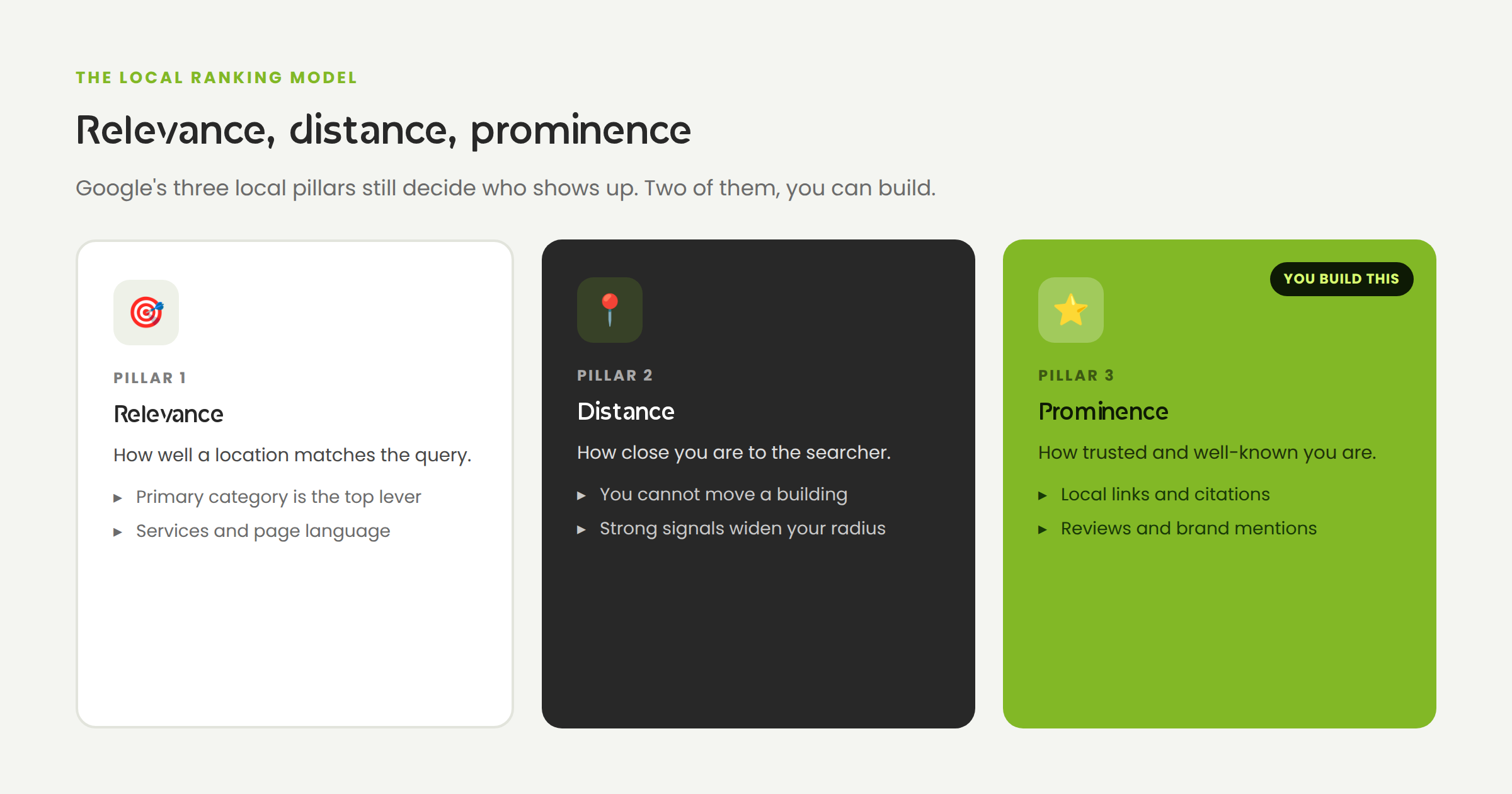
Before we get to AI, understand what hasn’t changed. Google has said for years that local rankings come down to three factors, laid out in its own local ranking guidance: relevance, distance, and prominence.
- Relevance: how well a location’s data matches the query. Driven by your primary category (the single strongest lever), secondary categories, listed services, and the language on your Business Profile and location page.
- Distance: how close the location is to the searcher or the place named in the query. You can’t move a building, but strong relevance and prominence let a location compete across a wider radius.
- Prominence: how well-known and trusted the location is. Built from reviews, brand mentions, local citations, and links from reputable, locally relevant sites.
Notice that two of the three, relevance and prominence, are things you can build. And notice what feeds prominence: links, mentions, and reviews. The same authority signals that drive organic and AI rankings drive local ones. We’ve broken down how authority signals shape AI search answers before, and local is no exception.
Why AI local search is a stricter game
Traditional local search ranks a list. AI local search builds a recommendation, and it’s far more conservative about who it names.
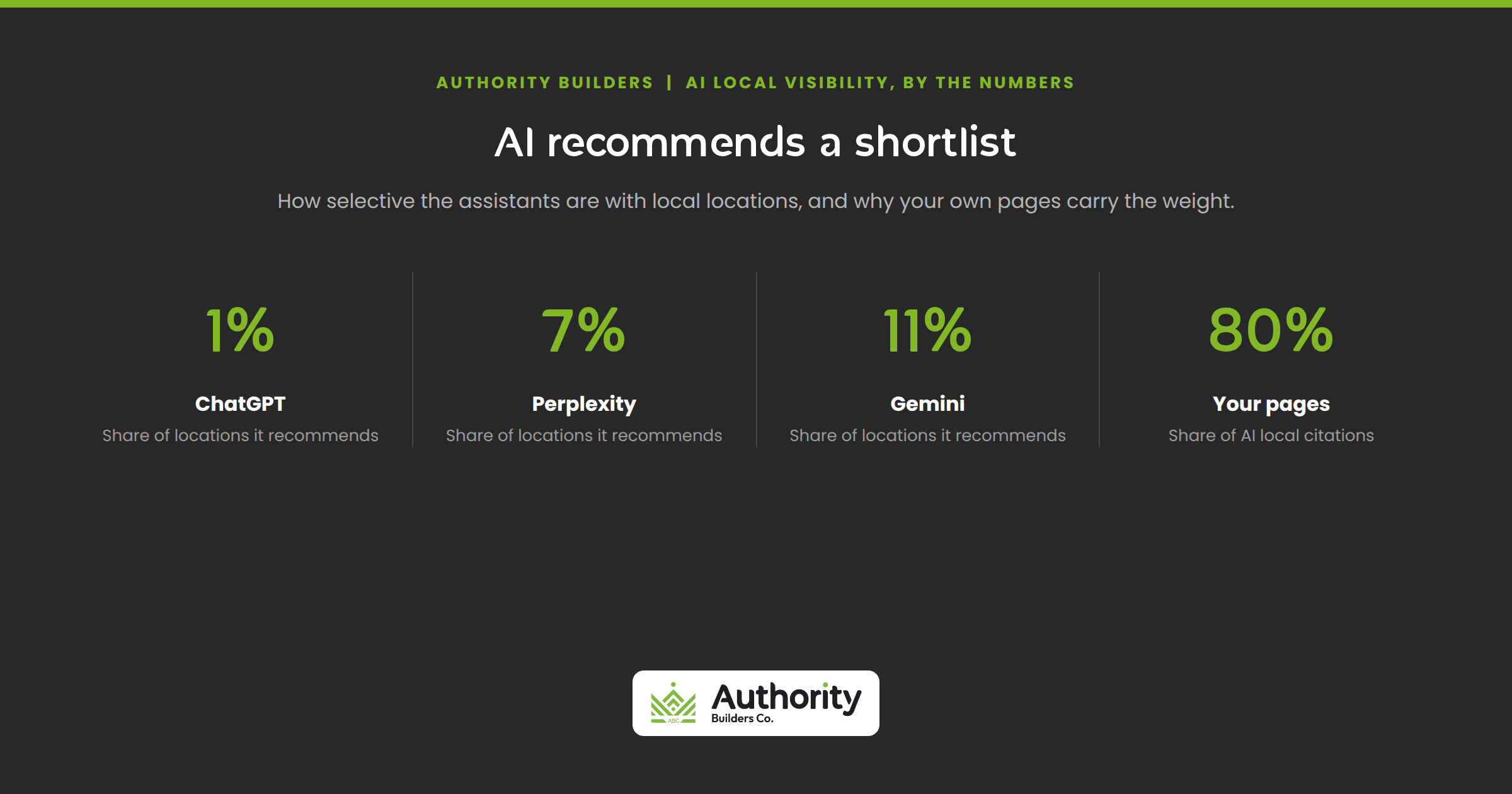
The selectivity is dramatic. In one 2026 study of thousands of locations, ChatGPT recommended only around 1% of them, Perplexity around 7%, and Gemini around 11%, which makes earning a spot in AI answers many times harder than ranking in traditional local results. The same research surfaced something else worth sitting with: strong traditional performance does not carry over automatically. In retail, fewer than half of the brands leading in classic local search also showed up among the most-recommended in AI results.
The reason is a change in what the system is doing. A ranking algorithm sorts pages. An AI assistant evaluates confidence. It asks whether it can trust the accuracy, reputation, and consistency of a business enough to put its name in an answer. Locations with incomplete data, conflicting listings, or thin reviews fail that confidence check and get bypassed. Not penalized, just skipped.
Picture the query “orthodontist in Uptown that takes my insurance and has weekend hours.” A traditional engine returns a ranked list and lets the user sort it out. An assistant has to commit to a recommendation, so it needs a location it can verify on every dimension of that question: the right service, the right neighborhood, the insurance detail, the weekend hours, and enough reputation to feel safe naming. If any of those facts is missing or contradicts another source, the safer move for the model is to recommend a competitor it can fully verify. Ambiguity doesn’t get you a lower ranking. It gets you left out of the sentence.
The multi-location paradox
Here’s the part that stings for enterprise brands. Early patterns show AI systems often favor single-location businesses, because their data, reputation, and activity signals are simpler and more unified. A local shop has one address, one set of hours, one review stream, one story. A 300-location brand has 300 chances for a phone number to drift, a category to be wrong, or a location page to read like a template.
More locations create more opportunity and more surface area for inconsistency. That inconsistency is exactly what lowers an AI system’s confidence. So the real work of multi-location local SEO in an AI world is making a sprawling brand look as clean and coherent as a single trusted business, at scale.
Location pages: your highest-leverage AI asset
If you do one thing, fix your location pages. Research into AI citations found that the large majority of sources AI engines pull for local answers are business websites, not third-party directories. Your own location pages are the single highest-leverage asset for earning an AI citation.
But not any location page. Templated pages that swap a city name into boilerplate are now a liability. Google’s spam policies apply to AI features, and thin, scaled, templated location content is exactly what they target. A page that reads “Welcome to [Brand] in [City], your trusted provider of [service]” tells an AI nothing it can use.
A citation-worthy location page needs:
- Specific local detail: the real address, service area, parking notes, staff names, nearby landmarks, and real photos of that location, not stock images.
- Intent-matching content: the services offered at that location, hours including special hours, accepted insurance or payment, and clear answers to the layered questions people really ask.
LocalBusiness structured data: NAP, geo-coordinates, hours, and services marked up so AI systems can read the entity cleanly. Sound technical SEO is what makes each page machine-readable at scale.
Write each location page as if it’s the only page an AI will read about that location. For that query, it is.
Entity and NAP consistency at scale
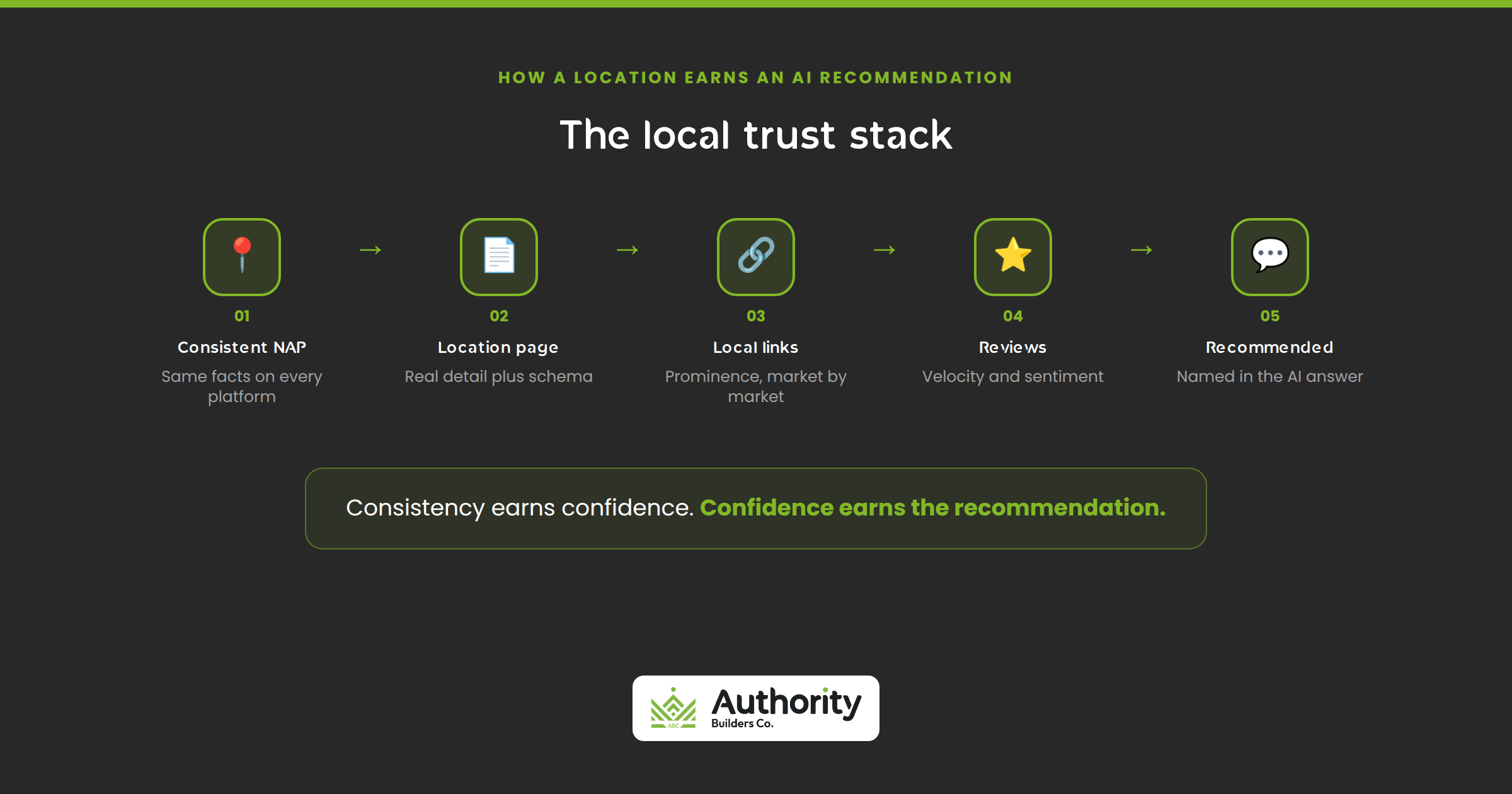
AI systems don’t read your locations one at a time. They cross-reference. They pull your name, address, and phone number from your site, your Google Business Profile, Bing Places, Apple Maps, and legacy directories, and they look for agreement. When the facts line up everywhere, confidence goes up. When ChatGPT sees one phone number on your site and a different one on a directory, it treats the conflict as risk and moves on.
This is why citations, the consistent listing of your NAP across the web, went from a checkbox task to a trust foundation. Consistent citations are how you tell every engine, human and AI, that this entity is stable and real.
A few practical points that matter more than they used to:
- Sync everywhere, not just Google. ChatGPT leans on Bing for local data, so a claimed, accurate Bing Places listing isn’t optional. Apple Business Connect feeds Siri and Apple Maps. Aggregators like Data Axle and Foursquare feed dozens of downstream sources.
- Watch the legacy directories. There’s evidence that language models cross-check business facts against old, highly structured directories. A stale Yellow Pages or MapQuest entry can quietly undercut cleaner data elsewhere.
- Build local, relevant links. Prominence still leans on links. A link from a local chamber of commerce, a regional news site, or a community sponsor is a strong local trust signal, and this is where a real high-authority link program pays off for each market.
At a few locations you can manage this by hand. Past a couple dozen, you need a single source of truth that pushes accurate data out to every platform and flags drift when a local team or a third party changes something. The goal isn’t a one-time sync. It’s a system that keeps every location’s facts identical everywhere an engine might look, so no query ever surfaces a version of your business that contradicts another.
Reviews and prominence: the trust layer
Reviews were always a prominence signal. In an AI world they carry even more weight, and they work differently than you might expect.
Star ratings still matter, but the text is where the value sits now. A written review that mentions a specific service, a staff member, a wait time, or a neighborhood gives an AI concrete language to match against a detailed query. “Great service” is noise. “Dr. Lee got my daughter’s braces on same-day at the Uptown office” is a signal an assistant can use to recommend that exact location for that exact need.
Two things follow for multi-location brands:
- Track review velocity by location, not in aggregate. A brand-level 4.6 average hides the three locations with stale, thinning review streams that are quietly dropping out of AI recommendations. Find and fix velocity at the location level.
- Treat sentiment as a signal. Reputation and brand sentiment feed how AI decides which brands to trust, so a location sitting at 3.4 stars with a low response rate isn’t just underperforming, it’s disqualified from a growing share of answers.
Governance and measurement
None of this holds without governance. The core tension for multi-location brands is real: give local teams too much freedom and you get compounding inconsistencies, category drift, and rogue edits. Lock everything down centrally and local teams build workarounds that create the same mess. Governance is what resolves that tension, one authoritative source of truth for location data, with controlled local input.
Treat local data as a living asset, not a one-time cleanup. AI engines run live checks on every relevant query. A location that slips below a review threshold or develops a data conflict can lose visibility in real time, long before it shows up in a quarterly audit.
And measure the right thing. Classic rank tracking misses most of this, because a location can be recommended by ChatGPT while sitting in a mediocre map position, or rank well and never get named. Track the AI layer directly: whether each location gets recommended for its core queries, listing accuracy across platforms, review velocity, and the local actions that follow, like calls, directions, and bookings. We keep a running rundown of the best AI search visibility tracking tools if you want a place to start.
Where to start: a priority order
If you’re staring at hundreds of locations wondering where to begin, work in this order. Each step builds the confidence signals the one after it depends on.
- Audit data consistency first. Pull your NAP, categories, and hours across your site, Google Business Profile, Bing Places, Apple, and the major aggregators. Fix conflicts before anything else. Inconsistent data caps the return on every other effort.
- Rebuild location pages with real detail and schema. Replace templated boilerplate with location-specific content and LocalBusiness structured data. These are your highest-leverage citation assets, so they come before campaigns.
- Close review velocity gaps by location. Identify the specific locations with thin or stale review streams and stand up a steady, per-location review and response process.
- Build local links per market. Earn locally relevant links and mentions for individual locations, not just the brand domain. Prominence is won market by market.
- Stand up tracking and governance. Put AI-visibility measurement and a single source of truth for location data in place so the gains hold instead of drifting back apart.
Turn local visibility into locations AI recommends
Winning local now means being the location an AI is confident enough to name. That takes clean data, citation consistency, credible local links, real reviews, and location pages built to be read by machines, maintained across every market without drift.
That’s the system our Local SEO service is built to run, from Google Business Profile and citation consistency to the local link building and location-page work that earns prominence. Pair it with our Citations service to lock your NAP across the web, and you’re sending every engine, human and AI, the same trusted signal.
Want to see which of your locations are getting recommended and which are being bypassed? Book a call and we’ll map your local AI visibility with you.