
There’s a ton of talk online about how AI search forced brands to prioritize contextual relevance over DA/DR scores when building links.
Here’s what most people are missing, though.
Top-level marketers were already focusing on quality and contextual relevance years before AI Overviews and ChatGPT.
Google’s algorithm had long been able to identify irrelevant backlinks, spammy links, and thin content before LLMs and AI chatbots entered the picture.
In fact, they began punishing manipulative link-building practices as far back as the Penguin Update in 2012. The Hummingbird Update of the following year (2013) also introduced the concept of semantic search to Google, which is when contextual relevance really started to matter.
That’s why our agency has always prioritized premium link-building tactics like:
- Digital PR
- High-quality guest posts on niche-adjacent blogs
- Earning referral traffic and backlinks through top-tier content
At this point, we’ve been investing in building high-quality, contextually relevant backlinks for over a decade. The good news is contextual relevance remains the #1 most important visibility factor on AI search, so not much has actually changed.
In this guide, we’ll break down what contextual link-building is and why it still reigns supreme in the AI search era.
Here’s what we’ll cover:
- What contextual actually means in an AI SEO context
- Why contextually relevant backlinks still perform better
- Where you can build contextual backlinks in 2025
What the Word ‘Contextual’ Actually Means
In the world of LLM-powered search, the word ‘contextual’ has a unique meaning.
Essentially, contextual means that a machine, like an algorithm or LLM, is able to understand and respond to prompts based on meaning, relationships, and intent instead of just matching keywords.
Early search engine algorithms used to strictly rely on keyword matching and link graph signals, but they’ve gotten far more robust in recent years.
Google’s algorithm began including elements of semantic understanding back in 2013, but they really ramped things up in 2015 with RankBrain, which was their first public use of machine learning and AI in search.
The algorithm used RankBrain to help understand unfamiliar or ambiguous queries by better understanding the relationships between words and concepts. In other words, Google became more sophisticated at contextual understanding, and that was 10 years ago.
Google incorporated deep learning into its algorithm with BERT in 2019 (which made it better at understanding conversational queries), and expanded on it with MUM in 2021 so that it could understand text, images, and sound (multimodal).
Despite what most blogs might have you believe, the SEO game has been about quality and contextual relevance for a very long time.
LLMs are simply the next evolution, the natural endpoint of Google’s lengthy journey from keyword matching to true semantic understanding.
In terms of link-building, LLMs infer the context behind a link by:
- Analyzing the in-content placement – The LLM will pay attention to where and how your backlink appears on a page. Backlinks that appear in the body of a page’s content carry more clout than links in the footer, sidebar, or author bio. The surrounding words and the containing paragraph will also be examined to infer relevance. Ideally, your backlink should make sense in the context of what’s being discussed.
Here’s an example: ‘Working out can place strain on the body. (Brand X)’s Magnesium and B-complex supplements can support muscle recovery and combat fatigue.’ The link is in the body of the text, and it makes contextual sense given what’s being discussed (working out).
- Confirming surrounding topical alignment – Next, the LLM will check to see if the backlink is topically aligned with A) the linking page, B) the linked page, and C) the overall domain. For instance, if the aforementioned backlink to a health supplement site appeared on a website about fitness and wellness, it would be topically aligned with the linking page.
- Anchor text and co-citation patterns – Anchors are extremely important in AI search because they’re semantic labels that help LLMs form entity associations between you and the domains that link to you. If an LLM notices that 10 other websites link to your blog about AMRAP resistance training with anchors like ‘AMRAP’, ‘resistance training guide’, and ‘AMRAP training,’ it’ll associate your brand with those concepts.
Why Contextual Backlinks Still Perform Better
We’ll be the first to tell you that contextually relevant backlinks have been the most significant needle movers for our clients over the years, and that hasn’t changed with AI search.
Here’s why contextual backlinks are still the hottest game in town:
- Stronger trust signals for AI – Research by Ahrefs found that the three most important AI visibility factors are branded web mentions, branded anchors, and branded search volume, all of which are provided by contextual backlinks. If you want to earn more AI citations, you need contextually relevant backlinks.
- Better user engagement – Your users will engage more with backlinks that actually make sense and provide helpful resources. A link to a free tool or helpful guide will attract more attention and clicks than an out-of-context backlink, even if it’s on a high-DA site. Relevant backlinks will also reflect well on your reputation, so you can build trust with your audience.
- Easier crawling and indexing – Crawler bots follow internal links to discover new pages, and it’s made easy whenever the links make contextual sense. Thus, your contextual backlinks will get crawled and indexed faster and with fewer risks of errors than other types of backlinks.
- Referral traffic – Marketers sometimes forget that backlinks can also drive highly targeted traffic directly to your site. For example, a backlink to one of your free tools on a contextually relevant page can attract visitors who are already interested in your niche, creating a strong opportunity to generate leads and sales.
Where to Build Contextual Backlinks in 2025
Not every link-building tactic is good for generating contextual backlinks, so you need to be choosy with the strategy you invest in.
In our experience, these are the best places to build high-quality, contextually relevant backlinks:
Insertions in existing authoritative content
One of the best ways to build contextual backlinks is to target existing content for link insertions. First, parse through related websites to find instances where it would make sense to link to one of your products or services.
For instance, if you sell magnesium workout supplements, fitness blogs and websites would be the first place to check.
You can use search operators on Google to narrow your search. Let’s use intitle:“workout fatigue” inurl:blog to quickly find some blogs that mention ways to deal with exercise fatigue:
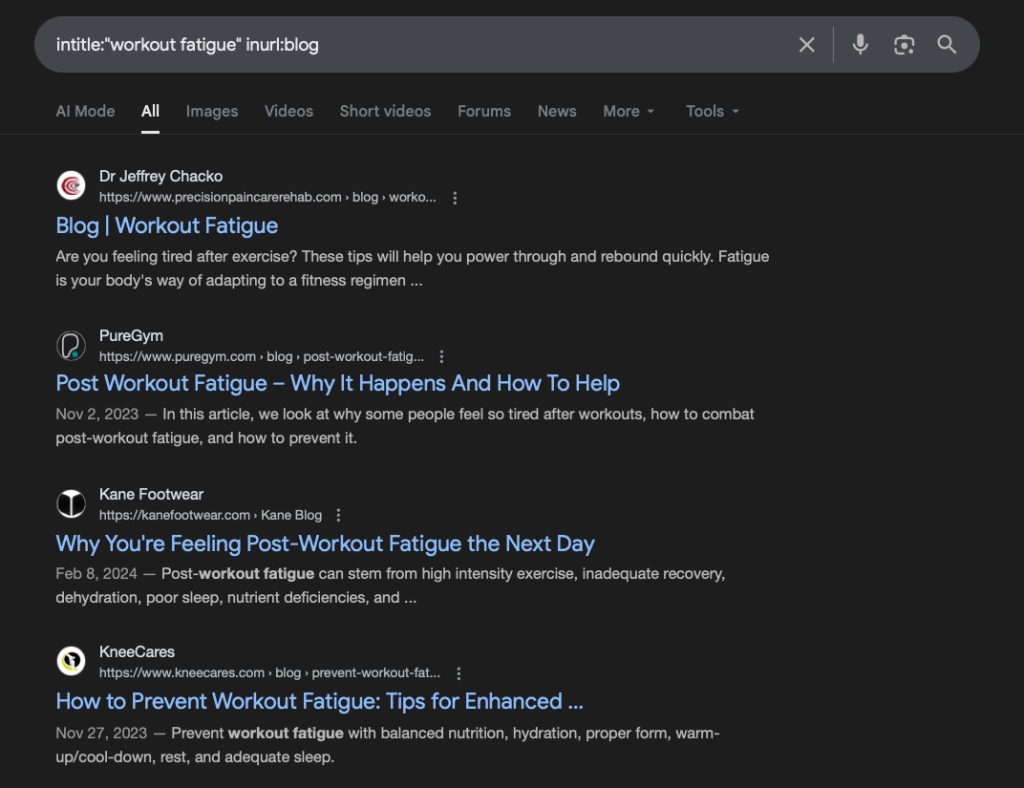
These would all be viable options for inserting a link to one of your magnesium supplements to help reduce fatigue and strain.
Digital PR pieces
Digital PR campaigns are heavily focused on earning contextually relevant brand mentions and backlinks, both of which are perfect for AI search optimization.
Tactics like newsjacking relevant stories, developing original research, and publishing expert interviews are all fantastic ways to establish authority and earn more AI citations.
Networking with journalists through platforms like HARO and Qwoted is also a best practice, as it can lead to highly valuable media placements.
Editorial, niche-targeted guest content
Not all guest content is suitable for AI search. To see the best results, you need to carefully vet each blog for niche relevance and editorial quality.
As long as you guest post on niche-adjacent blogs that publish decent content themselves, you should see decent results. Just do your best to ensure that you’re posting actually helpful content that discusses your primary areas of expertise.
Final Thoughts: Contextual Link-Building Still Reigns Supreme
To wrap up, contextual link-building matters even more in AI search than it did in organic SEO, but savvy marketers were already wise to the game.
Trusted link-builders and content creators have been focusing on relevance and context for a long time, and now it’s paying off in big ways.
Are you ready to start capitalizing on contextually relevant backlinks?
Don’t wait to check out our Link Insertions and Platinum packages to start earning the types of links LLMs trust.