
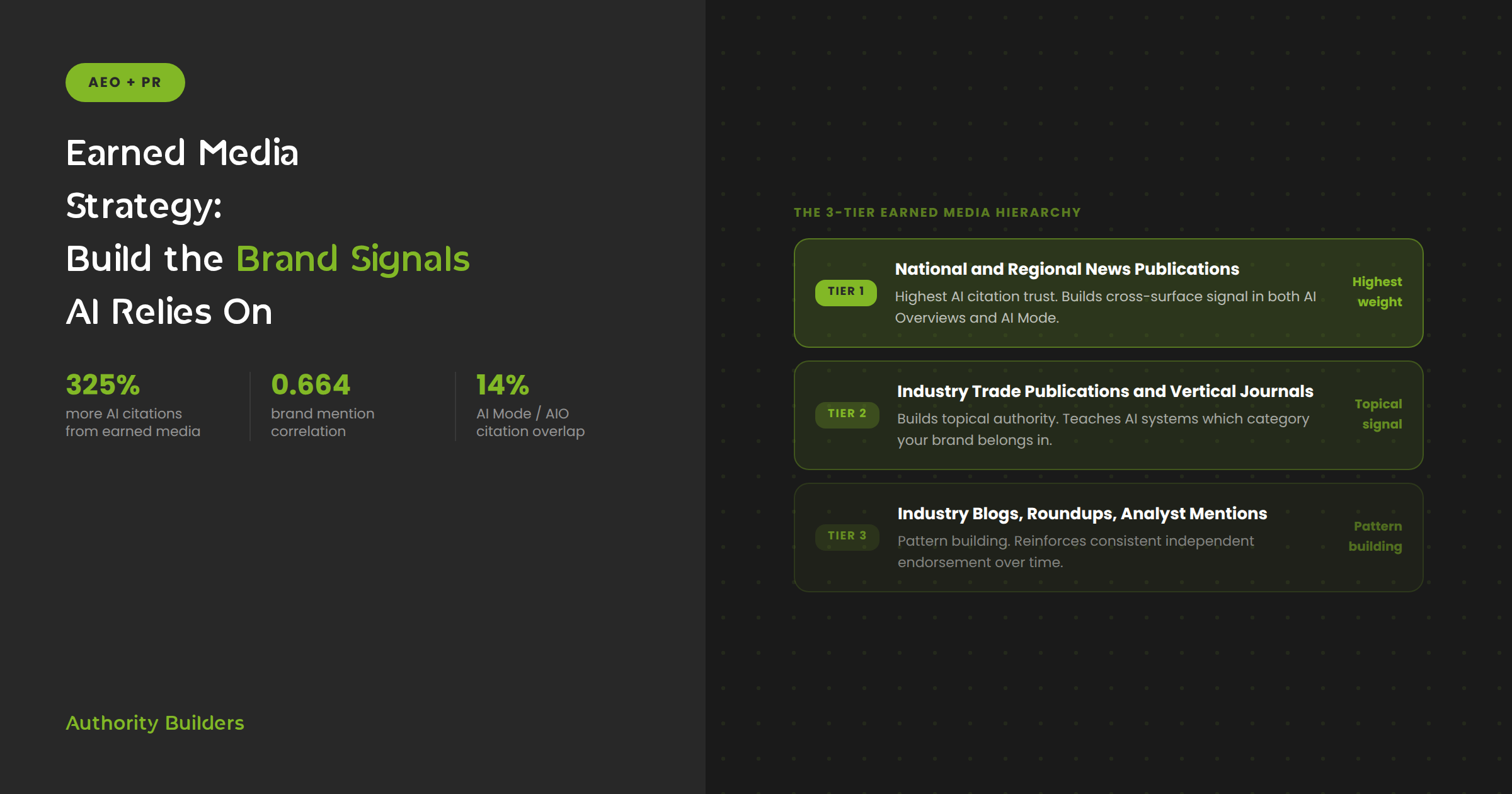
Most brands treat earned media as a PR outcome: something that happens when a good story gets picked up, measured in clippings, and reported to leadership as a win. That framing isn’t wrong, but it’s incomplete. In 2026, earned media is a strategic input into both search visibility and AI citation eligibility, and brands that don’t have a deliberate approach to it are leaving compounding authority on the table.
The shift is straightforward once you see it. AI systems don’t search the web in real time when generating answers. They draw from training data and indexed content that reflects which sources the web consistently treats as credible. A brand that appears repeatedly in independent editorial coverage, cited by journalists, mentioned in industry publications, and referenced by analysts, builds a footprint in that dataset that makes it citation-worthy. A brand that only appears on its own site doesn’t.
This post covers what an earned media strategy looks like when the goal is both PR value and AI search authority, how to build one that compounds over time, and what 90 days of disciplined execution actually produces.
What Earned Media Strategy Actually Means in 2026
Earned media, in the traditional sense, is coverage you earn rather than buy. A journalist writes about your product. A trade publication features your research. An industry analyst references your data. The defining characteristic is that a third party chose to cover you based on the merit of your story, not because you paid for placement.
That distinction still matters. But the strategic value of earned media has expanded significantly.
In 2024, earned media was primarily valuable for three things: brand visibility, referral traffic, and SEO link equity from editorial placements. In 2026, it’s doing a fourth job: building the independent editorial footprint that AI systems use as a proxy for real-world authority.
When Google’s AI Overviews and AI Mode decide which brands to cite in a generated answer, they’re not just looking at who ranks. As we covered in our analysis of how to rank in AI Overviews, brand mentions across independent editorial sources track AI citation more closely than raw backlink counts do.
An earned media strategy in 2026 is a plan for building that editorial footprint deliberately, consistently, and in the publications where it matters most for both your audience and the AI systems that increasingly influence your buyers.
Why AI Search Has Raised the Stakes for Earned Media
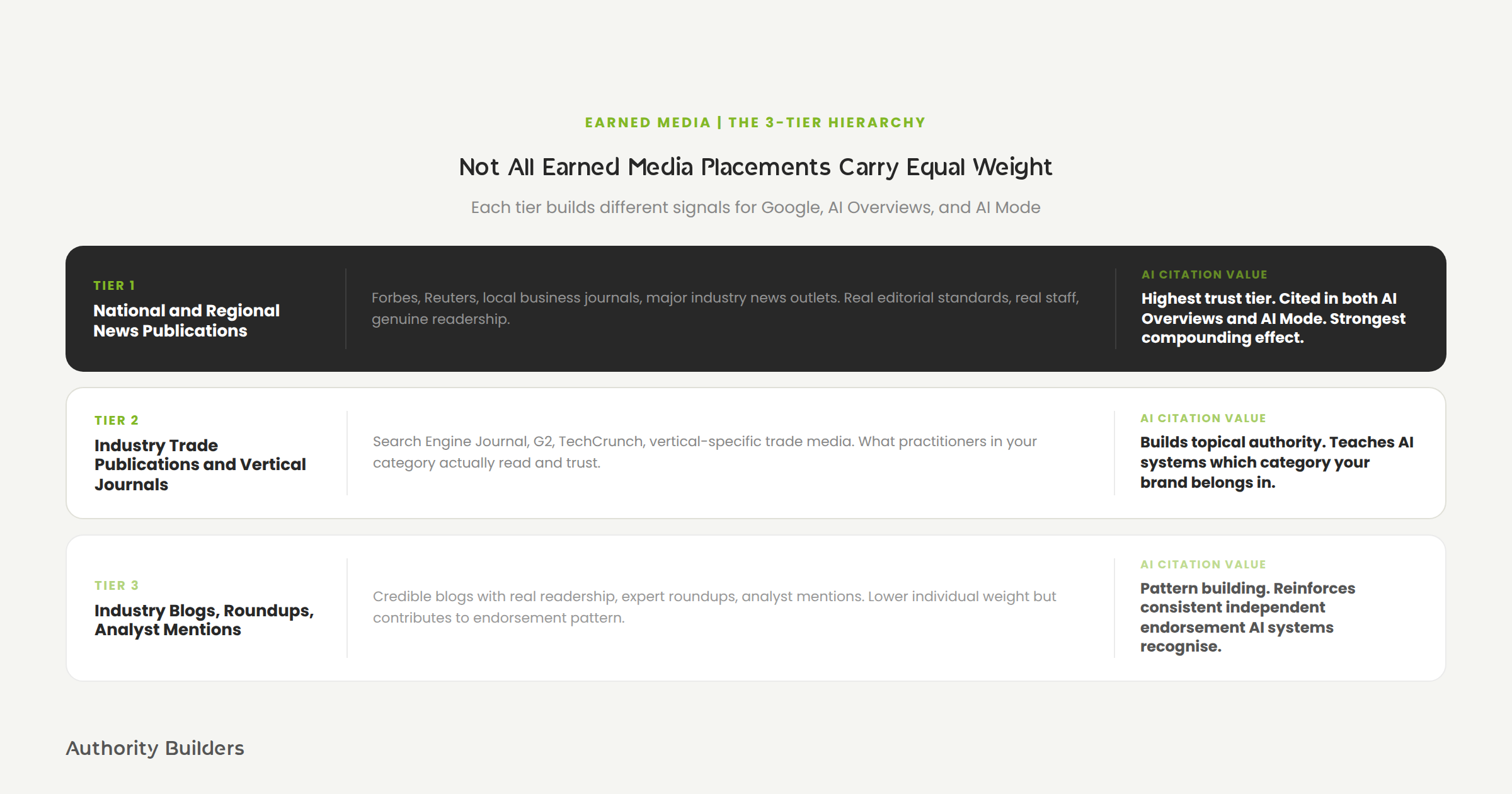
The practical impact of AI search on earned media value comes down to one finding: distributing the same content through third-party news outlets increased AI citation rates by up to 325% compared to publishing it only on a brand-owned site, according to research analyzed by Authority Tech. The content was identical. The only variable was where it lived.
The mechanism: AI systems weight the authority of the domain doing the citing, not just the content. A story covered by a genuine news publication earns citations that reference that publication as the source of authority. The same information on a brand blog earns a fraction of that signal because the brand blog doesn’t carry independent editorial credibility in the training data.
This creates a concrete ROI case for earned media investment that didn’t exist three years ago. The question is no longer just “how many people will read this coverage?” It’s “how much editorial footprint does this placement build in the dataset that AI systems learn from?” A story in a respected trade journal does different work than the same story on a press release wire.
At the same time, AI Mode, which crossed 1 billion monthly users after Google I/O 2026, draws from a separate citation pool than AI Overviews. As we covered in our post on what Google AI Mode means for SEOs, only about 14% of URLs overlap between the two surfaces, so earned coverage across credible publications is what gives you a real shot at being cited in both.
The 3-Tier Earned Media Hierarchy
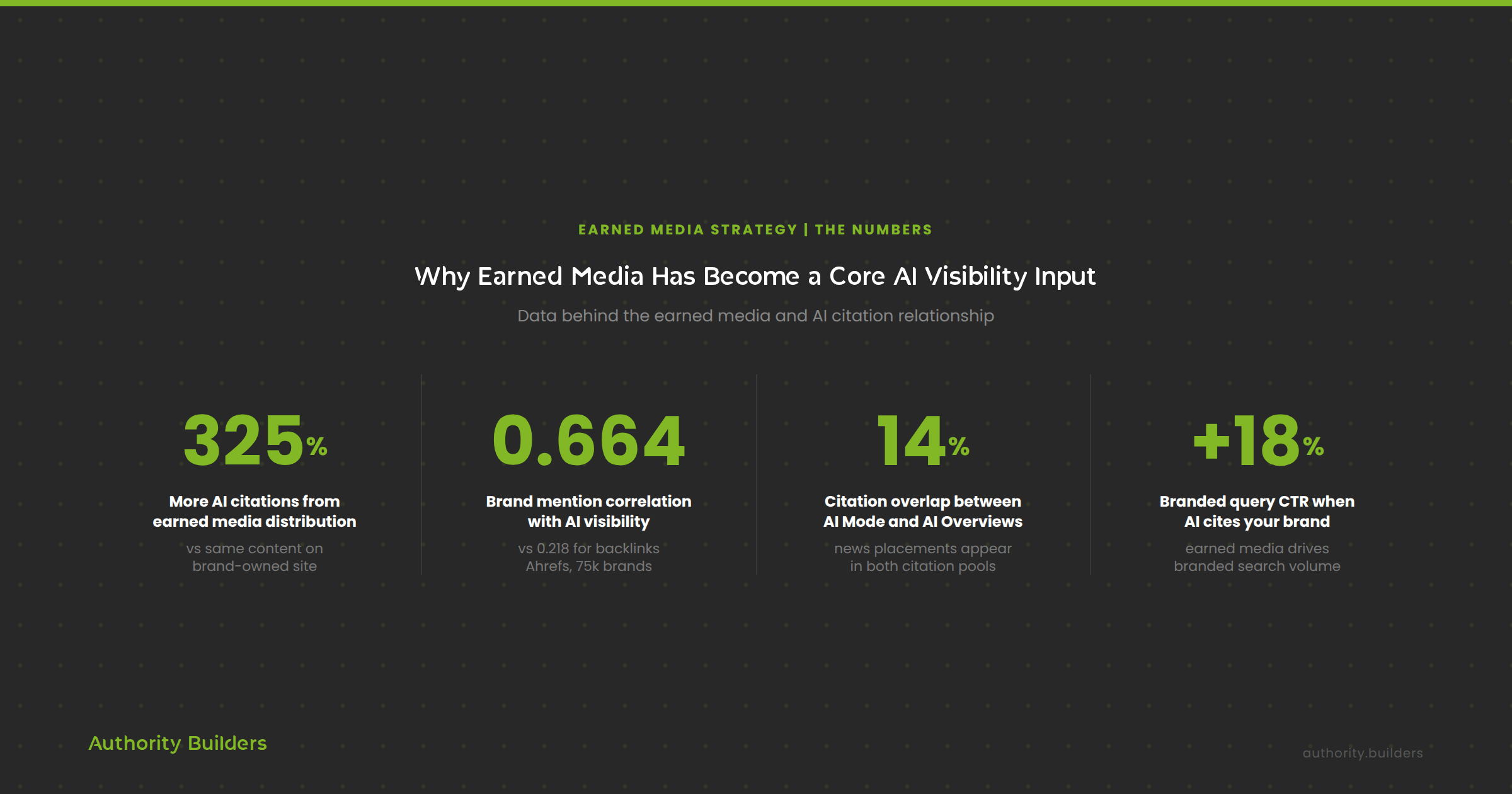
Not all earned media placements carry equal weight. Understanding the tier structure helps you prioritize effort and budget toward the placements that build the most compounding authority.
Tier 1: National and Regional News Publications
This is the highest-trust editorial tier for both Google and AI systems. National news publishers, regional news outlets with genuine audiences, and major industry trade journals. When AI systems are trained, these sources are weighted as high-credibility references because they have editorial standards, real staff, verification processes, and genuine readership.
A placement in a Tier 1 publication does the most work across all surfaces: it passes strong link equity for traditional SEO, it builds a brand mention in a high-credibility editorial source for AI training data, and it tends to generate secondary coverage as other writers reference the original piece. Authority Builders’ High-Authority Links service targets exactly this tier, genuine editorial placements in established news publications.
Tier 2: Industry Trade Publications and Vertical Journals
The specialized publications that practitioners in your category actually read and trust. For an SEO agency, that’s Search Engine Journal, Search Engine Land, and similar outlets. For a B2B SaaS company, it might be G2, TechCrunch, or vertical-specific trade media.
Tier 2 placements build topical authority alongside general credibility. AI systems use topical coherence as a citation signal. A brand consistently appearing in the trade publications of a specific category teaches AI systems that the brand belongs in that category, which is exactly how you earn citation eligibility in AI-generated answers about that topic. As covered in our post on link quality for AEO, topical coherence is one of the signals AI systems weigh most heavily when deciding which brands belong in a category.
Tier 3: Industry Blogs, Roundups, and Analyst Mentions
Credible blogs with real readership, industry roundups from respected sources, and analyst or expert mentions. These have lower authority weight than Tier 1 and 2 but contribute to the pattern of consistent independent endorsement that AI systems recognize.
Tier 3 placements are most valuable when they’re genuinely independent (not paid or arranged) and when they build the topical consistency of your brand mentions. A brand that appears across a mix of Tier 1, Tier 2, and Tier 3 sources has a more believable editorial footprint than one that only appears in one tier.
How to Build an Earned Media Strategy That Compounds
The difference between an earned media campaign and an earned media strategy is compounding. A campaign produces coverage. A strategy produces a growing editorial footprint that makes the next placement easier to earn because you’ve established the pattern of credibility.
Start with a story audit
Before pitching anything, inventory what you already have. What data does your business generate that journalists and analysts would find useful? What have your customers experienced that has a broader story angle? What positions do you hold on your industry that are genuinely differentiated from the consensus? Earned media that gets picked up consistently starts from here, not from “we need more press.”
Build your story pipeline around original data
The single highest-leverage input for an earned media strategy is original data. Industry surveys, proprietary research, customer outcome data, and benchmark studies give journalists something they can’t get anywhere else. Ahrefs’ research consistently shows that pages with unique statistics earn significantly more backlinks than standard content because they give other writers something to cite. The same logic applies to earned media: a story that contains data no one else has is more citable than a story that summarizes what everyone already knows.
Prioritize Tier 1 placements over volume
It’s tempting to measure earned media success by the number of placements. But a single Tier 1 news placement outperforms ten Tier 3 mentions for both AI citation signal and compounding authority. Focus your best story angles on the publications where the placement will do the most work. Use Tier 3 placements for topical consistency and pattern-building, not as the primary output.
Maintain topical consistency
AI systems learn your brand’s category from the topics of the publications and articles that mention you. A brand that earns coverage across a tight topical cluster builds clearer category authority than one whose placements scatter across unrelated industries. Your earned media strategy should reinforce the same topical territory as your link building and content strategy.
Treat distribution as a strategic variable
The 325% AI citation lift from third-party distribution vs. brand-owned publishing tells you that where your content lives matters as much as what it says. When you have a strong data story or a well-crafted angle, the question isn’t just “where can we publish this?” It’s “what’s the highest-tier outlet that will take this, and how do we get it there?”
What to Pitch and Why It Gets Picked Up
Journalists and editors receive hundreds of pitches. The ones that get picked up share a few characteristics:
- They contain a genuinely newsworthy data point. Not “our product is great” but “our data shows that X% of our customers experienced Y outcome, which contradicts the industry assumption that Z.”
- They have a clear audience angle. The pitch makes it obvious why the publication’s readers would care. A Tier 1 business publication cares about market implications. A trade journal cares about practitioner relevance.
- They’re timed to a relevant hook. Earnings seasons, industry events, regulatory changes, and news moments all create windows where a well-positioned brand story becomes more citable.
- They come from a recognizable brand. This is the compounding effect in action. Brands that have already earned Tier 1 and Tier 2 coverage are more likely to earn subsequent coverage because journalists recognize them as credible sources. Building that first editorial footprint is the hardest part. After that, it gets easier.
How to Measure Earned Media Impact on AI Visibility
Traditional earned media metrics (clippings, reach, AVE) don’t capture AI citation value. Here’s how to measure what actually matters:
Track brand mentions in AI answers
Use an AI visibility tracking tool to run a consistent set of prompts monthly and record whether your brand is mentioned, where in the answer it appears, and which sources AI systems cite when referencing you. As we covered in our post on the best AI search visibility tracking tools, you can run this with a dedicated platform or a simple monthly prompt-testing spreadsheet.
Monitor source attribution
When AI systems cite your brand, what sources are they pulling from? This tells you which of your earned media placements are making it into the AI citation ecosystem. If your Tier 1 news placements are driving AI citations but your Tier 3 mentions aren’t, that’s useful calibration for where to focus future effort.
Track branded search volume
Branded query CTR increases 18% when AI systems cite a brand in answers. An earned media campaign that successfully increases AI citation rates should also show up in branded search volume trends over 60 to 90 days. It’s an indirect but measurable downstream signal.
Measure referring domain tier quality
Pull new referring domains earned during a campaign and categorize them by tier. What percentage are Tier 1 news publications? What percentage are Tier 2 trade journals? Over time, a well-executed earned media strategy should shift the quality distribution of your referring domain portfolio toward higher tiers.
What a 90-Day Earned Media Campaign Looks Like
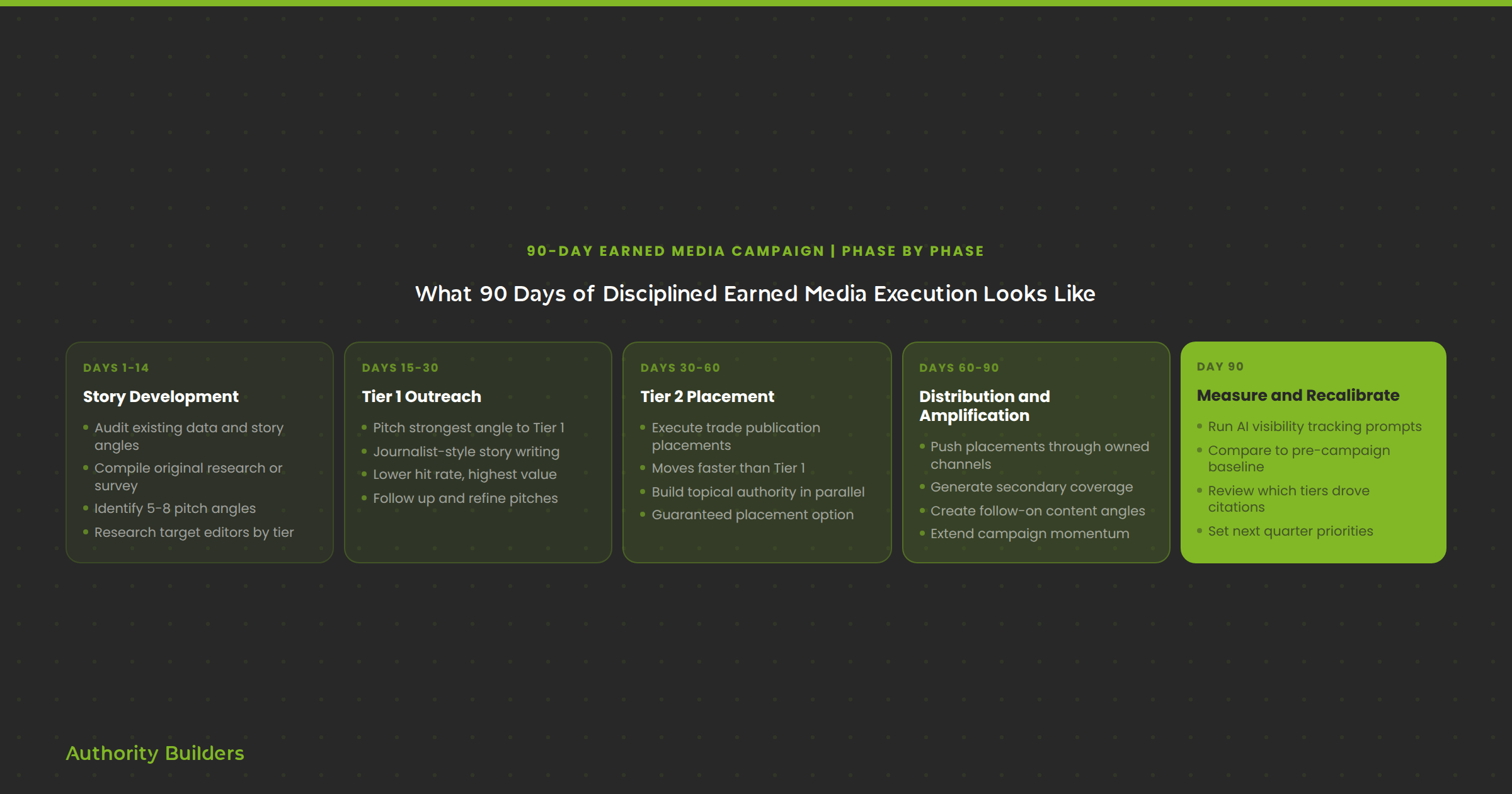
Here’s a realistic framework for a 90-day earned media push:
- Days 1 to 14: Story development. Audit existing data and story angles. Commission or compile a piece of original research. Identify 5 to 8 strong pitch angles across your story pipeline. Research target publications at each tier and the editors who cover your category.
- Days 15 to 30: Tier 1 outreach. Pitch your strongest story angle to Tier 1 targets first. This takes longer and has a lower hit rate but produces the highest-value placements. Authority Builders’ Earned Media service is built for this stage, pitching genuine, newsworthy stories to news publications.
- Days 30 to 60: Tier 2 placement execution. While Tier 1 pitches are in progress, execute Tier 2 placements in trade publications. These move faster and build topical authority in parallel.
- Days 60 to 90: Distribution and amplification. Push successful placements through owned and social channels to maximize reach and generate secondary coverage. Create follow-on content angles from earned coverage to extend the campaign’s momentum.
- Day 90: Measure and recalibrate. Run your AI visibility tracking prompts. Compare brand citation rates to the pre-campaign baseline. Review which tier placements generated the most citation signal. Use that data to inform the next quarter’s story priorities.
How Authority Builders Can Help
Authority Builders has three earned media services, each designed for a specific tier and use case:
- Earned Media: journalist-style storytelling built for editorial pickup in news publications. Coverage is not guaranteed on specific sites, but that’s by design. Because stories are genuinely pitched rather than placed, the coverage earns the credibility signals that AI systems weight most heavily.
- Press Authority: guaranteed placements in vetted publications for brands that need consistent, predictable editorial presence. Ideal for building Tier 2 topical authority at pace.
- Digital PR: data-driven campaigns built around original research and newsworthy angles. Designed for brands ready to invest in the story development that produces Tier 1 placement opportunities.
- ABC Platinum: fully managed campaigns that integrate earned media, editorial link building, and authority strategy into a single coordinated program. The right choice for brands that want all three tiers working together.
If you want to understand what an earned media strategy built around your specific category and authority gaps looks like, let’s set up a call and we’ll map it against your category and where your coverage gaps actually are.