
Enterprise Link Building at Scale: Governance, Velocity, and Quality Control Across Large Sites
Corey Batt
Enterprise link building fails for a different reason than small-site link building fails. A small site usually fails because it can’t get enough links. A large site usually fails because it gets links from too many directions at once, with nobody owning the rules.
We’ve seen it play out the same way across ecommerce catalogs, SaaS platforms, publishers, and multi-brand holding companies. Marketing buys guest posts. The partnerships team signs sponsorship deals that come with footer links. PR sends out press releases with optimized anchors. Three regional teams each hire their own vendor. Eighteen months later, the link profile looks like four different companies built it, because four different teams did.
This guide is about the operating model that prevents that. We’ll cover the three things that separate an enterprise link program from a big pile of links: governance (who decides), velocity (how fast, and where), and quality control (what gets rejected). We’ll also get into prioritization, measurement, and how to decide whether to run it in-house or through a managed partner like our ABC Platinum program.
What Makes Enterprise Link Building Different
“Enterprise” doesn’t mean a specific revenue figure. For link building purposes, a site is enterprise when it has most of these traits:
- Thousands of indexable URLs across multiple templates (category, product, resource, location, docs)
- Multiple stakeholders who can create or influence external links: marketing, PR, partnerships, product, regional teams, agencies
- Brand, legal, or compliance review on anything published under the company name
- Multiple markets or brands sharing a domain or a portfolio of domains
- A competitor set that also builds links at scale, so standing still means losing ground
Each of those traits changes the job. On a 40-page site, one person can hold the whole link strategy in their head. On a 40,000-page site, the strategy has to live in a document, a ledger, and a workflow, or it doesn’t exist.
Here’s the thing most enterprise teams underestimate: the risk profile is asymmetric. A single bad link on a small site is noise. A pattern of bad links across a large site is a footprint, and Google’s spam systems are built to find patterns. The bigger the site, the more a link program needs to look deliberate and editorial rather than opportunistic.
Governance: Who Owns the Link Program
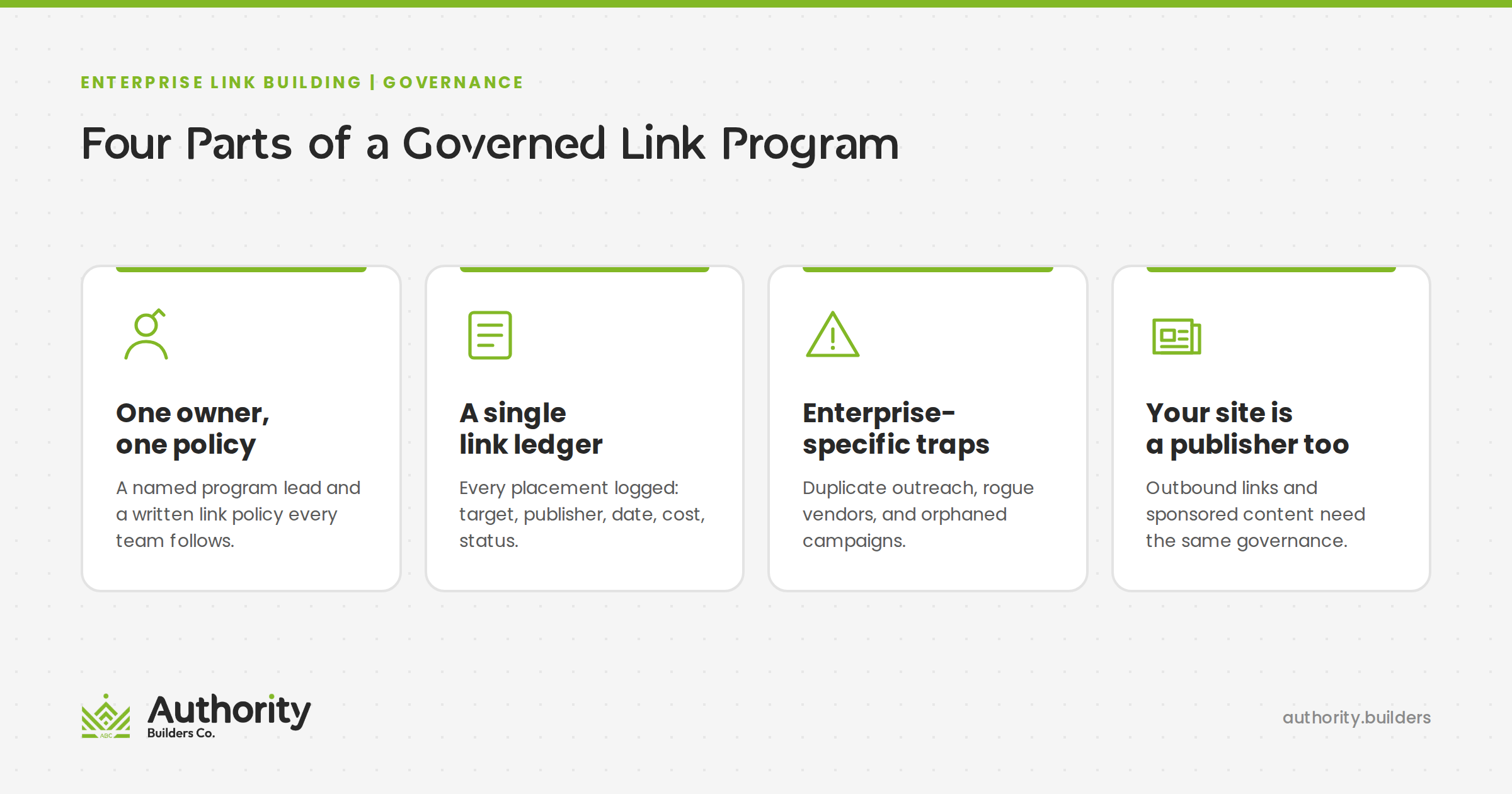
Governance is the unglamorous part, and it’s the part that determines whether everything else works. A governed link program has four components.
1. One owner, one policy
Someone has to own external links as a discipline, the same way someone owns brand voice or accessibility. That person (or team) publishes a link policy that answers:
- Which link types are allowed, which require approval, and which are prohibited
- How anchor text is chosen, and what the target distribution looks like across branded, partial-match, exact-match, and generic anchors
- Which vendors and publishers are approved, and how a new one gets vetted
- How sponsored, paid, or partner links are disclosed and tagged
- Who signs off before a link goes live under the company name
Without this, every department is writing its own policy by default, and the defaults are usually wrong.
2. A single link ledger
Every enterprise program needs one source of truth for every external link the company has acquired, requested, or paid for. At minimum, it records the source URL, target URL, anchor text, link type, date, cost, vendor, and the person who approved it.
The ledger does three jobs. It keeps teams from building the same link twice. It makes anchor text distribution measurable across the whole site instead of per-campaign. And if a link ever needs to be removed or disavowed, you can find it in minutes instead of weeks. We covered the operational side of this in our guide to backlink management, and the short version is that a link you can’t find is a link you can’t manage.
3. The enterprise-specific traps
Google’s spam policies list the link practices that can get a site demoted or removed. Most of them read like small-site problems (comment spam, low-quality directories), but several are things large companies do routinely without thinking of them as link building:
- Contractual link requirements. Requiring a link in a Terms of Service, partner agreement, or vendor contract without letting the other party qualify it with rel=”nofollow” or rel=”sponsored” is explicitly listed as link spam.
- Widely distributed footer and template links. Embedding a “Powered by” or partner link across hundreds of client sites is a pattern, and patterns get flagged.
- Widget and embed links. Keyword-rich links inside distributed widgets, badges, or calculators count the same way.
- Press releases and advertorials with optimized anchors. Paying for placement is fine when the link is qualified. Paying for placement and stuffing exact-match anchors into it is not.
- Sending free product in exchange for a linked write-up without disclosure and qualification.
Every one of these is usually owned by a team that doesn’t report to SEO. That’s the governance problem in one sentence. The link policy has to reach partnerships, PR, product marketing, and legal, because those teams are creating links whether they know it or not.
4. Your own site is a publisher too
One more policy that cuts both ways: Google’s site reputation policy applies when third-party content is published on a host site mainly to borrow the host’s ranking signals. If your enterprise domain runs a partner content section, a sponsored resource hub, or a white-label affiliate directory, that section is subject to the same scrutiny as the sites you’re getting links from. Governance includes what you let onto your own domain, not just where you point links from.
Velocity: How Fast Is Too Fast for a Large Site
Let’s break down the question everyone asks first: how many links per month?
There’s no universal number, and anyone who gives you one without looking at your competitor set is guessing. What we can tell you is how to reason about it.
Velocity is relative, not absolute
The right pace is set by the gap between your link profile and the profiles of the sites you’re trying to outrank, measured at the page and topic level, not just the domain level. A competitor link gap analysis tells you how many referring domains, at what authority range, the ranking pages in your category have, and how that compares to yours. That gap, divided by the timeline you’re working to, is your velocity target.
For a mid-market brand entering a competitive category, that might be 8 to 16 high-authority links a month. For an enterprise closing a large gap across dozens of commercial pages, it’s often 32 or more. Our ABC Platinum tiers map to roughly that range, with the Enterprise tier delivering 32+ custom-outreach DR50 to DR90 links per month, and the number is derived from the gap analysis rather than picked from a menu.
Distribution matters more than the monthly total
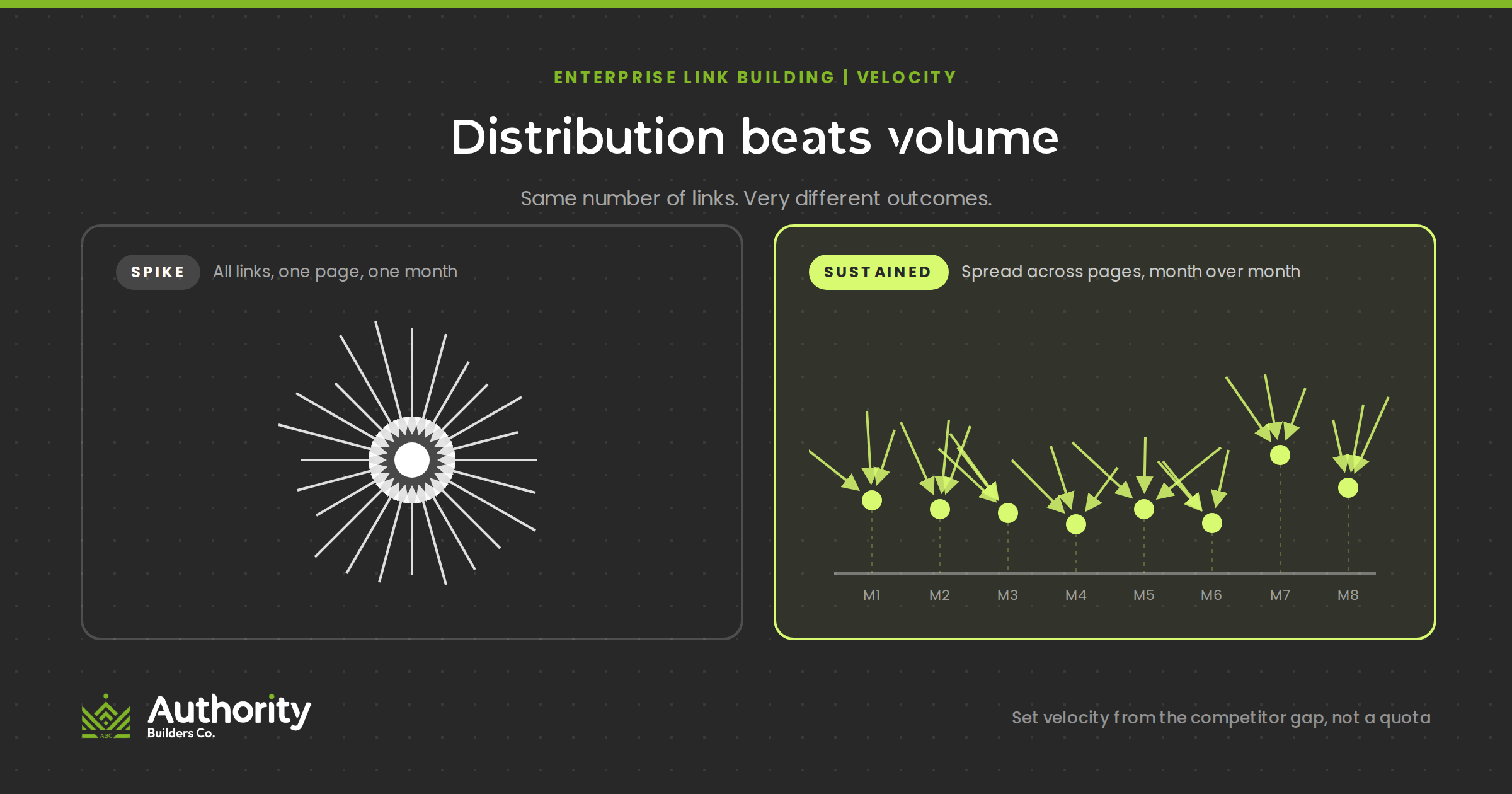
A large site can absorb a high monthly volume if the links are spread across many target pages, many referring domains, and a natural anchor mix. The same volume pointed at three pages with the same anchor text is a spike, and spikes are what pattern detection is built to catch.
Practical velocity rules we use on enterprise accounts:
- Cap links per target page per month relative to that page’s existing referring domain count. A page with 4 referring domains shouldn’t get 20 in a month.
- Spread across page types. Category pages, product pages, resource content, and the homepage should all receive links in proportions that reflect how competitors’ profiles look.
- Hold anchor text distribution at the site level, not per campaign. One team’s exact-match push can tip the whole domain if nobody is watching the aggregate.
- Sustain rather than burst. A steady 24 links a month for twelve months beats 150 in one quarter and nothing for the next three.
What sustained velocity looks like in practice
One of our customers, a content-driven social and environmental brand, is a useful reference point because its site behaved like several sites in one: dozens of topic clusters, each competing in its own niche, all under one domain. We started them on ABC Intermediate and scaled to Pro as the program proved out.
Over less than two years of steady building, the profile grew to include more than 4,200 links from sites with domain authority in the 80 to 100 range. Domain rating moved from 35 to 61. Organic traffic went from 4.1K monthly visits to 401K, with more than 2,400 keywords landing in the top three positions. You can read the full case study here.
The lesson for enterprise teams isn’t the traffic number. It’s that once we defined the topic clusters and the blueprint, the same playbook ran across every cluster in parallel. That’s what scale looks like: not more links, but a repeatable process applied consistently across a large surface area.
Quality Control: The Standards That Keep Scale From Becoming a Liability
At small scale, you can eyeball every placement. At enterprise scale, you need written acceptance criteria that a vendor, an in-house team, or a regional agency can apply without you in the room. These are ours.
Publisher criteria
- Real organic traffic, verified. We require a minimum of 1,000 monthly organic visitors on every publisher site in our network, checked with real data. Domain metrics can be gamed. Traffic from Google is much harder to fake.
- Topical relevance. The publisher covers your category, or a category your buyers read. A DR70 link from an unrelated site is worth less than a DR45 link from the right one.
- Editorial integration. Your content should sit in the site’s normal sections, in the site’s design, with a real author. Google’s site reputation review looks at exactly these factors: presentation, quality, authorship, and whether the content is duplicated across other sites. A publisher that fails that test is a publisher whose links may stop counting.
- No PBNs, no public marketplaces. Exclusive placements from real outreach. If a site is listed on a public link marketplace, every competitor in your category can buy the same placement, and the footprint is shared.
- Authority in the right range. For enterprise campaigns we target DR50 to DR90. Below that, the link rarely moves a competitive page. Above that, availability drops and cost per link climbs steeply.
Placement criteria
- In-content, dofollow, contextual. Footer, sidebar, and author-bio links are worth a fraction of an editorial link inside the body.
- Content that stands on its own. Google’s scaled content abuse policy targets pages generated primarily to manipulate rankings, regardless of whether a human or a model wrote them. A link inside a page like that is a liability, not an asset. Every placement should be a piece someone would read if the link weren’t there.
- Anchor text that fits the sentence. Branded and natural-language anchors should dominate. Exact-match anchors are a small, deliberate minority reserved for pages that can support them.
- One link, one intent. A placement that links to five of your pages with five keyword anchors is the advertorial pattern Google uses as its own example of link spam.
The rejection rate is the quality metric
Here’s a tell for whether a link vendor or an in-house team has real quality control: ask what percentage of candidate sites they reject. A program with standards turns down most of what it evaluates. A program that approves everything doesn’t have criteria, it has a budget.
Prioritization: Which Pages Get Links First
An enterprise site can’t build links to everything. Prioritization is where the link program connects to revenue, and it’s where we see the most wasted budget.
- Start with the money pages that are close. Commercial pages ranking in positions 4 to 15 for keywords with real volume are the highest-ROI targets. A modest link investment can move them onto page one, where the traffic difference is dramatic.
- Then the category and hub pages. On large sites, authority flows down through internal linking. Links to a category page lift every product or article beneath it. This is usually a better use of budget than linking to individual long-tail pages.
- Then the pages that feed AI answers. Guides, comparisons, and definitional content are what generative search features pull from when they build a response. Links to these pages build the entity-level trust that gets a brand cited, not just ranked.
- Reserve 10 to 20 percent for opportunistic wins. A journalist request, a data study that gets picked up, a partner launch. Enterprise programs that lock 100 percent of budget to a plan miss the links that are hardest to replicate.
The competitor link gap analysis that starts every ABC Platinum engagement produces this priority list directly: which of your pages are outgunned, by how much, and which competitors’ links are realistically winnable. We’ve written more about what high-authority backlinks look like and why the top of the authority hierarchy matters most for competitive pages.
Measurement: Tracking Links, Rankings, and AI Visibility
Enterprise reporting has to serve two audiences: the SEO team that needs operational detail, and the executives who need to know whether the budget is working. Both come from the same data.
Operational metrics
- Links delivered vs. planned, by target page, by month, from the ledger
- Referring domain growth for your site vs. each named competitor, on the same chart
- Anchor text distribution at the site level, trended over time
- Live link audits. Links get removed, pages get deleted, publishers change to nofollow. A quarterly recheck of every ledger entry catches attrition before it compounds.
- Search Console’s Links report as a cross-check against third-party tools, since it reflects what Google has discovered.
Outcome metrics
- Ranking movement on the target keyword clusters, not domain-wide averages that hide the signal
- Organic traffic and conversions on the target pages, tied back to the links built to them
- AI visibility. Search Console now includes a Generative AI performance report showing how your content surfaces in AI Overviews and AI Mode. Track it alongside rankings. Google’s own guidance on optimizing for generative AI features is clear that these features are grounded in the same core ranking systems, which means the authority signals that move rankings also influence what gets cited.
When something goes wrong
If a legacy vendor, an acquired brand, or a rogue regional team leaves you with a batch of links you’d rather not have, the first move is removal, not disavow. Google’s disavow tool documentation is explicit that most sites never need it and that it should only be used when a considerable volume of manipulative links has caused, or is likely to cause, a manual action. For enterprise teams, the practical takeaway is that the ledger is your insurance policy: if you know where every link is, cleanup is a project instead of a crisis.
In-House vs. Managed: Choosing the Right Operating Model
Most enterprise programs end up as a hybrid. The question is which parts to keep and which to hand off.
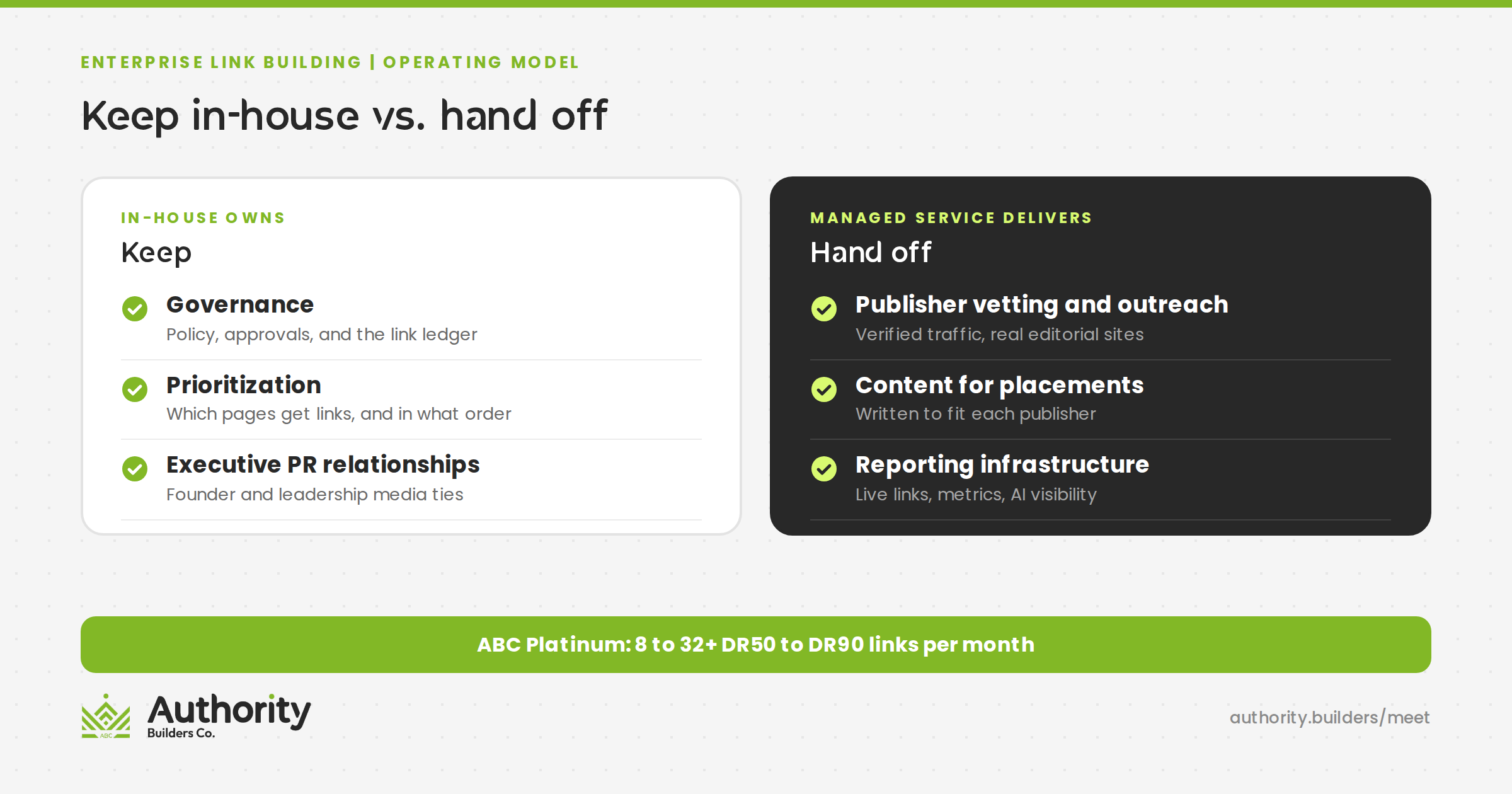
Keep in-house
- Governance. The link policy, the approval workflow, and the ledger should be owned internally. A vendor can operate within them but shouldn’t define them.
- Prioritization. Which pages matter is a business decision tied to revenue data a vendor doesn’t have.
- Digital PR relationships that depend on named executives and spokespeople.
Consider handing off
- Publisher vetting and outreach at volume. This is where in-house teams burn out. Building and maintaining relationships with hundreds of qualified publishers is a full-time operation.
- Content production for placements. Every link needs a piece of content behind it. At 30 links a month, that’s a writing team.
- Reporting infrastructure. Competitor tracking, live link audits, and anchor distribution monitoring are tooling problems a managed partner has already solved.
The economics usually favor the hybrid. We broke down the numbers in our link building pricing guide, and the short version is that a year of ABC Platinum at the Enterprise tier costs less than the fully loaded cost of building an equivalent in-house outreach and content team, before accounting for the ramp time.
How ABC Platinum fits an enterprise program
ABC Platinum is our fully managed tier for brands that need volume, authority, and governance at the same time. Every engagement starts with a competitor link gap analysis and a strategic link plan, which becomes the velocity and prioritization framework described above. From there, the program delivers custom-outreach DR50 to DR90 placements each month, with full transparent reporting your team can drop into the ledger.
Tiers run from Starter (8 links a month) through Enterprise (32+), so the program scales with the gap rather than forcing a single volume. Campaigns are built around anchor text balance, topical depth, and content structure, which serves both traditional rankings and AI visibility.
For enterprises where earned press is part of the plan, Digital PR Plus layers top-tier publication coverage on top of the link program. And for teams measuring AI citations as a primary KPI, AI Plus extends the same authority-building approach to how LLM-powered tools discover and cite your brand.
Enterprise Link Building FAQ
What is enterprise link building?
Enterprise link building is the practice of acquiring high-authority backlinks for a large website (typically thousands of pages, multiple stakeholders, and multiple brands or markets) under a governed process. It differs from standard link building in its emphasis on policy, centralized tracking, cross-team coordination, and controlled velocity, because at scale the risk of an unnatural link footprint is higher and the cost of a mistake is larger.
How many links per month should an enterprise site build?
There is no fixed number. Velocity should be derived from a competitor link gap analysis: the difference between your referring domain profile and the profiles of the pages you need to outrank, spread over your timeline. Enterprise programs commonly run 16 to 32+ high-authority links per month, distributed across many target pages and referring domains rather than concentrated on a few.
Is paying for links against Google’s policies?
Paying for links that pass ranking credit is listed as link spam in Google’s spam policies. Paid or sponsored links are permitted when they are qualified with rel=”sponsored” or rel=”nofollow”. Editorial placements earned through genuine outreach, where a publisher chooses to link because the content merits it, are the standard enterprise programs should be built on.
How do you keep link building compliant across multiple departments?
Publish a single link policy that covers every team capable of creating external links (marketing, PR, partnerships, product, legal, regional teams and their agencies), route every link through one approval workflow, and record every link in one shared ledger. The policy should specifically address contractual link requirements, distributed footer and widget links, and press release anchors, since those are the enterprise-specific practices Google’s policies flag.
Does link building still matter for AI search visibility?
Yes. Google states that its generative AI features are rooted in the same core ranking and quality systems as traditional search, so the authority signals that move rankings also influence which sources get retrieved and cited. High-authority, topically relevant links from real publishers build the entity-level trust that both search engines and LLM-powered tools use to decide whom to cite.
When should an enterprise use the disavow tool?
Rarely. Google’s documentation says most sites never need it, and that it should only be used when a considerable number of manipulative links has caused or is likely to cause a manual action. The better enterprise practice is prevention through governance, plus a complete link ledger so that removal requests can be executed quickly if a problem surfaces.
Build the System, Then Build the Links
Enterprise link building at scale is less about outreach volume than about the operating model around it. Get governance right and every other team stops creating risk by accident. Set velocity from the competitor gap and distribute it across the site so growth looks earned. Hold quality criteria that reject most of what they evaluate. Prioritize the pages that move revenue. Measure rankings and AI visibility side by side.
If you’d like a competitor link gap analysis for your site and a velocity plan built from it, schedule a call with our team. We’ll show you where the gap is, what closing it would take, and how an ABC Platinum program would run inside your governance model.