
If you’re running an ecommerce store and wondering why your competitors outrank you despite having similar products and prices, links are almost certainly part of the answer.
Here’s the thing: ecommerce is one of the most competitive spaces in SEO. You’re not just competing with other stores in your niche. You’re competing with product aggregators, review sites, and media publications that have been building domain authority for years. Without a deliberate link building strategy, even a well-built store with great products will struggle to break through.
This guide isn’t a list of quick-win tactics. It’s a practical look at how ecommerce sites build the kind of authority that compounds over time, drives organic sales, and positions your brand as a trusted source in your niche, including in AI-powered search.
Why Ecommerce Sites Are Harder to Link To (And Why That Makes Links More Valuable)
Most natural link building happens around content. Bloggers link to helpful guides. Journalists link to research. Publishers link to expert resources.
Product pages and category pages don’t naturally attract that kind of attention. Nobody’s writing a round-up post and linking to your “Women’s Running Shoes” category page. That means ecommerce stores have to work harder and smarter to earn links than content-first sites do.
The upside? Because most ecommerce competitors aren’t doing serious link building, a focused effort can move the needle quickly. We see this with clients who are entering competitive niches with zero existing presence. The gap between them and established competitors is often smaller than it looks, because most of those competitors built their link profiles passively over years, not aggressively.
A new store with 6 to 12 months of consistent link building can leapfrog sites that have been around for years but never invested in their authority.
The Authority Problem: What Sets Ranking Stores Apart
When we audit underperforming ecommerce sites, the pattern is almost always the same. Strong on-page fundamentals, decent product content, reasonable site architecture, but a thin or low-quality backlink profile.
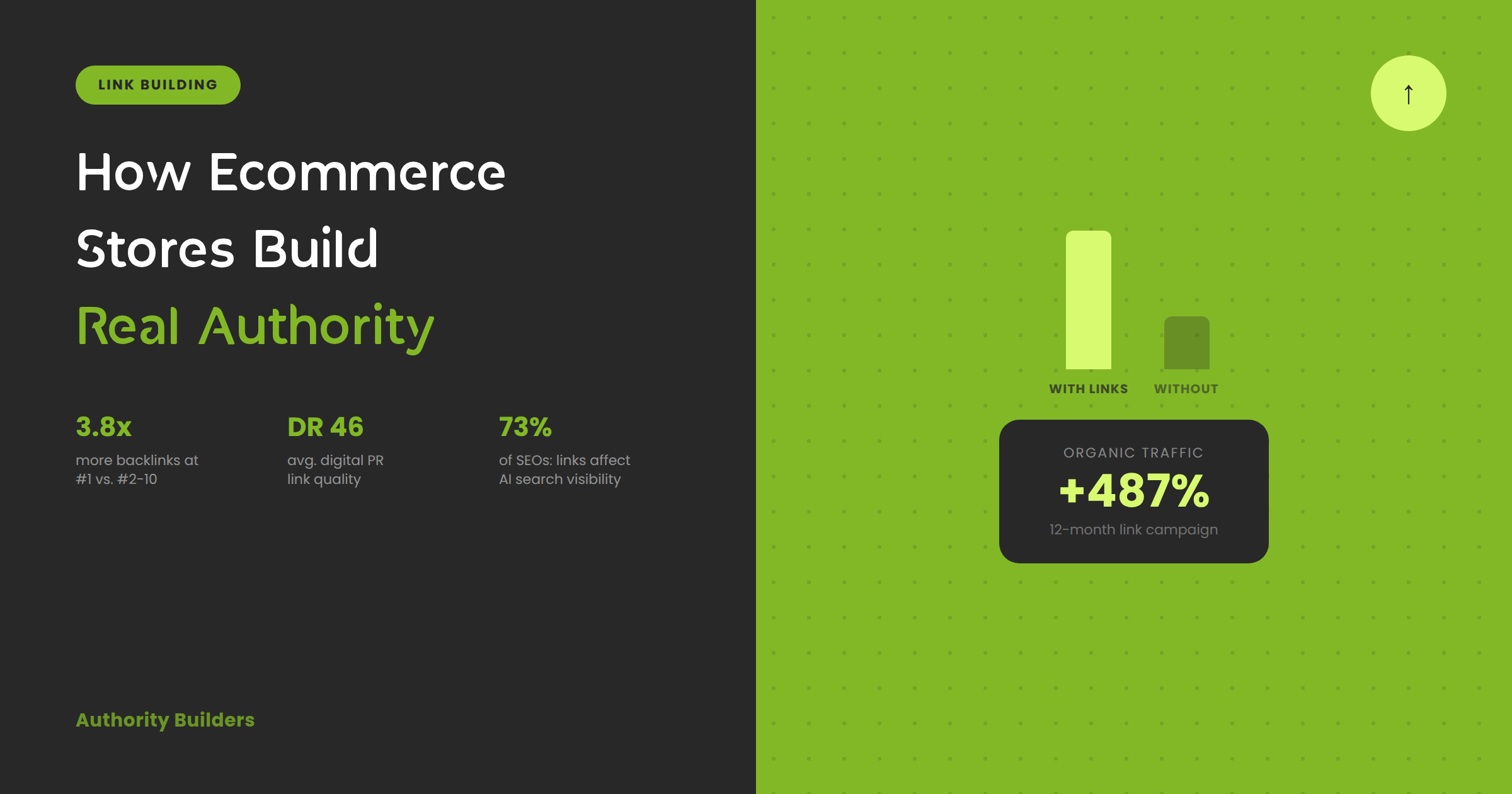
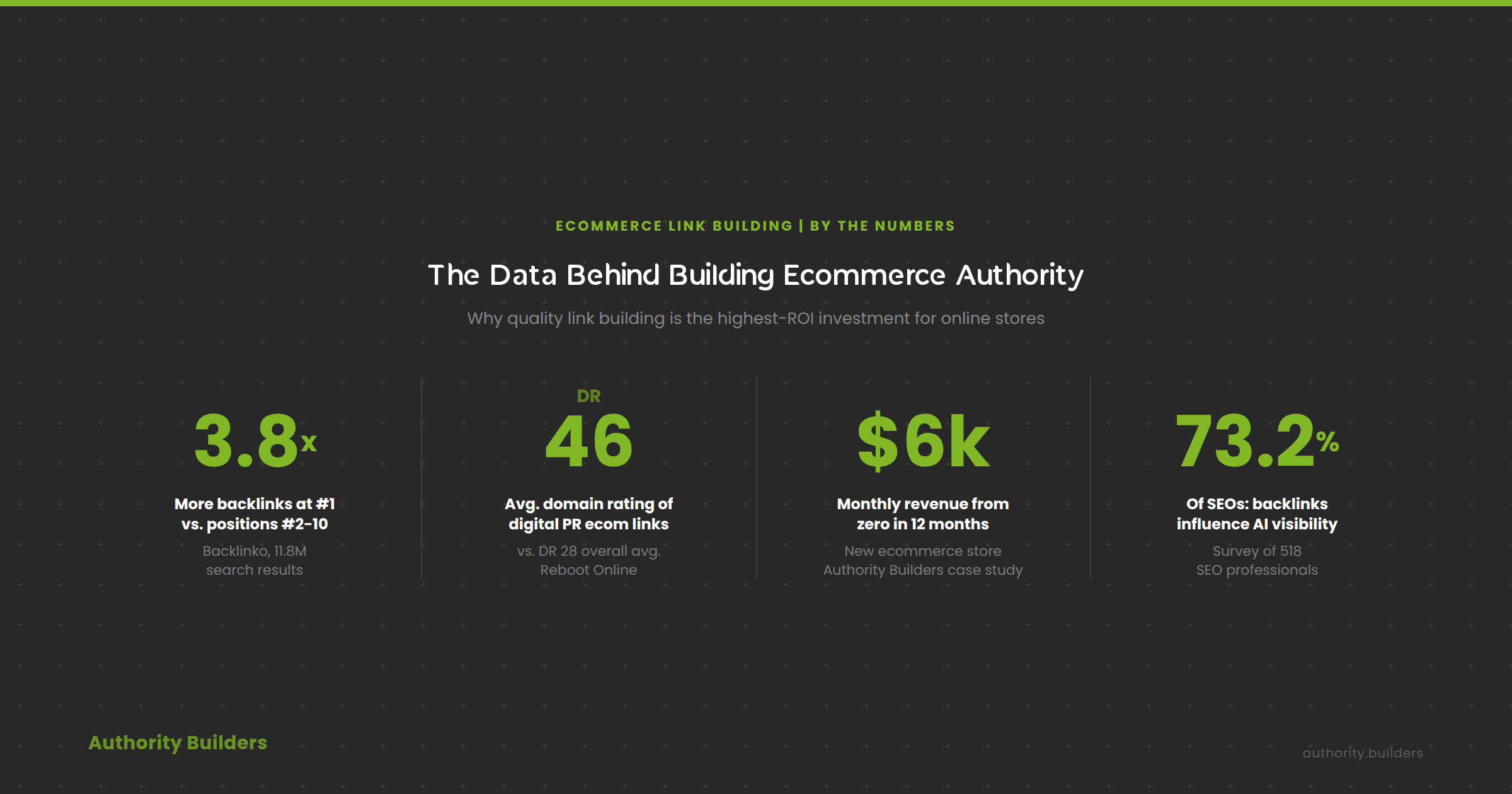
Google uses links as a proxy for trust. When authoritative sites in your niche link to you, they’re effectively vouching for your credibility. A DR 50 link from a respected industry publication tells Google something a DR 10 link from a general blog directory simply can’t. The data backs this up: according to a Backlinko analysis of 11.8 million search results, the #1 ranking page has an average of 3.8x more backlinks than pages ranked #2 through #10.
But it’s not just about domain rating. Relevance matters enormously for ecommerce. A link from a kitchenware review site to a cookware store carries more weight than a link from a generic lifestyle blog. Google is sophisticated enough to understand topical context, and it rewards sites that build authority within their niche, not just across the web broadly.
The stores that dominate their niches have usually done three things well:
- Built foundational authority through a consistent volume of quality, niche-relevant links
- Targeted high-value pages (category pages, best-seller pages) rather than only linking to their homepage
- Maintained link velocity over time rather than doing one big push and stopping
Link Building Strategies That Actually Work for Ecommerce
Not every link building tactic translates well to ecommerce. Here’s what we’ve seen work consistently for online stores across verticals.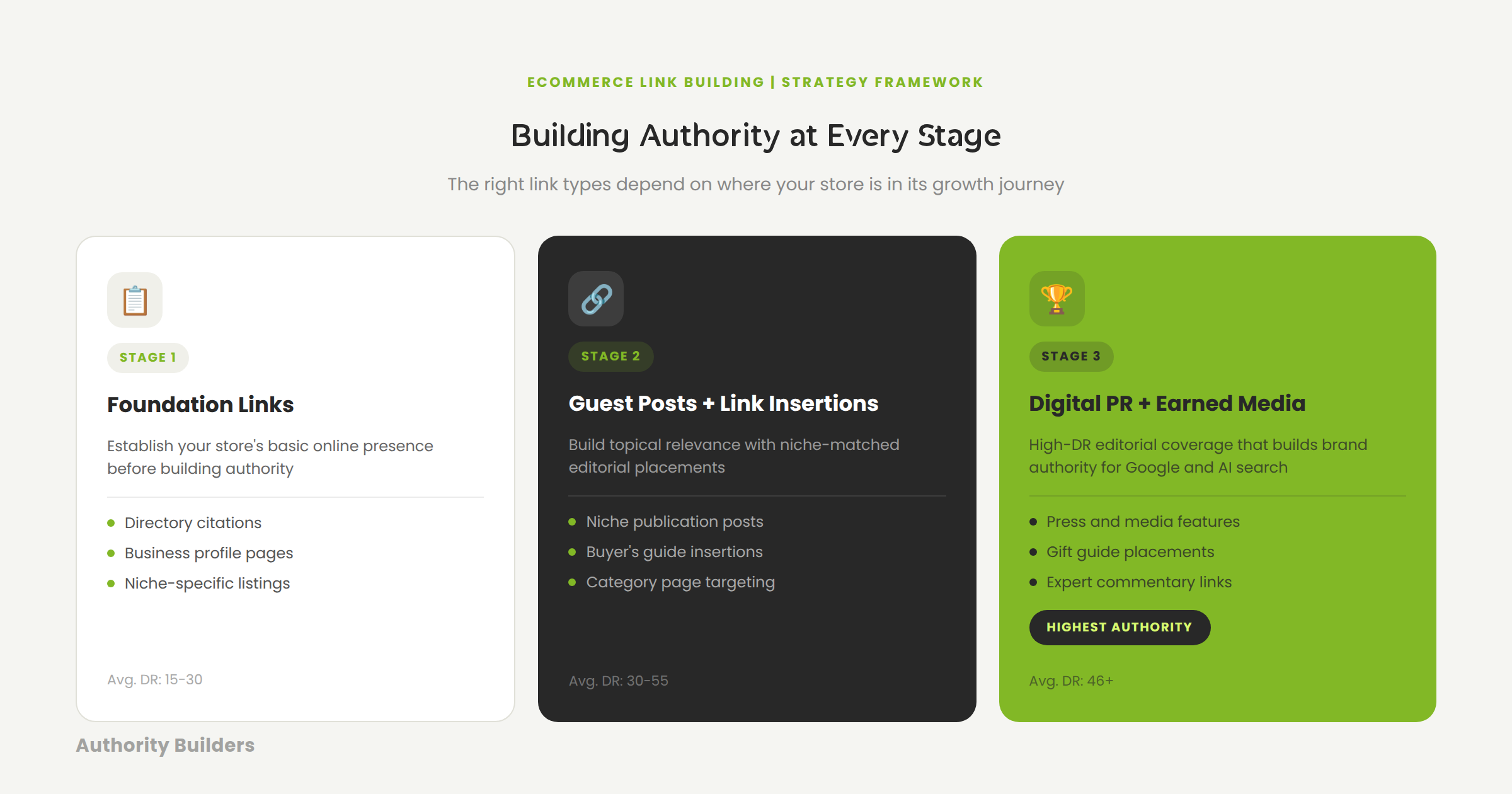
Guest Posts on Niche-Relevant Publications
Guest posting remains one of the most reliable and scalable ways to build links for ecommerce. The key word is “niche-relevant.” A supplement store linking from health and fitness publications. A pet supply store linking from pet care sites and animal welfare blogs. A kitchenware brand linking from food and cooking publications.
What makes guest posts work for ecommerce specifically is the content angle. Rather than pitching content about your products, pitch content that serves the publication’s audience, then link back to a relevant resource or category page on your store. It’s a value exchange that benefits both parties.
Authority Builders places guest posts on vetted, traffic-verified sites, with every domain meeting a minimum of 1,000 monthly visitors confirmed by Ahrefs.
Link Insertions into Existing Content
Link insertions, sometimes called niche edits, involve placing a link to your site within content that already exists and already has traffic. This is particularly powerful for ecommerce because the content context is already established. You’re not building something from scratch, you’re inserting your brand into a relevant conversation that’s already happening.
For ecommerce, look for articles like “best [product type] of [year],” “how to choose [product],” or “[niche] buyer’s guide” on relevant sites. A well-placed link insertion here puts your store in front of people who are actively in buying mode.
Foundational Citations for New Stores
If your store is brand new, citation links are your starting point. Citations are directory listings, business profile pages, and niche-specific directories that establish your store’s basic online presence.
They’re not high-authority links, but they serve an important purpose: they confirm to Google that your business exists, has consistent information, and belongs in your niche. Think of citations as the foundation you build on, not the structure itself.
One of our ecommerce clients came to us with literally no online presence. We started with a citation foundation, then layered in guest posts over the following months. Within 12 months, their total impressions grew from nearly zero to close to 60,000, and the store was generating over $6,000 per month in revenue. That success gave them the confidence to launch two additional stores in related niches.
Digital PR and Earned Media
Digital PR is the highest-ceiling strategy for ecommerce brands that want to build real brand authority, not just backlinks. This involves getting your brand, products, or expertise covered by journalists and publications without paying for placement.
For ecommerce, digital PR can look like product features in gift guides, founder stories in trade publications, data-driven research that journalists reference, or expert commentary on industry topics. These links tend to come from high-DR publications and carry significant weight with both Google and AI search systems.
Digital PR is a longer game than guest posts or link insertions, but the payoff in brand authority is substantial. A Reboot Online analysis of 2 million+ ecommerce backlinks found that the average DR of a link earned via digital PR was 46, compared to an overall ecommerce backlink average of 28. See how Authority Builders’ Digital PR service works.
Affiliate and Partner Links (Use Carefully)
Many ecommerce stores build links through affiliate relationships and brand partner programs. These can work, but they come with caveats.
Affiliate links should be properly disclosed and, in most cases, carry the nofollow attribute, which means they pass less direct ranking authority. Partner links from suppliers, distributors, or co-marketing relationships are often more valuable because they tend to be editorial rather than paid placements.
Use these as supplementary links, not your primary strategy.
How to Prioritize: Which Pages Need Links First?
One of the most common mistakes ecommerce sites make with link building is sending all their links to the homepage. Your homepage already has the most internal link equity of any page on your site. What moves the needle is building links to the pages that are actually going to drive revenue.
Here’s how we think about link priority for ecommerce:
High-Revenue Category Pages
Your top-level category pages are your biggest revenue drivers. If you sell outdoor gear, your “hiking boots” or “camping tents” category pages are worth far more than a dozen individual product pages. Getting links to these pages helps entire categories rank rather than isolated products.
Competitive Keyword Pages
Run a keyword gap analysis against your top competitors. Find the keywords where they’re outranking you, then trace the link gap. Pages where competitors have substantially more links than you, despite similar content, are your best short-term link building targets.
Pillar Blog Content
If your store has a blog (and it should), your pillar content pieces are link magnets that can flow authority back to your product and category pages internally. A well-linked buying guide or “how to choose” article can rank in its own right and funnel that authority into your commercial pages.
The AI Search Angle: Why Authority Matters More Than Ever
Here’s something most ecommerce stores aren’t thinking about yet: AI search changes the stakes for domain authority.
When someone asks ChatGPT, Google’s AI Overview, or Perplexity for product recommendations, those systems don’t just parse keywords. They evaluate whether your brand is a credible, trusted source based on the signals they’ve ingested during training and retrieval. Backlinks from authoritative, topically relevant sites are part of that signal set.
A store with 300 referring domains from niche-relevant, high-traffic publications is far more likely to surface in AI-generated product recommendations than a store with 2,000 low-quality directory links. This isn’t just intuition: a survey of 518 SEO professionals found that 73.2% believe backlinks influence the chance of appearing in AI search results. AI systems, like Google’s traditional algorithm, are fundamentally trying to identify trustworthy sources. The definition of “trustworthy” for AI search skews even harder toward editorial credibility.
This means the investment you make in quality link building today isn’t just an SEO play. It’s building the brand authority signal that positions you for AI search visibility over the next several years.
What a Real Ecommerce Link Campaign Looks Like
When we build link campaigns for ecommerce clients, they tend to follow a consistent structure.
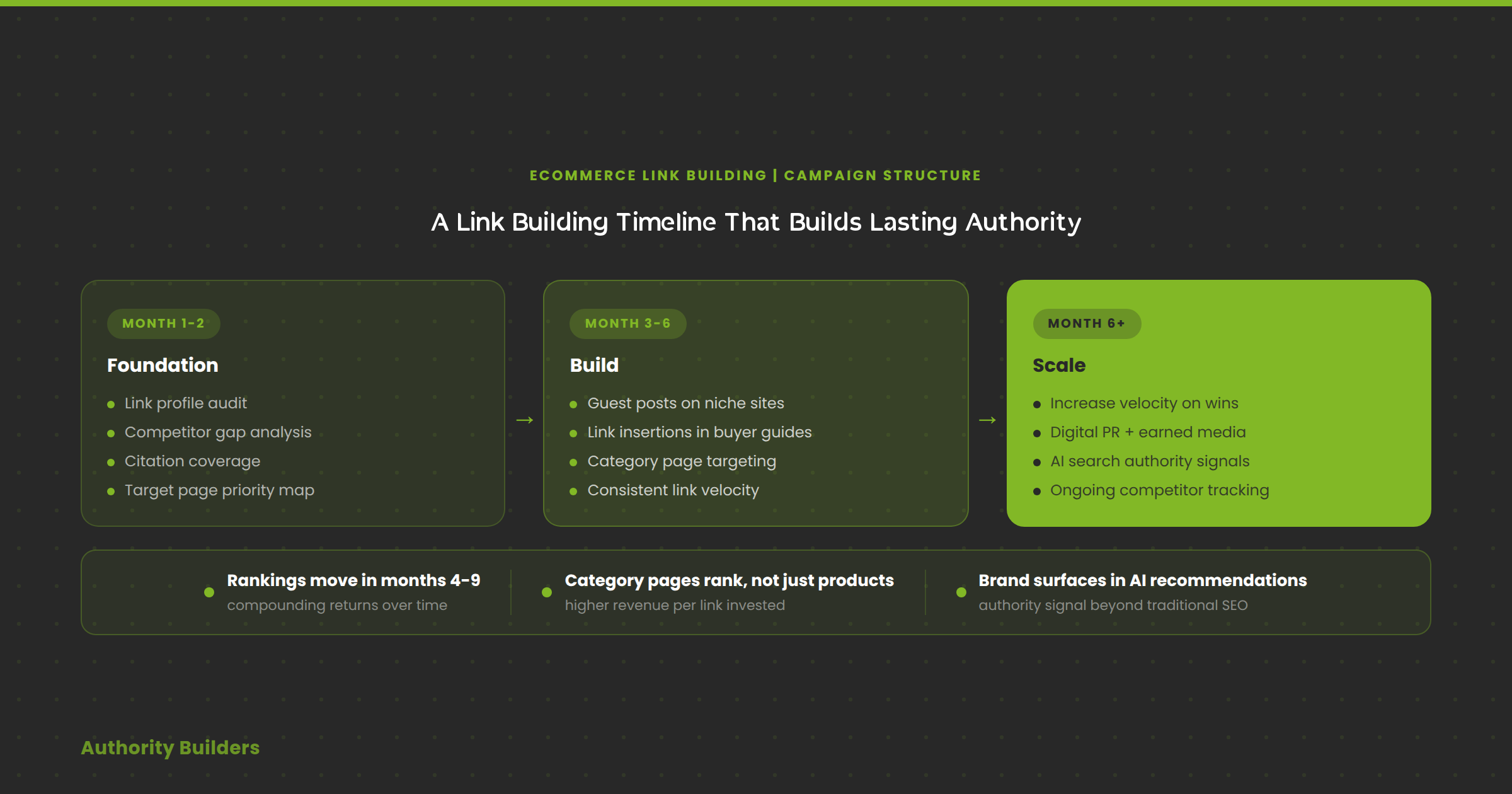
Month 1 to 2: Foundation. Audit the existing link profile, identify the link gap vs. top competitors, establish citation coverage if the site is new or undertreated, and identify the highest-priority target pages.
Month 3 to 6: Build. Begin consistent guest post placements on niche-relevant publications. Add link insertions on high-traffic existing content. Focus the bulk of links on category pages and competitive keyword targets.
Month 6 onward: Scale and diversify. Increase link velocity on pages showing traction. Add earned media and digital PR to build higher-DR links. Continue monitoring competitors and adjusting target pages as rankings shift.
The timeline isn’t glamorous. Link building compounds over time, and most meaningful ranking movement happens in months 4 through 9. But the stores that commit to this consistently are the ones that own their niches two or three years from now.
Want to see what results look like in practice? Browse our ecommerce link building case studies.
How Authority Builders Can Help
We’ve been building links for ecommerce brands since 2016. Every link we place goes through a strict vetting process, with a minimum of 1,000 monthly visitors verified by Ahrefs. If a placement doesn’t meet our quality standards, we replace it at no cost.
We offer a few ways to work with us depending on your situation:
- Browse and purchase individual link placements through our self-serve marketplace
- ABC Plus for a hands-off, fully managed link building subscription with monthly reporting
- ABC Platinum for a custom-built campaign with full competitor analysis, anchor text mapping, and a dedicated account manager
Whichever option fits your stage, the goal is the same: building the kind of link profile that earns rankings, drives sales, and positions your store as the authority in your niche.
Ready to start building authority for your ecommerce store? Apply for an account or book a free consultation at Authority Builders.