
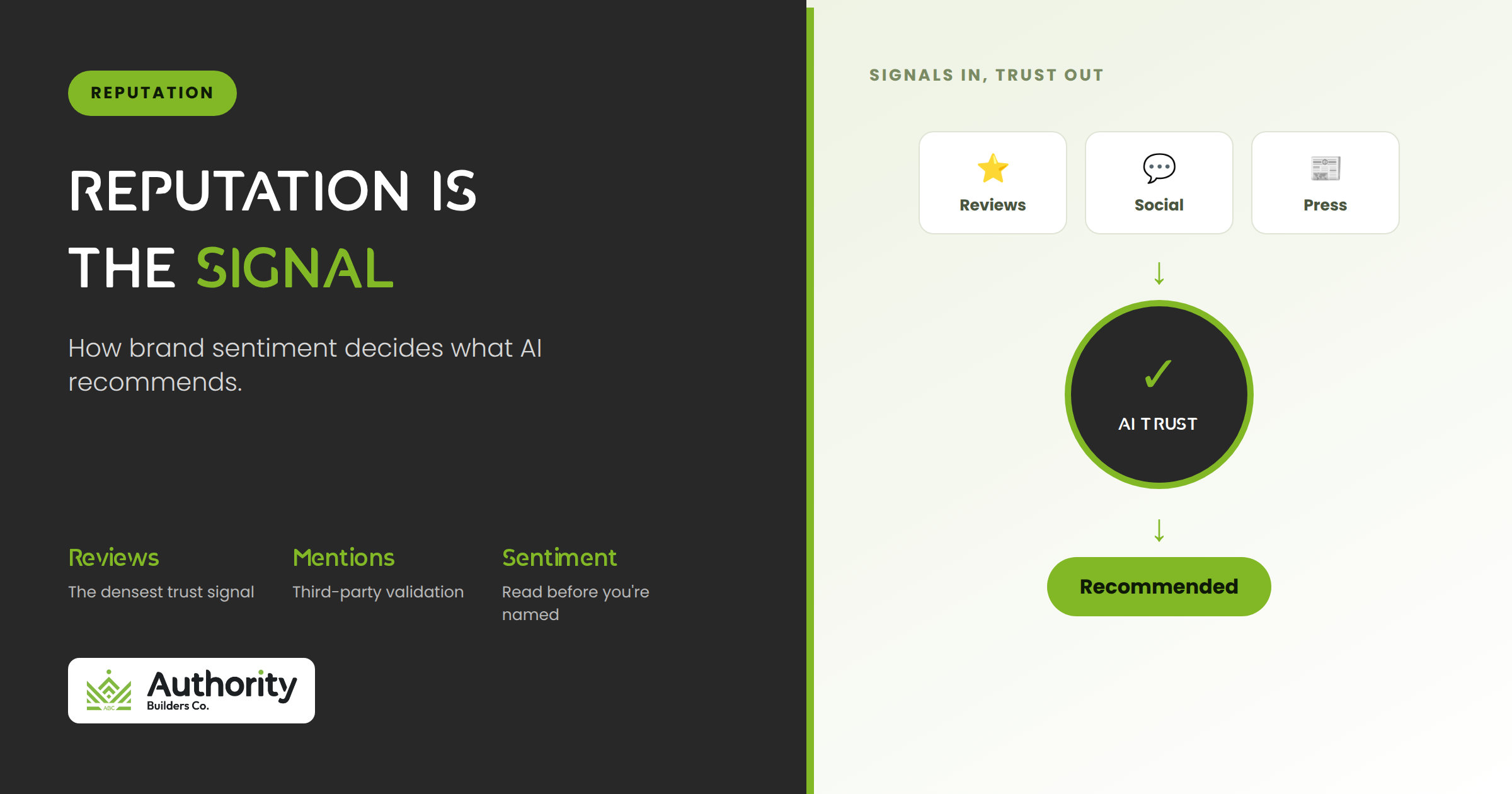
Reputation used to be a brand problem. Now it’s a retrieval problem. When someone asks ChatGPT for the best option in your category, the model doesn’t just check who ranks. It weighs who’s trusted, and it assembles that judgment from the sentiment, reviews, and mentions attached to your name across the web. If your reputation is thin or noisy, you don’t get a lower ranking. You get left out of the recommendation entirely.
Here’s why this matters more than it used to. Buyers increasingly skip the results page and ask an assistant to name a winner. That moves reputation from something customers read after they find you to a signal the AI reads before it decides whether to mention you at all. Sentiment became infrastructure.
This guide is for teams who treat reputation as a growth lever, not a fire drill. We’ll cover how large language models ingest sentiment and reviews, why established brands get a head start, and what a reputation program built for AI visibility looks like in practice.
Why reputation became a ranking input
Reputation always drove conversion. People read reviews before they buy, and a wall of positive feedback closes deals. That hasn’t changed. What’s new is a second job reputation now does, upstream of the customer ever seeing it.
AI systems evaluate trust before they recommend. A ranking algorithm sorts pages and lets the user judge. An assistant has to commit to naming a business, so it needs to feel confident about that business first. Reputation is one of the largest inputs into that confidence. We’ve broken down how AI decides which brands to trust before, and sentiment sits at the center of it.
This is the trust side of answer engine optimization. The old goal was to be found. The new goal is to be chosen, and an assistant only chooses a brand it can stand behind. Your reputation is the evidence it uses to decide whether that’s you.
It helps to see the sequence. In the old model, a buyer searched, clicked through a few sites, read some reviews, and decided. Reputation did its work at the end, on your turf. In the answer-first model, the assistant does that reading for them. It scans the reputation signals, forms a judgment, and hands the buyer a short list, often before they’ve seen a single one of your pages. Your reputation now gets evaluated earlier in the journey, by a reader you can’t talk to directly. The only way to influence that reader is to improve the signals it’s reading.
How AI reads your reputation
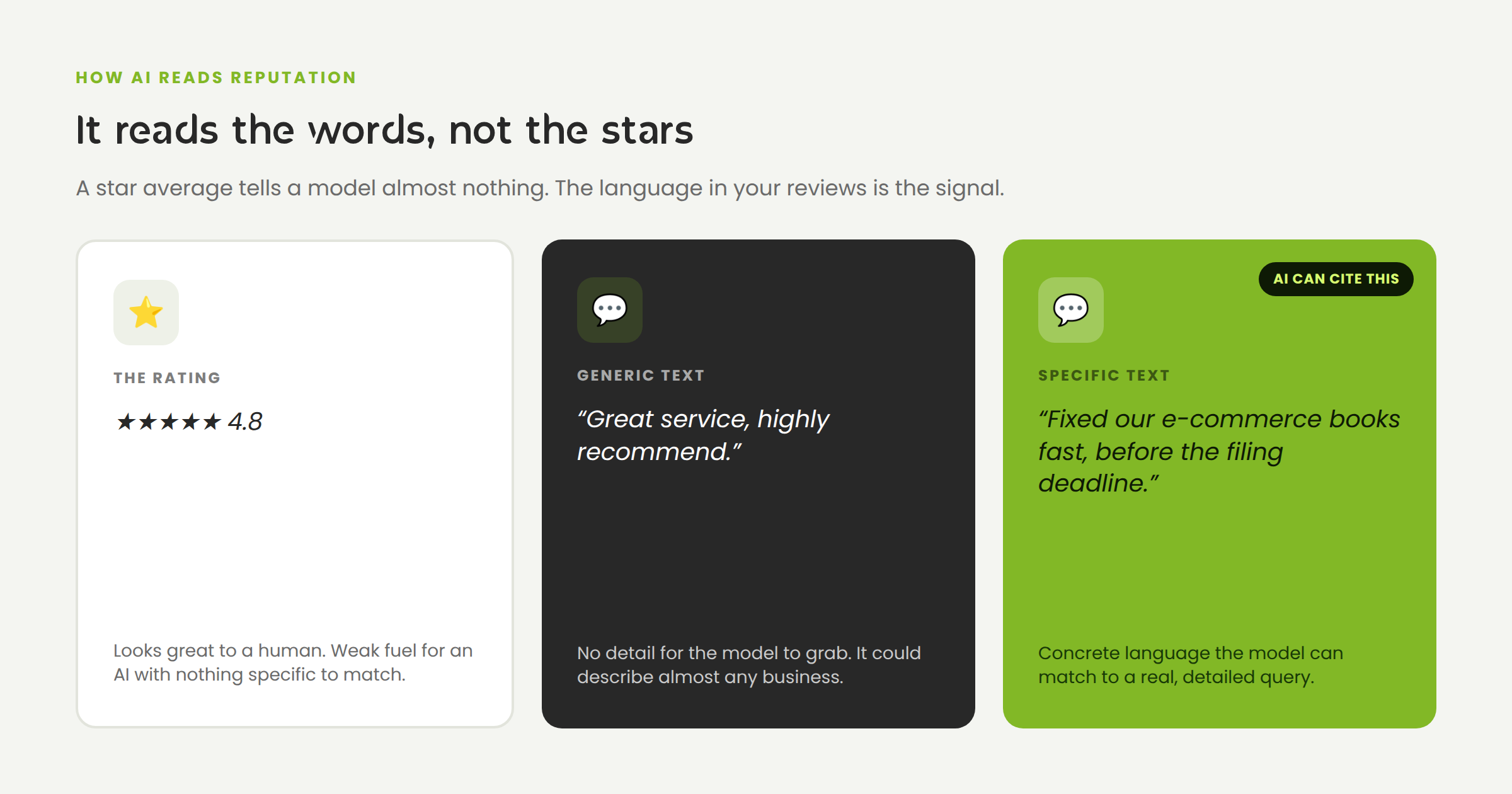
Start with a correction: large language models don’t count your stars. They read your text. Research on how these models handle reviews shows they mine review language for sentiment, tone, and the specific phrases customers use, not just the numeric score. A four-star average tells the model far less than what the reviews say.
That single fact reshapes the work. A pile of “great service” five-star ratings is weak fuel. A steady stream of reviews that name the service, the outcome, the staff member, and the context gives the model concrete language to match against a specific question. When someone asks for “a reliable provider that handles complex cases,” the assistant is looking for a brand whose reputation text contains that story.
Picture the difference in practice. A prospect asks an assistant, “Which local accounting firm is good with e-commerce clients and quick to respond during filing deadlines?” A brand with fifty reviews that all say “great service” offers nothing to match. A brand with twenty reviews that mention e-commerce bookkeeping, fast replies, and specific results hands the model the exact language it needs to justify the recommendation. Same star average, completely different odds of being named. The reviews that win aren’t the highest-rated. They’re the most specific.
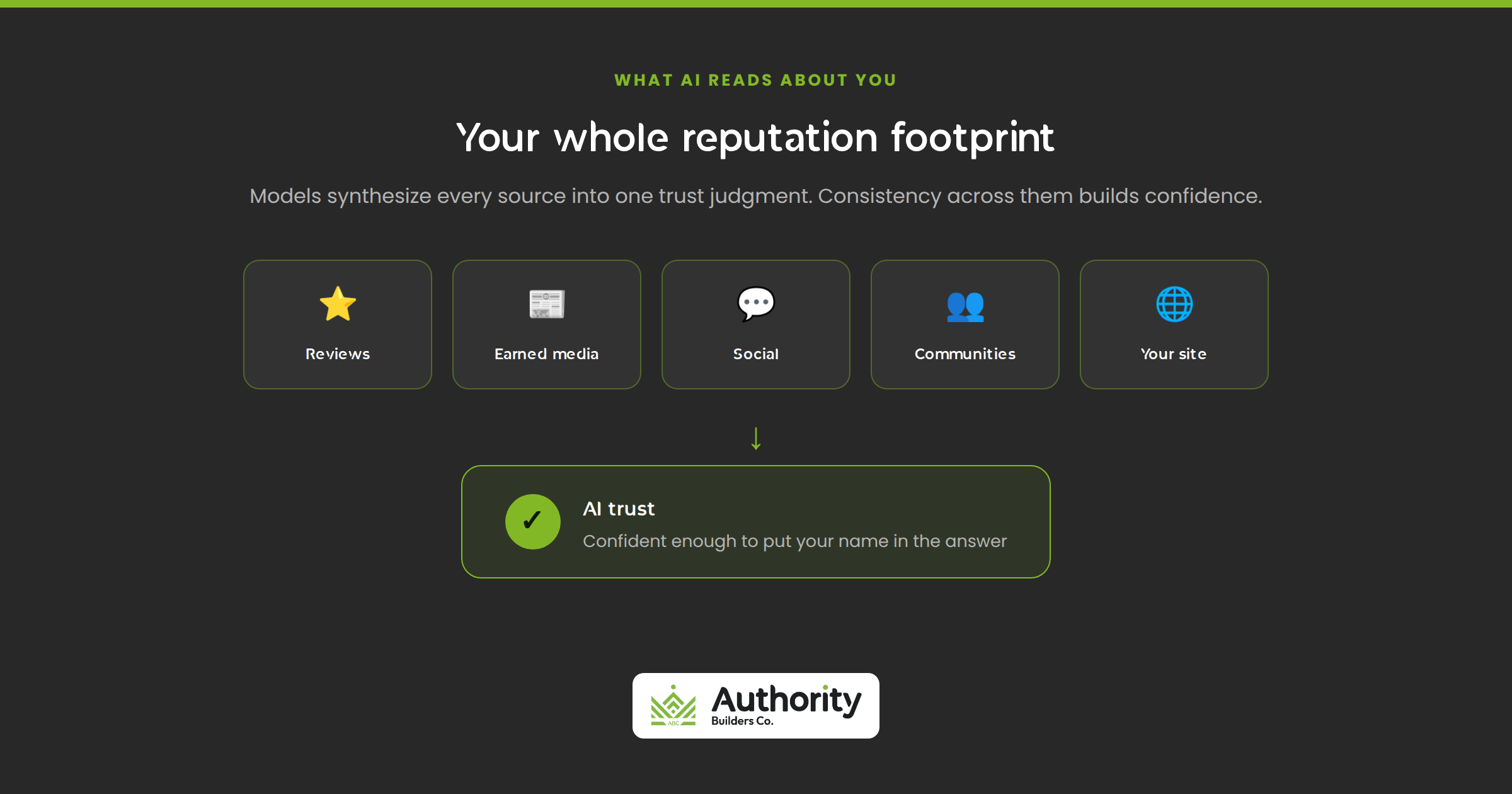
Models also synthesize across sources. They don’t read one review site in isolation. They pull a picture from Google, Facebook, Yelp, industry-specific platforms, forums, and press, and they look for a consistent story. Agreement across sources builds confidence. Contradiction, an outdated address here, a cluster of unresolved complaints there, reads as risk, and the safe move for the model is to recommend a brand it can verify more cleanly.
The incumbent advantage, and how to close it
Here’s the uncomfortable part for challenger brands. Research into LLM recommendations found a consistent incumbent advantage: models recommend well-known brands more often, even when lesser-known competitors are equally good. The established name gets named, and the better product nobody’s heard of stays invisible.
The mechanism is no mystery. A model absorbs the web’s existing consensus. Established brands carry more reviews, more mentions, and more coverage, so the model is simply more confident putting their name in an answer. Reputation compounds, and incumbents got a head start.
But the same body of research points to the way out. It shows that authority and social-proof language in how a brand is described can shift which options a model recommends. Reputation isn’t a fixed inheritance. It’s a signal you build. For a challenger, that means manufacturing the evidence of trust the incumbents accumulated by default: review volume and velocity, third-party mentions, inclusion in roundups and comparisons, and credible press. Every legitimate mention is another vote that raises the model’s confidence, and this is exactly where reputation work overlaps with earned media.
Consider a strong regional brand up against a national name. On product quality, the regional brand wins. In the model’s eyes, it loses, because the national brand has ten times the review volume, a decade of press, and a thousand more mentions. The fix isn’t a rebrand. It’s a deliberate campaign to close the evidence gap: drive review velocity in every market, earn coverage in the publications your buyers read, and get included in the comparison and roundup content the model leans on. Do that consistently and the confidence gap narrows, because you’re feeding the system the same proof the incumbent collected for free.
Reviews: the highest-signal reputation asset
Of all the reputation signals, reviews are the densest and most useful. They’re public, fresh, specific, and structured, exactly the kind of source an AI can read and trust. If you’re going to concentrate effort anywhere, start here. Four things decide whether your reviews work for you:
- Volume and velocity. A steady stream of recent reviews signals an active, trusted business. A profile that peaked two years ago decays. Consistency matters more than a one-time push.
- Text specificity. Reviews that name services, outcomes, and context give AI language to match. Prompt happy customers toward detail, not just a star rating.
- Sentiment and response. Replying to reviews, positive and negative, shows engagement and lets you shape the narrative. Unaddressed negative sentiment compounds into a risk signal.
- Distribution. Reviews spread across Google, Facebook, Yelp, and industry platforms build a consistent cross-source story, which is what AI systems reward.
One hard rule: don’t fake it. Fabricated reviews violate platform policies, and AI systems are increasingly sensitive to inauthentic patterns. A burst of suspiciously similar five-star reviews is a liability, not an asset. Authenticity is the part competitors can’t copy, so it’s the part worth protecting.
Beyond reviews: your full sentiment footprint
Reviews are the core, but they aren’t the whole signal. An AI builds its read of your brand from everything written about you: press coverage, social sentiment, forum and community discussion, comparison articles, and the language of the sites that link to you. All of it feeds the same trust judgment.
Earned media carries outsized weight here. A mention in a credible publication is third-party validation, and models treat that differently than anything you say about yourself. The same logic applies to plain brand mentions with no link: when your name keeps appearing next to your category in trusted contexts, the association hardens into something the model treats as fact. We’ve covered how authority signals shape AI search answers, and reputation is a big part of that signal.
Consistency across the footprint is what ties it together. When your reviews, your press, your social presence, and your own site all tell the same story about what you do and do well, you’re easy to summarize and safe to recommend. When they contradict each other, the model’s confidence drops. Part of reputation management is simply making the whole footprint agree.
The flip side is defense. A cluster of unresolved complaints, a bad news cycle, or a community pile-on can quietly suppress your recommendations. You won’t see a penalty notice. You’ll just stop getting named. Resolving, diluting, and outweighing negative sentiment is real work, and it’s part of the job.
Community sentiment deserves special attention. Models lean on discussion from places like Reddit, industry forums, and Q&A threads, because that’s where people talk candidly and at length. A thread where real users vouch for you, in their own words, is powerful validation. A thread full of unresolved gripes is the opposite. You can’t fabricate these conversations, and you shouldn’t try, but you can earn them by being worth talking about and by showing up to help where your brand already comes up.
Reputation mistakes that quietly cost you AI visibility
Most reputation damage in an AI world isn’t dramatic. It’s the slow accumulation of small gaps that lower a model’s confidence one notch at a time. The common ones:
- Chasing ratings, ignoring text. A 4.8 built on one-word reviews reads as thin. Depth of language beats a decimal place.
- Letting velocity lapse. A profile that stopped growing signals a business that stopped caring. Recency is its own signal.
- Leaving negatives unanswered. Silence on complaints compounds, and it’s visible to both humans and models scanning your footprint.
- Single-platform focus. All your reviews on Google and nothing on Yelp, Facebook, or industry sites reads as a partial story. Breadth builds confidence.
- Inconsistent claims. When your site says one thing and your reviews and press say another, the model can’t form a clean picture, so it hedges by recommending someone else.
Building a reputation program for AI visibility
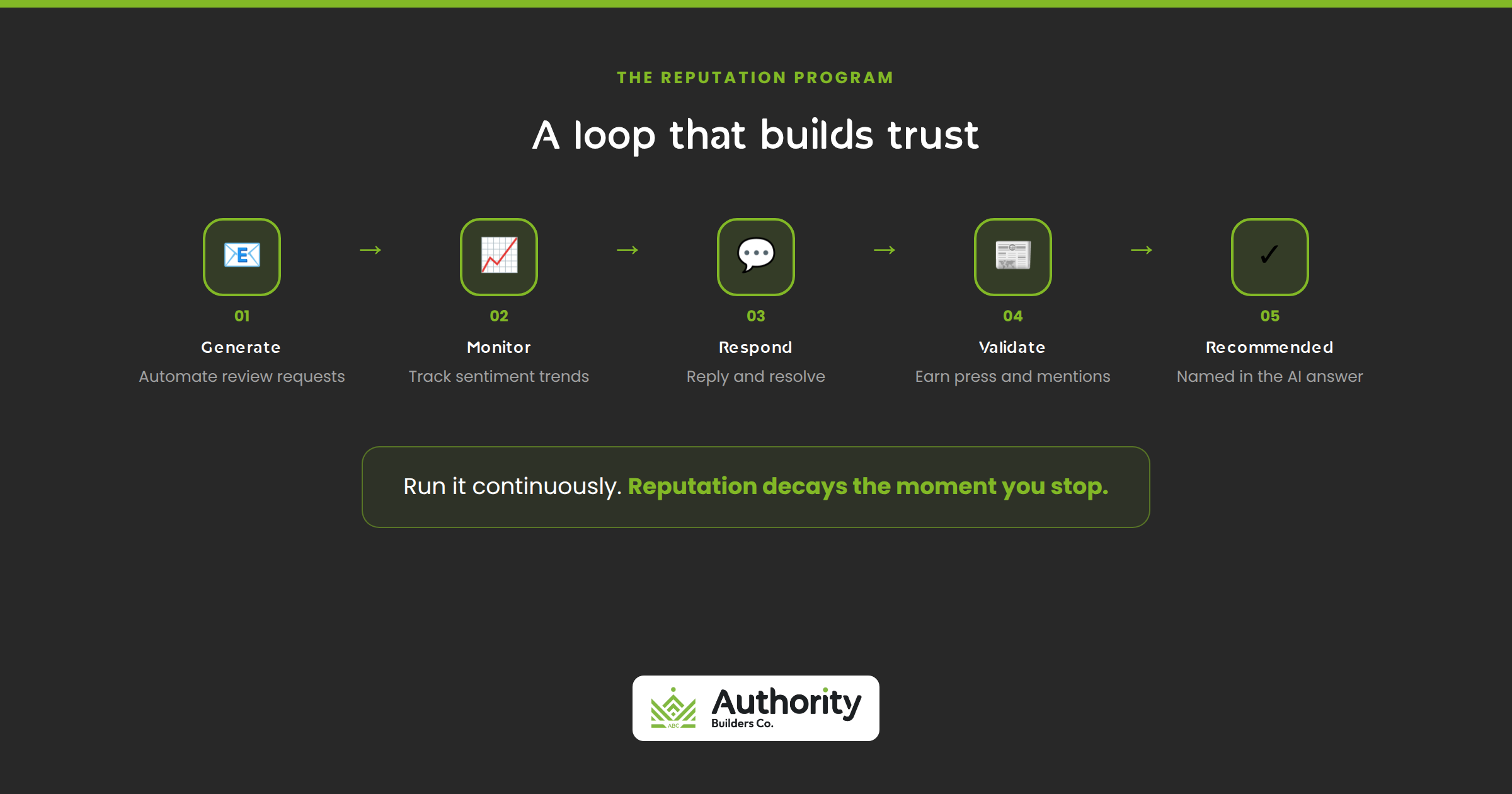
Reputation for AI visibility is an operating discipline, not a cleanup project. A program that moves the signal runs five things on a loop. The brands that pull ahead don’t treat these as occasional projects, they run them continuously, because reputation decays the moment you stop feeding it:
- Generate reviews systematically. Automate timely review requests by email and SMS at the moments customers are happiest, and keep velocity steady across the platforms that matter for your category.
- Monitor sentiment across sources. Track reviews, mentions, and social sentiment in one place so you catch shifts before they compound. Watch the trend, not a single snapshot.
- Respond and resolve. Reply to reviews and address complaints in public. A visibly resolved problem is itself a trust signal, and it dilutes the negative sentiment that would otherwise stick.
- Earn third-party validation. Pursue press, expert mentions, and inclusion in roundups and comparisons. This is where reputation work meets earned media and link building.
- Keep the story consistent. Align your positioning across reviews, press, social, and your own site so every source reinforces the same brand rather than competing versions of it.
How to measure reputation as a signal
Classic reputation metrics, average rating and total review count, miss the layer that now matters. They tell you how you look to a human skimming a profile, not whether an AI is confident enough to recommend you.
Measure the signal instead. Track review velocity and sentiment trend by platform, the volume and quality of third-party mentions, and, most importantly, whether assistants name you for your core category queries. Watching how your sentiment correlates with AI recommendation presence over time is the feedback loop that tells you what’s working. We keep a running rundown of the best AI search visibility tracking tools if you want a place to start.
The point is to close the loop: see which reputation signals move AI recommendations, then invest there instead of chasing a vanity star average that no model reads the way you think it does.
A practical way to start: pick your ten most important category queries, run them through the major assistants each month, and record whether you’re named, how you’re described, and who’s named alongside you. That one habit turns reputation from a feeling into a tracked metric, and it shows you exactly which competitors the model trusts more than you, and where the gap is.
Turn reputation into recommendations
Reputation is a growth channel now, not just a defensive one. The brands AI recommends are the ones with deep, fresh, consistent, positive signals spread across the web, and that’s a system you can build on purpose.
That’s what our Review and Reputation Management service runs: automated review generation by email and SMS, cross-platform monitoring and sentiment reporting, and the visibility work that turns social proof into AI and Google presence. Pair it with earned media and links to build the third-party validation AI weights most heavily.
Want to see how your brand’s reputation reads to an AI right now? Book a call and we’ll map it out with you.