
SEO Content Writing in 2026: How to Engineer Content for Citation, Not Just Ranking
Corey Batt
Ranking used to be the finish line. You hit position three, the clicks showed up, and the post paid for itself. That deal has changed.
Answers now sit on top of the results, and a large share of searches end without anyone visiting a website at all. Your page can be the source an AI system summarizes and still never see the visitor. Which means the job of an SEO writer has quietly split in two: you’re writing to rank, and you’re writing to be the passage a machine pulls, trusts, and names.
Here’s the thing. Most of the advice floating around about this is invented. There’s a whole cottage industry selling formatting tricks, special files, and mention-farming packages that Google has publicly said it ignores. Meanwhile the things that do move the needle are less exciting and a lot more useful: sharper briefs, answer-first construction, real expertise on the page, and an off-page footprint that tells AI systems you’re worth citing in the first place.
This guide covers what we’ve learned writing content for our own site and for clients: how to structure a page for extraction, what Google says you can stop worrying about, and how to tell whether any of it is working.
Ranking and Getting Cited Are No Longer the Same Job
Start with the click math, because it reframes everything that follows.
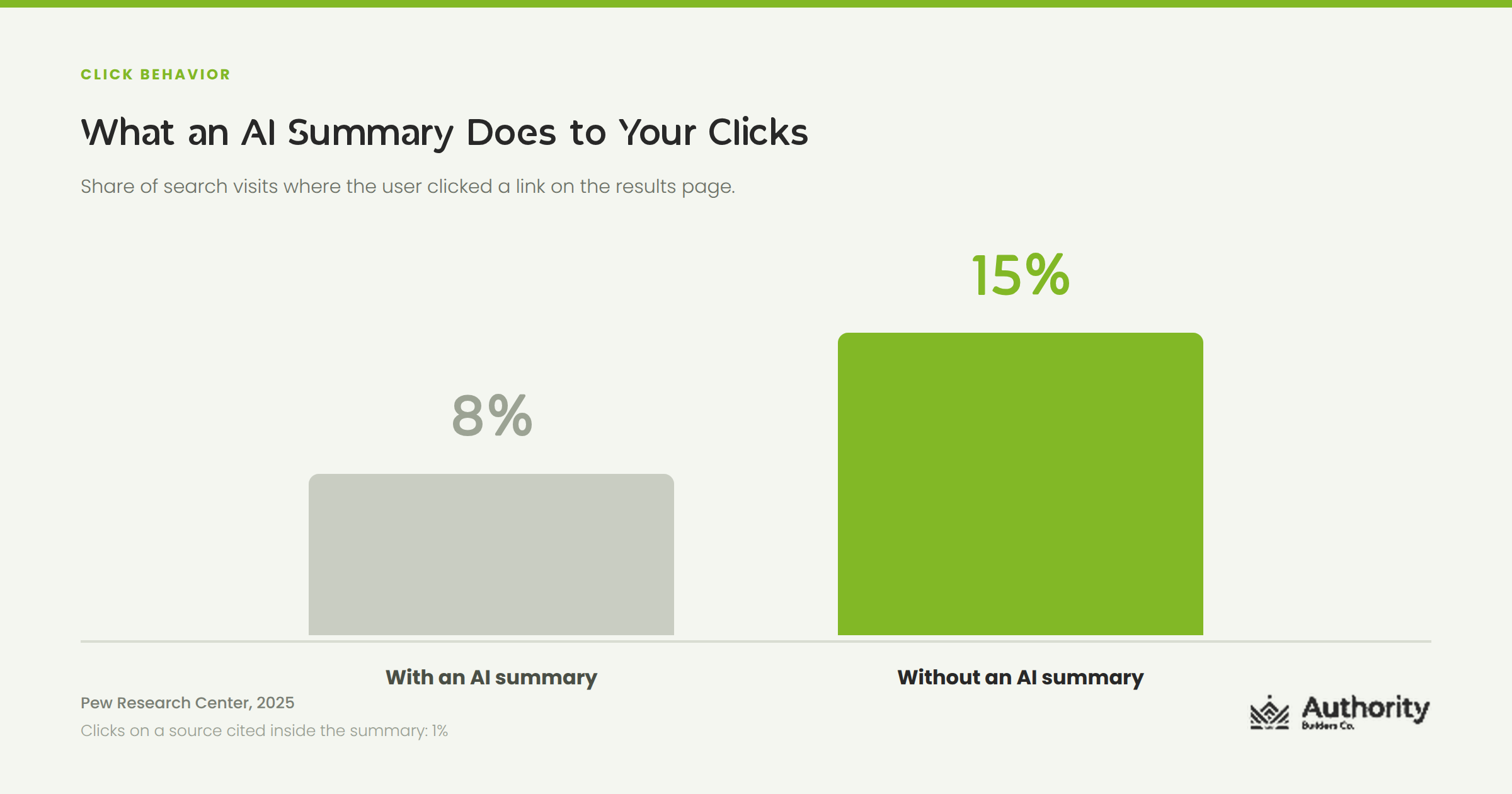
Pew Research Center analyzed the browsing behavior of 900 US adults across 68,879 Google searches and found that when an AI summary appeared, users clicked a traditional search result in 8% of visits. Without a summary, they clicked in 15% of visits, close to double. Clicks on the sources cited inside the summary itself happened in roughly 1% of visits.
Two more numbers from that same analysis are worth sitting with. Around 18% of searches in the study produced an AI summary, and 88% of those summaries cited three or more sources. Longer, more specific queries triggered them far more often: 53% of searches with ten or more words returned a summary, compared with 8% of one and two-word searches.
Put those together and a strategy emerges. The queries that trigger AI answers are the long, specific, question-shaped ones. Those answers usually name three or more sources. Being one of the named three is a real acquisition position, because a user who arrives after reading a summary that recommended you is not browsing, they’re checking you out.
So the target shifts. You still want the ranking, since AI features pull from the same index. But a page that ranks and never gets summarized is leaving the more valuable half on the table.
What Google Says Matters, and What It Says You Can Skip
Google published a dedicated guide on this, and it’s the single most useful document in the category because it spends as much time telling you what not to do as what to do. Worth reading in full:
Google’s official guide to optimizing for generative AI features on Search makes the underlying mechanics explicit. AI Overviews and AI Mode run on retrieval-augmented generation, meaning they use the core Search ranking systems to retrieve pages from the index and then generate a response grounded in those pages. There’s also query fan-out, where the model spins up a set of related queries alongside the original one and pulls results for those too.
That single detail explains a lot. If the model is quietly running “best herbicides for lawns” and “remove weeds without chemicals” while the user typed something broader, then depth across a topic beats a page that answers exactly one phrasing.
The four things Google says to focus on
- Non-commodity content. Google’s own example is sharp: “7 Tips for First-Time Homebuyers” is common knowledge that could have come from anyone. A piece explaining why a specific buyer waived an inspection and what the sewer line turned up is not. If a generative model could produce your page from general knowledge, it has no reason to cite your page.
- A clear technical structure. A page has to be indexed and eligible to appear with a snippet before it can appear in a generative feature at all. Crawlability, page experience, and reduced duplication are prerequisites, not optimizations.
- Organization that helps a reader. Paragraphs, sections, and headings that make the page navigable. Google frames this as a human readability concern, and the machine-readability benefit follows from it rather than the other way around.
- Supporting images and video. Generative features surface relevant images and video, which is additional surface area beyond a text link.
The five things Google says you can ignore
This is the part that saves you money, so we’ll be specific. Per that same guidance:
- llms.txt and similar files. Google Search doesn’t use them. Maintaining one is harmless, and it will neither help nor hurt visibility in Google Search.
- “Chunking” your content. There’s no requirement to break pages into tiny fragments. Google’s systems handle multiple topics on a page and surface the relevant piece. There’s no ideal page length.
- Rewriting content specifically for AI systems. These systems understand synonyms and intent, so you don’t need to capture every possible phrasing variant.
- Chasing inauthentic mentions. Manufactured mentions across the web aren’t as useful as they’re sold to be, since the same spam systems that protect ranking also feed the generative features.
- Overfocusing on structured data. Schema isn’t required for generative search and there’s no special markup for it. Keep using it for rich results, but don’t treat it as an AI lever.
Google is blunt about the labels too. From its perspective, optimizing for generative search is optimizing for search, so AEO and GEO describe a subset of SEO rather than a separate discipline. We agree, with one caveat: the practical craft of writing an extractable passage is a real skill, and most content teams have never been briefed on it. That’s the rest of this post.
If you want the earlier, shorter version of the same position, Google Search Central’s post on succeeding in AI search is where this guidance started, and it holds up.
How to Write a Page That Gets Extracted
None of what follows is a hack. It’s editing discipline that happens to align with how retrieval works.
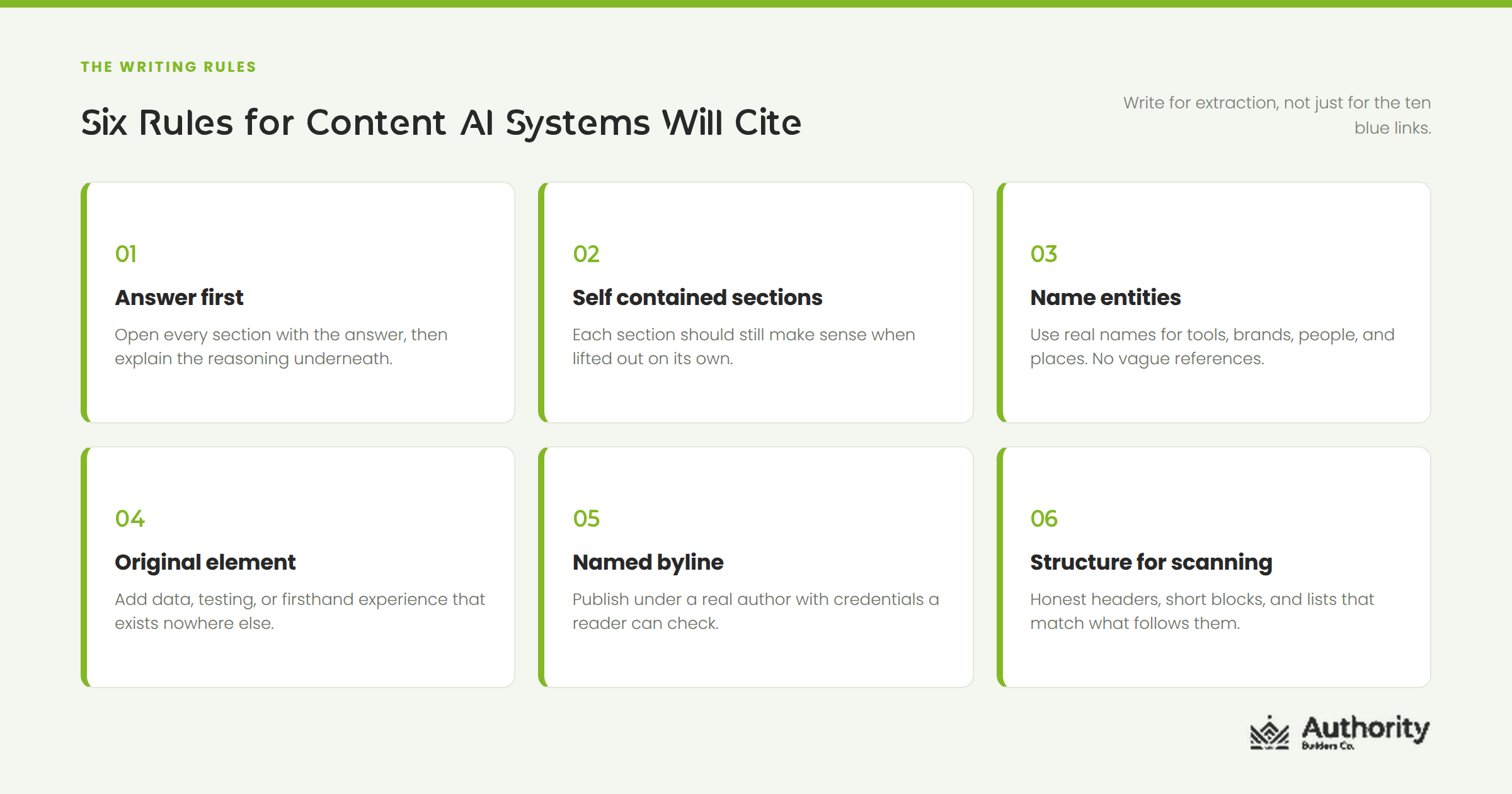
1. Answer in the first two sentences, then earn the rest
Most SEO drafts open with a runway: context, a statistic, a promise of what’s coming. Retrieval systems don’t wait for the runway to end. Neither do readers.
Lead each section with the direct answer to the question that heading implies, stated as a complete claim. Then add the nuance, the exceptions, and the example. You lose nothing, because the reader who wanted the quick answer got it and the reader who wanted depth keeps reading.
A test we use: cover everything except a section’s first two sentences. If what’s left standing doesn’t answer the heading, rewrite the opener.
2. Make every section survive on its own
A passage that gets pulled out of your page arrives somewhere else with no context attached. If your third H2 opens with “This is why it matters,” the “this” is gone.
So resolve your pronouns. Restate the subject in each section instead of relying on the one above it. Repeat the entity name rather than defaulting to “it” or “the platform.” This reads slightly more redundant in a linear read and considerably better everywhere else.
3. Name entities plainly and consistently
Write out the names of products, companies, standards, and tools rather than gesturing at them. “A leading link building marketplace” tells a model nothing. “Authority Builders” is an entity it can attach a claim to.
The same applies to your own numbers. “Significant growth” is unusable. “784% growth in generative AI sessions over 12 months” is a fact a summary can carry, with your name attached to it.
4. Put something on the page that isn’t available elsewhere
This is the highest-leverage item on the list and the one most content programs skip, because it costs more than paraphrasing the top ten results.
First-party data qualifies. So does a documented process, a teardown of a real campaign, a screenshot of your own dashboard, a number your team measured, or an argument that contradicts the consensus and defends itself. Anything that makes your page the origin of a fact rather than a repeater of one.
If you’re staring at a brief with nothing original in it, that’s a briefing problem, not a writing problem. We’ll get to that.
5. Attribute the expertise to a person
Bylines, credentials, and specifics about how the author knows what they know. First-hand framing helps here: what you tested, what you ran, what broke. Google’s guidance leans on first-hand experience as a differentiator between unique content and a summary of existing content, and a named practitioner is easier to trust than a house voice.
6. Structure for scanning, not for a formula
Descriptive headings that state the point rather than tease it. Short paragraphs. Lists where the content is a list and prose where it isn’t. A comparison table where readers are weighing options.
Note what this is not: it isn’t chopping your post into 40-word fragments because someone said AI prefers chunks. Google says that outright. Format because it helps a reader navigate, and the retrieval benefit comes along for free.
The Brief Does Half the Work
Writers can’t add originality that the brief didn’t budget for. If the brief is a keyword, a word count, and three competitor URLs, you’ll get a competent synthesis of those three URLs, which is the definition of commodity content.
Let’s break down what we put in a brief when the goal includes citation:
- The question behind the keyword. Not “seo content writing” but the actual thing a person is trying to resolve, written as a sentence.
- Three to five fan-out questions. The related queries a model would plausibly run alongside the main one. Each becomes a section with a real answer.
- The original element. Named up front. Which internal data, which client result, which process we’re documenting, which contrarian position we’re taking.
- Required primary sources. Linked in the brief, already verified. If a claim needs a source, the writer shouldn’t be hunting for one at the end.
- The entity list. Products, competitors, standards, and tools that should appear by name.
- The author and their angle. Who is signing this and what they’ve personally done that qualifies them.
Six lines. It reliably produces a better draft than doubling the word count ever has for us.
Why Writing Alone Won’t Get You Cited
Here’s the uncomfortable part. You can execute every item above and still not get named, because retrieval systems have to decide you’re a credible source before your beautifully structured passage is a candidate.
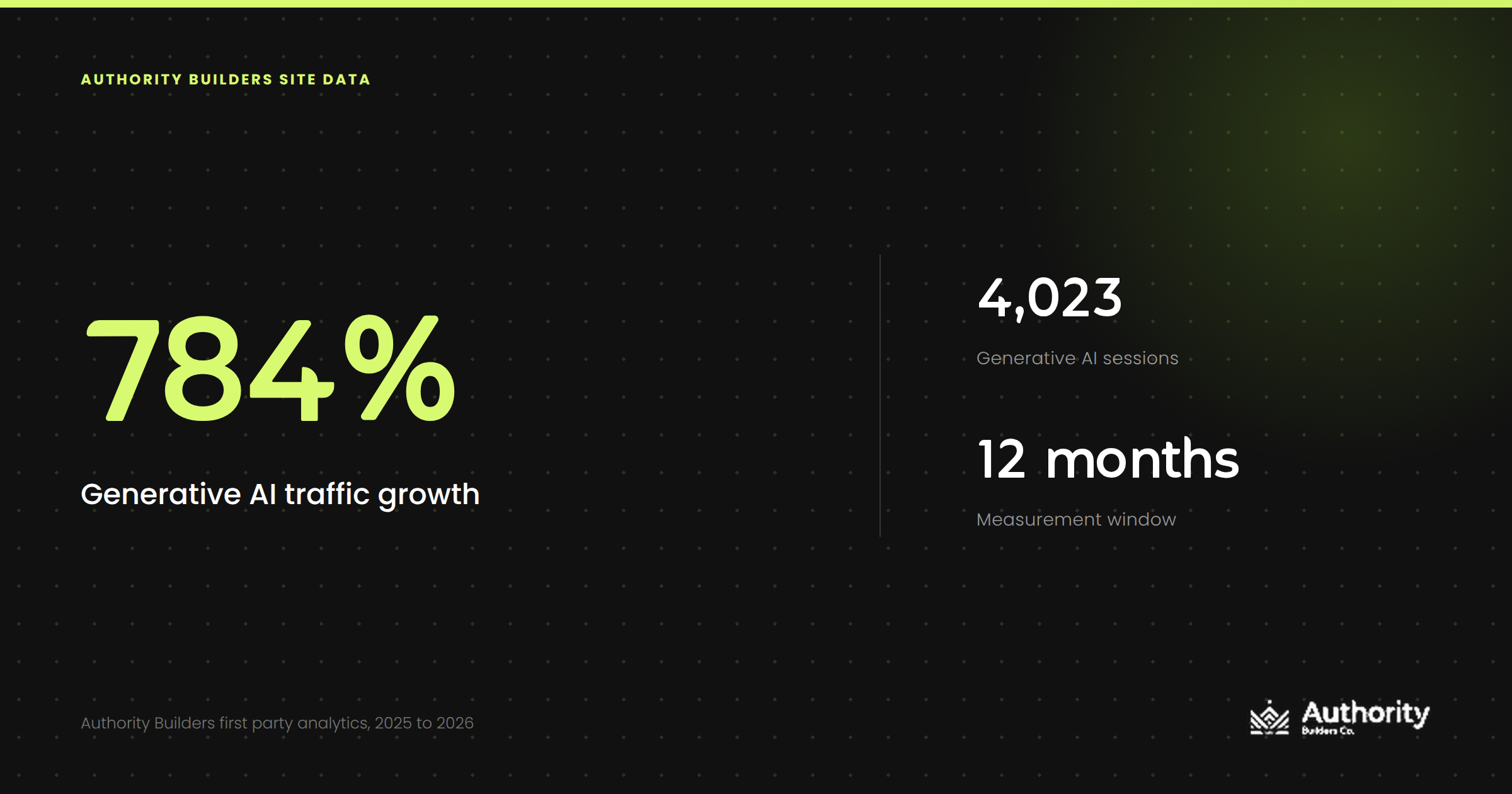
We tested this on ourselves rather than theorizing about it. Over a 12-month period covering January 2025 through February 2026, generative AI traffic to authority.builders grew 784%, reaching 4,023 sessions. During that same window, our traditional organic search traffic declined 26%, in line with what most sites in this industry saw.
The platform split: ChatGPT accounted for 3,846 of those sessions, 95.6% of the total. Perplexity grew 541%, Gemini 683%, Claude 950%. Every major platform moved in the same direction independently, which tells you the signal wasn’t platform-specific.
What’s more interesting is where that traffic landed. Not scattered across blog posts. It concentrated on the homepage and service pages, with 1,603 sessions to the homepage and 142 to our guest posts page. AI systems were recommending us as a solution, not just as a source of information, and the people arriving were closer to a purchase than a typical blog visitor.
There was no trick behind it. We published consistently, refreshed existing posts, ran quarterly technical crawls, built links to our own site using the same marketplace we sell, and put a named expert on camera weekly. The same fundamentals we run for clients, tracked through a second lens.
The off-page half of this is its own subject, and we’ve covered it at length in our breakdown of what the data shows about ranking in AI Overviews and in our analysis of the real impact of citation quality on AI search. If you’re rebuilding your link strategy around this, start with the new rules for high authority backlinks.
The short version: content quality determines whether you’re citable, and authority determines whether you’re considered. You need both, and the second one takes longer.
How to Measure Citation Performance
For years the honest answer here was “you can’t, not well.” That’s improving.
Google Search Console now includes a generative AI performance report, which shows how content is performing in generative AI features on Google Search and Discover. It’s first-party data about your own site, which puts it in a different category from third-party estimates.
Google is also direct about those third-party tools: no external tool has access to its internal ranking or AI systems, so treat any product claiming to report “real” AI ranking data with skepticism. Use the tools if they fit your workflow, and check what they tell you against the official guidance.
Alongside Search Console, three things worth tracking in your analytics:
- Referral sessions by AI platform. Segment ChatGPT, Perplexity, Gemini, and Claude separately. The growth rates differ and the mix tells you something.
- Landing pages receiving AI referrals. If they’re all informational posts, you have a visibility win. If service pages are showing up, you have a pipeline.
- Behavior on arrival. Compare AI-referred sessions against organic on the actions you care about. Ours converted at a different level, which is the whole argument for tracking them apart.
A Workflow You Can Run This Week
- Pick your ten highest-value pages. Revenue pages and the informational posts that feed them.
- Read the first two sentences of every section. Rewrite any that don’t answer the heading as a standalone claim.
- Resolve context dependencies. Any section that only makes sense after the one before it gets its subject restated.
- Find the original element in each page. If there isn’t one, add one or accept that the page is a commodity and plan accordingly.
- Add or upgrade the byline. A real person with a credential and a reason to be credible on this topic.
- Check the dates. Freshness matters for retrieval eligibility, and a page last touched in 2023 is competing against ones touched last month.
- Set up the measurement. Search Console’s generative AI report plus AI referral segments in analytics, before you make changes rather than after.
If step four keeps coming back empty across a lot of pages, the problem is upstream in your content planning, and a systematic refresh is usually the faster fix. We walk through that process in our content refresh strategy guide.
Where We Fit
Most teams know what good content looks like and run out of hours before they run out of ideas. That’s the gap we fill. Our SEO Blog Writing service produces long-form content built around keyword clusters and internal linking, written by people who work in a niche rather than generalists rotating through one. For revenue pages where the copy has to convert as well as rank, SEO Copywriting handles the service and product pages that AI referrals tend to land on.
If your problem is a back catalog rather than a blank page, Content Refresh systematically updates existing posts so they stay eligible for retrieval instead of aging out. And when the constraint is authority rather than output, Guest Posts places content on sites with verified organic traffic, while AI Plus runs the combined content, links, and reputation program aimed specifically at AI search visibility.
The Takeaway
Writing for citation isn’t a new discipline with its own rulebook. It’s the old discipline with a sharper standard: say something only you can say, say it clearly enough that a fragment of it survives on its own, put a real name behind it, and build enough third-party credibility that systems consider you in the first place.
The teams winning at this in 2026 aren’t the ones who found a formatting trick. They’re the ones who were already doing the work, and who now measure a second outcome alongside rankings.
If you’d like a second opinion on where your content sits against that standard, schedule a call with our team and we’ll walk through it with you.