
Guest Posting Services: How to Vet Sites, Score Relevance, and QA Every Placement
Corey Batt
Most people buy guest posts the same way. Filter a list by Domain Rating, sort by price, pick the cheapest thing above DR 50, and hope.
Then a few months later they’re looking at a backlink profile full of placements that never moved a ranking, never sent a visitor, and never got cited anywhere. The links are live. They’re just inert.
Here’s the thing. The gap between a placement that compounds and a placement that does nothing has almost no relationship to the metric you filtered on. It comes down to whether the site is a real publication with a real audience, whether the page hosting your link sits near the page it points at, and whether anyone checked the placement after it went live.
This guide covers the three layers we run every placement through: site vetting, relevance scoring, and placement QA. It’s the part of guest posting services that never appears on a pricing page, and it’s the part that decides whether you got value for the money.
What Guest Posting Services Cover, and Where the Risk Sits
Let’s be direct about the category before we get into mechanics.
A guest posting service does some combination of four things: it finds sites that accept contributor content, it pitches and negotiates the placement, it writes the article, and it gets the piece published with a link back to you. Providers differ enormously in how much judgment goes into that first step, and almost not at all in how they describe it.
It’s also worth stating plainly what Google says, because a lot of content in this category talks around it. Google’s spam policies name advertorials and native advertising as link spam when payment is received for articles containing links that pass ranking credit, and the same section calls out links with optimized anchor text in articles, guest posts, or press releases distributed on other sites. Google also states that buying and selling links is a normal part of the web’s advertising economy and is not a policy violation when those links carry a rel=”nofollow” or rel=”sponsored” attribute.
There’s a second policy that matters here. Google’s site reputation abuse policy targets third-party content published on a host site mainly because of that host’s already-established ranking signals. Worth noting is what Google explicitly excludes from that policy: columns, opinion pieces, articles and other work of an editorial nature, along with third-party content where the purpose is to share content directly with readers rather than to capitalize on the host’s rankings.
Read those two policies together and a usable test drops out. The question isn’t “does this link pass ranking credit.” The question is whether the placement exists to reach an audience or exists only to move a signal.
Which gives you one filter to run on any placement before you spend a dollar:
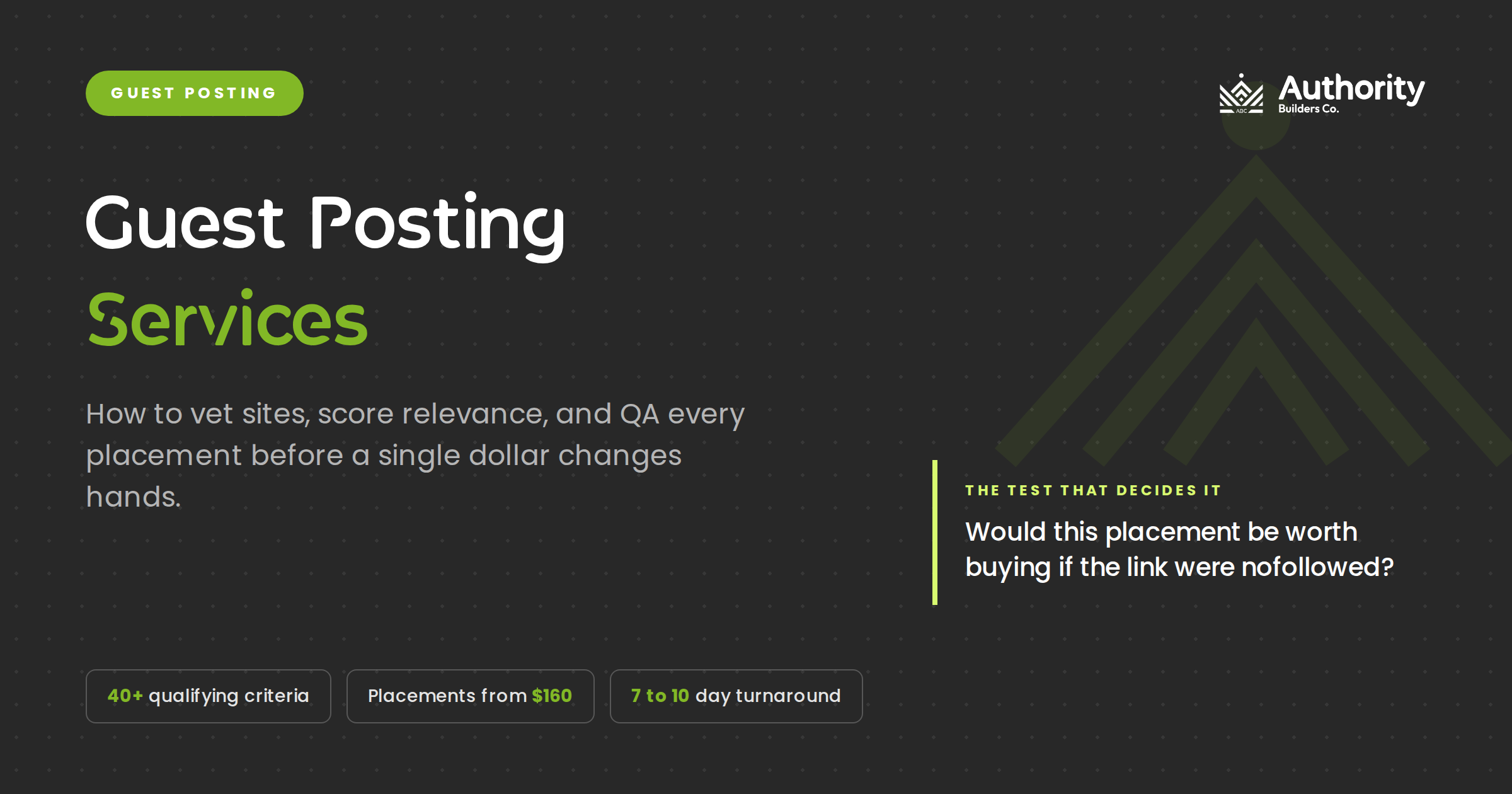
Would this placement be worth buying if the link were nofollowed?
If the answer is yes, because the site has readers who look like your buyers, because the piece will get shared, because the brand exposure carries standalone value, then you’re looking at a real editorial placement. If the answer is no, you’re buying a ranking signal and nothing else, and you’re carrying the full risk that Google’s systems price that signal at zero.
We’ll be upfront about our position: we sell guest posts. We also decline a large share of the sites that apply to our network, and the test above is why. A site that can’t clear it isn’t worth selling.
Layer One: Site Vetting
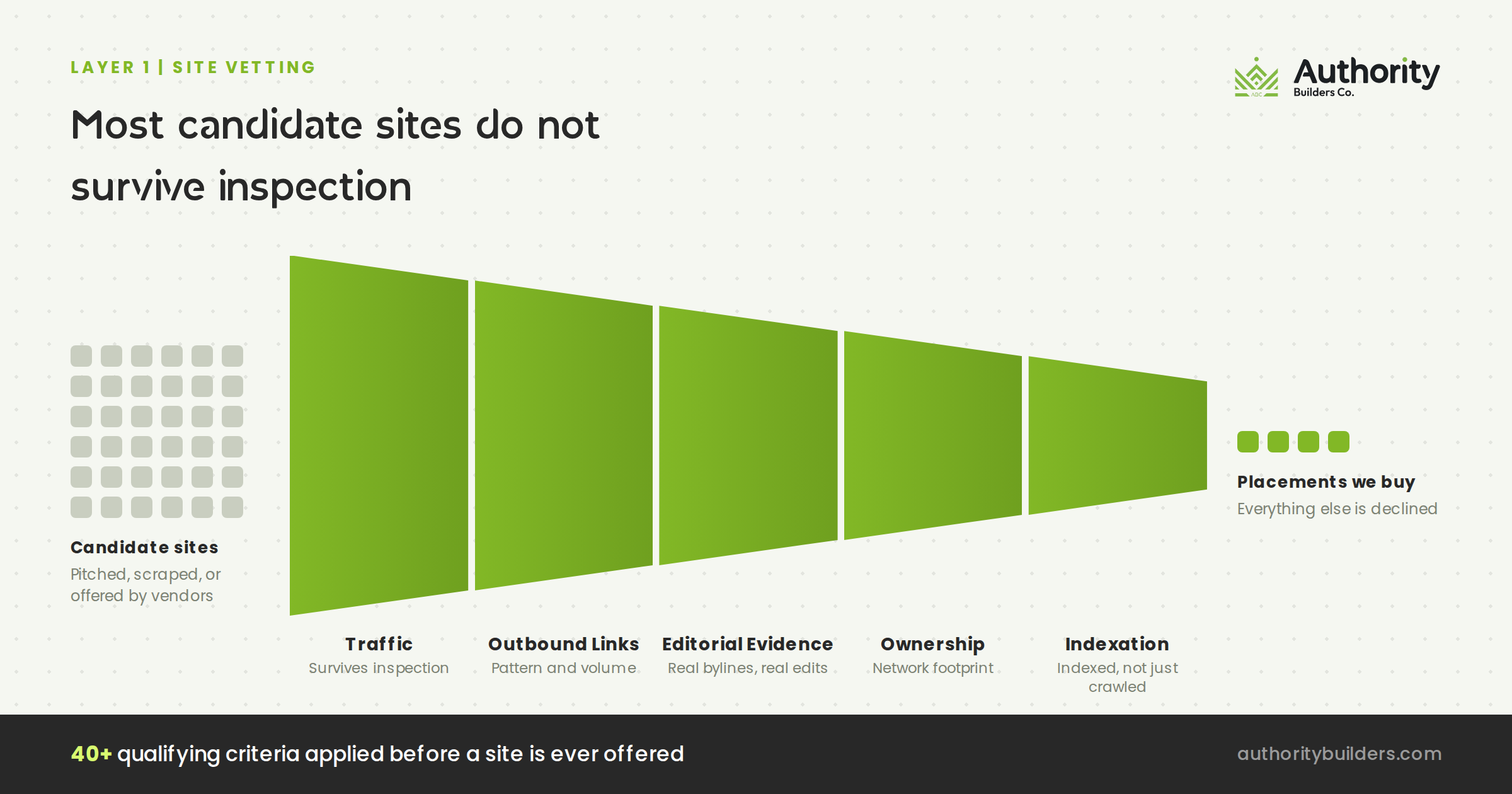
Vetting is where most of the value gets created or destroyed. Here’s what we check, roughly in the order that eliminates prospects fastest.
Traffic that survives inspection
Domain Rating and Domain Authority are third-party scores built on link graphs. A determined operator can inflate either one in a matter of weeks. Organic traffic is much harder to manufacture, which makes it the better starting point.
Pull the site’s organic traffic in Ahrefs or Semrush, then look past the headline number:
- Is the trend up, flat, or collapsing? A site down 70% over eighteen months is being demoted, and you don’t know what for.
- Where is the traffic from? A supposed US business publication pulling 80% of its sessions from countries you don’t sell into is worth nothing to you, whatever the DR says.
- What keywords drive it? If the top-traffic keywords have no relationship to the site’s stated subject, you’re looking at a domain that got repurposed after it was bought.
- Is it one lucky page? A site with 40,000 monthly visits where 38,000 land on a single viral post is not an authority in its niche. It’s a site with one hit.
- Does traffic match the pitch? Plenty of sites in the market quote a traffic figure that a tool has never confirmed. Verify it yourself.
Our own threshold is verified organic traffic on every site in the network, confirmed in Ahrefs rather than taken on the site owner’s word. We cover the reasoning behind that standard in more depth in our guide to the new rules for high authority backlinks.
The outbound link pattern
This exposes link farms faster than anything else, and it takes about four minutes.
Open six or eight recent posts and read the outbound links.
Real publications link out to sources. Studies, documentation, news coverage, competitors, reference material. The links are mixed dofollow and nofollow because nobody on staff is thinking about it that hard.
Inventory sites link out almost exclusively to commercial pages, always dofollow, usually two or three per article, with anchors that read like someone’s keyword research. Once you’ve seen the pattern you can spot it in seconds.
If every article on the site contains a dofollow commercial link and the anchors are keyword-heavy, the footprint is already visible to anyone who looks, including the systems built to look.
Content a human would choose to read
Ask the plain question: would anyone read this if they weren’t paid to write it?
Start with bylines. Google’s guidance on people-first content puts real weight on whether it’s self-evident who created a piece and whether bylines lead to background about the author. A site where every post is credited to “Admin,” or to twelve different names with no author pages behind them, is not a publication.
Then look at topical spread. A site publishing about cryptocurrency, mattresses, personal injury law, and pet insurance in the same month is a link inventory wearing a blog as a costume.
Then look at the comments, the social accounts, and whether anything on the site has been updated since it launched. Real publications leave evidence of an audience.
Ownership and footprint
Run a reverse IP lookup and see what else lives on that server. Check whether the same template, footer boilerplate, or contact form shows up across a dozen other “independent” publications. Networks tend to be careless about exactly this, because building fifty distinct sites properly costs more than the links are worth.
Indexation
Search a distinctive sentence from a recent post in quotes. If the page isn’t in the index, the link can’t pass anything, and no AI system is going to cite a page it can’t retrieve.
Layer Two: Relevance Scoring
Once a site is clean, the next question is whether it’s relevant to you. Most buyers stop at “it’s in my niche,” which is far too coarse to be useful.
Relevance operates at three levels, and they compound.
Domain-level relevance is whether the site’s overall subject sits near yours. A project management SaaS placed on a general business blog picks up some relevance. Placed on a dedicated productivity publication, it picks up considerably more.
Page-level relevance is whether the specific article hosting your link covers a topic adjacent to the page you’re pointing at. This matters more than most buyers assume, and it’s the first thing cheap placements cut. A relevant site with an article bolted on around your keyword is weaker than a relevant site with an article that would have existed anyway.
Audience relevance is whether the people reading that site could plausibly buy from you. This is the level that separates a link sending qualified traffic from a link that sits there looking respectable in a report.
A scoring method that takes two minutes
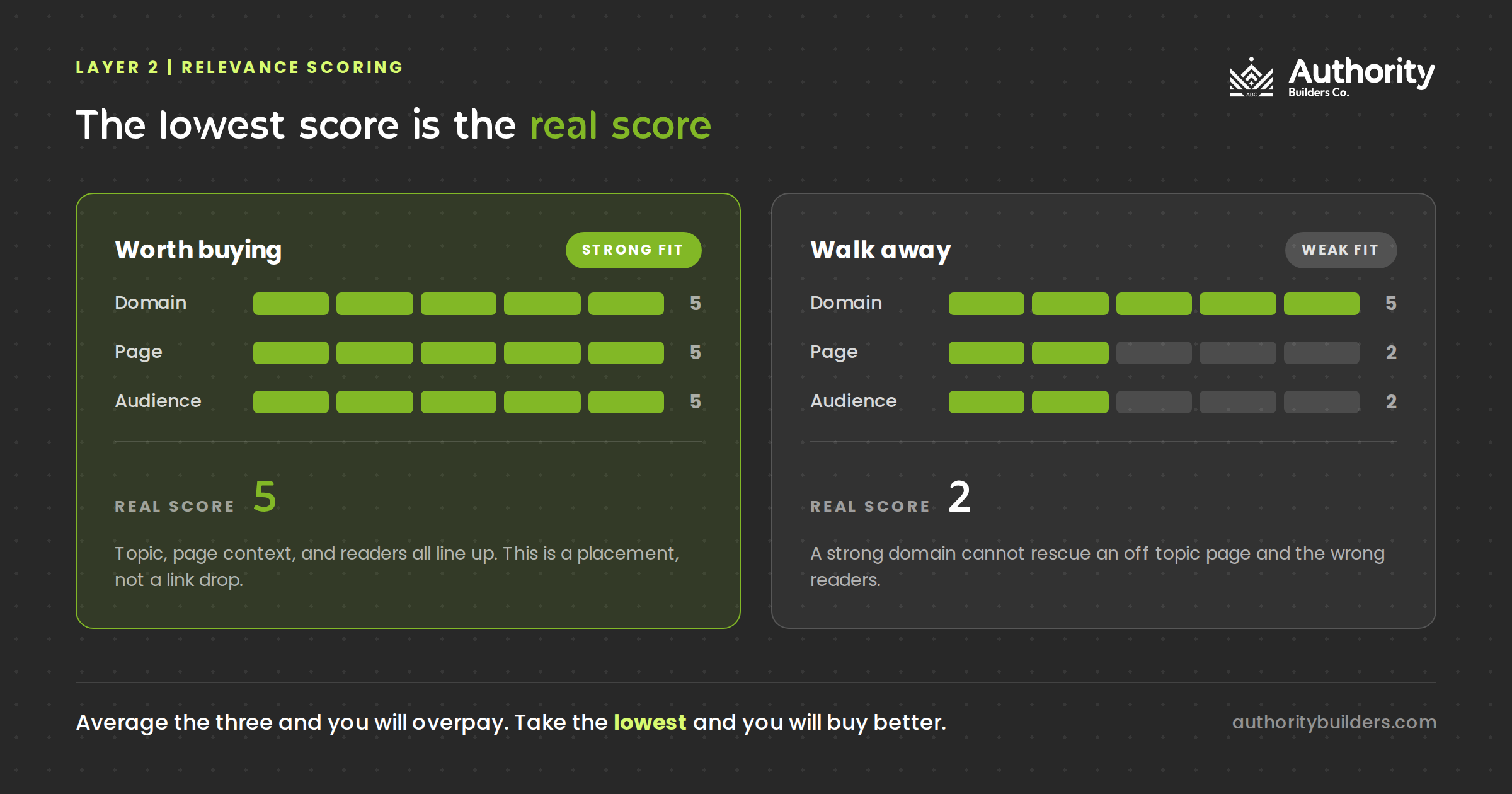
Rate each candidate from 1 to 5 on all three levels. Then ignore the average and look only at the lowest score.
The floor is what matters. A placement scoring domain 5, page 5, audience 1 is a bad placement, and averaging it to 3.7 hides that. A weakness at any single level makes the strength at the other two much harder to convert into anything real.
We’d take a DR 40 site scoring 5, 5, 5 over a DR 80 site scoring 5, 2, 2. Every time, and it isn’t close.
If you want a systematic way to build the candidate list before you score it, our walkthrough on running a link gap analysis covers how to pull the domains already linking to your competitors.
The anchor text question
Anchor text is where a good placement gets ruined at the last step.
Google’s spam policy names links with optimized anchor text in guest posts as an example of link spam, which means treating every placement as a chance to drop an exact-match commercial anchor is the fastest available way to make a clean placement look manipulative.
Across a real profile, most anchors should be branded, naked URLs, or natural phrases that read like something a writer would type. Exact-match commercial anchors belong in the minority, and they should point at pages where the anchor describes what’s on the page it lands on. If the anchor promises something the destination doesn’t deliver, you’ve created a mismatch that hurts on both the ranking side and the conversion side.
Layer Three: Placement QA
The article goes live. Most people mark the task complete and move on. This is where value quietly leaks out of a campaign.
Run every live placement through this list:
- The link is present and it’s the exact URL you specified. Dropped parameters and quiet typos are more common than you’d expect.
- The link is dofollow, or you know that it isn’t. Some publishers add nofollow at publish time without mentioning it. That changes what you bought.
- The anchor text matches what was agreed. Editors edit, and anchor text is an easy thing for them to rewrite.
- The article is indexed. Check two weeks after publication, not the same day.
- The article is reachable from the site’s own navigation. A piece that exists only at a URL nothing internally links to is an orphan page, and orphan pages get crawled less and trusted less.
- The page isn’t labeled as sponsored or partner content, unless that was the arrangement. If it is and you didn’t agree to it, you paid a dofollow price for a nofollow link.
- The content wasn’t gutted. Some publishers cut an accepted article by half before it runs.
- No unexpected outbound links were added to your article, pointing at the provider’s other clients.
- The publication date is visible and the byline is intact.
- Screenshot everything. Placements get edited or pulled months later, and reporting to a client is far easier with a record than with a memory.
Re-check placements at 90 days and again at a year. Links come down, sites get sold, and articles get pruned in content audits. Our own placements carry a replacement guarantee if a link is removed within a year, which is only workable because the placements get monitored.
Questions to Ask Any Provider Before You Buy
If you’re evaluating guest posting services rather than doing this yourself, these questions separate operators quickly. The answers matter less than whether the provider can answer at all.
- Can I see the site before I pay? Some providers mask domains to protect an inventory list, which is reasonable. Most will share URLs with established customers on request. A provider who will never show you a domain is asking for a lot of trust.
- How is traffic verified? The answer should name a tool and a threshold, not a range.
- Do you sell PBN links? Ask directly and get it in writing.
- Will the post be marked as sponsored? You want to know before, not after.
- Who writes the article, and can I review it before it runs? Content you’d be embarrassed by is still content with your name on it.
- What happens if the link comes down? A replacement or refund window is a reasonable expectation.
- How do you handle anchor distribution across a campaign? If the answer is “you tell us the anchor,” nobody is managing your ratios but you.
What Changes When AI Search Is in the Picture
Here’s where the vetting standard matters more than it used to.
AI search features are grounded in the same index and the same ranking systems as traditional search. Google’s guide to optimizing for generative AI features is explicit that these features rely on core Search ranking systems to retrieve relevant pages, and that a page must be indexed and eligible to appear with a snippet to be eligible at all. The placements that earn citations in AI answers are, mechanically, placements on sites those systems already treat as reliable.
The same guidance is equally direct in the other direction. It lists seeking inauthentic mentions across the web as a tactic that is less useful than it appears, noting that core ranking systems focus on high-quality content while separate systems block spam, and that generative AI features depend on both.
The translation is simple. A link on a site nothing trusts doesn’t become valuable because AI search arrived. If anything, the gap between real editorial placements and bulk inventory got wider.
What we saw in our own data
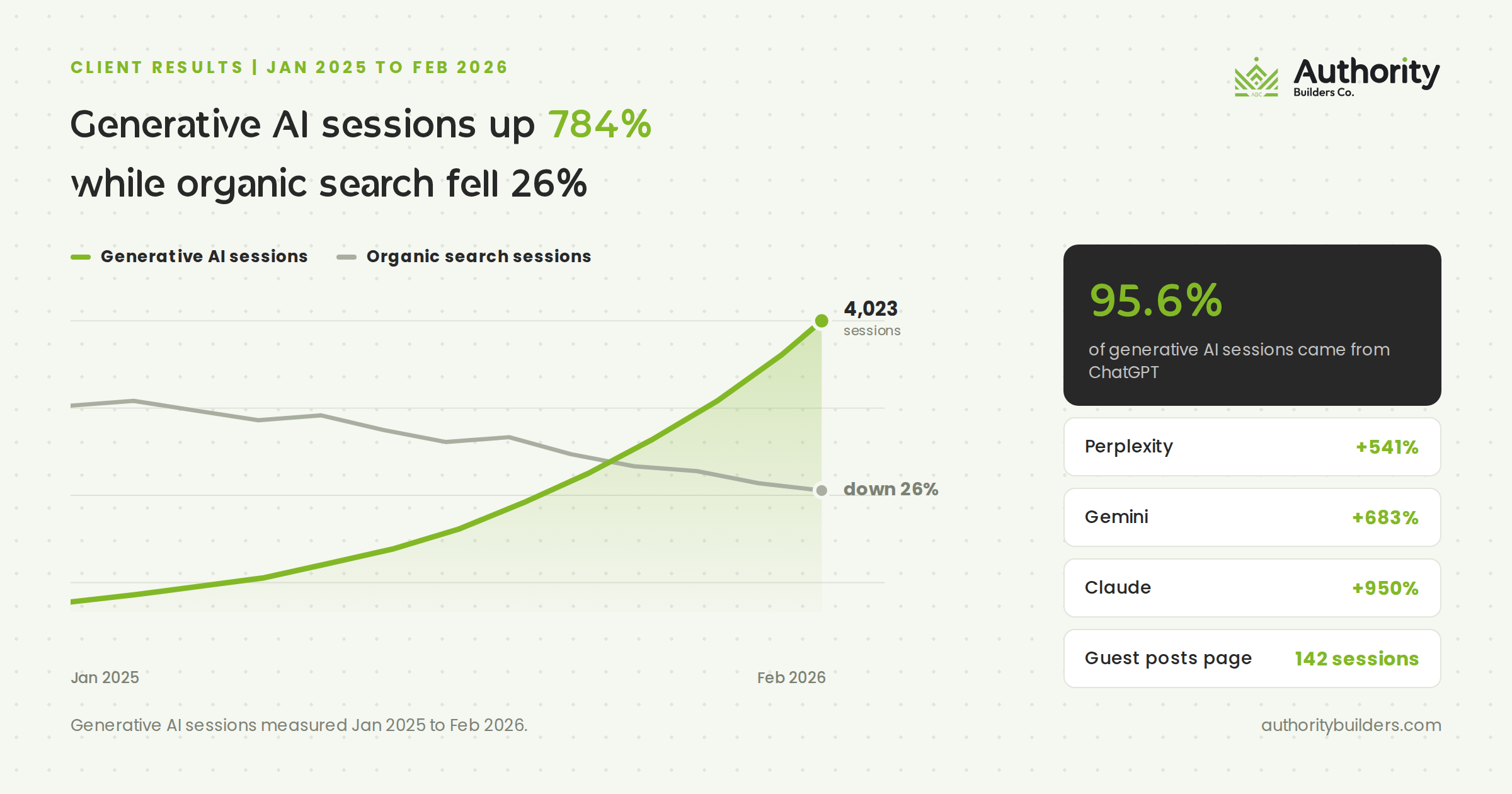
We tracked this on our own site rather than theorizing about it. Between January 2025 and February 2026, we measured generative AI referrals to authority.builders alongside traditional organic traffic.
Generative AI sessions grew 784% to 4,023 sessions across that window, while our organic search traffic declined 26% over the same period. ChatGPT accounted for 95.6% of the AI traffic, though every platform grew: Perplexity up 541%, Gemini up 683%, Claude up 950%.
The part relevant to this guide is where that traffic landed. AI referrals didn’t scatter across random blog posts. Our guest posts service page took 142 generative AI sessions and our guest posting sites article took 99, with the homepage taking the largest share by a wide margin. When we looked at company-level visitor data, 79.5% of identified companies landed on link building, homepage, and guest post pages.
We did nothing AI-specific to produce that. No prompt optimization, no special markup, no llms.txt. We built links to our own site using the standards described above, published consistently, ran quarterly technical crawls, and invested in expert-attributable content. AI systems learned to recommend the brand because the signals underneath were real.
That’s the practical case for careful vetting. The placements that hold up under AI citation are the same placements that would have held up under a manual review five years ago. You can read the full breakdown in our case studies.
How We Handle This
We built our vetting process because we were buying links ourselves and kept getting burned by inventory dressed up as publications.
Our Guest Posts service runs every site through more than forty qualifying criteria before it enters the network, with organic traffic verified in Ahrefs rather than claimed by the site owner. We don’t sell PBN links, we don’t sell homepage links, and no placement is published as sponsored content. Pricing starts around $160 per placement depending on the site’s authority, traffic, and niche, and most orders complete within 7 to 10 days.
If you’d rather not manage vetting, anchor ratios, and QA in-house, ABC Plus is our managed service. We handle prospect qualification, placement mix, and anchor distribution across the whole campaign, and reporting records live dates and anchor ratios automatically so you’re not maintaining a spreadsheet.
When the better move is a placement inside existing content rather than a new article, our link insertions service is usually faster and works well wherever the contextual match is strong. And if AI search visibility is the specific goal, AI Plus is built around it.
The Short Version
Guest posting services get priced like a commodity and they aren’t one. The difference between two placements at the same DR and the same price sits entirely in the judgment applied before, during, and after publication.
Vet the site on traffic that survives inspection, outbound link patterns, editorial evidence, and ownership footprint. Score relevance at the domain, page, and audience level, and treat the lowest of the three as the real score. QA every placement once it’s live, then check it again at 90 days and at a year.
And run the test that cuts through all of it: would you want this placement if the link were nofollowed? If yes, buy it. If no, you’re not buying a placement, you’re renting a signal, and the lease is shorter than you think.
If you’d like us to run that process for you, schedule a call and we’ll walk through your current backlink profile and where the gaps are.