
Anchor text is the smallest part of a backlink, and it’s the part people overthink the most. Some SEOs are still chasing a magic exact-match percentage. Others are so worried about a penalty that every link they build says “click here.” Both camps are leaving value on the table.
Here’s the thing: anchor text optimization isn’t about hitting a number. It’s about making every link describe the page it points to, in the words a reader would use, without leaving a pattern that looks engineered.
That engineered pattern is something Google’s spam policies call out by name. The descriptive part is what search engines, and the retrieval models behind AI answers, can learn from. Get the balance right and every link does two jobs at once.
In this guide, we’ll break down the anchor types that make up a healthy profile, the anchor text ratio benchmarks we use as a starting point (and why Google won’t give you one), where over-optimization risk sits after four spam updates in 2026, and what research tells us about how retrieval systems read anchors and the sentences around them.
What Anchor Text Optimization Means Now
Anchor text is the visible, clickable text of a link. Google’s link best practices documentation describes it as text that tells both people and Google something about the page you’re linking to.
Google’s standard for good anchor text is short: it should be descriptive, reasonably concise, and relevant to both the page it sits on and the page it points to. The same documentation adds a detail most people skip. The words before and after the link matter too, so Google tells you to pay attention to the sentence as a whole.
Notice what’s missing from that standard. Nothing in it says “include your target keyword.” Google goes the other direction and warns against cramming related keywords into anchors, tying that habit directly to its keyword stuffing policy. Their own test is useful: ask whether the reader needs those keywords to understand the next page.
So when we talk about anchor text optimization, we mean three things:
- Descriptive accuracy. The anchor tells you what’s on the other side of the click.
- Natural variety. Your profile looks like many different people described your page in their own words.
- Context quality. The sentence around the link reinforces what the anchor says.
Keyword matching is a side effect of doing those three well, not the goal.
The Anchor Text Types You’re Balancing
Every anchor in your profile lands in one of a handful of buckets. You need to know them before any ratio conversation makes sense.
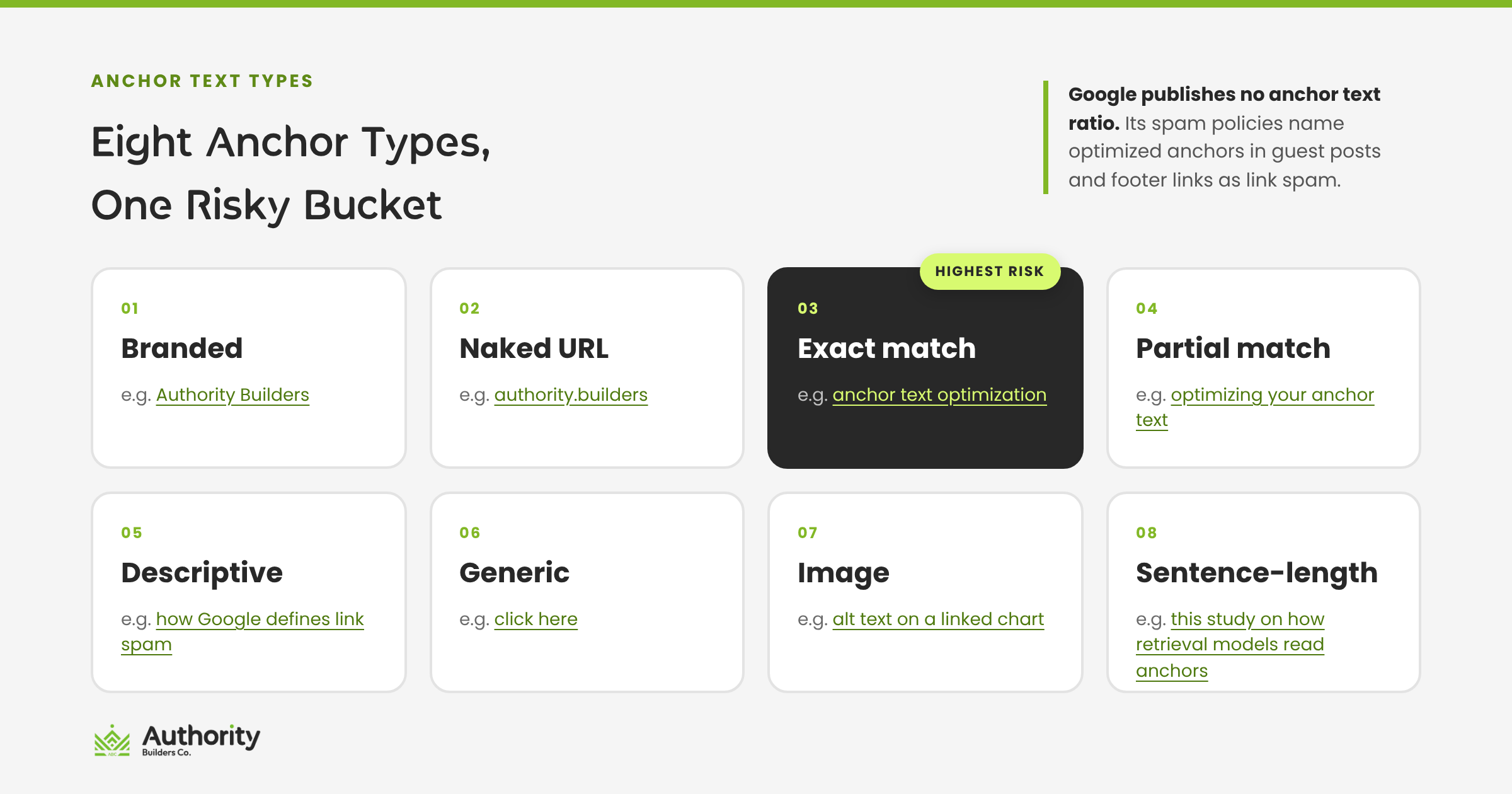
- Branded: your company or product name. “Authority Builders,” “ABC Plus.”
- Naked URL: the address itself, like “authority.builders” or the full https version.
- Exact match: the anchor is your target keyword, word for word. For this page, that would be “anchor text optimization.”
- Partial match: the target keyword plus other words. “Our guide to anchor text optimization.”
- Topical or descriptive: describes the page without using the exact phrase. “How to balance the wording of your backlinks.”
- Generic: “click here,” “read more,” “this website.” Google lists these as bad examples because they say nothing about the destination.
- Image anchors: when an image is the link, Google uses the image’s alt attribute as the anchor text, so empty alt text means an empty anchor.
- Sentence-length anchors: half a sentence or more is linked. Google flags anchors that run weirdly long as a problem, too.
Here’s what matters most: exact match is the only bucket with real downside risk at scale. Generic and overlong anchors waste a link. Exact match, repeated across many sites, creates the pattern spam systems look for.
Anchor Text Ratio Benchmarks (and Why Google Won’t Give You One)
Let’s get this out of the way. Google doesn’t publish an anchor text ratio, and it never has. Its link documentation takes the same stance on internal link counts: there’s no magical ideal number, and if it feels like too much, it probably is.
That means every anchor text ratio you’ve seen online, including ours, is a practitioner benchmark. It’s useful as a starting point. It isn’t a rule Google enforces.
Benchmark against the pages that already rank
The most reliable benchmark is the one your own search results hand you. Pull the backlink anchors for the top three to five pages ranking for your target query, bucket them into the types above, and see what “normal” looks like in your niche.
Two rules make that comparison honest:
- Count referring domains, not total links. One site with a sitewide footer link can produce thousands of identical anchors. Counting by domain stops a single template from skewing the whole picture.
- Compare like with like. A service page and a how-to guide earn different anchors. Guides naturally attract descriptive anchors because people link to them while explaining something. Service pages lean branded.
Our starting framework for a commercial page
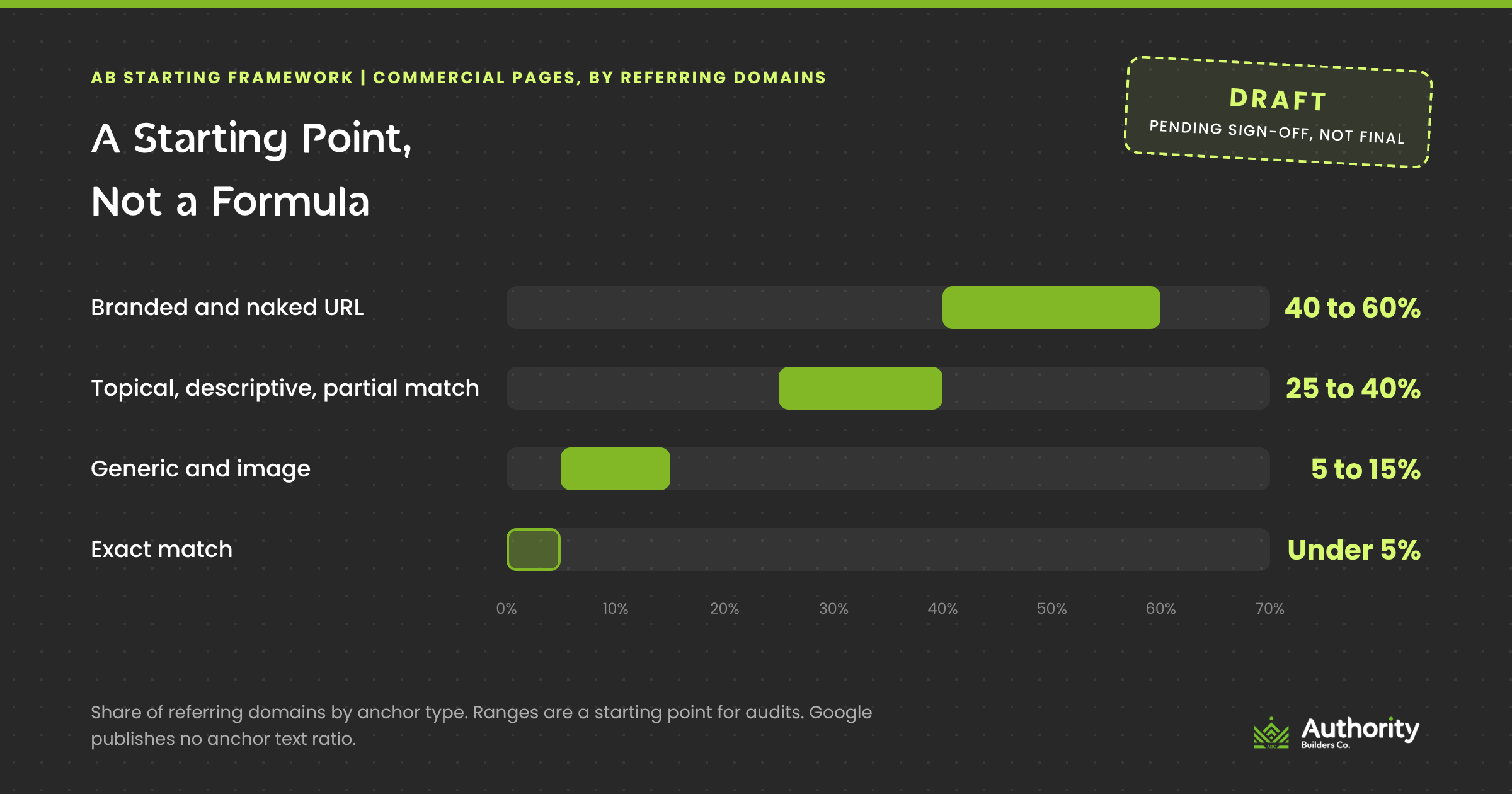
When we don’t have clean competitor data yet, this is the distribution we start from for a service or product page, measured by referring domains:
| Anchor type | Share of referring domains |
| Branded and naked URL | 40 to 60% |
| Topical, descriptive, and partial match | 25 to 40% |
| Generic and image | 5 to 15% |
| Exact match | Under 5% |
Informational posts can safely carry a larger share of descriptive and partial match anchors, because that’s how people naturally cite guides. Exact match stays thin either way.
The number to watch isn’t any single bucket. It’s concentration: the same commercial phrase showing up across dozens of unrelated domains. If a reader skimmed your anchor report and guessed which keyword you’re trying to rank for in five seconds, a spam system can too.
Over-Optimization Risk After the 2026 Spam Updates
The risk is spelled out in writing. Google’s spam policies for web search define link spam as creating links primarily to manipulate rankings, and the examples are specific about anchors.
Among the listed link spam patterns:
- Links with optimized anchor text in articles, guest posts, or press releases distributed on other sites
- Keyword-rich or low-quality links embedded in widgets distributed across many sites
- Widely distributed links in the footers or templates of various sites
- Forum comments with optimized links in the post or signature
Google’s own illustration is a short paragraph about weddings where nearly every phrase (“wedding rings,” “best ring,” “buy flowers”) is a separate keyword-rich link. That’s the extreme version. The quieter version is a profile where every guest post you’ve ever bought uses the same money phrase.
Four spam updates this year, and none came with a target list
The Google Search Status Dashboard ranking history lists four spam updates in 2026:
- March 2026: started March 24 and finished in under a day
- June 2026: started June 24 and ran about two days
- August 2026: started August 18 and ran under three days
- September 2026: started September 24 and ran almost 14 days
Google didn’t announce a specific target for any of them. So if your rankings dropped during one of those windows, don’t assume anchor text was the cause. Audit it, but rule out content and technical issues too.
The real cost is the link you paid for
Here’s the part that should change how you buy links. Google’s documentation on spam updates explains that when its systems remove the effect of spammy links, any ranking benefit those links generated is lost, and it can’t be regained by making changes afterward.
That’s the quiet risk. It isn’t always a dramatic penalty. Sometimes it’s a line item in your budget that turns into nothing. The spam policies also note that violating sites can rank lower or drop out of results, and that human review can lead to a manual action, so the louder outcome is still on the table.
The patterns that raise the risk tend to look like this:
- The same exact-match anchor repeated across many referring domains
- Commercial anchors that show up only on placements you arranged, while your naturally earned links are branded
- Anchors that don’t match the destination page (a “best CRM software” anchor pointing at your homepage)
- A sudden burst of new keyword-rich anchors in a short window
What AI Retrieval Reads in an Anchor
This is where anchor text gets more interesting than the old ratio debate. If you need a primer on how embeddings work, we covered the mechanics in our guide to semantic SEO and how embeddings decide what AI cites, so we won’t repeat it here.
The short version: retrieval systems match questions to passages by meaning, not exact strings. Anchor text turns out to be a useful signal for that kind of matching, and there’s peer-reviewed research showing why.
Anchors look a lot like search queries
Researchers from Carnegie Mellon and Microsoft published Unsupervised Dense Retrieval Training with Web Anchors at SIGIR 2023. Their starting observation is simple. Anchor text usually describes what the linked page contains, which is the same job a search query does when it describes what a user wants to find.
They trained a dense retrieval model, Anchor-DR, to match anchor text to the document it linked to. It beat the other unsupervised dense retrievers they tested on standard benchmarks, and the gains were biggest on search and question-answering tasks. Their analysis concluded that anchor-to-document pairs follow a pattern similar to query-to-document pairs.
Generic and template anchors got thrown out
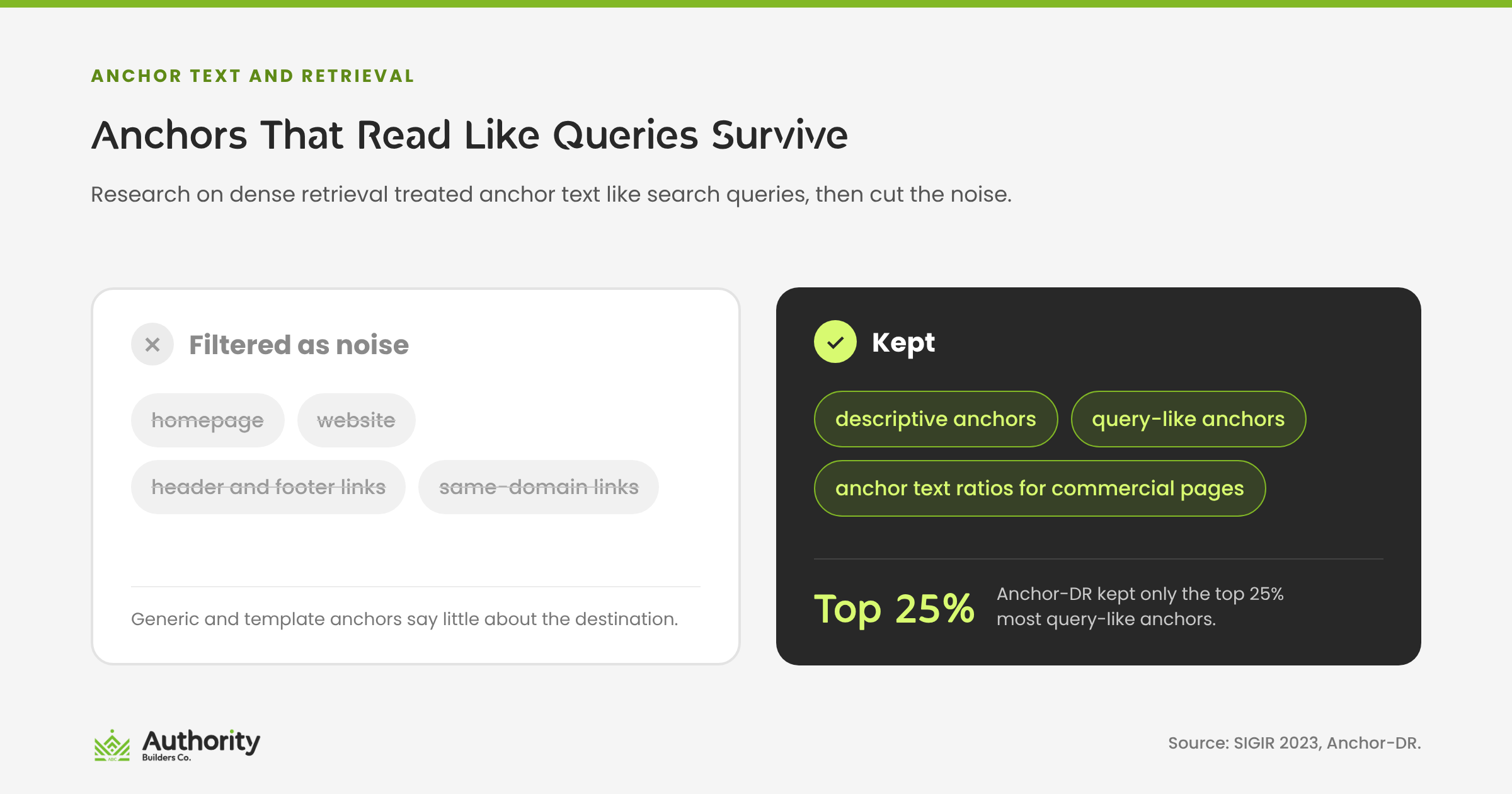
The most useful detail for link builders is what the researchers filtered out. Before training, they removed:
- Functional anchors like “homepage” and “website”
- Links in headers and footers
- Links between pages on the same domain
Then they ran a classifier and kept only the top quarter of the remaining anchors, the ones that looked most like real search queries. Everything else was treated as noise.
What we take from that (and what we don’t)
Let’s be careful here. This is one research model. It doesn’t prove what ChatGPT, Perplexity, or Google’s AI features use internally, and no AI platform has published that.
But it lines up with what Google already tells you. Generic anchors are a weak signal. Footer and template links are a spam pattern. Descriptive anchors and the sentence around them are what carry meaning. Our read on the practical takeaway:
- Write anchors that read like the question your page answers. “How to audit your anchor text distribution” carries more descriptive information than “this guide.”
- Treat the whole sentence as part of the anchor. Google says surrounding words matter, and retrieval systems embed passages, not isolated links. A link sentence that makes sense quoted on its own is a better signal than one that leans on the paragraph before it.
- Don’t expect generic or sitewide links to carry topical weight, even if they pass some authority.
That’s also why exact match is less necessary than it used to be. Systems that match by meaning can connect “how to balance your backlink wording” to a query about anchor text ratios. You don’t need the literal phrase on every link to be understood.
What happened on our own site
We ran this playbook on authority.builders. Between January 2025 and February 2026, our generative AI traffic grew 784%. The work behind it included link insertions and guest posts to our own service pages and guides, placed contextually on relevant sites with real organic traffic, alongside content and technical work.
The AI referrals didn’t scatter. They landed on our homepage, our guest posts page, and our core link building guides. We can’t isolate anchor text as the cause, because it was one piece of a larger program. But a profile built from varied, descriptive, contextual anchors is the one we’d build again.
|
How to Optimize Anchor Text, Step by Step
Let’s break it down into the workflow we use.
- Audit by referring domain. Export your anchors from your backlink tool, group them by referring domain, and bucket each one by type. Flag any single commercial phrase that appears across many unrelated domains.
- Map anchors to page intent. Each target page gets one primary topic and a family of descriptive variants. Write five to ten ways a real person would describe that page before you place a single link.
- Write the sentence first, then link it. The link should land on the words that describe the destination. If the sentence only works because of the link, rewrite it.
- Keep exact match thin and earned. Save it for the most editorial, most relevant placements, and never repeat the same exact phrase across a batch of placements built at the same time.
- Match anchor type to placement type. Google names optimized anchors in guest posts and distributed articles specifically. On arranged placements, lean branded and descriptive.
- Watch repetition and pacing. A steady build with varied anchors looks like a site earning attention. Twenty identical anchors in a month looks like a campaign.
- Apply the same standard internally. Google encourages descriptive anchor text on internal links and warns against chaining several links side by side. We went deeper on structure in our guide to internal linking architecture for crawl efficiency.
- Re-audit on a schedule. Check your distribution quarterly and after any confirmed spam update, so you see drift before it becomes a pattern.
One more thing on vetting. Anchor text can’t rescue a bad placement. If the linking site is off-topic or low quality, the most natural anchor in the world won’t help. Our framework for vetting guest post sites and scoring relevance covers that side of the equation.
How We Handle Anchors on Link Insertions and Guest Posts
Anchor control is a big part of why people buy links instead of waiting for them. It’s also where most over-optimization starts. Here’s how we handle it.
With our link insertion outreach service, you choose your target URLs and anchors, and every plan includes anchor text analysis and link velocity analysis. If a webmaster can’t use the anchor you asked for, we tell you and get your confirmation before the link goes live, so nothing lands in your profile that you didn’t approve.
Our guest post placements on real, niche-relevant blogs work the same way: you can pick the anchor yourself or let our team handle it, and our system records your anchor text ratios as placements go live, so you can see your distribution as it builds.
If you’d rather not manage any of this yourself, ABC Plus, our managed link building service, plans anchors, placements, and pacing as one campaign. And if AI visibility is the priority, AI Plus, our managed AI search authority service, builds the contextual mentions and links retrieval systems learn from.
FAQ
What is a good anchor text ratio?
There’s no official one. Google doesn’t publish a ratio. As a starting point for a commercial page, we aim for a profile dominated by branded and naked URL anchors, a solid share of descriptive and partial match anchors, a small amount of generic anchors, and exact match kept under 5% of referring domains. The best benchmark is the anchor distribution of the pages already ranking for your query.
Can exact match anchor text get you penalized?
Exact match anchors aren’t banned. The risk comes from patterns. Google’s spam policies list optimized anchor text in guest posts, articles, and press releases on other sites as link spam. Repeating the same exact phrase across many domains is what creates that pattern.
Does anchor text matter for AI search?
Research suggests it can. A SIGIR 2023 study found anchor text behaves much like a search query and used it to train a retrieval model that performed well on search and question-answering tasks. No AI platform has confirmed how it uses anchors, so treat descriptive anchors and strong surrounding sentences as the safe bet.
Should internal links use exact match anchors?
Google encourages descriptive anchor text on internal links because it helps people and Google understand your site. The spam policy examples focus on links placed on other sites. Even so, write internal anchors for readers and vary them naturally rather than repeating one keyword sitewide.
How do I check my anchor text distribution?
Export your anchors from a backlink tool, group them by referring domain, and sort each into branded, naked URL, exact match, partial match, descriptive, generic, and image. Then compare your shares against the top-ranking pages for your target query.
What should I do if my anchors look over-optimized?
Stop adding new exact match anchors first. Then shift future placements toward branded and descriptive anchors to rebalance your distribution over time. Where you control a placement, you can ask the site owner to update the anchor. Google notes that the ranking benefit from links its systems neutralize is lost, so focus on building a cleaner profile going forward.
The Bottom Line
Anchor text optimization comes down to one habit: describe the destination accurately, in varied words, inside a sentence that makes sense on its own. That’s what Google’s documentation asks for. It’s what keeps you clear of the link spam patterns Google lists. And it’s what research suggests retrieval systems can learn from.
Skip the magic percentage. Benchmark against what ranks, keep exact match thin, and let context do the work.
Want a second set of eyes on your anchor profile? Book a call with our team and we’ll walk through your distribution with you.