
Proper backlink management is paramount in 2025.
Even if you’ve completely adjusted your link-building strategy to appeal to LLMs alongside search algorithms, you still need to know how to manage your backlinks.
Neglect the links you’ve built, and you’ll inevitably wind up with:
- Broken links
- Links you should disavow
- Too many anchors of the same type
- Unindexed backlinks
All of these problems can wreck your SEO strategy, so it’s worth safeguarding the links you work so hard to build.
However, since AI has radically altered the search landscape, there are some backlink management tasks that you don’t have to worry about anymore.
In this guide, we’ll show you which backlink management tasks are worth keeping and which you should let fall by the wayside.
Here’s what we’ll explore:
- Why backlink management still matters in 2025
- Which tasks to prioritize
- Backlink management tactics that aren’t worth it anymore
Why Backlink Management Still Matters in 2025
Building links is only one aspect of link-building. If you aren’t actively managing your backlink profile, you could be sabotaging your results without even knowing it.
Periodically, you need to audit aspects of your profile to ensure everything is running smoothly, like your anchor text.
Too many exact-match keywords scream spam to search algorithms and LLMs, so you need a diverse anchor text ratio.
Also, Ahrefs found that branded anchors are a major visibility signal for LLMs, so you should try to use your brand name as anchor text more often (without overdoing it, of course).
Overall, the main reasons you should engage in regular backlink management practices are:
- Risk prevention – Auditing your backlink profile will help you catch potential risks, like toxic backlinks and inactive links, before they become a problem.
- Quality control – There are some sites that you probably don’t want to associate with, either because of irrelevance or a bad reputation. Regularly auditing your backlink profile is the best way to maintain its quality.
- Long-term strategy alignment – With LLM-powered search on the rise, relevance and quality matter more than DR scores and link volume. Properly managing your links will align your backlink profile with your long-term link-building strategy.
Key Tasks in Backlink Management That Still Work in 2025
Next, let’s look at the backlink management tasks that you should continue to practice well into the foreseeable future.
Indexing checks
Just because a site owner agreed to add one of your backlinks doesn’t mean that it will actually get discovered by Google. Crawling and indexing errors occur all the time, and there are things that can go wrong, like a typo in the backlink URL.
There’s nothing worse than doing the hard work required to score an exceptional backlink only for it to not get indexed, rendering it invisible and useless. The best ways to ensure this doesn’t happen is to:
- Periodically audit your backlink profile and cross-check it with a list of all the backlinks you’ve built.
- Set up automated alerts (like Ahrefs Alerts) to notify you whenever you gain or lose a backlink. Granted, these notifications will not tell you when and if the backlink is indexed by Google. To find that out, keep an eye on the Links Report in your Google Search Console. If you don’t see a newly acquired backlink appear on the report within a few weeks, you may need to fix an indexing error.
Disavow decisions
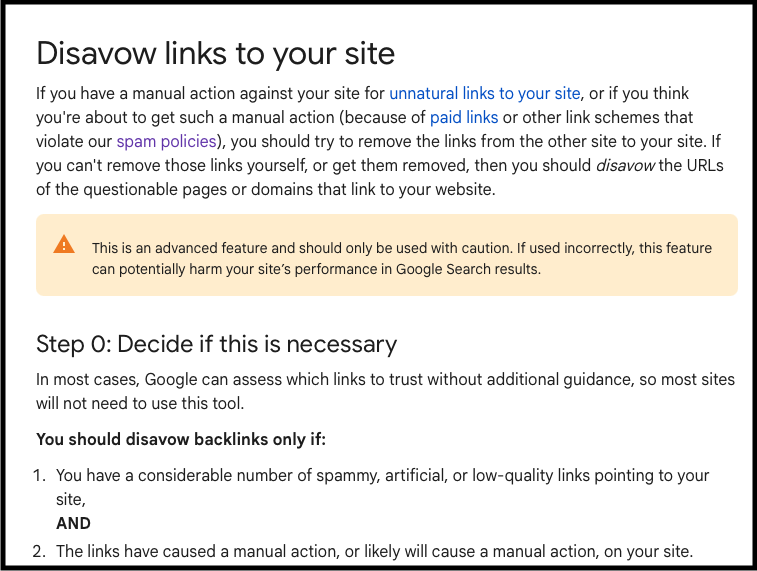
While there are very few instances when you should disavow backlinks, it can still happen, so you should know what to do in case of an emergency.
First, you should know the difference between toxic backlinks and spammy backlinks.
- Spammy backlinks come from low-quality, irrelevant, or automated websites. They typically originate from comment spam, scraped content, and unrelated directories. LLMs and algorithms know that it’s normal for websites to accrue these types of links without even trying. Because of this, most spammy backlinks are devalued and ignored, so you do not need to disavow them.
- Toxic backlinks directly violate Google’s guidelines, so they’re high-risk for receiving penalties. Paid backlinks, malware links, and link schemes (link farms and PBNs) are all examples of toxic backlinks. These are the only types of backlinks you should disavow.
Even then, you should double and triple-check that the backlink is actually toxic. That’s because using Google’s Disavow Tool can backfire if you aren’t careful (by disavowing links that were actually helping your SEO instead of hindering it).
Basically, there are only two situations where it makes sense to disavow backlinks:
- You know for a fact that there are many toxic backlinks pointing at your site (and you know precisely which ones they are).
- You’ve already received a manual action from Google and cannot recover your SEO until you disavow the links that got you in trouble.
Beyond these two instances, using the Disavow Tool can cause more harm than good. Remember, LLMs and modern search algorithms are very good at devaluing spammy backlinks, so you shouldn’t lose any sleep over them.
Anchor diversity audits
Both LLMs and search algorithms can pick up on anchor text spam, so you shouldn’t use too many exact-match keywords or branded anchors.
Instead, aim for a diverse array of partial-match, natural, and even naked anchors (bare URLs) thrown in with your branded and exact-match anchors.
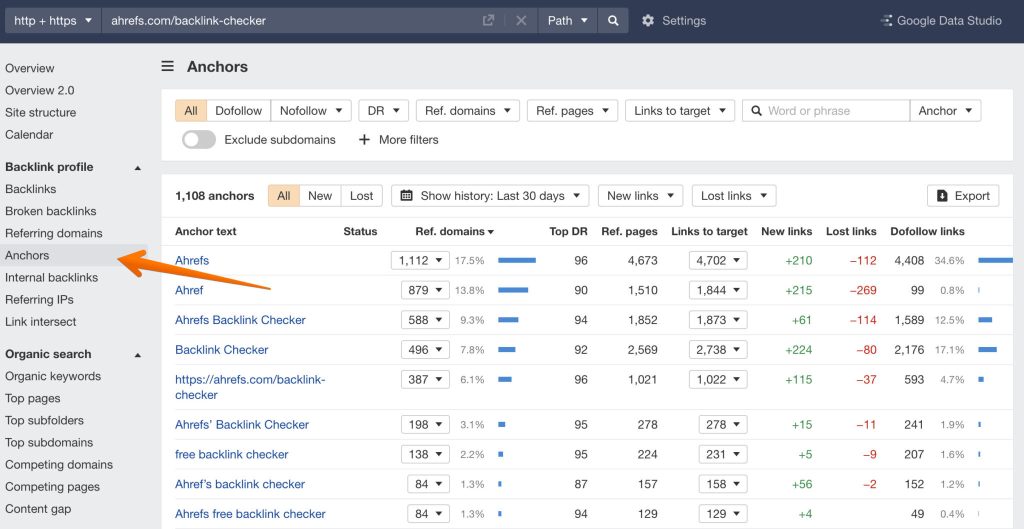
Whenever you’re auditing your backlink profile, you should take a close look at your anchor text ratio.
This is where it’s helpful to have a paid subscription to a tool like Ahrefs or Semrush. They have detailed reports that list all your anchors in one spot, which makes auditing them especially easy:
Ensuring relevance and monitoring sources
LLMs value relevancy, source quality, and helpfulness over raw domain authority scores. Because of this, you need to audit your backlink profile for contextual relevance. This begins by altering your link-building strategy to focus on earning backlinks from:
- Topically aligned websites
- Niche blogs with topical authority
- Relevant news sites and media outlets
- Respected industry roundups and comparison guides
When it comes to backlink management, you should ensure that your most authoritative backlinks are relevant and come from trusted sources.
As an example, you would want to keep a backlink on an industry news site over a random backlink on an unrelated blog, even if the blog has a DR score in the 90s. Beyond that, check which links are actually generating referral traffic. LLMs view site traffic and human interaction as usefulness signals, so backlinks that bring in traffic are especially valuable.
Backlink Management Tactics You Should Ignore
Next, let’s examine the backlink management strategies that don’t work anymore. While these tactics were once effective, their usefulness has all but vanished:
- Focusing on DA/DR scores – DA and DR scores don’t matter to the LLMs that power Google’s AI Overviews and tools like ChatGPT. Even Google’s search algorithm has become more advanced at understanding context and relevancy, so you shouldn’t focus on sites that have high DA/DR scores. Instead, focus on building relevant, contextual backlinks that generate traffic and provide helpful resources to users.
- Disavowing one-off ‘toxic’ links – Remember, you should only touch the Disavow Tool if you have numerous toxic backlinks that display a clear pattern of manipulation. Isolated toxic backlinks are actually nothing to worry about, so you shouldn’t take action if you only have one or two ‘harmful’ backlinks.
- Using third-party tools to flag ‘toxic’ links – In our direct experience, most third-party tools have an exaggerated or untruthful understanding of what constitutes a ‘toxic’ backlink. As a result, they often flag backlinks that either aren’t toxic (and may actually be helping your SEO) or are simply spammy and will get ignored anyway.
Final Thoughts: Backlink Management in 2025
Managing your backlink profile remains a necessity in 2025, but there are certain legacy SEO tactics that you should abandon.
As long as you focus on ensuring relevance, anchor text diversity, and proper indexing, you’ll wind up with a strong backlink profile. If you remain stuck in the past and focus on DA/DR scores and disavowing spammy backlinks, you probably won’t see great results, to say the least.
Do you want to clean up your backlink profile without losing momentum?
Check out our Link Audit service and ABC Plus, our fully managed link-building solution.