
Entity SEO and Knowledge Graph Optimization: How to Become a Brand Google and AI Search Recognize
Corey Batt
Type your brand name into ChatGPT and ask what it does. If the answer is vague, wrong, or describes a different company with a similar name, you’ve just found the most expensive gap in your SEO strategy. Not a keyword gap. An identity gap. The systems that decide what gets surfaced, whether that’s Google’s Knowledge Graph or the retrieval layer behind an AI answer, don’t rank strings of words. They rank things they recognize, and they can only recommend a thing they’ve been able to confirm exists.
That’s what entity SEO is about. It’s the work of turning your brand from a name that appears on some pages into a defined, disambiguated entity with a stable set of facts attached to it, corroborated by sources the machines already trust. Here’s the thing: most brands have never done this deliberately. They’ve published content, built some links, and hoped the identity would sort itself out. Sometimes it does. Often it doesn’t, and the brand ends up invisible in AI answers for reasons that have nothing to do with content quality.
In this guide we’ll break down what an entity is in practical terms, how Google’s Knowledge Graph decides you exist, why entity recognition matters even more in AI search than it did in classic search, and the exact signals we use to build a brand entity from scratch. We’ll also show what happened to our own AI referral traffic when we treated Authority Builders as an entity to be built rather than a site to be ranked.
What Entity SEO Is (and What It Isn’t)
An entity is a distinct, identifiable thing: a company, a person, a product, a place, a concept. It has attributes (a founding date, a location, a category) and relationships to other entities (a founder, a parent company, a competitor). Crucially, an entity exists independently of the words used to describe it. “Apple” the fruit and “Apple” the company share a string but they’re two entities, and a search system that can’t tell them apart is going to serve a lot of wrong answers.
Entity SEO is the practice of making sure search engines and AI systems can identify your brand as one specific entity, attach the right facts to it, and connect it to the right related entities. That’s a different job from keyword optimization, which is about matching pages to queries, and it’s a different job from topical authority, which is about proving depth on a subject. We covered how link clusters build topical authority that AI systems recognize in a separate post, and the two disciplines reinforce each other. But you can have deep topical coverage and still be an unresolved entity, and that’s the failure mode we see most often.
Knowledge graph optimization is the subset of entity SEO focused on the databases that store entity facts. Google’s Knowledge Graph is the one everybody talks about, but Wikidata, Crunchbase, LinkedIn, industry registries, and Google Business Profile all function as knowledge sources too. Your goal is a consistent, corroborated record across all of them, because that consistency is exactly what an automated system looks for before it commits to a fact.
One more distinction worth making. Entity SEO isn’t the same as semantic SEO, even though the two get lumped together. Semantic SEO is about how meaning gets encoded and retrieved. We wrote about how embeddings and retrieval decide what AI cites if you want that layer. Entity SEO sits underneath it: before a system can retrieve your content as relevant, it needs to know who you are.
How Google’s Knowledge Graph Decides You Exist
Google introduced the Knowledge Graph in 2012 with a phrase that still explains the whole idea: things, not strings. The graph is a database of facts about entities and the relationships between them, and it’s what powers knowledge panels, direct answers, and a large share of how Google interprets ambiguous queries.
Where do those facts come from? Google’s own explanation of how the Knowledge Graph works lists three inputs: public sources that compile factual information, licensed data for things like stock prices and sports scores, and information supplied directly by content owners, including businesses that have claimed their knowledge panel. The same page makes a point that matters for every brand reading this: knowledge panels are generated automatically when there’s enough information available on the open web. Not when you ask for one. When the evidence is sufficient.
So the practical question is what counts as sufficient evidence, and the answer is corroboration. Google needs to see the same core facts about your brand (name, category, location, founding, key people, official website) repeated across sources it already trusts, with no contradictions. A single About page saying you’re a link building agency founded in 2016 is a claim. That claim showing up on your site, your LinkedIn company page, Crunchbase, a Wikidata item, two press features, and a Google Business Profile is a fact the graph can commit to.
You can help the process along on your own site. Google’s Organization structured data documentation says the markup helps Google understand your organization’s administrative details and disambiguate it from other organizations. Some properties, like iso6523Code and naics, exist purely for disambiguation behind the scenes. Others, like logo, influence what shows in your knowledge panel. There are no required properties, and Google recommends putting the markup on your home page or a single About page rather than on every URL.
Two properties in that doc do more entity work than the rest combined. sameAs is where you list the URLs of your official profiles on other sites, which is how you tell Google “this LinkedIn page and this Crunchbase page and this Wikidata item are all me.” And name plus alternateName are where you declare the exact strings your brand goes by, which Google asks you to keep consistent with your site name. That’s the disambiguation handshake: your site says who it is, and the sameAs links point to independent sources saying the same thing.
Why Entities Matter More in AI Search
Classic search was forgiving of weak entities. If your page matched the query and had enough links, you could rank without Google ever forming a clear picture of who you were. AI search doesn’t work that way, for two reasons.
First, the output is a recommendation, not a list. When someone asks ChatGPT or AI Mode for the best option in a category, the system produces names. It has to resolve “who is worth naming” before it can answer, and it can only name entities it has a stable representation of. A brand that exists in the training data as scattered, inconsistent mentions is a brand the model has low confidence about, and low confidence means it gets left out or, worse, confused with someone else.
Second, the retrieval layer is entity-aware. Google’s guide to optimizing for generative AI features describes how AI Overviews and AI Mode are grounded in the core Search index through retrieval-augmented generation, and how the model issues query fan-out, a set of related sub-queries to pull in more sources. A well-defined entity gets pulled into fan-out queries it never explicitly targeted, because the system knows what it’s related to. An undefined one doesn’t.
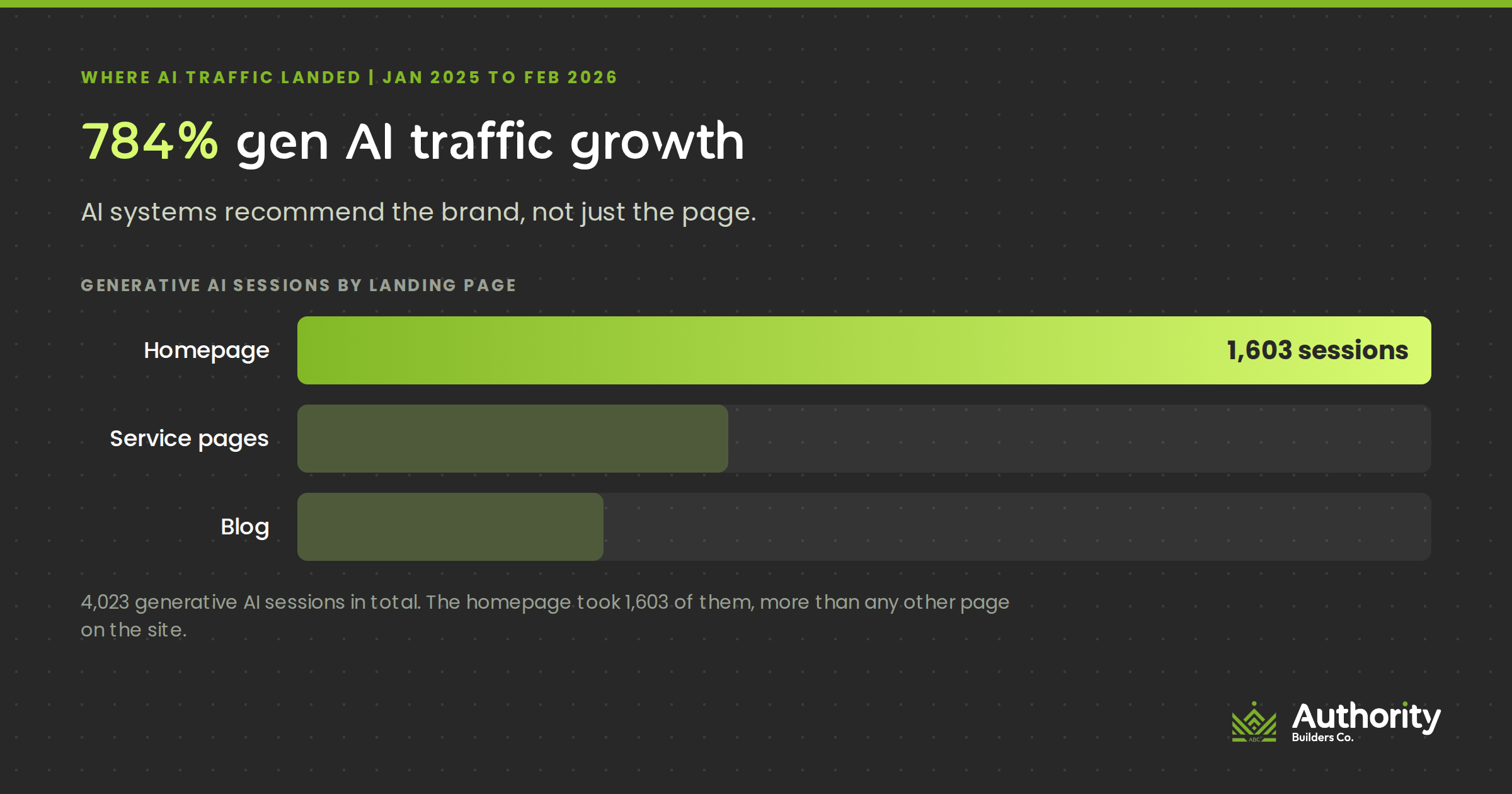
We watched this play out on our own site. Between January 2025 and February 2026, we tracked generative AI referrals to authority.builders alongside traditional organic, and the pattern was unmistakable. Generative AI traffic grew 784% over the period, to 4,023 sessions. ChatGPT alone sent 3,846 of those, up 794%, but growth was consistent across every platform we could attribute: Perplexity up 541%, Gemini up 683%, Claude up 950%. Every major AI system was independently learning to recommend the same brand.
The detail that matters for this post is where that traffic landed. It didn’t scatter across blog posts. The homepage took 1,603 generative AI sessions, more than any other URL, and the next pages down were service pages. That’s what entity recognition looks like in analytics: the AI isn’t citing a paragraph, it’s naming a company and sending people to the front door. And we got there without any special AI markup or prompt tricks, which is consistent with Google’s own guidance. The generative AI guide says plainly that structured data isn’t required for AI features and that seeking inauthentic mentions across the web doesn’t help. What worked was the boring stuff: consistent naming, real editorial placements, thought leadership attributable to named people, and a technically clean site. The full breakdown is in our case studies.
The Disambiguation Problem
Most entity failures are disambiguation failures, and they’re usually self-inflicted. Here are the ones we diagnose constantly.
Name drift
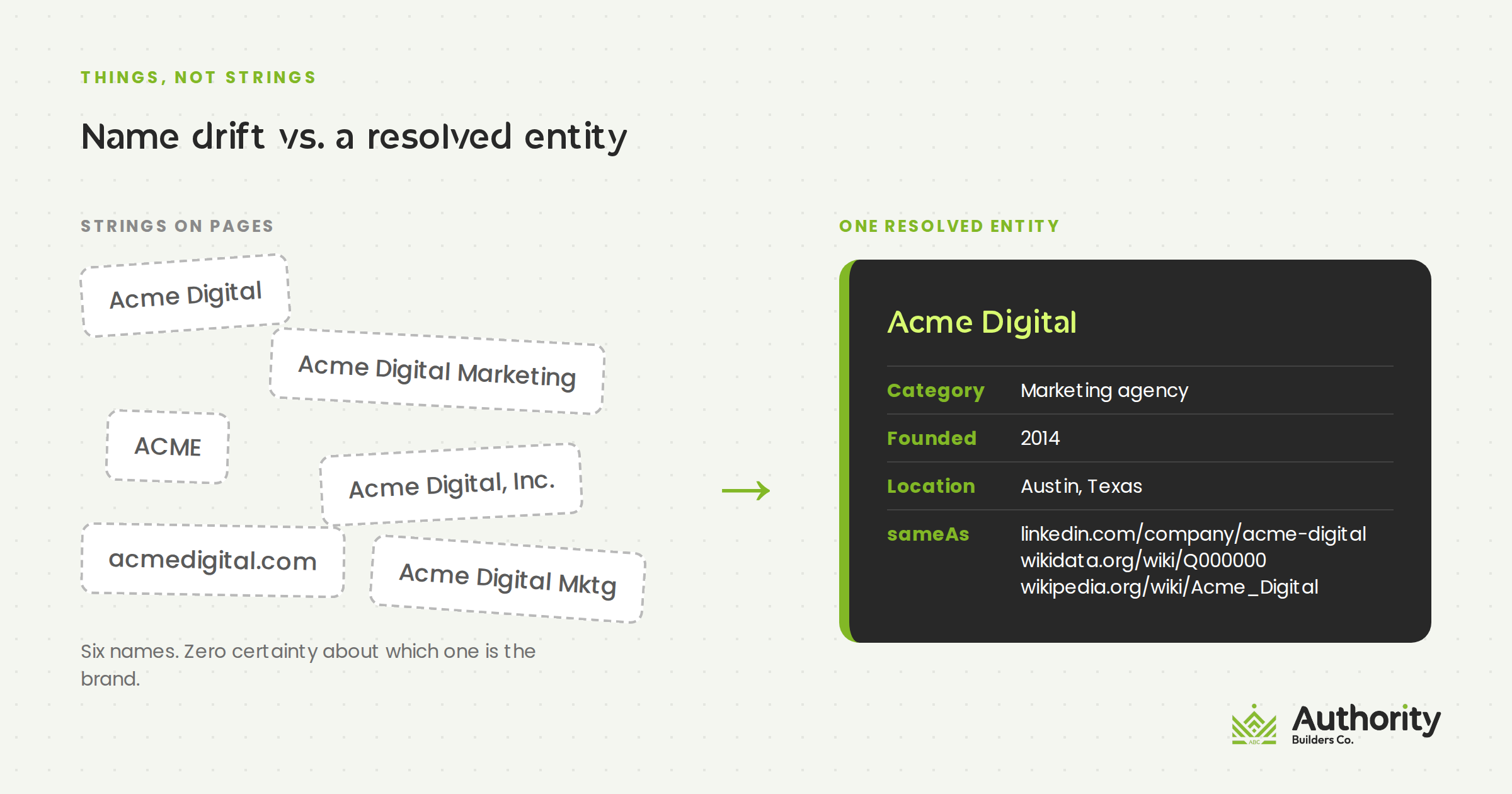
Your site says “Acme Digital.” Your LinkedIn says “Acme Digital Marketing.” Your press releases say “ACME.” Crunchbase says “Acme Digital, Inc.” To a human, obviously the same company. To a system deciding whether four mentions corroborate one entity or describe four, it’s noise. Pick one canonical name and one short form, put both in name and alternateName, and use them everywhere.
Name collision
Generic brand names share a string with other companies, products, or common nouns. If you’re “Summit Legal” there are probably a dozen of you. The fix isn’t a rename. It’s distinguishing attributes stated consistently: location, founding year, category, founders, registered identifiers. That’s exactly what the disambiguation properties in Organization schema exist for, and it’s why we push clients to fill in address, foundingDate, and naics even when those feel like paperwork.
Orphaned people
Your founder or lead expert is quoted in press, speaks at events, and writes your content, but nothing connects that person entity to your organization entity. Their author bio doesn’t link to a profile page, the profile page has no schema, and their LinkedIn doesn’t match the name on the byline. You’re generating expertise signals that never accrue to the brand.
Category ambiguity
You describe yourself as “a growth partner” on the homepage, “an SEO agency” on LinkedIn, and “a marketing technology company” in a press release. Machines need a primary category to place you in the graph and to decide which fan-out queries you belong in. Ambiguity here is why brands with excellent content still don’t show up when an AI is asked for “the best [category] in [place].”
Knowledge Graph Optimization: The Five Signals That Build an Entity
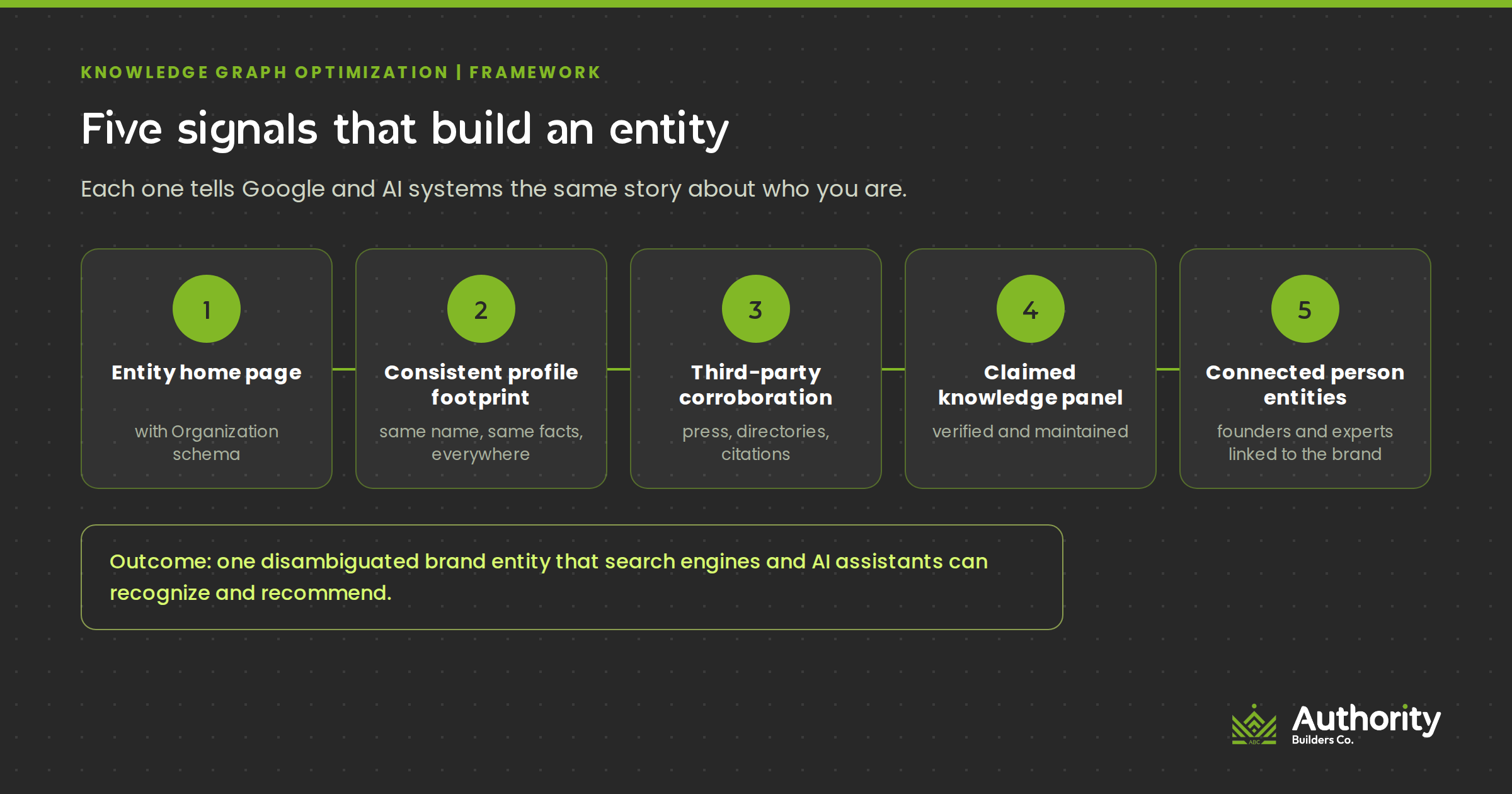
Here’s the framework we run. Each signal is independently useful, but they compound, and the order matters: you establish the entity home first so every later signal has somewhere to point.
1. An entity home page with Organization schema
Every entity needs one canonical URL that states who it is. For most brands that’s the homepage or About page. It should carry Organization markup (or the most specific subtype that fits, like OnlineStore or a LocalBusiness type) with name, alternateName, url, logo, description, foundingDate, address, sameAs, and any registered identifiers you hold. Validate it with the Rich Results Test, then leave it alone. This page is the anchor everything else references.
2. A consistent profile footprint
Build or clean up your presence on the sources knowledge graphs already draw from: LinkedIn company page, Crunchbase, Google Business Profile (if you have a physical presence), relevant industry directories, and a Wikidata item once you’re notable enough to warrant one. Wikidata’s introduction explains that it’s a free, structured knowledge base where every item gets a unique identifier and statements are recorded with their sources, which is precisely the kind of machine-readable corroboration a graph wants. Every profile should carry identical core facts and link back to the entity home. Then list every one of those profile URLs in your sameAs array.
3. Third-party corroboration
This is the signal most brands underinvest in and the one we spend most of our time on. Self-declared facts are claims. Facts that appear in independent editorial coverage, industry publications, and expert roundups are corroboration. When a trade publication writes “Authority Builders, a link building agency founded in 2016,” it’s confirming three attributes of the entity at once, in a source the graph trusts more than our own site. Aim for coverage that states your name, category, and one or two distinguishing facts, ideally with a link to the entity home.
4. A claimed knowledge panel
Once Google generates a panel for your brand, claim it. Google’s Knowledge Graph help explains that verified representatives can suggest changes, and that’s the one direct line you have into the graph. Use it to correct the description, logo, and social links, and to fix any attribute Google’s automated systems got wrong. If you don’t have a panel yet, that’s your signal that signals one through three aren’t strong enough. Keep building corroboration and check again in a few months.
5. Connected person entities
Give your key people the same treatment. Each expert gets a profile page on your site with Person structured data, a consistent name across bylines and external profiles, and a worksFor or affiliation relationship pointing to your Organization entity. Every guest article, podcast appearance, and conference talk they do then attaches to the brand graph instead of floating free. We treat brand sentiment and reputation as an AI trust signal for the same reason: the machine is assembling a picture of who you are from everything attached to your name, and named experts are a big part of that picture.
Where Links and Mentions Fit In
We’re a link building company, so let’s be precise about what links do for an entity and what they don’t.
A backlink from a relevant, trusted site does three entity jobs. It corroborates that you exist (signal three above). It associates you with the linking site’s topic and the surrounding entities on the page, which is how a graph learns what you’re related to. And when the anchor text or nearby copy uses your canonical name and category, it reinforces the disambiguation you set up on your entity home. That’s why we treat brand-name and branded-plus-category anchors as entity assets rather than wasted link equity.
Unlinked mentions do most of the same work. A named citation in a publication, with or without a hyperlink, is still a source telling the system your brand exists and what it does. Our content team wrote about engineering content for citation rather than just ranking, and the same logic applies to your brand: the mention is the unit of trust, the link is a bonus.
What links don’t do is substitute for the foundation. Google’s generative AI guidance is blunt that manufactured mentions aren’t helpful, and we’ve seen brands with strong link profiles remain unresolved entities because the links pointed at a site with no schema, four different names, and no profile footprint. Build the entity home first. Then every link you earn has something to attach to.
A 90-Day Entity SEO Checklist
This is the sequence we run for a new client. It’s deliberately front-loaded with the unglamorous work because that’s what unlocks everything after it.
Days 1 to 14: Audit and define
- Ask ChatGPT, Gemini, Perplexity, and Google AI Mode who your brand is and what it does. Record every inaccuracy and every confusion with another entity.
- Search your brand name in Google and note whether a knowledge panel exists, what it says, and whether it’s claimed.
- Inventory every place your brand is named online and log the exact name string, category description, and founding date used on each. Count the variants. That number is your problem.
- Decide your canonical name, short name, one-sentence category description, and the five to eight facts you want every source to agree on.
Days 15 to 30: Build the entity home
- Rewrite the About page so the first paragraph states the canonical facts in plain language.
- Deploy Organization structured data on the homepage or About page with the full recommended property set, including sameAs.
- Create profile pages with Person schema for every expert who represents the brand publicly.
- Validate with the Rich Results Test and confirm with URL Inspection that Google sees the markup.
Days 31 to 60: Align the footprint
- Update every profile you found in the audit to the canonical name, description, and facts. Add the entity home URL to each.
- Claim and clean up Google Business Profile if applicable, and fix citation inconsistencies across directories.
- Claim the knowledge panel if one exists and submit corrections.
- If you meet notability standards, create or improve a Wikidata item with sourced statements. Don’t fabricate notability; a deleted item is worse than none.
Days 61 to 90: Earn corroboration
- Secure editorial placements in relevant publications where the copy states your canonical name and category. Brief writers on the exact phrasing.
- Get named experts quoted, interviewed, or published under bylines that match their profile pages.
- Pursue inclusion in category listicles and comparison pages that already rank and already get cited by AI systems.
- Re-run the day-one AI prompts and compare. Track brand mentions and citations at the domain level over time.
How We Build Brand Entities for Clients
Entity work is one of those things that’s easy to describe and tedious to execute well, because the value comes from consistency across dozens of touchpoints you don’t fully control. That’s most of what our managed programs do.
AI Plus is our managed AI search authority program, and entity building is its foundation. We audit how every major AI platform currently describes your brand, define the canonical entity, deploy and validate the structured data, align your profile footprint, and then run the ongoing corroboration campaign: editorial placements, expert attribution, and listicle inclusion, all tracked through reporting that shows your visibility in both Google and AI answers.
For brands that need the corroboration layer specifically, Earned Media secures the kind of named, editorial coverage in trusted publications that knowledge graphs and language models treat as independent confirmation of who you are. And if your entity problem is a local one, with inconsistent business data across directories, our Citations service cleans up the name, address, and category data local knowledge sources use to identify you.
Entity SEO FAQ
What is entity SEO?
Entity SEO is the practice of making a brand, person, or product identifiable as one distinct thing to search engines and AI systems, with consistent facts attached and corroborated by trusted third-party sources. It focuses on identity and disambiguation rather than on matching keywords to pages.
What is knowledge graph optimization?
Knowledge graph optimization is the part of entity SEO that targets the databases where entity facts live, such as Google’s Knowledge Graph, Wikidata, and Google Business Profile. It involves structured data on your own site, consistent profiles on external knowledge sources, claiming your knowledge panel, and earning corroborating coverage.
Do I need a Wikipedia page to be in the Knowledge Graph?
No. Google generates knowledge panels automatically when there’s enough consistent information on the open web. A Wikipedia article helps, but plenty of brands have panels without one, built from structured data, profile footprints, and editorial coverage.
Is structured data required to show up in AI Overviews?
Google says structured data isn’t required for its generative AI features and that no special schema exists for them. It still recommends structured data as part of overall SEO, and Organization markup in particular helps Google disambiguate your brand, which is the entity job it’s doing for you.
How long does entity SEO take to work?
On-site changes are visible to Google within days of recrawling. Knowledge panel generation and AI recommendation shifts depend on corroboration accumulating across sources, which is typically a matter of months. Our own generative AI referral growth of 784% played out over roughly 14 months of consistent work.
Become a Thing, Not a String
Every AI answer that names a competitor and not you is an entity decision, made by a system that had more confidence in their identity than in yours. That’s fixable. Define the entity, build the home for it, align every source that describes it, and then earn the independent coverage that turns your claims into facts. Do that consistently and the machines stop guessing who you are.
If you want to know how ChatGPT, Gemini, and Google AI Mode currently describe your brand, and what it would take to change that, book a call with our team and we’ll walk through it together.