
Topical Authority: Building Link Clusters AI Recognizes
Corey Batt
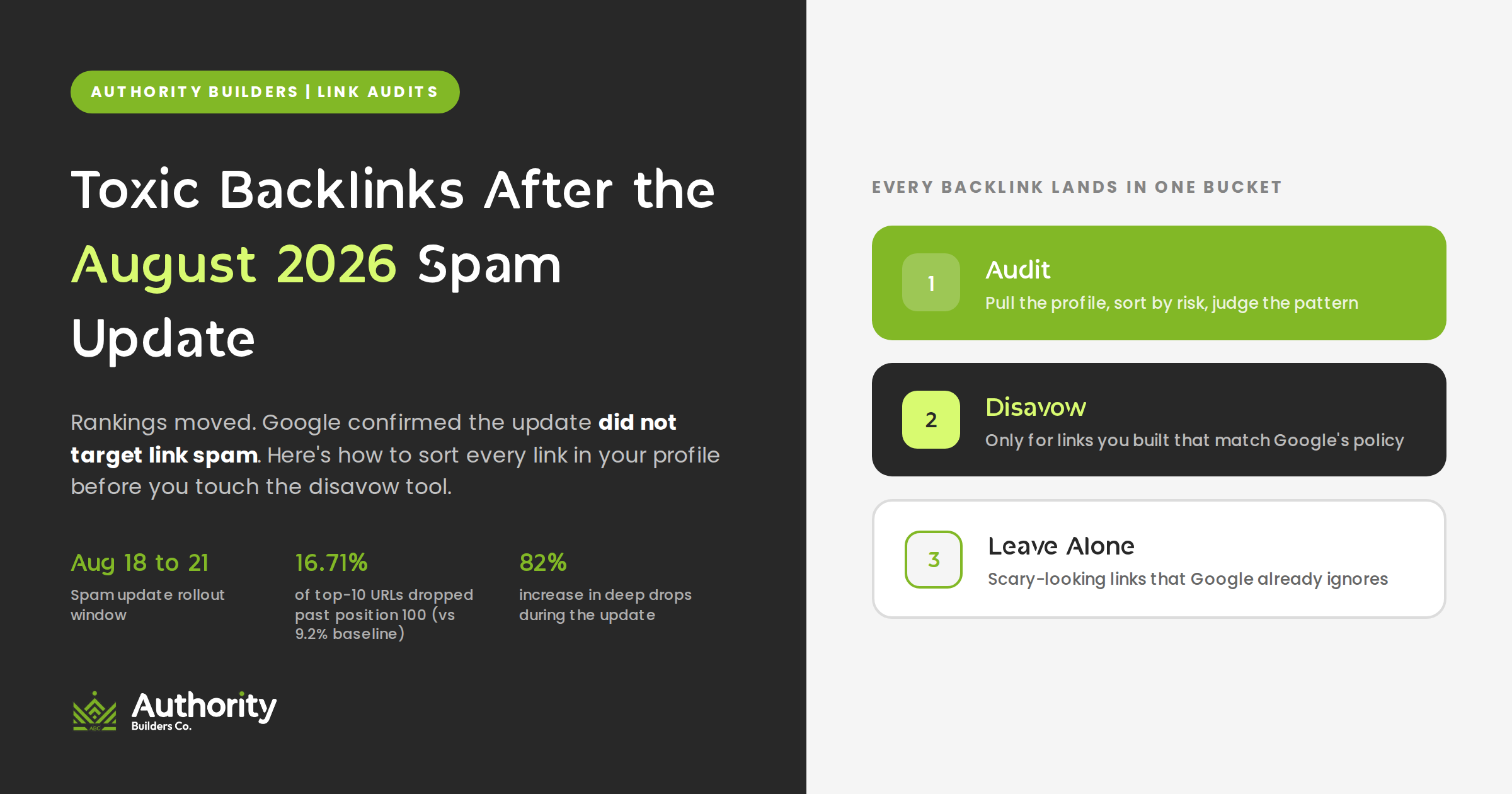
Google rolled out its August 2026 spam update between August 18 and August 21, and…
Read More
Google rolled out its August 2026 spam update between August 18 and August 21, and…
Read MoreJoin 30,000+ Professional SEO Link Builders
The old game was ranking a page for a keyword. The new game is being recognized as the authority on a topic, by Google and by the AI answer engines that now sit on top of it. A site that covers a subject completely, and earns links concentrated in that subject, gets treated as the … Continued
Your access logs used to be a quiet place. Googlebot, Bingbot, a few scrapers, and that was the list. Open them now and you’ll find GPTBot, ClaudeBot, PerplexityBot, and a dozen agents you’ve never written a rule for. Most SEO teams have no policy for any of them, and that gap cuts two ways. Either … Continued
Reputation used to be a brand problem. Now it’s a retrieval problem. When someone asks ChatGPT for the best option in your category, the model doesn’t just check who ranks. It weighs who’s trusted, and it assembles that judgment from the sentiment, reviews, and mentions attached to your name across the web. If your reputation … Continued
Ranking number one in the map pack used to be the finish line. Now it’s the qualifying round. Someone searching for what you sell might see a Google local pack, an AI Overview, an Ask Maps summary, or a ChatGPT answer that names three businesses and moves on. For a brand with one location, that’s … Continued
Search stopped rewarding exact-match keywords a while ago. It rewards meaning now. If you’re still optimizing the way you did in 2020, matching literal strings and counting densities, you’re tuning for a system that no longer exists. Here’s why this matters right now. Between January 2025 and February 2026, we grew our own generative AI … Continued
Most brands that come to Authority Builders have already tried link building. They’ve bought links from marketplaces. They’ve hired freelancers. Some have worked with agencies. And a common version of that story ends the same way: links that look fine on paper, no meaningful movement in rankings, and the growing suspicion that they’ve been buying … Continued
Most brands treat earned media as a PR outcome: something that happens when a good story gets picked up, measured in clippings, and reported to leadership as a win. That framing isn’t wrong, but it’s incomplete. In 2026, earned media is a strategic input into both search visibility and AI citation eligibility, and brands that … Continued
If you’ve been tracking your rankings in Ahrefs or Semrush and feeling pretty good about where things sit, there’s a blind spot worth knowing about. AI Overviews now appear in roughly 50% of Google searches. ChatGPT has over 880 million monthly active users. Perplexity is the tool of choice for a growing share of research-first … Continued
High authority backlinks have always been the most valuable links you can earn. Links from respected, relevant sources signal to Google that your content is worth ranking, and they’ve driven more sustainable SEO results than any other single factor for the past two decades. But the definition of “high authority” has changed. In 2024, a … Continued
More than half of SEO professionals outsource at least part of their link building. According to a survey of 518 SEO practitioners by Editorial.link, 56% outsource at least some of it, and the ones who’ve been burned by the wrong agency tend to have a very similar story: impressive-sounding promises, a convincing pitch, then a … Continued
Outreach Strategy

By Peter King
With Google constantly adapting the search algorithm it means you not only need to be thinking about what are the best SEO practices right now but also, you need to keep an eye on where Google seems to be heading. For example, as a community, we’ve known that mobile first indexing was going to … Continued
Tips & Tricks

By Corey Batt
SEO experts agree that improving your internal link structure will boost your rankings in Google. What exactly are Internal links? They are a form of hyperlinks that point to pages on the same domain. These types of links are different from external links, which backlink to pages on other domains. Instead, internal links go to other … Continued
Tips & Tricks
By Corey Batt
Are your in-house marketing campaigns failing to achieve your goals for business growth? Then you’ll likely find more success if you outsource your marketing to a professional agency. After all, marketing activities are time-consuming and demand a lot of resources, which is a lot to contend with for small-to-medium-sized businesses. Even larger businesses sometimes choose … Continued
Tips & Tricks

By Matt Diggity
You may have heard that infographic can be a great tool for SEO… five years ago. But their usefulness is still very powerful today, if you know what you’re doing with them. We ran a poll in the Affiliate SEO Mastermind Facebook group, asking members how they are utilizing infographics in today’s SEO landscape. The … Continued
Click to contact customer support